Page 256 of 292

newspaper, rinse off the loosened debris
with water.
Water marks
Problem:
Rain, fog, dew, and even tap water can
contain harmful minerals such as salt
and lime. If moisture containing these
minerals settles on the vehicle and
evaporates, the minerals will
concentrate and harden to form white
rings. The rings can damage your
vehicle's finish.
Prevention:
It is necessary to wash and wax your
vehicle to preserve its finish according
to the instructions in this section. These
steps should be taken immediately after
you find water marks on your vehicle's
finish.
Paint chipping
Problem:
Paint chipping occurs when gravel
thrown in the air by another vehicle's
tires hits your vehicle.
How to avoid paint chipping:
Keeping a safe distance between you
and the vehicle ahead reduces the
chances of having your paint chipped
by flying gravel.
Note:
The paint chipping zone varies with
the speed of the vehicle. For example, when travelling at 55 mph (90 km/h),
the paint chipping zone is 164 ft
(50 m).
In low temperatures a vehicle's
finish hardens. This increases the
chance of paint chipping.
Chipped paint can lead to rust
forming on your vehicle. Before this
happens, repair the damage by using
FCA touch-up paint according to the
instructions in this section. Failure to
repair the affected area could lead to
serious rusting and expensive repairs.
Follow all label and container directions
when using a chemical cleaner or
polish. Read all warnings and cautions.
Maintaining The Finish
Washing
To help protect the finish from rust and
deterioration, wash your vehicle
thoroughly and frequently, at least once
a month, with lukewarm or cold water.
If the vehicle is washed improperly, the
paint surface could be scratched. Here
are some examples of how scratching
could occur:
The vehicle is washed without first
rinsing off dirt and other foreign matter.
The vehicle is washed with a rough,
dry, or dirty cloth.
The vehicle is washed at a car wash
that uses brushes that are dirty or too
stiff.
Cleansers or wax containing
abrasives are used.
Note: FCA is not responsible for
scratches caused by automatic car
washes or improper washing.
Scratches are more noticeable on
vehicles with darker paint finishes.
When the wiper lever is in the AUTO
position and the ignition is placed in the
ON mode, the wipers may move
automatically in the following cases:
If the windshield above the rain
sensor is touched or wiped with a cloth.
If the windshield is struck with a hand
or other object from either outside or
inside the vehicle.
Note:
Keep hands and scrapers clear of
the windshield when the wiper lever is
in the AUTO position and the ignition is
placed in the ON mode as fingers
could be pinched or the wipers and
wiper blades damaged when the
wipers activate automatically. If you are
going to clean the windshield, be sure
the wipers are turned off completely
(when it is most likely that the engine is
left running) this is particularly
important when clearing ice and snow.
254
SERVICING AND MAINTENANCE
Page 257 of 292
Do not spray water in the engine
compartment. Otherwise, it could
result in engine-starting problems or
damage to electrical parts.
When washing and waxing the
vehicle, be careful not to apply
excessive force to any single area of
the vehicle hood. Otherwise, you could
dent the vehicle.
Do not use automatic car washing
machines and car washing devices
using high water pressure.
Make sure that the fuel door is
closed and lock the doors. Otherwise,
the fuel flap may be forcefully opened
by water pressure causing damage to
the vehicle or fuel door.
To minimize scratches on the vehicle's
paint finish:
Rinse off any dirt or other foreign
matter using lukewarm or cold water
before washing.
Use plenty of lukewarm or cold water
and a soft cloth when washing the
vehicle. Do not use a nylon cloth.
Rub gently when washing or drying
the vehicle.
Take your vehicle only to a car wash
that keeps its brushes well maintained.
Do not use abrasive cleansers or
wax that contain abrasives.
Caution!
Do not use steel wool, abrasive cleaners,
or strong detergents containing highly
alkaline or caustic agents on chrome
plated or anodized aluminium parts. This
may damage the protective coating; also,
cleaners and detergents may discolor or
deteriorate the paint.
Pay special attention to removing salt,
dirt, mud, and other foreign material
from the underside of the fenders, and
make sure the drain holes in the lower
edges of the doors and rocker panels
are clean.
Insects, tar, tree sap, bird droppings,
industrial fallout, and similar deposits
can damage the finish if not removed
immediately. When prompt washing
with plain water is ineffective, use a mild
soap made for use on vehicles.
Thoroughly rinse off all soap with
lukewarm or cold water. Do not allow
soap to dry on the finish.
After washing the vehicle, dry it with a
clean chamois to prevent water spots
from forming. Waxing
Your vehicle needs to be waxed when
water no longer beads on the finish.
Always wash and dry the vehicle before
waxing it. In addition to the vehicle
body, wax the metal trim to maintain its
lustre:
Use wax which contains no
abrasives. Waxes containing abrasive
will remove paint and could damage
bright metal parts.
Use a good grade of natural wax for
metallic, mica, and solid colors.
When waxing, coat evenly with the
sponge supplied or a soft cloth.
Wipe off the wax with a soft cloth.
Note: A spot remover to remove oil,
tar, and similar materials will usually also
take off the wax. Rewax these areas
even if the rest of the vehicle does not
need it.
255
Page 260 of 292
2. Remove the drain filter while
pressing the tab.
3. Remove leaves and other matter
accumulated in the drain filter.4. Reinstall the drain filter in the reverse
order of the removal procedure.
Note:
Make sure that the drain filter is
securely attached to its designated
position by pushing it until the tab
locks. Water may enter the vehicle if the
drain filter is not secured to its
designated position. For this operation
go to an Authorized Dealer.
Plastic Part
Maintenance
When cleaning the plastic lenses of the
lights, do not use gasoline, paraffin,
rectified spirit, paint, thinner, highly
acidic detergents, or strongly alkaline
detergents.
Otherwise, these chemical agents can
discolor or damage the surfaces
resulting in a significant loss in
functionality. If plastic parts become
inadvertently exposed to any of these
chemical agents, flush with water
immediately.
If plastic parts such as the bumpers
become inadvertently exposed to
chemical agents or fluids such as
gasoline, oil, engine coolant, or battery
fluid, it could cause discoloration,
staining, or paint peeling. Wipe off any
such chemical agents or fluids using a
soft cloth immediately.
Caution!
High water temperature and high water
pressure car washers are available
depending on the type of high pressure car
washer device. If the car washer nozzle is
put too close to the vehicle or aimed at one
area for an extended period of time, it
could deform plastic parts or damage the
paint.
Do not use wax containing compounds
(polish). Otherwise, it could result in paint
damage.
In addition, do not use an electrical or
air tool to apply wax. Otherwise, the
frictional heat generated could result in
deformation of plastic parts or paint
damage.
GUID-07040110123001Drain Filter Location
1 — Drain Filter
2 — Bow
GUID-07040110124001Drain Filter Tab
258
SERVICING AND MAINTENANCE
Page 264 of 292
TECHNICAL SPECIFICATIONS
IDENTIFICATION DATA........263
RECOMMENDED TIRE INFLATION
PRESSURE ...............264
ENGINE..................266
TRANSMISSION ............267
BRAKES ................ .268
SUSPENSIONS .............269
STEERING ............... .270
DIMENSIONS ..............271
FLUID CAPACITIES ..........273
FLUIDS AND LUBRICANTS .....274
PERFORMANCE ............276
ELECTROMAGNETIC
COMPATIBILITY ............277
262
Page 266 of 292

Engine Number
The engine number label is located on
the engine.
RECOMMENDED
TIRE INFLATION
PRESSURE
On the tire label you will find the
recommended tire inflation pressure in
both psi and kPa for the tires installed
as original equipment on the vehicle.
It is very important that the inflation
pressure of the tires on your vehicle is
maintained at the recommended
pressure.
You should check the tire pressure
regularly to insure that the proper
inflation pressure is maintained.
Note:
Tire pressures listed on the vehicle
placard or tire information label indicate
the recommended cold tire inflation
pressure, measured when the tires are
cold, after the vehicle has been parked
for at least three hours. As you drive,
the temperature in the tire warms up,
increasing the tire pressure.
Always check the tire inflation
pressures on a regular basis according
to the recommended tire inflation
pressure on the tire label and in
conjunction with the information in this
Owner's Manual. Driving your vehicle
with under-inflated tires is dangerous.
Under-inflation is the most common
cause of failures in any kind of tire and
may result in severe cracking, tread
separation or “blowout”, with
unexpected loss of vehicle control and
increased risk of injury. Under-inflation
increases sidewall flexing and rolling
resistance, resulting in heat buildup
and internal damage to the tire. It
results in unnecessary tire stress,
irregular wear, loss of control and
accidents. A tire can lose up to half of
its air pressure and not appear to be
flat. It is impossible to determine
whether or not tires are properly
inflated just by looking at them.
10010107-121-002-high.jpgTire Pressure Label
264
TECHNICAL SPECIFICATIONS
Page 268 of 292
ENGINE
Engine
1.4 Turbo Multi Air
Cycle Four
Number
and position of cylinders 4 in line
Piston bore and stroke (mm) 72.0 x 80.4
Total displacement (cm³) 1368
Compression ratio 9.8:1
Maximum power (EEC) (kW) 122
Maximum power (EEC) (HP) 164
Corresponding engine speed (rpm) 5500
Maximum torque (EEC) (Nm) 250
Maximum torque (EEC) (lb.-ft.) 184
Corresponding engine speed (rpm) 2500
Spark plugs We recommend you use MOPAR Spark Plugs.
Fuel 91 Octane Recommended (87 Octane Acceptable) Maximum 15%
Ethanol Content
Note:
When cleaning the iridium plugs, do not use a wire brush. The fine particulate coating on the iridium alloy and platinum tips
could be damaged.
Warning!
Modifications or repairs to the fuel supply system that are not carried out correctly or do not take the system’s technical specifications into
account, can cause malfunctions leading to the risk of fire.
266
TECHNICAL SPECIFICATIONS
Page 269 of 292
TRANSMISSION
EngineTraction TypeDescription
1.4 Turbo Multi Air R
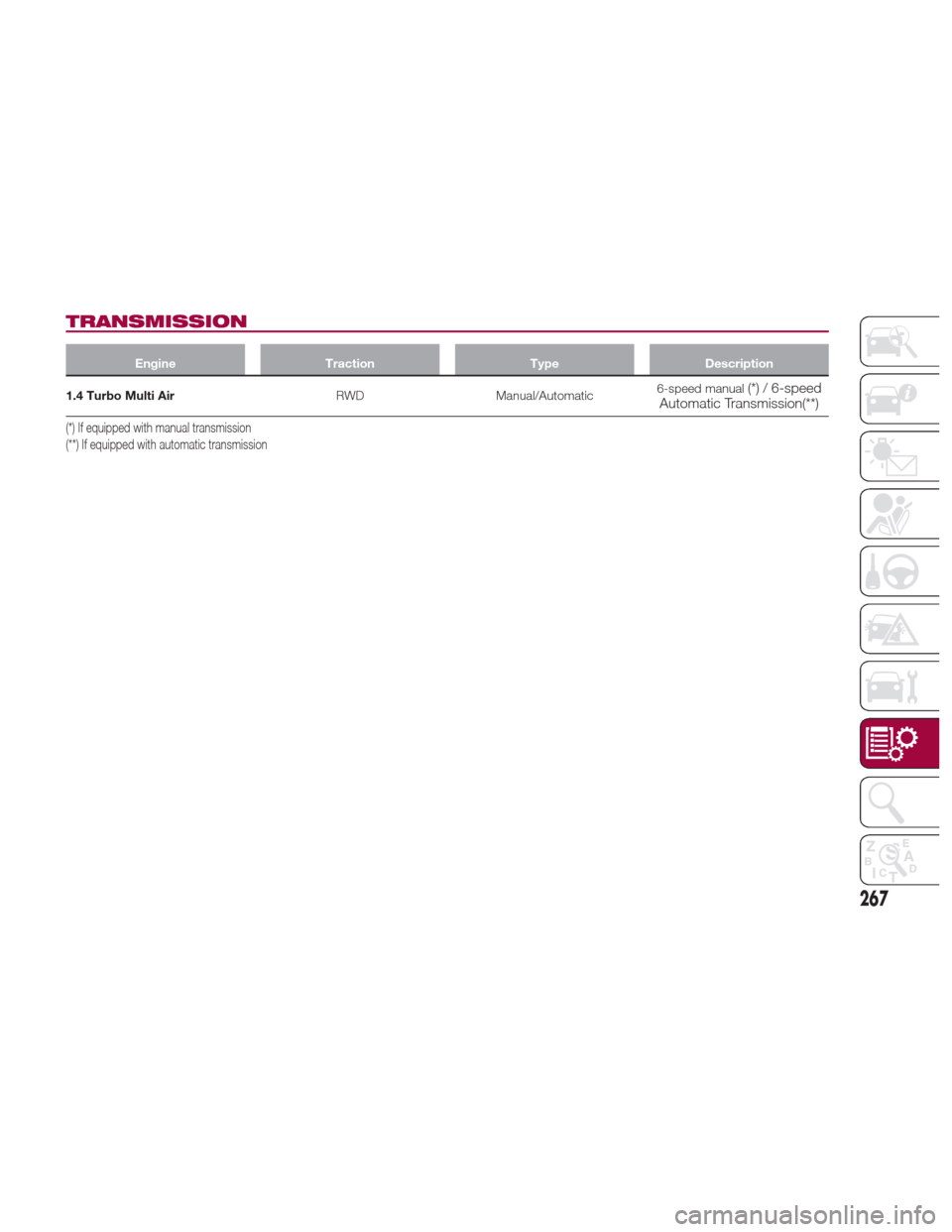
WDManual/Automatic 6-speed manual(*) / 6-speed
Automatic Transmission(**)
(*) If equipped with manual transmission
(**) If equipped with automatic transmission
267
Page 270 of 292
BRAKES
EngineFront brakes Rear brakesParking brake
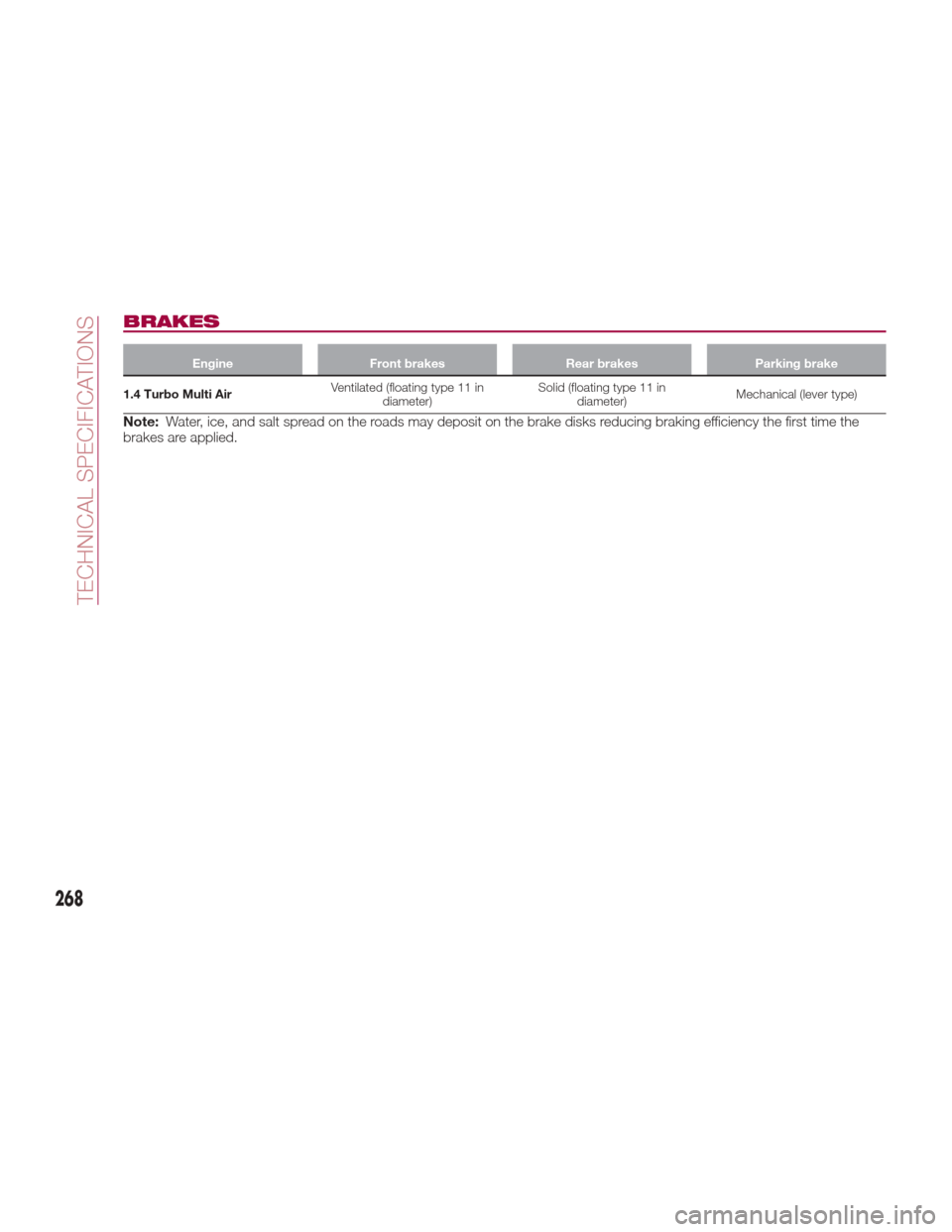
1.4 Turbo Multi Air V
entilated (floating type 11 in
diameter) Solid (floating type 11 in
diameter) Mechanical (lever type)
Note:
Water, ice, and salt spread on the roads may deposit on the brake disks reducing braking efficiency the first time the
brakes are applied.
268
TECHNICAL SPECIFICATIONS