2017 Citroen GRAND C4 PICASSO trailer
[x] Cancel search: trailerPage 195 of 527

193
C4-Picasso-II_en_Chap04_conduite_ed02-2016
Front parking sensors
The sound emitted by the speaker (front
or rear) indicates whether the obstacle
is in front or behind.The system will be deactivated
automatically if a trailer is being
towed or a bicycle carrier is fitted on
a towbar (vehicle fitted with a towbar
installed in line with the manufacturer's
recommendations).In bad weather or in winter, ensure
that the sensors are not covered with
mud, ice or snow. When reverse gear is
engaged, an audible signal (long beep)
indicates that the sensors may be dirty.
Certain sound sources (motorcycle,
lorry, pneumatic drill, etc.) may trigger
the audible signals of the parking
sensor system.
As an addition to the rear parking sensors, the
front parking sensors are triggered when an
obstacle is detected in front and the speed of
the vehicle remains below 6 mph (10 km/h).
The front parking sensors are interrupted if
the vehicle stops for more than three seconds
in for ward gear, if no further obstacles are
detected or when the speed of the vehicle
exceeds 6 mph (10 km/h).
The parking sensors can be deactivated in the
touch screen.
F
I
n the Driving
menu, select the " Driving
functions " tab, then " Parking sensors ".
Operating fault
In the event of a malfunction of
the system, when reverse gear is
engaged, this warning lamp flashes
for a few moments then stays on
continuously.
This indicator comes on in the
instrument panel.
A new selection reactivates the function.
High pressure jet wash
When washing your vehicle, do not
direct the lance within 30 cm of the
sensors.
The parking sensors are deactivated
while the Park Assist system is
measuring a space.
For more information on Park Assist
,
refer to the corresponding section.
Deactivation / Activation of
the front and rear parking
sensors
A message appears, accompanied by an
audible signal.
Contact a CITROËN dealer or a qualified
workshop.
4
Driving
Page 206 of 527

204
C4-Picasso-II_en_Chap04_conduite_ed02-2016
The system is deactivated by pressing the
control.
The system is deactivated automatically:
-
o
n switching off the ignition,
-
i
f the engine stalls,
-
i
f no manoeuvre is started within 5 minutes
of selection of the type of manoeuvre,
-
a
fter a prolonged stop of the vehicle during
a manoeuvre,
-
i
f the road wheel anti-slip regulation (ASR)
is triggered,
-
i
f the speed of the vehicle exceeds the
stated limit,
-
w
hen the driver interrupts movement of the
steering wheel,
-
a
fter 4 manoeuvre cycles,
-
o
n opening the driver's door,
-
i
f one of the front wheels encounters an
obstacle.
The operation indicator lamp goes off in the
instrument panel and a message is displayed
accompanied by an audible signal.
The driver should then take back control of the
vehicle's steering.
Deactivation
The system is switched off automatically:
- w hen towing a trailer, connected
electrically,
-
i
f the driver's door is opened,
-
i
f the speed of the vehicle is above 42 mph
(70 km/h).
To switch the system of for a prolonged period,
contact a CITROËN dealer or a qualified
workshop.
Operating faults
In the event of a fault with the power
steering, this warning lamp flashes in
the instrument panel, accompanied
by a message.
Contact a CITROËN dealer or a qualified
workshop.
Switching off
If the lateral distance between your
vehicle and the space is too great, the
system may not be able to measure the
space.
Anything projecting beyond the envelope
of the vehicle (a ladder on the roof, for
example) is not taken into account by the
Park Assist system during a manoeuvre.
In bad weather or in winter, ensure that
the sensors are not covered by road
dirt, ice or snow.
In the event of a fault, have the system
checked by a CITROËN dealer or a
qualified workshop.
If the system is deactivated during a
manoeuvre, the drive should reactivate
it to repeat the measurement. In the event of a fault, this warning
lamp flashes for a few seconds,
accompanied by an audible signal.
If the fault occurs during the use
of the system, the warning lamp
goes
off. High pressure jet washing
When washing your vehicle, keep the
lance at least 30 cm away from the
sensors.
Driving
Page 269 of 527

267
C4-Picasso-II_en_Chap07_info-pratiques_ed02-2016
Towbar with quickly detachable towball
Fitting
F Below the rear bumper, unclip and remove the protective cover on the carrier. F
B efore fitting the towball, check that the
points of contact, indicated by the arrows,
are clean.
U
se a soft clean cloth.F
E
nsure that the towball is fully engaged.
The two pins must be in contact with
the cut-outs in the carrier and the
trigger B must have returned to the
"locked" position.
F
I
nstall and clip in place the protective
cover, by rotating it to the left.
F
O
n the towball, press and hold control A .
F
R
elease the locking mechanism by
pressing the trigger B . F
P
ut the end of the towball into the carrier,
located below the bumper, as far as it will go.
No tools are required to install or remove the towball on this genuine towbar system.
F
C
onnect the trailer plug to the 13 -way
socket provided, located next to the carrier.
F
M
ake the trailer safe by attaching its safety
cable to the eye provided for this purpose,
located on the carrier.
7
Practical information
Page 270 of 527
268
C4-Picasso-II_en_Chap07_info-pratiques_ed02-2016
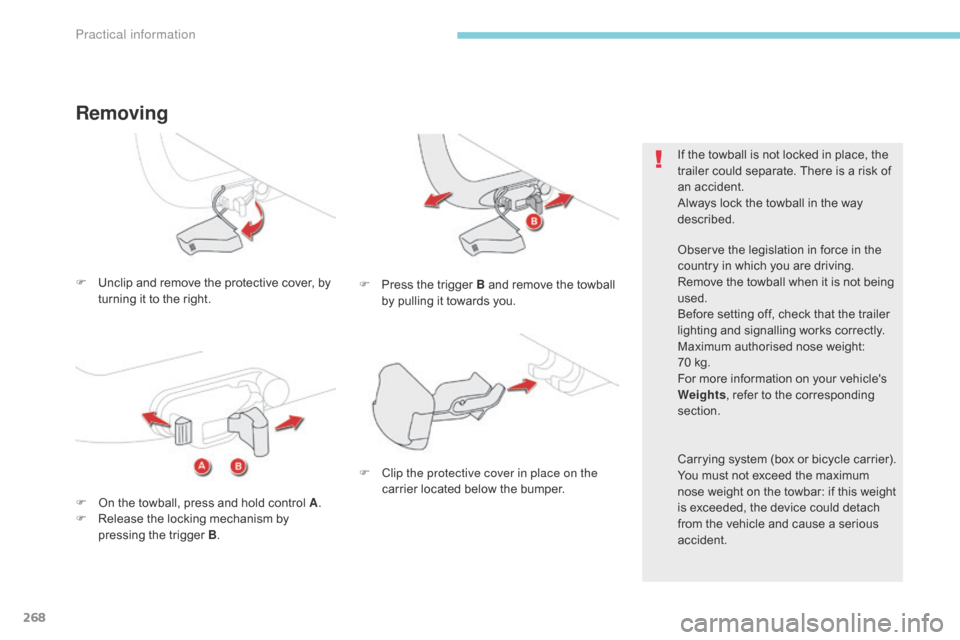
F Unclip and remove the protective cover, by turning it to the right.
Removing
F Press the trigger B and remove the towball by pulling it towards you.
F
O
n the towball, press and hold control A .
F
R
elease the locking mechanism by
pressing the trigger B . If the towball is not locked in place, the
trailer could separate. There is a risk of
an accident.
Always lock the towball in the way
described.
Observe the legislation in force in the
country in which you are driving.
Remove the towball when it is not being
used.
Before setting off, check that the trailer
lighting and signalling works correctly.
Maximum authorised nose weight:
70
kg.
For more information on your vehicle's
Weights , refer to the corresponding
section.
Carrying system (box or bicycle carrier).
You must not exceed the maximum
nose weight on the towbar: if this weight
is exceeded, the device could detach
from the vehicle and cause a serious
accident.
F
C
lip the protective cover in place on the
carrier located below the bumper.
Practical information
Page 271 of 527

269
C4-Picasso-II_en_Chap07_info-pratiques_ed02-2016
Towing a trailer
We recommend the use of genuine
CITROËN towbars and their harnesses
that have been tested and approved
from the design stage of your vehicle,
and that the fitting of the towbar is
entrusted to a CITROËN dealer or a
qualified workshop.
If the towbar is not fitted by a
CITROËN dealer, it must still be
fitted in accordance with the vehicle
manufacturer's instructions.
Your vehicle is primarily designed for
transporting people and luggage, but it may
also be used for towing a trailer.
Driving with a trailer places greater
demands on the towing vehicle and the
driver must take particular care.
For more information on Driving
advice
, particularly when towing, refer
to the corresponding section.
For more information on Weights (and
the towed loads which apply to your
vehicle) refer to the corresponding
section.
You must observe the maximum trailer
weight, indicated on the registration
certificate or in the technical
specification for your vehicle. When not towing a trailer, remove the
quickly-detachable tow ball before
driving.
The lane departure warning system is
deactivated while a trailer is connected.
7
Practical information
Page 317 of 527

315
C4-Picasso-II_en_Chap08_en-cas-panne_ed02-2016
Dashboard fuses
The two fuseboxes are located in the lower dashboard (left-hand side).
F
R
efer to "Access to the tools".
Fuse tables
Fusebox 1Fuse N° Rating Functions
F1 40 AHeated rear screen.
F2 20 AElectric door mirrors.
F5 30 APanoramic sunroof blind
F6 20 A12
V socket, rear multimedia.
F7 20 A230 V socket.
F9 25 AHeated seats.
F10 20 ATrailer inter face unit.
F11 20 AAir conditioning fan.
F12 30 AElectric window motors.
Access to the fuses
8
In the event of a breakdown
Page 329 of 527

327
C4-Picasso-II_en_Chap09_caracteristiques-techniques_ed02-2016
* The weight values are calculated with a towbar.
** The kerb weight is equal to the unladen weight + driver (75 kg).
***
T
he weight of the braked trailer can be increased, within the GTW limit, if the GV W of the towing vehicle is reduced by an equal amount; warning,
towing using a lightly loaded towing vehicle may have an adverse effect on its road holding.
Petrol engine
PureTech 110 S&S*PureTech 130 S&S*
Gearbox Manual (6-speed)Manual (6-speed)EAT6 automatic (6 -speed)
Model code 3D
3D... 3E... 3A... 3D... 3E... 3A...
HNX...
M/1S - M/2SM HNY…
M/1S - M/2SM HNY…
T/1S - T/2S
Unladen weight 1 2801 280 - 1 295 - 1 297 1 298 - 1 315 - 1 317
Kerb weight** 1 3551 355 - 1 370 - 1 372 1 373 - 1 390 - 1 392
Gross vehicle weight (GV W) 1 9051 905 - 2 075 - 2 125 1 918 -1 957 - 2 136
Gross train weight (GTW)
on a 12% gradient 3 035
3 175 - 3 125 - 3 175 3 188 - 3 007 - 3 186
Braked trailer (within the GTW limit)
on a 10% or 12% gradient 1 130
1 270 - 1 050 - 1 050 1 270 - 1 050 - 1 050
Braked trailer*** (with load transfer within the
GTW limit) 1 330
1 470 - 1 350 - 1 350 1 470 - 1 350 - 1 350
Unbraked trailer 640640 - 647 - 648 640 - 647 - 648
Recommended nose weight 707070
Petrol weights and towed loads (in kg)
The GTW and towed load values indicated are valid up to a maximum altitude of 1 000 metres; the towed load mentioned must be reduced by 10 % for
each additional 1 000 metres of altitude.
When towing, the speed must never exceed 60 mph (100 km/h) (comply with the legislation in force in your country).
High exterior temperatures may result in a reduction in the per formance of the vehicle to protect the engine; if the exterior temperature is above 37 °C,
limit the towed load.
9
Technical data
Page 330 of 527

328
C4-Picasso-II_en_Chap09_caracteristiques-techniques_ed02-2016
The weight of the braked trailer can be increased, within the GTW limit, if the GV W of the towing vehicle is reduced by an equal amount; warning,
towing using a lightly loaded towing vehicle may have an adverse effect on its road holding.
When towing, the speed must never exceed 60 mph (100 km/h) (comply with the legislation in force in your country).
High exterior temperatures may result in a reduction in the per formance of the vehicle to protect the engine; if the exterior temperature is above 37 °C,
limit the towed load.Petrol engine
THP 150 / 160THP 165 S&STHP 165 S&S***
Gearbox EAT6 automatic (6 -speed) EAT6 automatic (6 -speed) EAT6 automatic (6 -speed)
Model code 3D... 3E... 3A...
3D... 3E... 3A...3D... 3E... 3A...
5GX - 5GY...
A-A/1-A/2-A/D- A/1D- A/2D- Y-Y/1-Y/ 2 5G Z T/S
5GY...
A /S - A /1S - A /2S
Unladen weight 1 405 - 1 428 - 1 4301 310 - 1 318 - 1 3201 390 - 1 425 - 1 425
Kerb weight* 1 480 - 1 503 - 1 5051 385 - 1 393 - 1 3951 465 - 1 500 - 1 500
Gross vehicle weight (GV W) 1 940 - 2 140 - 2 1601 930 - 2 100 - 2 1501 930 - 2 100 - 2 150
Gross train weight (GTW)
on a 12% gradient 2 740 - 2 940 - 2 960
3 330 - 3 350 - 3 350 3 330 - 3 350 - 3 350
Braked trailer (within the GTW limit)
on a 10% or 12% gradient 800
1 400 - 1 250 - 1 200 1 400 - 1 250 - 1 200
Braked trailer** (with load transfer within the
GTW limit) 800
1 600 - 1 550 - 1 500 1 600 - 1 550 - 1 500
Unbraked trailer 600685 - 690 - 690 685 - 690 - 690
Recommended nose weight 707070
* The kerb weight is equal to the unladen weight + driver (75 kg).
**
T
he weight of the braked trailer can be increased, within the GTW limit, if the GV W of the towing vehicle is reduced by an equal amount; warning,
towing using a lightly loaded towing vehicle may have an adverse effect on its road holding.
*** For Israel.
Technical data