Page 124 of 442
122
Seat belts
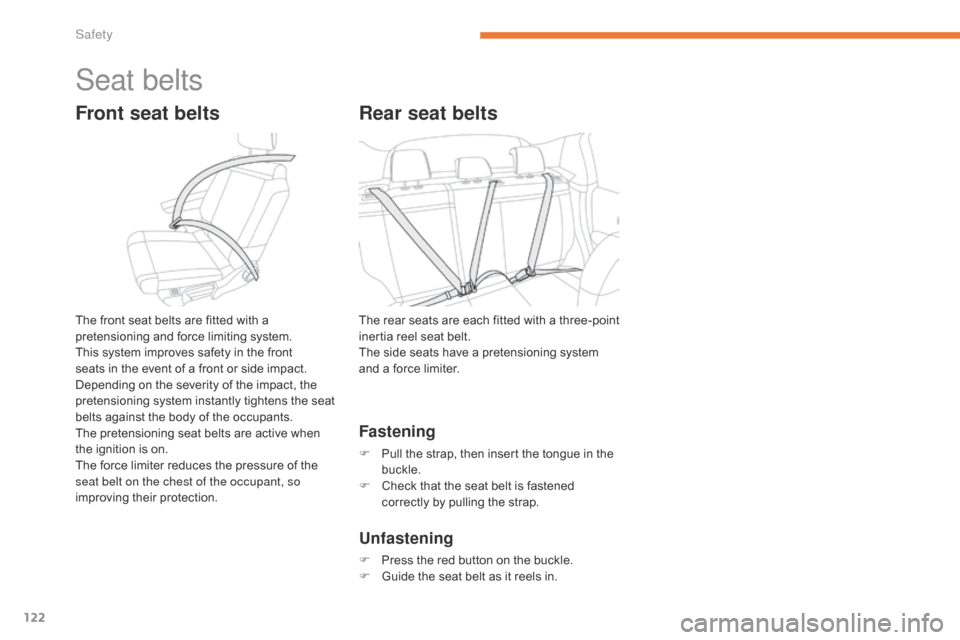
Front seat belts
The front seat belts are fitted with a
pretensioning and force limiting system.
This system improves safety in the front
seats in the event of a front or side impact.
Depending on the severity of the impact, the
pretensioning system instantly tightens the seat
belts against the body of the occupants.
The pretensioning seat belts are active when
the ignition is on.
The force limiter reduces the pressure of the
seat belt on the chest of the occupant, so
improving their protection.
Fastening
F Pull the strap, then insert the tongue in the buckle.
F
C
heck that the seat belt is fastened
correctly by pulling the strap.
Unfastening
F Press the red button on the buckle.
F G uide the seat belt as it reels in.
Rear seat belts
The rear seats are each fitted with a three-point
inertia reel seat belt.
The side seats have a pretensioning system
and a force limiter.
Safety
Page 126 of 442

124
The driver must ensure that passengers use
the seat belts correctly and that they are all
fastened before setting off.
Wherever you are seated in the vehicle,
always fasten your seat belt, even for short
journeys.
Do not interchange the seat belt buckles as
they will not fulfill their role fully.
The seat belts are fitted with an inertia reel
permitting automatic adjustment of the
length of the strap to your size. The seat belt
is stowed automatically when not in use.
Before and after use, ensure that the seat
belt is reeled in correctly.
The lower part of the strap must be
positioned as low as possible on the pelvis.
The upper part must be positioned in the
hollow of the shoulder.
The inertia reels are fitted with an automatic
locking device which comes into operation in
the event of a collision, emergency braking
or if the vehicle rolls over. You can release
the device by pulling the strap firmly and
then releasing it so that it reels in slightly.
In the event of an impact
Depending on the nature and
seriousness of the impact, the
pretensioning device may be deployed
before and independently of the airbags.
Deployment of the pretensioners is
accompanied by a slight discharge of
harmless smoke and a noise, due to the
activation of the pyrotechnic cartridge
incorporated in the system.
In all cases, the airbag warning lamp
comes
on.
Following an impact, have the seat belts
system checked, and if necessary replaced,
by a CITROËN dealer or a qualified
workshop.
In order to be effective, a seat belt must:
-
b
e tightened as close to the body as
possible,
-
b
e pulled in front of you with a smooth
movement, checking that it does not
twist,
-
b
e used to restrain only one person,
-
n
ot bear any trace of cuts or fraying,
-
n
ot be converted or modified to avoid
affecting its performance.
Recommendations for children
Use a suitable child seat if the passenger is
less than 12 years old or shorter than one
and a half metres.
Never use the same seat belt to secure more
than one person.
Never allow a child to travel on your lap.
For more information on Child seats , refer
to the corresponding section.
In accordance with current safety
regulations, for all repairs on your vehicle's
seat belts, go to a qualified workshop with
the skills and equipment needed, which a
CITROËN dealer is able to provide.
Have your seat belts checked regularly by
a CITROËN dealer or a qualified workshop,
particularly if the straps show signs of
damage.
Clean the seat belt straps with soapy
water or a textile cleaning product, sold by
CITROËN dealers.
After folding or moving a seat or rear bench
seat, ensure that the seat belt is positioned
and reeled in correctly.
Advice
Safety
Page 131 of 442

129
Sit in a normal upright position.
Wear a correctly adjusted seat belt.
Do not leave anything between the
occupants and the airbags (a child, pet,
object...), nor fix or attach anything close to
the inflation trajectory of the airbags; this
could cause injuries during their deployment.
Never modify the original definition of your
vehicle, particularly in the area directly
around the airbags.
After an accident or if the vehicle has been
stolen or broken into, have the airbag
systems checked.
All work on the airbag system must be
carried out by a CITROËN dealer or a
qualified workshop.
Even if all of the precautions mentioned
are observed, a risk of injury or of minor
burns to the head, chest or arms when an
airbag is deployed cannot be ruled out. The
bag inflates almost instantly (within a few
milliseconds) then deflates within the same
time discharging the hot gas via openings
provided for this purpose.Front airbags
Do not drive holding the steering wheel by its
spokes or resting your hands on the centre
part of the wheel.
Passengers must not place their feet on the
dashboard.
Do not smoke as deployment of the airbags
can cause burns or the risk of injury from a
cigarette or pipe.
Never remove or pierce the steering wheel or
hit it violently.
Do not fit or attach anything to the steering
wheel, the dashboard or the passenger's
sun visor as this could cause injuries with
deployment of the airbags.
Advice
Lateral airbags
Use only approved covers on the seats,
compatible with the deployment the lateral
airbags. For information on the range of seat
covers suitable for your vehicle, you can
contact a CITROËN dealer.
Do not fix or attach anything to the seat
backs (clothing...). This could cause injury
to the chest or arms if the lateral airbag is
deployed.
Do not sit with the upper part of the body any
nearer to the door than necessary.
Curtain airbags
Do not fix or attach anything to the roof. This
could cause injury to the head if the curtain
airbag is deployed.
If fitted on your vehicle, do not remove the
grab handles installed on the roof, they play
a part in securing the curtain airbags.
For the airbags to be fully effective, observe the safety recommendations below:
The vehicle's front door panels include side
impact sensors.
A damaged door or any unauthorised or
incorrectly executed work (modification or
repair) on the front doors or their interior trim
could compromise the operation of these
sensors - Risk of malfunction of the lateral
airbags!
Such work must only be done by a CITROËN
dealer or a qualified workshop.
5
Safety
Page 132 of 442
130
General points relating to child seats
CITROËN recommends that children
should travel on the rear seats of your
vehicle:
-
re
arward facing up to the age of 3,
-
fo
rward facing over the age of 3.
Although one of CITROËN's main criteria when designing your vehicle, the safety of your children
also depends on you.
For maximum safety, please observe the
following recommendations:
-
i
n accordance with European regulations,
all children under the age of 12 or less
than one and a half metres tall must
travel in approved child seats suited to
their weight , on seats fitted with a seat
belt or ISOFIX mountings*,
-
s
tatistically, the safest seats in your
vehicle for carr ying children are the
rear seats,
-
a c
hild weighing less than 9 kg must
travel in the rear ward facing position
both in the front and in the rear.
*
T
he regulations on carrying children are
specific to each country. Refer to the
legislation in force in your country.
Safety
Page 133 of 442
131
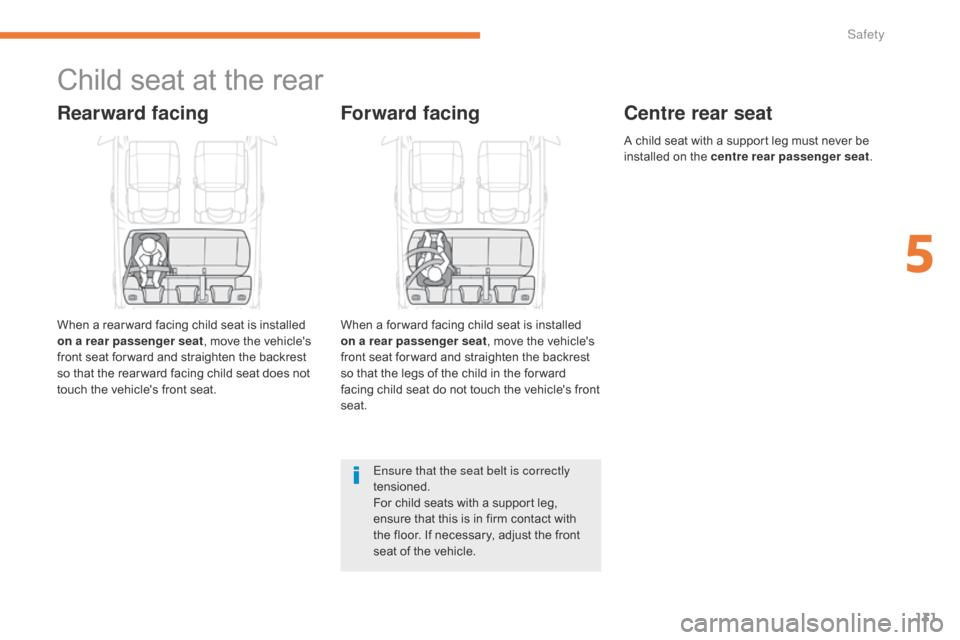
Child seat at the rear
Rearward facing
When a rear ward facing child seat is installed
on a rear passenger seat, move the vehicle's
front seat for ward and straighten the backrest
so that the rear ward facing child seat does not
touch the vehicle's front seat.
Forward facing
When a for ward facing child seat is installed
on a rear passenger seat , move the vehicle's
front seat for ward and straighten the backrest
so that the legs of the child in the for ward
facing child seat do not touch the vehicle's front
seat.
Ensure that the seat belt is correctly
tensioned.
For child seats with a support leg,
ensure that this is in firm contact with
the floor. If necessary, adjust the front
seat of the vehicle.
Centre rear seat
A child seat with a support leg must never be
installed on the centre rear passenger seat .
5
Safety
Page 134 of 442
132
Child seat in the front*
Rearward facingForward facing
Passenger seat adjusted to the fully back
position.
Ensure that the seat belt is correctly
tensioned.
For child seats with a support leg,
ensure that the support leg is in stable
contact with the floor. If necessary,
adjust the passenger seat.
When a rear ward facing child seat is installed
on the front passenger seat
, adjust the seat
to the fully back position, with the backrest
straightened.
The passenger's front airbag must be
deactivated. Otherwise, the child would
risk being seriously injured or killed if the
airbag were to inflate . When a for ward facing child seat is installed on
the front passenger seat
, adjust the vehicle's
seat to the fully back position with seat backrest
straightened and leave the passenger's front
airbag activated.
*
R
efer to the current legislation in your country
before installing a child seat on this seat.
Safety
Page 138 of 442
136
Child seats recommended by CITROËN
Group 0+: from bir th to 13 kgGroups 2 and 3: from 15 to 36 kg
L1
"RÖMER Baby-Safe Plus"
Installed in the rear ward facing position. L5
"RÖMER KIDFIX XP"
Can be fitted to the vehicle's ISOFIX mountings. The child is restrained by the seat belt. L6
"GRACO Booster"
The child is restrained by the seat belt.
CITROËN offers a range of recommended child seats which are secured using a three point seat belt
.
Safety
Page 139 of 442
137
Locations for child seats secured using the seat belt
In accordance with European regulations, this table indicates the options for installing child seats secured using the seat belt and universally
approved (a) in relation to the weight of the child and the seat in the vehicle.
Weight of the child / indicative age
Seat Passenger's
front airbag Under 13 kg
(groups 0 (b)
and 0+)
Up to about 1 year From 9 to 18 kg
(group 1)
From 1 to about 3
yearsFrom 15 to 25 kg
(group 2)
From 3 to about 6
yearsFrom 22 to 36 kg
(group 3)
From 6 to about 10 years
Row 1 (c) Passenger seat Deactivated
"OFF" U
UUU
Activated "ON" XUF UFUF
Row 2 (d) Seat behind the
driver's seat
U
UUU
Seat behind the
passenger's
seat U
UUU
Centre rear
seat (e) U
UUU
5
Safety