2017 Citroen C3 RHD fuel consumption
[x] Cancel search: fuel consumptionPage 165 of 442

163
Stop & Start
Going into engine STOP mode
Never refuel with the engine in STOP
mode; you must switch off the ignition. For your comfort, during parking
maoeuvres, STOP mode is not
available for a few seconds after
coming out of reverse gear.
Stop & Start does not affect the
operation of vehicle systems such as
braking, power steering, etc.
The Stop & Start system puts the engine
temporarily into standby - STOP mode - during
stops in the traffic (red lights, traffic jams, etc.).
The engine restarts automatically - START
mode - as soon as you want to move off.
The restart takes place instantly, quickly and
silently.
Per fect for urban use, the Stop & Start system
reduces fuel consumption and exhaust
emissions as well as the noise level when
stationary.
With a manual gearbox
, vehicle
stationary, this warning lamp
comes on in the instrument panel
and the engine goes into standby
automatically when you place the
gear lever in neutral and you release
the clutch pedal.
With an automatic gearbox ,
vehicle stationary, this warning lamp
comes on in the instrument panel
and the engine goes into standby
automatically when you press
the brake pedal or place the gear
selector in position N .
Stop & Star t time counter
(minutes / seconds or hours / minutes) A time counter calculates the time
spent in STOP mode during a
j o u r n ey.
It resets to zero every time the ignition is
switched on.
6
Driving
Page 188 of 442

186
Driving with under-inflated tyres
increases fuel consumption.The under-inflation detection system
does not replace the need for vigilance
on the part of the driver.
This system does not avoid the need to
check the tyre pressures (including the
spare wheel) every month as well as
before a long journey.
Driving with under-inflated tyres impairs
road holding, extends braking distances
and causes premature tyre wear,
particularly under arduous conditions
(high loading, high speed, long journey).
The inflation pressures defined for
your vehicle can be found on the tyre
pressure label.
For more information on the
Identification markings
, refer to the
corresponding section.
Snow chains
The system does not have to be
reinitialised after fitting or removing
snow chains.
Under-inflation detection
System which automatically checks the pressures of the tyres while driving.
The system monitors the pressures in the four
tyres, once the vehicle is moving.
It compares the information given by the four
wheel speed sensors with reference values,
which must be reinitialised ever y time the
tyre pressures are adjusted or a wheel
changed .
The system triggers an alert as soon as it
detects a drop in the inflation pressure of one
or more tyres. Checking tyre pressures
This check should be done when
the
tyres are "cold" (vehicle stopped
for
1 hour or after a journey of less than
6 miles (10 km) at moderate speeds).
Other wise, add 0.3 bar to the pressures
shown on the label.
Driving
Page 212 of 442

210
AdBlue® and SCR system
for BlueHDi Diesel engines
To assure respect for the environment and
conformity with the new Euro 6 emissions
standard, without adversely affecting the
per formance or fuel consumption of Diesel
engines, CITROËN has taken the decision to
equip its vehicles with an effective system that
associates SCR (Selective Catalytic Reduction)
with a particle filter (FAP) for the treatment of
exhaust gases.
SCR system
Using a fluid called AdBlue® containing
urea, a
catalytic converter turns up to 85%
of nitrogen oxides (NOx) into nitrogen and
water, which are harmless to health and the
environment. Once the AdBlue
® tank is empty,
a
system required by regulations
prevents starting of the engine.
If the SCR
system is faulty, the level
of emissions from your vehicle will no
longer meet the Euro 6 standard: your
vehicle becomes polluting.
In the event of a confirmed fault
with the SCR system, you must go
to a CITROËN dealer or a qualified
workshop as soon as possible: after
a running distance of 650 miles
(1
100 km), a system will be triggered
automatically to prevent engine starting.
In either case, a range indicator gives
you the distance you can travel before
the vehicle is immobilised.
The AdBlue® is held in a special tank with
a capacity of about 15 litres: this provides
a driving range of about 11 000 miles
(18
000
km). An alert is triggered automatically
to warn you when the reserve level is
reached: you can then drive about 1 500 miles
(2
400
km) before the tank is empty.
Freezing of the AdBlue
®
AdBlue® freezes at temperatures below
around -11°C.
The SCR system includes a heater
for the AdBlue
® tank, allowing you
to continue driving in all weather
conditions.
Practical information
Page 255 of 442

253
Identification markings
A. Vehicle identification number (VIN),
under the bonnet.
The number is engraved on the body structure.-
t he maximum authorised vehicle weight
(the Gross Vehicle Weight or GV W),
-
t
he maximum authorised vehicle + trailer
weight (the Gross Train Weight or GTW),
-
t
he maximum weight on the front axle,
-
t
he maximum weight on the rear axle.-
t
he spare tyre pressure.
It also indicates the paint colour code.
B. Vehicle identification number (VIN), on
the dashboard.
The number is on a label, visible through the
windscreen. Checking tyre pressures
The tyre pressures should be checked when
cold at least monthly.
The pressures given on the label are valid for
cold tyres. If you have driven for more than
10
minutes or more than 6 miles (10 kilometres)
at more than 30 mph (50 km/h), the tyres will be
warm; in this case 0.3 bar (30 kPa) should be
added to the pressures given on the label.
Different visible markings for the identification of your vehicle.
Low tyre pressures increase fuel
consumption.Never reduce the pressure of a warm
tyre. The original tyres fitted to the vehicle
may have a load index or speed rating
higher than those given on the label;
this has no effect on the inflation
pressures.
C. Manufacturer's label.
This self-destructing label is affixed to the right-
hand door aperture.
It bears the following information:
-
t
he name of the manufacturer,
-
t
he European Whole Vehicle Type Approval
number,
-
t
he vehicle identification number (VIN), D. Tyres / paint code label.
This label is affixed to the driver's door
aperture.
It bears the following information on the tyres:
-
t
he tyre pressures, unladen and laden,
-
t
he reference, size, type, load index and
speed rating,
9
Technical data
Page 257 of 442
255
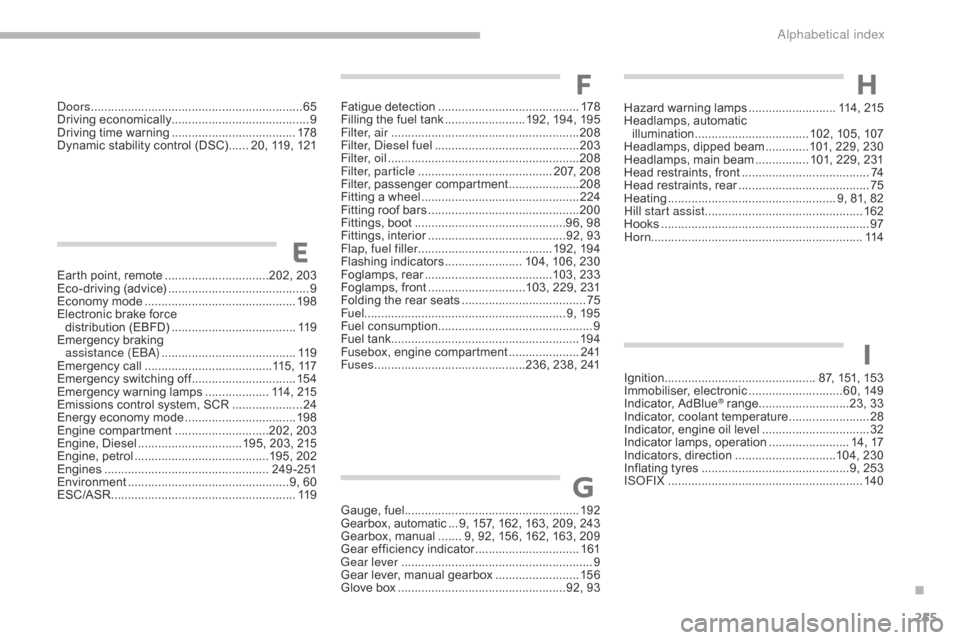
Earth point, remote ...............................202, 203
Eco-driving (advice) .......................................... 9
E
conomy mode
...............................
..............198
Electronic brake force distribution (EBFD)
..................................... 11
9
Emergency braking
assistance (EBA)
........................................ 11
9
Emergency call
...................................... 11
5 , 117
Emergency switching off
...............................15
4
Emergency warning lamps
................... 1
14, 215
Emissions control system, SCR
.....................24
E
nergy economy mode
.................................19
8
Engine compartment
............................2
02, 203
Engine, Diesel
...............................1
95, 203, 215
Engine, petrol
........................................1
95, 202
Engines
..............................
...................24 9 - 2 51
Environment
...............................
.................9, 60
ESC/ASR
...............................
........................11 9 Hazard warning lamps
.......................... 1
14, 215
Headlamps, automatic illumination
...............................
... 102, 105, 107
Headlamps, dipped beam
.............1
01, 229, 230
Headlamps, main beam
................ 1
01, 229, 231
Head restraints, front
......................................
74
H
ead restraints, rear
.......................................
75
H
eating
................
.................................. 9, 81, 82
Hill start assist
...............................................
16
2
Hooks
...............................
...............................
97
Horn ............................................................... 114
G
I
HF
Gauge, fuel.................................................... 192
Gearbox, automatic ... 9 , 157, 162, 163, 209, 243
Gearbox, manual
....... 9
, 92, 156, 162, 163, 209
Gear efficiency indicator
...............................16
1
Gear lever
..............................
........................... 9
Gear lever, manual gearbox
.........................15
6
Glove box
..................................................9
2, 93Ignition
................
............................. 87, 151, 153
Immobiliser, electronic
............................6
0, 149
Indicator, AdBlue
® range ...........................2 3, 33
Indicator, coolant temperature ........................ 28
I
ndicator, engine oil level
................................ 32
I
ndicator lamps, operation
........................ 1
4, 17
Indicators, direction
..............................1
04, 230
Inflating tyres
..............................
..............9, 253
ISOFIX
...............
........................................... 140
E
Doors .............................................................. .65
Driving economically ......................................... 9
Driving time warning
..................................... 17
8
Dynamic stability control (DSC)
...... 2
0, 119, 121Fatigue detection ..............................
............178
Filling the fuel tank
........................1 92, 194, 195
Filter, air
...............
.........................................208
Filter, Diesel fuel
........................................... 20
3
Filter, oil
......................................................... 20
8
Filter, particle
........................................ 2
07, 208
Filter, passenger compartment
..................... 20
8
Fitting a wheel
...............................
................224
Fitting roof bars
.............................................20
0
Fittings, boot
.............................................9
6, 98
Fittings, interior
.........................................9
2, 93
Flap, fuel filler
...............................
.........192, 19 4
Flashing indicators
....................... 1
04, 106, 230
Foglamps, rear
......................................1
03, 233
Foglamps, front
.............................1
03, 229, 231
Folding the rear seats
.....................................75
Fu
el............................................................ 9, 195
Fuel consumption
.............................................. 9
F
uel tank........................................................19 4
Fusebox, engine compartment
..................... 2
41
Fuses
................
.............................236, 238, 241
.
Alphabetical index
Page 258 of 442

256
Maintenance (advice) ....................................2 14
Maintenance, routine ........................................ 9
M
ap reading lamps
......................................... 90
M
arkings, identification
................................. 25
3
Mat
.......
.....................................................92, 95
Memorising a speed
..................................... 16
6
Mirror, rear view
............................................ 10
0
Mirrors, door............................................99, 180
Misfuel prevention
...............................
..........19 4
Mountings, Isofix
...............................
............13 9 Pads, brake
...................................................
20
9
Paint colour code
..........................................
25
3
Panoramic glass sunroof
................................
91
P
arcel shelf, rear ....................................... 9 7, 98
Parking brake ..................................1 5, 155, 209
Parking sensors, rear.................................... 183
Plates, identification ...................................... 253
Port, USB
..................................................
92, 94
Pre-heater, Diesel
...............................
............15
Pressures, tyres
....................................2
20, 253
Pre-tensioning seat belts
..............................12
4
Priming the fuel system
................................2
15
Protecting children
........................ 1
26, 130 -132,
137, 139 -141, 143
Protectors
...................................................... 2
14
Puncture
................
........................................216
Number plate lamps
...................................... 23
4
M
P
N
Lighting, interior ..............................................90
L ighting, welcome ......................................... 10
7
Loading
..............................
............................... 9
Load reduction mode
.................................... 19
8
Localised Assistance Call
......................11
5 , 117
Locating your vehicle
...................................... 55
Lo
cking
......................................................5
4, 60
Locking from the inside
..............................
........................67
Low fuel level
..............................
..................192Oil change
............................... ......................204
Oil consumption
............................................20
4
Oil, engine
...............................
......................204
Opening the bonnet
......................................2
01
Opening the boot
..............................
. 54, 56, 66
Opening the doors
............................. 5
4, 56, 65
O
Labels, identification .....................................25 3
Lamp, boot ............................... ............... 91, 235
Lamps, parking
............................................. 10
6
Lane Departure Warning System (LDWS)
...17
9
LEDs - Light-emitting diodes
........................10
6
Level, AdBlue
................................................ 2
07
Level, brake fluid
........................................... 20
5
Level, Diesel additive
.................................... 2
07
Level, engine coolant
..............................2
8, 206
Level, engine oil
...............................
.......32, 204
Levels and checks
..............................
..202-207
Level, screenwash fluid
................................20
6
Lighting
................
............................................ 14
Lighting, guide-me home
..............................10
7
L
Key ......................................... 53, 56, 58, 60, 61
Key, electronic ...........................................56
-58
Keyless Entry and Starting
... 5
6, 58, 60, 149, 152
Key not recognised
....................................... 15
4
Key with remote control
................................14
9
Kit, temporary puncture repair
................ 9
7, 216K
Jack .................................................94, 221, 222
Jump starting .............................. ..................244
J
Alphabetical index
Page 315 of 442
49
.
4
5
6
Audio and Telematics
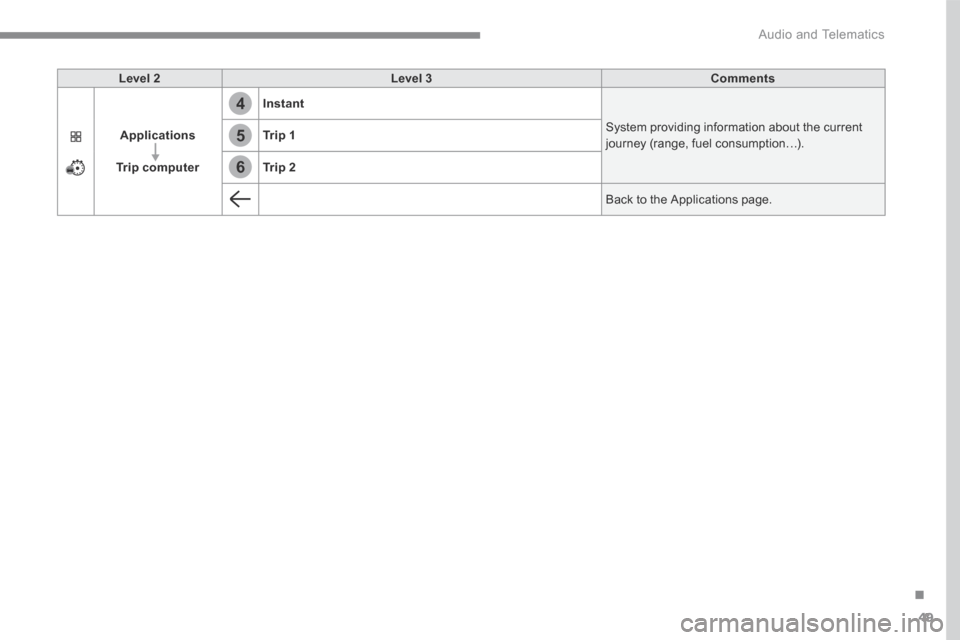
Level 2Level 3Comments
Applications
Trip computer
Instant
System providing information about the current journey (range, fuel consumption…). Tr i p 1
Tr i p 2
Back to the Applications page.
Page 347 of 442

81
.
1
15
16
1
1
11
12
13
14
9
8
10
Audio and Telematics
Level 2Level 3Level 4Comments
Settings
OPTIONS
System settings
Units
Distance and fuel consumption Set the units used for distance, fuel consumption and temperature. Temperature
Factory settings Reinitialize Restore the factory settings.
System info View
View the versions of the different modules
(system, mapping, risk areas) installed in the system as well as the updates available.
Save the settings.
Settings
OPTIONS
Languages
All
Select the language then confirm.
Europe
Asia
America
Having selected the language, save the setting.
Settings
OPTIONS
Screen configuration
Animation Activate or deactivate settings.
Brightness Move the cursor to adjust the brightness of the screen and/or of the instrument panel.
Save the settings.