Page 113 of 292

111
C3Picasso_en_Chap08_securite_ed01-2015
The system is reinitialised with the ignition
on and the vehicle stationary, via the vehicle
configuration menu.
F
P
ress the MENU button for access to the
main menu.
F
P
ress the " 5" or " 6" button to select
the Veh conf ig menu, then confirm by
pressing the OK button.
F
P
ress the " 5" or " 6" button to select
" Reinit inflat ", then confirm by pressing
the OK button.
F
Sel
ect "yes" or " no" then press OK.
A m
essage is displayed asking you to
confirm the instruction.
F
C
onfirm by pressing the OK button.
F
C
onform then quit the menu. F
P
ress the MENU button for access to the
main.
F
P
ress the "5" or " 6" button to select the
menu, " Personalisation-configuration "
then confirm by pressing the button OK.
F
P
ress the "5" or " 6" button to select the
" Define vehicle parameters ", menu, then
confirm by pressing the OK button.The new pressure settings registered are
considered to be reference values by the
system.
Vehicles without audio or
navigation system Vehicles with audio system
F Press the "
5" or " 6" button to select
the " Tyre pressures ", menu then the
" Reinitialisation " menu, then confirm by
pressing the OK button.
A
message confirms the reinitialisation.
8
Safety
Page 114 of 292
112
C3Picasso_en_Chap08_securite_ed01-2015
Operating fault
Before doing anything to the system,
the pressures of the four tyres must be
checked and the system reinitialised.
The flashing and then fixed illumination of the
under-inflation warning lamp accompanied
by illumination of the Service warning lamp
indicates a fault with the system.
In this case, under-inflation monitoring of the
tyres is no longer assured.
Have the system checked by a CITROËN
dealer or a qualified workshop.
Snow chains
The system does not have to be
reinitialised after fitting or removing
snow chains.
The under-inflation alert is only
dependable if the system has been
reinitialised with all four tyres inflated to
the correct pressures.
Safety
Page 115 of 292
113
C3Picasso_en_Chap08_securite_ed01-2015
Braking assistance systems
Anti-lock braking system
and electronic brake force
distribution
Linked systems which improve the stability and
manoeuvrability of your vehicle when braking,
in particular on poor or slippery sur faces.
Activation
The anti-lock braking system comes into
operation automatically when there is a risk of
wheel lock.
Normal operation of the ABS may make itself
felt by slight vibration of the brake pedal.When braking in an emergency, press
very firmly without releasing the
pressure.
Group of supplementary systems which help
you to obtain optimum braking in complete
safety in emergency situations:
-
a
nti-lock braking system (ABS),
-
e
lectronic brake force distribution (EBFD),
-
em
ergency braking assistance (EBA).
Operating fault
If this warning lamp comes on,
accompanied by an audible signal
and a message in the screen, it
indicates a malfunction of the anti-
lock braking system which could
result in loss of control of the vehicle
when braking.
If this warning lamp comes on,
together with the STOP
and ABS
warning lamps, accompanied by an
audible signal and a message in the
screen, it indicates a malfunction of
the electronic brake force distribution
which could result in loss of control of
the vehicle when braking.
Emergency braking assistance
System which, in an emergency, enables you
to obtain the optimum braking pressure more
quickly, thus reducing the stopping distance.
Activation
It is triggered by the speed at which the brake
pedal is pressed.
The effect of this is a reduction in the
resistance of the pedal and an increase in
braking efficiency.
In either case, contact a CITROËN dealer or a
qualified workshop. When braking in an emergency, press
firmly without releasing the pressure.
When replacing wheels (tyres and
rims), ensure that they conform to the
manufacturer's recommendations.
You must stop as soon as it is safe to do so.
8
Safety
Page 116 of 292

114
C3Picasso_en_Chap08_securite_ed01-2015
Deactivation
In exceptional conditions (starting a vehicle
which is bogged down, stuck in snow, on soft
ground...), it may be advisable to deactivate the
DSC and ASR systems, so that the wheels can
move freely and regain grip.
F
P
ress the button, located in the centre of
the dashboard.
Illumination of the indicator lamp in the button
indicates that the DSC and ASR systems are
deactivated.
Reactivation
These systems are reactivated automatically
each time the ignition is switched back on or
from 30 mph (50 km/h).
F
P
ress the button again to reactivate them
manually.
Operating fault
The illumination of this warning lamp
comes in the instrument panel and in
the button, accompanied by an audible
signal and a message in the multifunction
screen, indicates a fault in these systems.
Trajectory control systems
The anti-slip regulation (also known as traction
control) optimises traction to prevent skidding of
the wheels, by acting on the brakes of the driving
wheels and on the engine.
The electronic stability control acts on the brake
of one or more wheels and on the engine to keep
the vehicle on the trajectory required by the driver,
within the limits of the laws of physics.
Anti-slip regulation (ASR)
and dynamic stability
control (DSC)
This is indicated by flashing of this
warning lamp in the instrument panel.
Activation
These systems are activated automatically
each time the vehicle is started.
They come into operation in the event of a grip
or trajectory problem. The DSC/ASR systems offer
exceptional safety in normal driving, but
this should not encourage the driver to
take extra risks or drive at high speed.
The correct operation of these
systems depends on observation of
the manufacturer's recommendations
regarding wheels (tyres and rims),
braking components, electronic
components and assembly and repair
procedures.
After an impact, have these systems
checked by a CITROËN dealer or a
qualified workshop.
Have it checked by a CITROËN dealer or a
qualified workshop.
Safety
Page 152 of 292
150
C3Picasso_en_Chap11_informations-pratiques_ed01-2015
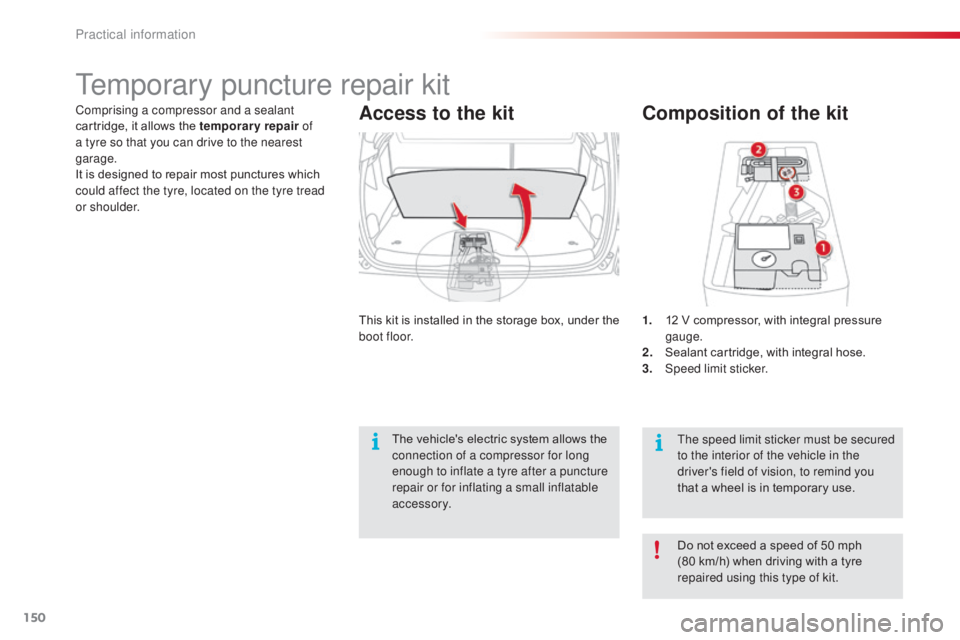
Composition of the kit
1. 12 V compressor, with integral pressure gauge.
2.
S
ealant cartridge, with integral hose.
3.
Spe
ed limit sticker.
Access to the kit
This kit is installed in the storage box, under the
boot floor.
The speed limit sticker must be secured
to the interior of the vehicle in the
driver's field of vision, to remind you
that a wheel is in temporary use.
Comprising a compressor and a sealant
cartridge, it allows the temporary repair
of
a tyre so that you can drive to the nearest
garage.
It is designed to repair most punctures which
could affect the tyre, located on the tyre tread
or shoulder.
Do not exceed a speed of 50 mph
(80 km/h) when driving with a tyre
repaired using this type of kit.
The vehicle's electric system allows the
connection of a compressor for long
enough to inflate a tyre after a puncture
repair or for inflating a small inflatable
accessory.
Temporary puncture repair kit
Practical information
Page 153 of 292
151
C3Picasso_en_Chap11_informations-pratiques_ed01-2015
F Switch off the ignition.
F S ecure the speed limit sticker inside the
vehicle. F
U ncoil the pipe stowed under the
compressor.
F
C
onnect the pipe from the compressor to
the sealant cartridge.
F
T
urn the the sealant cartridge and secure it
in the cut-out provided on the compressor.
Avoid removing any foreign bodies
which have penetrated into the tyre. F
R emove the valve cap from the tyre to be
repaired, and place it in a clean area.
F
C
onnect the hose from the sealant
cartridge to the valve of the tyre to be
repaired and tighten firmly.
Repair procedure
11
Practical information
Page 154 of 292

152
C3Picasso_en_Chap11_informations-pratiques_ed01-2015
F Check that the compressor switch is at the "O " position.
F
U
ncoil fully the electric cable, stowed under
the compressor.
F
C
onnect compressor's plug to the vehicle's
12 V socket.
F
S
witch on the ignition. Take care, the sealant product
is harmful (e.g. ethylene-glycol,
colophony...) if swallowed and causes
irritation to the eyes.
Keep this product out of the reach of
children.
The use-by date is marked on the
cartridge.
After use, do not discard the
cartridge by the roadside, take it to
a CITROËN
dealer or an authorised
waste disposal site.
Don't forget to obtain a new sealant
cartridge, available from a CITROËN
dealer or a qualified workshop.
F
S tart the compressor by placing the switch
at the " I" position and leave it running until
the tyre pressure reaches 2.0 bar.
T
he sealant product is injected into the tyre
under pressure; do not disconnect the pipe
from the valve during this operation (risk of
splashing and stains). If after around 5 to 7 minutes the
pressure is not attained, this indicates
that the tyre is not repairable; contact
a CITROËN dealer or a qualified
workshop for assistance.
Practical information
Page 155 of 292
153
C3Picasso_en_Chap11_informations-pratiques_ed01-2015
F Place the switch in the "O" position.
F R emove the kit.
F
D
rive immediately for approximately
three miles (five kilometres), at reduced
speed (between 15 and 35 mph (20 and
60
km/h)), to plug the puncture.
F
S
top to check the repair and the tyre
pressure using the kit.
Checking / adjusting tyre pressures
You can also use the compressor, without
injecting sealant, to check and if necessary
adjust the tyre pressures
F
R
emove the valve cap from the tyre and
place it in a clean area.
F
U
ncoil the pipe stowed under the
compressor.
F
S
crew the pipe onto the valve and tighten
f i r m l y. F
C heck that the compressor switch is at the
" O " position.
F
U
ncoil fully the electric cable, stowed under
the compressor.
F
C
onnect the compressor's plug to the
vehicle's 12 V socket.
F
S
witch on the ignition.
11
Practical information


