2017 CITROEN C-ELYSÉE bonnet
[x] Cancel search: bonnetPage 5 of 260

.
.
C-elysee_en_Chap00a_sommaire_ed01-2016
Direction indicators 100
Hazard warning lamps
1
00
Horn
10
0
Under-inflation
d
etection
1
01
Braking
assistance systems
1
05
Trajectory
control systems
1
06
Front
seat belts
1
07
Airbags
1
10
Safety
Child seats 1 14
Deactivating the passenger's front airbag
1
17
ISOFIX
mountings
1
23
Child
lock
1
28
Child safety
Fuel tank 129
Misfuel prevention (Diesel)
1
30
Running
out of fuel (Diesel)
1
32
AdBlue
® additive and SCR system
(
BlueHDi Diesel) 1 33
Temporary
puncture repair kit
1
40
Spare
wheel
1
45
Snow
chains
1
52
Changing
a bulb
1
53
Changing
a fuse
1
59
12
V
battery
1
64
Electrical
energy economy mode
1
68
Changing
a wiper blade
1
69
Towing
the vehicle
1
70
Towing
a trailer
1
72
Very
cold climate screen(s)
1
74
Advice
on care and maintenance
1
75
Accessories
1
75
M at s
17
7
Roof
bars
1
78
Practical information
Petrol engines 1 88
Petrol weights
1
89
Diesel
engines
1
90
Diesel
weights
1
91
Dimensions
1
92
Identification
ma
rkings
1
93
Technical data
Audio system / Bluetooth 1 95
Audio system
2
27
Audio and telematics
Visual search
Alphabetical
in
dex
Checks
Bonnet 18
0
Petrol engines
1
81
Diesel
engine
1
82
Checking
levels
1
83
Checks
18
6
Contents
Page 39 of 260

37
C-elysee_en_Chap02_ouvertures_ed01-2016
System which p rotects a nd p rovides a d eterrent a
gainst theft and break-ins. It provides
p
erimeter protection as well as a self-protection
f
unction.
Alarm
Perimeter protection
The system checks for opening of the vehicle.
T he alarm is triggered if anyone tries to open a
d
oor, the boot, the bonnet...
Self-protection function
The system checks for the putting out of service of its components.
The
alarm is triggered if the battery, the
c
entral control or the wires of the siren
are
put out of service or damaged.
Locking the vehicle with
alarm
Activation
F Switch off the ignition and get out of the vehicle.
F Press the locking button on the r
emote control.
The
perimeter protection is activated 5 seconds
a
fter
pressing the locking button on the remote
c
ontrol.
If
an
opening (door, boot...) is not closed
f
ully,
the
vehicle is not locked but the alarm is
a
ctivated. F
P
ress the unlocking button on
t
he remote control.
Deactivation
The alarm is deactivated: the indicator lamp goes off.
The
alarm is activated: a indicator
l
amp in the switch panel to the
left of the steering wheel flashes
o
nce per second.
For
all
work
on
the
alarm
system,
c
ontact
a
CITROËN
dealer
or
a
q
ualified
w
orkshop.
2
Access
Page 86 of 260

84
C-elysee_en_Chap05_conduite_ed01-2016
In the event of a fault with the system, the indicator lamp in the "ECO OFF" button
flashes
for a few moments, then comes on
c
ontinuously.
Have
it checked by a CITROËN dealer or a
q
ualified
w
orkshop.
In
the event of a fault in STOP mode, the
v
ehicle may stall. All of the warning lamps
i
n the instrument panel come on. It is then
n
ecessary to switch off the ignition and start
t
he engine again using the key.
Operating fault
The Stop & Start system requires
a 12 V battery with a special
s
pecification
a
nd
t
echnology.
All
work on this type of battery must be
c
arried out only by a CITROËN dealer
o
r a qualified workshop.
For
more information on the 12 V
b
attery, refer to the corresponding
s
ection.
Press
this
button
to
deactivate
the
system.
Deactivation
is
confirmed
by
illumination
of
the
i
ndicator
lamp
in
the
button
and
the
display
of
a
message.
Pressing
this
button
again
reactivates
the
s
ystem.
The
indicator
lamp
in
the
button
goes
off,
a
ccompanied
by
the
display
of
a
message.
Deactivation / Manual
reactivation
In certain cases, such as the need to maintain a comfortable temperature in the passenger
c
ompartment, it may be useful to deactivate the
S
top & Start system.
The
system can be deactivated at any time,
o
nce the ignition is on.
If
the engine is in STOP mode, it then restarts.
The
Stop & Start system is reactivated
a
utomatically every time the ignition is
switched
on.
Opening the bonnet
Before
doing anything under the
b
onnet, deactivate the Stop & Start
s
ystem to avoid the risk of injury
r
elated to an automatic change to
S
TART mode.
Driving on flooded roads
Before
driving through a flooded road,
i
t is strongly recommended that you
d
eactivate the Stop & Start system.
For
more advice on driving, particularly
o
n flooded roads, refer to the
c
orresponding
s
ection.
Driving
Page 98 of 260

96
C-elysee_en_Chap06_visibilite_ed01-2016
Headlamp beam height adjustment
To avoid causing a nuisance to other road users, the headlamp beams should be adjusted according to the load in the vehicle.
This
adjustment can be carried out using the control located:
-
u
nder the bonnet,
-
b
elow and to the left of the steering wheel (depending on version).
The
initial setting is position "0".
0
1
or 2 people in the front seats.
-
5
people.
1
5
people + maximum authorised load in
t
he boot.
-
D
river + maximum authorised load in the
b
oot.
The
higher number positions can be used,
b
ut may limit the area illuminated by the
h
eadlamps.
Under the bonnet
F Raise the bonnet for access to the control (one per headlamp).
F
T
urn the control to adjust the height of the
h
eadlamp
b
eam.
Travelling abroad
The design of the dipped beam headlamps allows, without modification,
d
riving in a country that drives on the
o
ther side of the road to the country in
w
hich your vehicle was sold.
To the left of the steering wheel
Visibility
Page 134 of 260

132
C-elysee_en_Chap09_info-pratiques_ed01-2016
On vehicle fitted with HDi engines, the fuel system must be primed if you run out of fuel;
r
efer to the engine compartment view on the
"
Diesel engine" section.
If
the tank on your vehicle is fitted with
a
misfuel prevention device, refer to the
c
orresponding
s
ection.
Running out of fuel (Diesel)
If the engine does not start first time, don't keep trying. Start the procedure
a
gain from the beginning.
HDi 92 engine
F Fill the fuel tank with at least five litres of d
iesel.
F
O
pen the bonnet.
F
S
queeze and release the priming pump
r
epeatedly until resistance is felt (there
m
ay be resistance at the first press).
F
O
perate the starter until the engine starts
(
if the engine does not start at the first
a
ttempt, wait around 15 seconds before
t
rying
ag
ain).
F
I
f the engine does not start after a few
a
ttempts, operate the priming pump again
t
hen start the engine.
F
C
lose the bonnet.
BlueHDi engine
F Fill the fuel tank with at least five litres of D
iesel.
F
S
witch on the ignition (without starting the
e
ngine).
F
W
ait around 6 seconds and switch off the
ig
nition.
F
R
epeat the operation 10 times.
F
O
perate the starter to run the engine.
Pr
Page 166 of 260

164
C-elysee_en_Chap09_info-pratiques_ed01-2016
12 V battery
Procedure for starting the engine using another battery or charging a discharged battery.T he battery is located under the bonnet.
To
gain access to it:
F
o
pen the bonnet using the interior release
l
ever, then the exterior safety catch,
F
s
ecure the bonnet stay,
F
r
emove the plastic cover on the (+) terminal.
Access to the battery
General points
Lead-acid starter batteries
Protect your eyes and face before h
andling the battery.
All
operations on the battery must be
c
arried out in a well ventilated area and
a
way from naked flames and sources
o
f sparks, so as to avoid the risk of
e
xplosion or fire.
Wash
your hands after wards.
Batteries
contain
harmful
substances
s
uch
as
sulphuric
acid
and
lead.
They
must
be
disposed
of
in
a
ccordance
with
regulations
and
must
n
ot,
in
any
circumstances,
be
discarded
w
ith
household
waste.
Take
used
remote
control
batteries
and
v
ehicle batteries to a special collection
point.
Versions
equipped
with
Stop
&
Start
are
f
itted
with
a
12
V
lead-acid
battery
of
s
pecific
t
echnology
a
nd
s
pecification.
Its
replacement
should
be
carried
out
o
nly
by
a
CITROËN
dealer
or
a
qualified
w
orkshop. If
you have an electronic or automatic
g
earbox, never try to start the engine by
p
ushing the vehicle. The
(-) terminal of the battery is not accessible.
A
remote earth point is located on the engine.
Practical information
Page 182 of 260
180
C-elysee_en_Chap10_verifications_ed01-2016
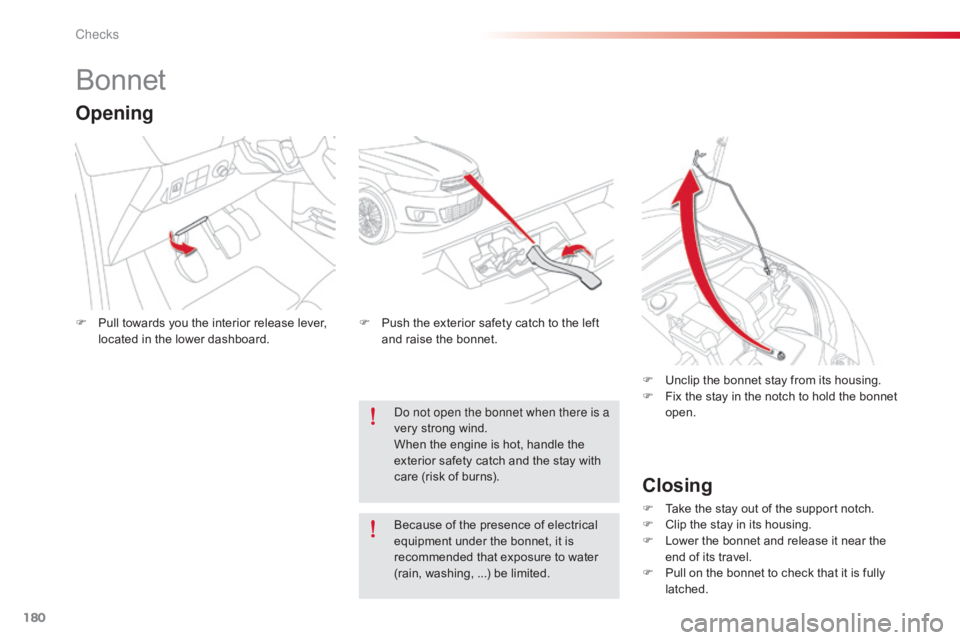
Bonnet
Closing
F Take the stay out of the support notch.
F C lip the stay in its housing.
F
L
ower the bonnet and release it near the
e
nd of its travel.
F
P
ull on the bonnet to check that it is fully
l
atched.
F
U
nclip the bonnet stay from its housing.
F
F
ix the stay in the notch to hold the bonnet
ope
n.
Do not open the bonnet when there is a
very
strong
wind.
When
the
engine
is
hot,
handle
the
e
xterior
safety
catch
and
the
stay
with
c
are
(risk
of
burns).
Opening
F Push
the exterior safety catch to the left a
nd raise the bonnet.
F
P
ull
towards
you
the
interior
release
lever,
l
ocated
in
the
lower
dashboard.
Because
of the presence of electrical
e
quipment under the bonnet, it is
r
ecommended that exposure to water
(
rain, washing, ...) be limited.
Checks
Page 185 of 260

183
C-elysee_en_Chap10_verifications_ed01-2016
Checking levels
Engine oil level
The check of the oil level is carried out with the dipstick, located under
t
he bonnet. For the position of the
d
ipstick, refer to the under-bonnet
v
iew on a previous page.Checking with dipstick
If you find that the oil level is above the A mark or below the B mark, do not star t the engine.
Take
care
when
working
under
the
bonnet,
as
certain
areas
of
the
engine
may
be
extremely
hot
(risk of burns) and the cooling fan could start at
a
ny
time
(even
with
the
ignition
off).
Check
all
of
these
levels
regularly,
in
line
with
the
manufacturer's
service
schedule.
Top
them
up
if
necessary, unless other wise indicated.
If
a
level
drops
significantly,
have
the
corresponding
system
checked
by
a
CITROËN
dealer
or
a
qualified workshop.
It
is
normal
to
top
up
the
oil
level
b
etween
two
services
(or
oil
changes).
C
ITROËN
recommends
that
you
check
t
he
level,
and
top
up
if
necessary,
every
3
000
miles
(5
000
km).
To
ensure
the
accuracy
of
the
reading,
your
v
ehicle
must
be
on
a
level
sur face,
with
the
e
ngine
off
for
at
least
30
minutes. -
I
f the level is above
t
he MAX
mark (risk of
e
ngine damage), contact
a
CITROËN dealer or a
q
ualified
w
orkshop.
-
I
f the level is below the
MIN
mark, you must
top-up
the engine oil.
Refer
to
the
under-bonnet
view
for
the
location
o
f
the
dipstick
on
your
vehicle.
F
T
ake
the
dipstick
by
its
coloured
grip
and
p
ull
it
out
completely.
F
W
ith
the
end
of
the
dipstick
with
a
clean
a
nd
non-fluffy
cloth.
F
R
efit
the
dipstick
and
push
it
fully
down,
t
hen
pull
it
out
again
for
a
visual
check
of
t
he
oil
level:
the
level
must
be
between
the
t
wo
marks
A
and
B .
10
Checks