2017 CITROEN C-ELYSÉE steering
[x] Cancel search: steeringPage 68 of 260

66
C-elysee_en_Chap05_conduite_ed01-2016
Never switch off the ignition before the vehicle is at a complete stop. With the
e
ngine off, the braking and steering
a
ssistance systems are also cut off: risk
o
f loss of control of the vehicle.
For
more information, refer to the
"
Practical information" section, under
"
Energy economy mode".
When
you leave the vehicle, keep the
k
ey with you and lock the vehicle.
To
facilitate
unlocking
of
the
steering
c
olumn,
it
is
recommended
that
the
w
heels
be
returned
to
the
straight
ahead
p
osition
before
switching
off
the
engine.
Switching off the engine
F Check that the parking brake is correctly a
pplied, particularly on sloping ground.
F
S
top the vehicle.
F
W
ith the engine running at idle, turn the key
t
o position 1
.
F
R
emove the key from the ignition switch.
F
T
o lock the steering column, turn the
s
teering until it locks.
Energy economy mode
After switching off the engine (position 1- Stop
), f
or a maximum of 30 minutes you can still use
f
unctions such as the audio and telematic
s
ystem, the wipers, dipped beam headlamps,
c
ourtesy lamps, ...
Key left in the "Ignition on"
position
On opening the driver's door, an alert message is displayed, accompanied by an a
udible signal, to remind you that the key is
s
till
i
n
t
he
i
gnition
s
witch
a
t
p
osition
1
(Stop).
If the key has been left in the ignition s
witch at position 2 (Ignition on) ,
the
ignition will be switched off
a
utomatically after one hour.
To
switch the ignition back on, turn the
k
ey to position 1 (Stop),
then back to
p
osition 2 (Ignition on) .
Driving
Page 84 of 260

82
C-elysee_en_Chap05_conduite_ed01-2016
Stop & Start
Operation
Going into engine STOP mode
The "ECO" warning lamp comes o
n in the instrument panel and the
e
ngine goes into standby:
-
w
ith a 5-speed electronic gearbox , with
the vehicle stationary, when you press
the
brake pedal or put the gear selector in
p
osition N .
A
time
counter calculates the sum of the
p
eriods
in
STOP mode during a journey. It rests
i
tself
to
zero every time the ignition is switched
o
n
with
the key.
The
Stop
&
Start system
puts
the
engine
t
emporarily
into
standby
-
STOP
mode
-
during
s
tops
in
the
traffic
(red
lights,
traffic
jams,
or
o
ther...).
The
engine
restarts
automatically
-
S
TART
mode
-
as
soon
as
you
want
to
move
o
ff.
The
restart
takes
place
instantly,
quickly
a
nd
silently.
Per fect
for
urban
use,
the
Stop
&
Start
system
r
educes
fuel
consumption
and
exhaust
e
missions
as
well
as
the
noise
level
when
s
tationary. Never
refuel with the engine in
S
TOP mode; you must switch off the
i
gnition with the key.
For
your comfort, during parking
m
anoeuvres, STOP mode is not
a
vailable for a few seconds after
c
oming out of reverse gear.
STOP
mode does not affect the
f
unctionality of the vehicle, such as for
example,
braking, power steering...
Driving
Page 87 of 260

85
C-elysee_en_Chap05_conduite_ed01-2016
Speed limiter
System which prevents the vehicle from exceeding the speed programmed by the driver.
When
the programmed speed limit is reached,
p
ressing the accelerator pedal in the normal
m
anner no longer has any effect.
The
speed limiter is switched on
m
anually:
i
t requires a programmed speed of at least
2
0 mph (30 km/h).
The
speed limiter is switched off by manual
o
peration of the control.
The
programmed speed can be exceeded
t
emporarily by pressing the accelerator firmly.
To
return to the programmed speed, simply
s
low down to a speed below the programmed
s
peed. The
speed limiter cannot, in any
c
ircumstances, replace the need to
r
espect speed limits, nor can it replace the
n
eed for vigilance on the part of the driver.The
controls of this system are grouped
t
ogether on stalk A.
1.
S
peed limiter mode selection thumb wheel.
2.
V
alue decrease button.
3.
V
alue increase button.
4.
S
peed limiter on / off button.Steering mounted controls
The programmed information is grouped together in the instrument panel screen.
5.
S
peed limiter on / off indication.
6.
S
peed limiter mode selection indication.
7.
P
rogrammed speed value.
Displays in the instrument panel
The programmed s peed r emains i n t he m emory w
hen the ignition is switched off.
5
Driving
Page 89 of 260

87
C-elysee_en_Chap05_conduite_ed01-2016
Cruise control
System which automatically maintains the speed of the vehicle at the value programmed
b
y the driver, without any action on the
a
ccelerator
ped
al.
The cruise control is switched on
m
anually:
it r
equires a minimum vehicle speed of 25 mph
(
40 km/h), as well as the engagement of:
-
f
ourth gear on a manual gearbox,
-
s
econd gear on a or automatic or electronic
g
earbox, in sequential mode,
-
p
osition A on an electronic gearbox or
p
osition D on an automatic gearbox.
The cruise control is switched off
m
anually
o
r by pressing the brake or clutch pedal or on
t
riggering of the trajectory control systems for
s
afety reasons.
It
is possible to exceed the programmed speed
t
emporarily by pressing the accelerator pedal.
To
return to the programmed speed, simply
r
elease the accelerator pedal.
Switching
off the ignition cancels any
p
rogrammed speed value. The
controls of this system are grouped
t
ogether on stalk A.
1.
C
ruise control mode selection thumb
w
heel.
2.
V
alue decrease button.
3.
V
alue increase button.
4.
C
ruise control off/resume button.Steering mounted controls
The cruise control cannot, in any
circumstances, replace the need to r
espect speed limits, nor can it replace the
n
eed for vigilance on the part of the driver.The
programmed information is grouped
t
ogether in the instrument panel screen.
5.
C
ruise control off/resume indication.
6.
C
ruise control mode selection indication.
7.
P
rogrammed speed value.
Displays in the instrument
panel
5
Driving
Page 98 of 260

96
C-elysee_en_Chap06_visibilite_ed01-2016
Headlamp beam height adjustment
To avoid causing a nuisance to other road users, the headlamp beams should be adjusted according to the load in the vehicle.
This
adjustment can be carried out using the control located:
-
u
nder the bonnet,
-
b
elow and to the left of the steering wheel (depending on version).
The
initial setting is position "0".
0
1
or 2 people in the front seats.
-
5
people.
1
5
people + maximum authorised load in
t
he boot.
-
D
river + maximum authorised load in the
b
oot.
The
higher number positions can be used,
b
ut may limit the area illuminated by the
h
eadlamps.
Under the bonnet
F Raise the bonnet for access to the control (one per headlamp).
F
T
urn the control to adjust the height of the
h
eadlamp
b
eam.
Travelling abroad
The design of the dipped beam headlamps allows, without modification,
d
riving in a country that drives on the
o
ther side of the road to the country in
w
hich your vehicle was sold.
To the left of the steering wheel
Visibility
Page 102 of 260

100
C-elysee_en_Chap07_securite_ed01-2016
Direction indicators
F Left: lower the lighting stalk beyond the p
oint of resistance.
F
R
ight: raise the lighting stalk beyond the
p
oint of resistance.
Three flashes of the direction
indicators
F Press briefly upwards or downwards, w
ithout going beyond the point of
r
esistance; the direction indicators will
f
lash 3 times.
Hazard warning lam ps
Automatic operation of
hazard warning lamps
When braking in an emergency, depending on t
he deceleration, the hazard warning lamps
c
ome on automatically.
They
switch off automatically the first time you
a
ccelerate.
F
Y
ou can also switch them off by pressing
t
he button.
F
P
ress this button, all of the direction
in
dicators
f
lash.
They can operate with the ignition off.
Horn
F Press
the central part of the steering w
heel.
Audible
warning system to alert other road
u
sers to an imminent danger.
Visual
warning
with
of
all
the
direction
i
ndicators
flashing
to
alert
other
road
users
to
a
v
ehicle
breakdown,
towing
or
accident.
Safety
Page 104 of 260

102
C-elysee_en_Chap07_securite_ed01-2016
Before reinitialising the system, ensure that the pressures of the four tyres are
correct
for the use of the vehicle and in
l
ine with the recommendations on the
t
yre pressure label.
The
under-inflation alert can only be
r
elied on if the reinitialisation of the
s
ystem has done with the pressures in
t
he four tyres correctly adjusted.
The
under-inflation detection system
d
oes not give a warning if a pressure is
i
ncorrect at the time of reinitialisation.
The
loss
of
pressure
detected
does
not
a
lways
cause
visible
bulging
of
the
tyre.
D
o
not
satisfy
yourself
with
just
a
visual
c
heck. The
alert
is
maintained
until
the
system
i
s
r
einitialised.
Under-inflation alert
This is given by fixed illumination of t his warning lamp, accompanied by
a
n audible signal and the display of a
m
essage.
F
R
educe speed immediately, avoid
e
xcessive steering movements and sudden
b
raking
F
S
top the vehicle as soon as it is safe to
do so. F
I f you have a compressor (such as the one
i
n the temporary puncture repair kit), check
t
he pressures of the four tyres when cold.
I
f it is not possible to carry out this check
s
traight away, drive carefully at reduced
s
peed.
or
F
I
n the event of a puncture, use the
temporary
puncture repair kit or the spare
w
heel (depending on equipment),
Reinitialisation
It is necessary to reinitialise the system every time one or more tyre pressures are adjusted,
a
nd after changing one or more wheels.
Safety
Page 108 of 260
106
C-elysee_en_Chap07_securite_ed01-2016
Anti-slip regulation (ASR)
and electronic stability
programme (ESP)
The anti-slip regulation (also known as Traction Control) optimises traction to prevent skidding o
f the wheels, by acting on the brakes of the
d
riving wheels and on the engine.
The
electronic stability programme acts on the
b
rake of one or more wheels and on the engine
t
o keep the vehicle on the trajectory required by
t
he driver, within the limits of the laws of physics.
This
is indicated by flashing of this
w
arning lamp in the instrument panel. The
ASR /ESP systems offer
e
xceptional safety in normal driving, but
t
his should not encourage the driver to
t
ake extra risks or drive at high speed.
The
correct functioning of these
s
ystems depends on observation of
t
he
ma
nufacturer's
r
ecommendations
r
egarding the wheels (tyres and rims),
t
he braking components, the electronic
c
omponents and the assembly
a
nd repair procedures used by the
C
ITROËN dealer network.
After
an impact, have these systems
c
hecked by a CITROËN dealer or a
q
ualified
w
orkshop.
Operating fault
Illumination of the warning lamp, accompanid by a message in the
s
creen indicates a malfunction of
t
hese systems.
Reactivation
These systems are reactivated automatically every time the ignition is switched of, or from
3
0 mph (50 km/h).
F
P
ress this button again to reactivate them
m
anually.
T
he lamp in the button goes off.
The
symbol going off in the instrument panel
i
ndicates the reactivation of the ASR and
ES
P systems.
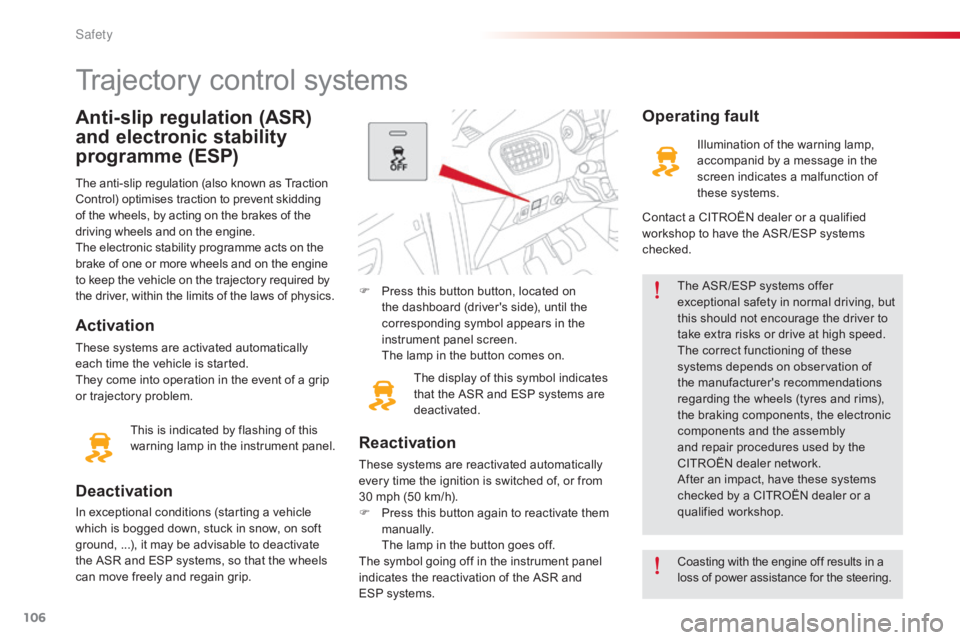
Deactivation
In exceptional conditions (starting a vehicle which is bogged down, stuck in snow, on soft
g
round, ...), it may be advisable to deactivate
t
he ASR and ESP systems, so that the wheels
c
an move freely and regain grip.
Trajectory control systems
Activation
These systems are activated automatically each time the vehicle is started.
They
come into operation in the event of a grip
o
r
t
rajectory
pro
blem. The
display of this symbol indicates
t
hat the ASR and ESP systems are
d
eactivated.
F
P
ress this button button, located on
t
he dashboard (driver's side), until the
c
orresponding symbol appears in the i
nstrument panel screen. T
he lamp in the button comes on.Contact
a CITROËN dealer or a qualified
w
orkshop to have the ASR /ESP systems
c
hecked.
Coasting with the engine off results in a
l
oss of power assistance for the steering.
S