Page 475 of 539

•Avoid using abrasive compounds and power buffing that
may diminish the gloss or thin out the paint finish.
CAUTION!
• Do not use abrasive or strong cleaning materials such
as steel wool or scouring powder that will scratch
metal and painted surfaces.
•
Use of power washers exceeding 1,200 psi (8 274 kPa)
can result in damage or removal of paint and decals.
Special Care
• If you drive on salted or dusty roads or if you drive near
the ocean, hose off the undercarriage at least once a
month.
• It is important that the drain holes in the lower edges of
the doors, rocker panels, and trunk be kept clear and
open.
• If you detect any stone chips or scratches in the paint,
touch them up immediately. The cost of such repairs is
considered the responsibility of the owner. •
If your vehicle is damaged due to a collision or similar
cause that destroys the paint and protective coating,
have your vehicle repaired as soon as possible. The cost
of such repairs is considered the responsibility of the
owner.
• If you carry special cargo such as chemicals, fertilizers,
de-icer salt, etc., be sure that such materials are well
packaged and sealed.
• If a lot of driving is done on gravel roads, consider mud
or stone shields behind each wheel.
• Use MOPAR Touch Up Paint on scratches as soon as
possible. Your authorized dealer has touch up paint to
match the color of your vehicle.
Wheel And Wheel Trim Care
• All wheels and wheel trim, especially aluminum and
chrome plated wheels, should be cleaned regularly with
a mild soap and water to prevent corrosion.
• To remove heavy soil and/or excessive brake dust, use
MOPAR Wheel Cleaner.
7
MAINTAINING YOUR VEHICLE 473
Page 476 of 539

NOTE:If your vehicle is equipped with Dark Vapor or
Black Satin Chrome wheels DO NOT USE wheel cleaners,
abrasives or polishing compounds. They will permanently
damage this finish and such damage is not covered by the
New Vehicle Limited Warranty. USE ONLY MILD SOAP
AND WATER WITH A SOFT CLOTH. Used on a regular
basis this is all that is required to maintain this finish.
CAUTION!
Do not use scouring pads, steel wool, a bristle brush, or
metal polishes. Do not use oven cleaner. These prod-
ucts may damage the wheel’s protective finish. Avoid
automatic car washes that use acidic solutions or harsh
brushes that may damage the wheel’s protective finish.
Only MOPAR Wheel Cleaner or equivalent is recom-
mended.
Stain Repel Fabric Cleaning Procedure — If
Equipped
Stain Repel seats may be cleaned in the following manner:
• Remove as much of the stain as possible by blotting with
a clean, dry towel.
• Blot any remaining stain with a clean, damp towel. •
For tough stains, apply MOPAR Total Clean, or a mild
soap solution to a clean, damp cloth and remove stain.
Use a fresh, damp towel to remove soap residue.
• For grease stains, apply MOPAR Multi-Purpose Cleaner
to a clean, damp cloth and remove stain. Use a fresh,
damp towel to remove soap residue.
• Do not use any harsh solvents or any other form of
protectants on Stain Repel products.
Interior Care
Use MOPAR Total Clean to clean fabric upholstery and
carpeting.
Use MOPAR Total Clean to clean vinyl upholstery.
MOPAR Total Clean is specifically recommended for
leather upholstery.
Your leather upholstery can be best preserved by regular
cleaning with a damp soft cloth. Small particles of dirt can
act as an abrasive and damage the leather upholstery and
should be removed promptly with a damp cloth. Stubborn
soils can be removed easily with a soft cloth and MOPAR
Total Clean. Care should be taken to avoid soaking your
leather upholstery with any liquid. Please do not use
polishes, oils, cleaning fluids, solvents, detergents, or
474 MAINTAINING YOUR VEHICLE
Page 478 of 539

with electric defrosters or windows equipped with radio
antennas. Do not use scrapers or other sharp instrument
that may scratch the elements.
When cleaning the rear view mirror, spray cleaner on the
towel or cloth that you are using. Do not spray cleaner
directly on the mirror.
Cleaning Plastic Instrument Cluster Lenses
The lenses in front of the instruments in this vehicle are
molded in clear plastic. When cleaning the lenses, care
must be taken to avoid scratching the plastic.
1. Clean with a wet soft cloth. A mild soap solution may beused, but do not use high alcohol content or abrasive
cleaners. If soap is used, wipe clean with a clean damp
cloth.
2. Dry with a soft cloth.
Seat Belt Maintenance
Do not bleach, dye or clean the belts with chemical solvents
or abrasive cleaners. This will weaken the fabric. Sun
damage can also weaken the fabric.
If the belts need cleaning, use a mild soap solution or
lukewarm water. Do not remove the belts from the vehicle
to wash them. Dry with a soft cloth. Replace the belts if they appear frayed or worn or if the
buckles do not work properly.
NOTE:
If the belts retract slowly, inspect the upper turning
loop for soiling. If soiling is present, clean with a wet soft
cloth until all residue is removed.
WARNING!
A frayed or torn belt could rip apart in a collision and
leave you with no protection. Inspect the belt system
periodically, checking for cuts, frays, or loose parts.
Damaged parts must be replaced immediately. Do not
disassemble or modify the system. Seat belt assemblies
must be replaced after a collision if they have been
damaged (i.e., bent retractor, torn webbing, etc.).
FUSES
WARNING!
• When replacing a blown fuse, always use an appro-
priate replacement fuse with the same amp rating as
the original fuse. Never replace a fuse with another
fuse of higher amp rating. Never replace a blown
(Continued)
476 MAINTAINING YOUR VEHICLE
Page 480 of 539
CavityCartridge Fuse Blade Fuse Description
F08 –25 Amp Clear Engine Control Module (ECM)/
Fuel Inj.
F09 – –Not Used
F10 –20 Amp Yellow Power Transfer Unit (PTU) – If
Equipped
F11 – –Not Used
F12 –20 Amp Yellow Brake Vacuum Pump – If
Equipped
F13 –10 Amp Red Engine Control Module (ECM)/
VSM (Engine Stop/Start Only)
F14 –10 Amp Red Drivetrain Control Module
(DTCM)/Power Transfer Unit (PTU) – If Equipped/RDM/
Brake System Module (BSM)/
Brake Pedal Switch/EPB (Electric Park Brake)
F15 – –Not Used
F16 –20 Amp Yellow Ignition Coil
F17 – –Not Used
478 MAINTAINING YOUR VEHICLE
Page 494 of 539
5. Disconnect the bulb from the electrical connector andthen connect the replacement bulb.
CAUTION!
Do not touch the new bulb with your fingers. Oil
contamination will severely shorten bulb life. If the
bulb comes in contact with any oily surface, clean the
bulb with rubbing alcohol.
6. Install the bulb and connector assembly into the head- lamp housing and rotate clockwise to lock it in place. 7. Install the headlamp bulb cap in the headlamp housing
and rotate clockwise to lock it in place.
8. Lock headlamp access door in wheel liner.
Front Turn Signal Lamp
1. Open the hood.
NOTE: Removal of the air cleaner filter housing may be
necessary prior to replacing bulbs in the lamp assembly on
the passenger side of the vehicle.
2. Remove the beauty cover, by removing all push pins and lifting beauty cover.
Headlamp Bulb
Beauty Cover
492 MAINTAINING YOUR VEHICLE
Page 497 of 539
Front Fog Lamp
1. Remove the three fasteners from the lower closeout, andpeel down the lower closeout.
2. Reach behind the fog lamp housing to access the bulb.
3. Rotate the front fog lamp socket counterclockwise, and remove the bulb and socket assembly from the front fog
lamp housing. 4. Pull the bulb out of the socket and insert the replace-
ment bulb.
CAUTION!
Do not touch the new bulb with your fingers. Oil
contamination will severely shorten bulb life. If the
bulb comes in contact with any oily surface, clean the
bulb with rubbing alcohol.
5. Install the front fog lamp socket assembly into the into the front fog lamp housing, and rotate the connector
clockwise to lock it in place.
Lower Closeout
Front Fog Lamp Socket
7
MAINTAINING YOUR VEHICLE 495
Page 502 of 539
FLUID CAPACITIES
U.S.Metric
Fuel (Approximate)
2.4L and 3.6L Engines 15.8 Gallons60 Liters
Engine Oil With Filter
2.4 Liter Engine (SAE 0W-20,
API Certified) 5.5 Quarts
5.2 Liters
3.6 Liter Engine (SAE 5W-20,
API Certified) 6 Quarts
5.6 Liters
Cooling System*
2.4 Liter Engine (MOPAR Antifreeze/
Engine Coolant 10 Year/
150,000 Mile Formula) 7.2 Quarts
6.8 Liters
3.6 Liter Engine (MOPAR Antifreeze/
Engine Coolant 10 Year/
150,000 Mile Formula) 8.7 Quarts
8.2 Liters
* Includes heater and coolant reservoir filled to MAX level.
500 MAINTAINING YOUR VEHICLE
Page 503 of 539
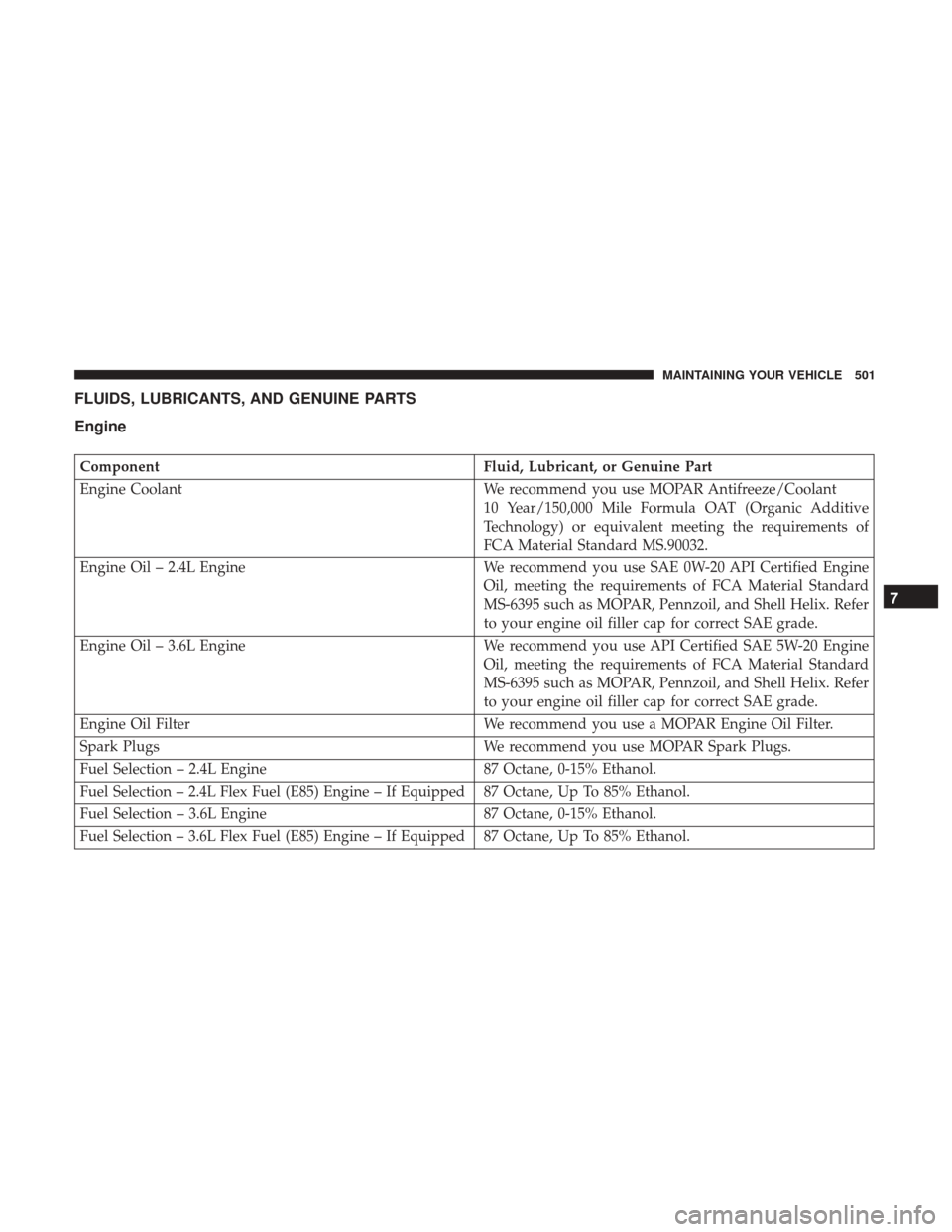
FLUIDS, LUBRICANTS, AND GENUINE PARTS
Engine
ComponentFluid, Lubricant, or Genuine Part
Engine Coolant We recommend you use MOPAR Antifreeze/Coolant
10 Year/150,000 Mile Formula OAT (Organic Additive
Technology) or equivalent meeting the requirements of
FCA Material Standard MS.90032.
Engine Oil – 2.4L Engine We recommend you use SAE 0W-20 API Certified Engine
Oil, meeting the requirements of FCA Material Standard
MS-6395 such as MOPAR, Pennzoil, and Shell Helix. Refer
to your engine oil filler cap for correct SAE grade.
Engine Oil – 3.6L Engine We recommend you use API Certified SAE 5W-20 Engine
Oil, meeting the requirements of FCA Material Standard
MS-6395 such as MOPAR, Pennzoil, and Shell Helix. Refer
to your engine oil filler cap for correct SAE grade.
Engine Oil Filter We recommend you use a MOPAR Engine Oil Filter.
Spark Plugs We recommend you use MOPAR Spark Plugs.
Fuel Selection – 2.4L Engine 87 Octane, 0-15% Ethanol.
Fuel Selection – 2.4L Flex Fuel (E85) Engine – If Equipped 87 Octane, Up To 85% Ethanol.
Fuel Selection – 3.6L Engine 87 Octane, 0-15% Ethanol.
Fuel Selection – 3.6L Flex Fuel (E85) Engine – If Equipped 87 Octane, Up To 85% Ethanol.
7
MAINTAINING YOUR VEHICLE 501