2017 CHEVROLET VOLT check oil
[x] Cancel search: check oilPage 249 of 376

Chevrolet VOLT Owner Manual (GMNA-Localizing-U.S./Canada/Mexico-
9807421) - 2017 - CRC - 11/18/15
248 Vehicle Care
Cooling System (Engine)
1. Engine Cooling Fans (Outof View)
2. Engine Coolant Surge Tank and Pressure Cap
{Warning
The electric fans under the hood
can start up even when the
engine is not running and can
cause injury. Keep hands,
clothing, and tools away from any
underhood electric fan. If the coolant inside the coolant
surge tank is boiling, do not do
anything else until it cools down.
The vehicle should be parked on a
level surface.
The coolant level should be up to
the cold fill line. If it is not, there
might be a leak at the radiator
hoses, heater hoses, radiator, water
pump, or somewhere else in the
cooling system.
{Warning
Heater and radiator hoses, and
other engine parts, can be very
hot. Do not touch them. If you do,
you can be burned.
Do not run the vehicle if there is a
leak. If you run the engine, it
could lose all coolant. That could
cause an engine fire, and you
could be burned. Get any leak
fixed before you drive the vehicle.
If there seems to be no leak, with
the engine on, check to see if the
cooling fans are running. If the
engine is overheating, the fans should be running. If it is not, the
vehicle needs service. Turn off the
vehicle.
Cooling System (High
Voltage Battery)
During vehicle operation and also
during charging, the high voltage
battery cells in the vehicle are kept
within a normal operating
temperature range. If the high
voltage battery cell temperature
rises above the normal operating
temperature range, the battery
cooling system turns on the air
conditioning compressor and cools
the coolant until the correct battery
cell temperature is reached. If the
high voltage battery cell temperature
falls below the normal operating
temperature range, a high voltage
heater, located in the battery, heats
the coolant until the correct battery
cell temperature is reached.
During high voltage battery system
cooling, you may feel temperature
changes at the air vents due to the
extra load on the system.
Page 251 of 376

Chevrolet VOLT Owner Manual (GMNA-Localizing-U.S./Canada/Mexico-
9807421) - 2017 - CRC - 11/18/15
250 Vehicle Care
The coolant needs to be replaced at
the appropriate interval. See
Maintenance Schedule0326.
Checking Coolant
The vehicle must be on a level
surface when checking the coolant
level.
The power electronics and charger
modules coolant reservoir is located
in the engine compartment. See
Engine Compartment
Overview 0242.
1. High Voltage Battery
Coolant Reservoir 2. Power Electronics Coolant
Reservoir
Check to see if coolant is visible in
the power electronics coolant
reservoir (2). If coolant is visible but
the coolant level is below the cold
fill line on the side of the reservoir,
there could be a leak in the cooling
system.
The power electronics cooling
system supports the operation of
sensitive electronics.
The power electronics cooling
system should only be serviced by a
qualified technician.
Engine Coolant
The engine cooling system in the
vehicle is filled with GM Premix
DEX-COOL engine coolant. See
Recommended Fluids and
Lubricants 0334. The coolant
requires changing at certain
intervals. See Maintenance
Schedule 0326. The following explains the cooling
system and how to check and add
coolant when it is low. If there is a
problem with engine overheating,
see
Engine Overheating 0253.
What to Use
{Warning
Adding only plain water or some
other liquid to the cooling system
can be dangerous. Plain water
and other liquids, can boil before
the proper coolant mixture will.
The coolant warning system is set
for the proper coolant mixture.
With plain water or the wrong
mixture, the engine could get too
hot but you would not get the
overheat warning. The engine
could catch fire and you or others
could be burned. Use GM Premix
DEX-COOL coolant.
Page 252 of 376

Chevrolet VOLT Owner Manual (GMNA-Localizing-U.S./Canada/Mexico-
9807421) - 2017 - CRC - 11/18/15
Vehicle Care 251
Use GM Premix DEX-COOL engine
coolant. If using this mixture,
nothing else needs to be added.
This mixture:
.Gives freezing protection down
to−37 °C (−34 °F), outside
temperature.
. Gives boiling protection up to
129 °C (265 °F), engine
temperature.
. Protects against rust and
corrosion.
. Will not damage aluminum parts.
. Helps keep the proper engine
temperature.
Caution
If improper coolant mixture,
inhibitors, or additives are used in
the vehicle cooling system, the
engine could overheat and be
damaged. Too much deionized
water or clean drinkable water
can freeze and crack engine
cooling parts. The repairs would
(Continued)
Caution (Continued)
not be covered by the vehicle
warranty. Use only the proper
mixture of engine coolant for the
cooling system. See
Recommended Fluids and
Lubricants0334.
Never dispose of engine coolant by
putting it in the trash, pouring it on
the ground, or into sewers, streams,
or bodies of water. Have the coolant
changed by an authorized service
center, familiar with legal
requirements regarding used
coolant disposal. This will help
protect the environment and your
health.
Checking Coolant
The vehicle must be on a level
surface when checking the coolant
level.
Check to see if coolant is visible in
the coolant surge tank. If the coolant
inside the coolant surge tank is
boiling, do not do anything else until
it cools down. If coolant is visible but the coolant level is not at or
above the cold fill mark, add GM
Premix DEX-COOL engine coolant
at the coolant surge tank, but be
sure the cooling system is cool
before this is done. See
Engine
Overheating 0253.
The coolant reservoir is on the
passenger side of the engine
compartment. See Engine
Compartment Overview 0242.
The coolant level should be at or
above the cold fill line on the
coolant surge tank. If it is not, there
could be a leak in the cooling
system.
How to Add Coolant to the
Coolant Surge Tank
{Warning
You can be burned if you spill
coolant on hot engine parts.
Coolant contains ethylene glycol
and it will burn if the engine parts
are hot enough. Do not spill
coolant on a hot engine.
Page 320 of 376

Chevrolet VOLT Owner Manual (GMNA-Localizing-U.S./Canada/Mexico-
9807421) - 2017 - CRC - 11/18/15
Vehicle Care 319
Brake System
Visually inspect brake lines and
hoses for proper hook-up, binding,
leaks, cracks, chafing, etc. Inspect
disc brake pads for wear and rotors
for surface condition. Inspect drum
brake linings/shoes for wear or
cracks. Inspect all other brake parts.
Steering, Suspension, and
Chassis Components
Visually inspect steering,
suspension, and chassis
components for damaged, loose,
or missing parts or signs of wear at
least once a year.
Inspect power steering for proper
attachment, connections, binding,
leaks, cracks, chafing, etc.
Visually check constant velocity joint
boots and axle seals for leaks.
Body Component Lubrication
Lubricate all key lock cylinders,
hood hinges, hatch/liftgate hinges,
and the steel fuel door hinge unless
the components are plastic.
Applying silicone grease onweatherstrips with a clean cloth will
make them last longer, seal better,
and not stick or squeak.
Underbody Maintenance
At least twice a year, spring and fall,
use plain water to flush dirt and
debris from the vehicle's underbody.
Your dealer or an underbody car
washing system can do this. If not
removed, rust and corrosion can
develop.
Do not directly power wash the
transfer case and/or front/rear axle
output seals. High pressure water
can overcome the seals and
contaminate the fluid. Contaminated
fluid will decrease the life of the
transfer case and/or axles and
should be replaced.
Sheet Metal Damage
If the vehicle is damaged and
requires sheet metal repair or
replacement, make sure the body
repair shop applies anti-corrosion
material to parts repaired or
replaced to restore corrosion
protection.
Original manufacturer replacement
parts will provide the corrosion
protection while maintaining the
vehicle warranty.
Finish Damage
Quickly repair minor chips and
scratches with touch-up materials
available from your dealer to avoid
corrosion. Larger areas of finish
damage can be corrected in your
dealer's body and paint shop.
Chemical Paint Spotting
Airborne pollutants can fall upon
and attack painted vehicle surfaces
causing blotchy, ring-shaped
discolorations, and small, irregular
dark spots etched into the paint
surface. Refer to
“Finish Care”
previously in this section.
Interior Care
To prevent dirt particle abrasions,
regularly clean the vehicle's interior.
Immediately remove any soils.
Newspapers or dark garments can
transfer color to the vehicle’s
interior.
Page 325 of 376

Chevrolet VOLT Owner Manual (GMNA-Localizing-U.S./Canada/Mexico-
9807421) - 2017 - CRC - 11/18/15
324 Service and Maintenance
Service and
Maintenance
General Information
General Information . . . . . . . . . . 324
Maintenance Schedule
Maintenance Schedule . . . . . . . 326
Special Application Services
Special ApplicationServices . . . . . . . . . . . . . . . . . . . . 331
Additional Maintenance
and Care
Additional Maintenanceand Care . . . . . . . . . . . . . . . . . . . . 331
Recommended Fluids,
Lubricants, and Parts
Recommended Fluids andLubricants . . . . . . . . . . . . . . . . . . . 334
Maintenance Replacement Parts . . . . . . . . . . . . . . . . . . . . . . . . 335
Maintenance Records
Maintenance Records . . . . . . . . 336
General Information
Your vehicle is an important
investment. This section describes
the required maintenance for the
vehicle. Follow this schedule to help
protect against major repair
expenses resulting from neglect or
inadequate maintenance. It may
also help to maintain the value of
the vehicle if it is sold. It is the
responsibility of the owner to have
all required maintenance performed.
Your dealer has trained technicians
who can perform required
maintenance using genuine
replacement parts. They have
up-to-date tools and equipment for
fast and accurate diagnostics. Many
dealers have extended evening and
Saturday hours, courtesy
transportation, and online
scheduling to assist with service
needs. Your dealer recognizes the
importance of providing
competitively priced maintenance
and repair services. With trained
technicians, the dealer is the place
for routine maintenance such as oil
changes and tire rotations and
additional maintenance items like
tires, brakes, batteries, and wiper
blades.
Caution
Damage caused by improper
maintenance can lead to costly
repairs and may not be covered
by the vehicle warranty.
Maintenance intervals, checks,
inspections, recommended fluids,
and lubricants are important to
keep the vehicle in good working
condition.
Page 327 of 376

Chevrolet VOLT Owner Manual (GMNA-Localizing-U.S./Canada/Mexico-
9807421) - 2017 - CRC - 11/18/15
326 Service and Maintenance
Maintenance
Schedule
Owner Checks and Services
At Each Fuel Stop
.Check the engine oil level. See
Engine Oil 0243.
Once a Month
. Check the tire inflation
pressures. See Tire
Pressure 0278.
. Inspect the tires for wear. See
Tire Inspection 0284.
. Check the windshield washer
fluid level. See Washer
Fluid 0253.
. Engine, power electronics, and
high voltage battery pack
coolant level checks. See
Cooling System (Engine) 0248
or Cooling System (High Voltage
Battery) 0248 orCooling
System (Power Electronics and
Charger Modules) 0249.
Engine Oil Change
Every 24 months or when the
CHANGE ENGINE OIL SOON
message displays, change the
engine oil and filter as soon as
possible, within the next 1 000 km/
600 mi. The engine oil and filter
must be changed at least once
every 24 months. After each oil and
filter change, the oil life system must
be reset. See Engine Oil Life
System 0245. More frequent
changes may be required when the
vehicle is exposed to a corrosive
environment, such as areas of high
humidity, along an ocean coast,
and/or areas that apply road salt
during winter.
Your trained dealer technician can
perform this work. If the engine oil
life system is reset accidentally,
service the vehicle within 5 000 km/
3,000 mi since the last service.
Reset the oil life system when the
oil is changed.
Tire Rotation and Required
Services Every 12 000 km/
7,500 mi
Rotate the tires, if recommended for
the vehicle, and perform the
following services. See Tire
Rotation 0284.
. Check engine oil level and oil
life percentage. If needed,
change engine oil and filter, and
reset oil life system. See Engine
Oil 0243 andEngine Oil Life
System 0245.
. Check engine coolant level. See
Engine Coolant 0250.
. Check windshield washer fluid
level. See Washer Fluid 0253.
. Visually inspect windshield wiper
blades for wear, cracking,
or contamination. See Exterior
Care 0314. Replace worn or
damaged wiper blades. See
Wiper Blade
Replacement 0258.
. Check tire inflation pressures.
See Tire Pressure 0278.
Page 329 of 376
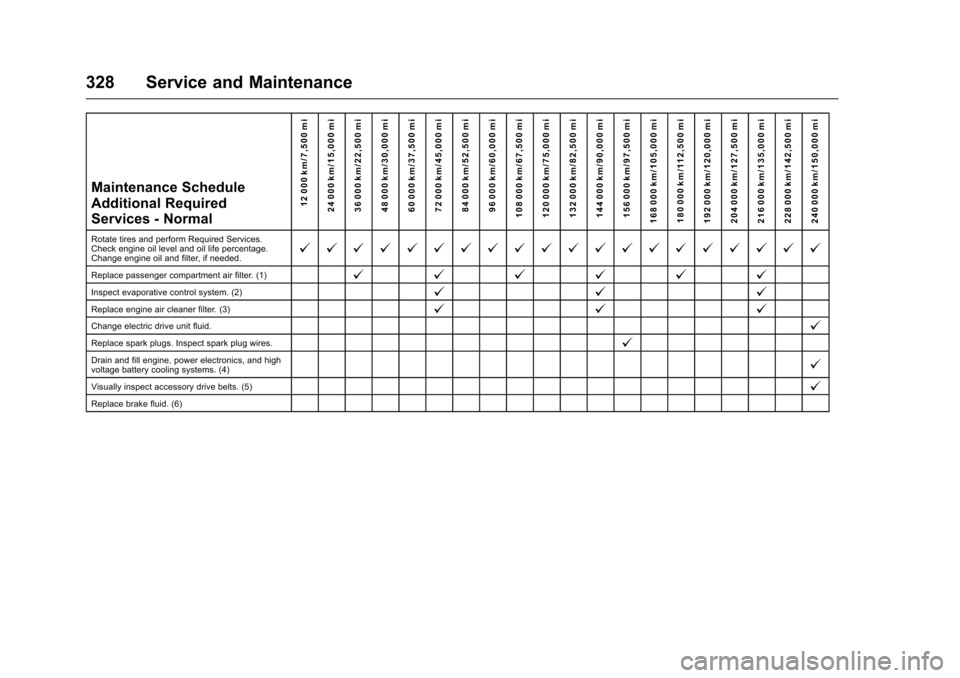
Chevrolet VOLT Owner Manual (GMNA-Localizing-U.S./Canada/Mexico-
9807421) - 2017 - CRC - 11/18/15
328 Service and Maintenance
Maintenance Schedule
Additional Required
Services - Normal12 000 km/7,500 mi
24 000 km/15,000 mi
36 000 km/22,500 mi
48 000 km/30,000 mi
60 000 km/37,500 mi
72 000 km/45,000 mi
84 000 km/52,500 mi
96 000 km/60,000 mi
108 000 km/67,500 mi
120 000 km/75,000 mi
132 000 km/82,500 mi
144 000 km/90,000 mi
156 000 km/97,500 mi
168 000 km/105,000 mi 180 000 km/112,500 mi
192 000 km/120,000 mi
204 000 km/127,500 mi
216 000 km/135,000 mi
228 000 km/142,500 mi
240 000 km/150,000 mi
Rotate tires and perform Required Services.
Check engine oil level and oil life percentage.
Change engine oil and filter, if needed.@ @ @ @ @ @ @ @ @ @ @ @ @ @ @ @ @ @ @ @
Replace passenger compartment air filter. (1)@ @@@@@
Inspect evaporative control system. (2)@ @@
Replace engine air cleaner filter. (3)@@@
Change electric drive unit fluid.@
Replace spark plugs. Inspect spark plug wires.@
Drain and fill engine, power electronics, and high
voltage battery cooling systems. (4)@
Visually inspect accessory drive belts. (5)@
Replace brake fluid. (6)
Page 330 of 376

Chevrolet VOLT Owner Manual (GMNA-Localizing-U.S./Canada/Mexico-
9807421) - 2017 - CRC - 11/18/15
Service and Maintenance 329
Footnotes—Maintenance
Schedule Additional Required
Services - Normal
(1) Or every two years, whichever
comes first. More frequent
passenger compartment air filter
replacement may be needed if
driving in areas with heavy traffic,
poor air quality, high dust levels,
or environmental allergens.
Passenger compartment air filter
replacement may also be needed if
there is reduced airflow, window
fogging, or odors. Your GM dealer
can help determine when to replace
the filter. (2)
Check all fuel and vapor lines
and hoses for proper hook-up,
routing, and condition.
(3) Or every four years, whichever
comes first. If driving in dusty
conditions, inspect the filter at each
oil change or more often as needed.
(4) Or every five years, whichever
comes first. See Cooling System
(Engine) 0248 orCooling System
(High Voltage Battery) 0248 or
Cooling System (Power Electronics
and Charger Modules) 0249. (5)
Or every 10 years, whichever
comes first. Inspect for fraying,
excessive cracking, or damage;
replace, if needed.
(6) Replace brake fluid every five
years. See Brake Fluid 0254.