2017 CHEVROLET SS ignition
[x] Cancel search: ignitionPage 244 of 400

Chevrolet SS Sedan Owner Manual (GMNA-Localizing-U.S.-10122752) -2017 - crc - 8/31/16
Driving and Operating 243
2. Lift up the EPB switchmomentarily.
The red parking brake status lightwill flash and then stay on once theEPB is fully applied. If the redparking brake status light flashescontinuously, then the EPB is onlypartially applied or there is aproblem with the EPB. A DICmessage will display. Release theEPB and try to apply it again. If thelight does not come on, or keepsflashing, have the vehicle serviced.Do not drive the vehicle if the redparking brake status light is flashing.See your dealer. SeeElectricParking Brake Light0103.
If the amber parking brake warninglight is on, lift up on the EPB switchand hold it up. Continue to hold theswitch until the red parking brakestatus light remains on. If the amberparking brake warning light remainson, see your dealer.
If the EPB is applied while thevehicle is moving, the vehicle willdecelerate as long as the switch is
held up. If the switch is held up untilthe vehicle comes to a stop, theEPB will remain applied.
If the EPB fails to apply, the rearwheels should be blocked toprevent vehicle movement.
EPB Release
To r e l e a s e t h e E P B :
1. Place the ignition in the ACC/ACCESSORY or ON/RUNposition.
2. Apply and hold the brakepedal.
3. Push down momentarily on theEPB switch.
The EPB is released when the redparking brake status light is off.
If the amber parking brake warninglight is on, release the EPB bypushing down on the EPB switchand holding it down. Continue tohold the switch until the red parkingbrake status light is off. If either lightstays on after release is attempted,see your dealer.
Caution
Driving with the parking brake on
can overheat the brake system
and cause premature wear or
damage to brake system parts.
Make sure that the parking brake
is fully released and the brake
warning light is off before driving.
Automatic EPB Release
The EPB will automatically release ifthe vehicle is running, placed intogear, and an attempt is made todrive away. Avoid rapid accelerationwhen the EPB is applied, topreserve parking brake lining life.
The EPB can also be used toprevent roll back for vehicles with amanual transmission taking off on ahill. When no roll back is desired, anapplied EPB will allow both feet tobe used for the clutch andaccelerator pedals in preparation forstarting the vehicle moving in theintended direction. In this case,there is no need to push the switchto release the EPB.
Page 248 of 400
Chevrolet SS Sedan Owner Manual (GMNA-Localizing-U.S.-10122752) -2017 - crc - 8/31/16
Driving and Operating 247
Driver Mode Control
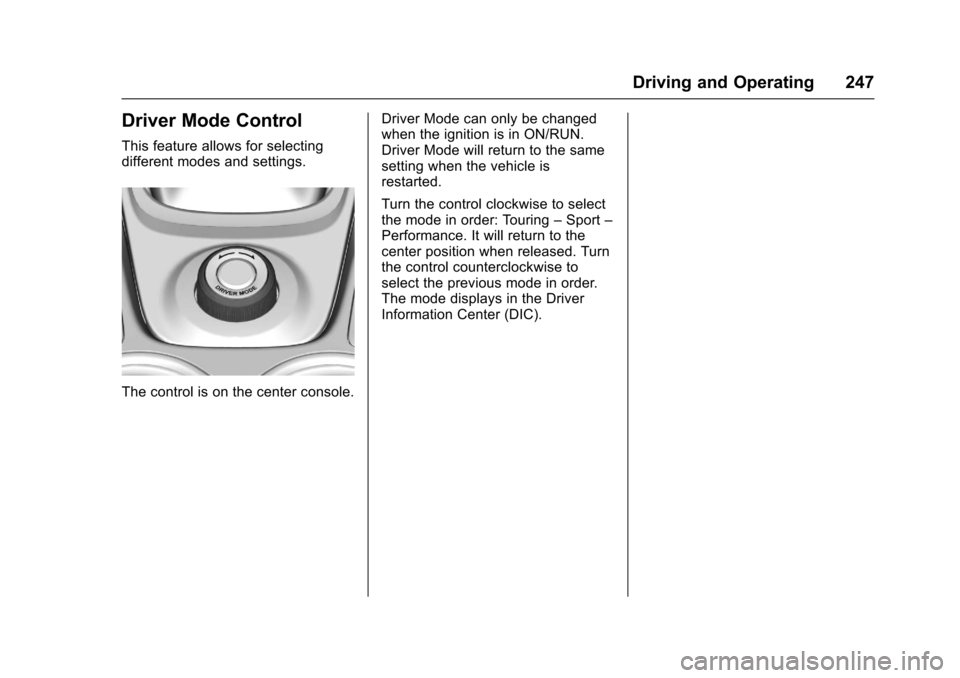
This feature allows for selectingdifferent modes and settings.
The control is on the center console.
Driver Mode can only be changedwhen the ignition is in ON/RUN.Driver Mode will return to the samesetting when the vehicle isrestarted.
Turn the control clockwise to selectthe mode in order: Touring–Sport–Performance. It will return to thecenter position when released. Turnthe control counterclockwise toselect the previous mode in order.The mode displays in the DriverInformation Center (DIC).
Page 283 of 400

Chevrolet SS Sedan Owner Manual (GMNA-Localizing-U.S.-10122752) -2017 - crc - 8/31/16
282 Vehicle Care
Caution
If improper coolant mixture,
inhibitors, or additives are used in
the vehicle cooling system, the
engine could overheat and be
damaged. Too much water in the
mixture can freeze and crack
engine cooling parts. The repairs
would not be covered by the
vehicle warranty. Use only the
proper mixture of engine coolant
for the cooling system. See
Recommended Fluids and
Lubricants0358.
Never dispose of engine coolant byputting it in the trash, pouring it onthe ground, or pouring it intosewers, streams or bodies of water.Have the coolant changed by anauthorized service center, familiarwith legal requirements regardingused coolant disposal. This will helpprotect the environment and yourhealth.
Checking Coolant
The vehicle must be on a levelsurface when checking the coolantlevel.
To c h e c k c o o l a n t :
1. Turn the ignition off.
2. Locate the coolant recoveryreservoir. SeeEngineCompartment Overview0274.
3. Turn the coolant recoveryreservoir dipstick capcounterclockwise and slowlypull out the dipstick. There aremaximum and minimummarkings on the dipstick.
4. When the engine is cold, thecoolant level should be at orabove the minimum mark (1).After the vehicle has beendriven and the engine is atnormal operating temperature,the level should be somewherebetween half full and themaximum mark (2).
5. If the coolant level is correct,replace the coolant recoveryreservoir dipstick cap and turnclockwise to secure.
Page 292 of 400

Chevrolet SS Sedan Owner Manual (GMNA-Localizing-U.S.-10122752) -2017 - crc - 8/31/16
Vehicle Care 291
3. With the engine off, turn theignition on, but do not start theengine. Without applying theregular brake, try to move theshift lever out of P (Park) withnormal effort. If the shift levermoves out of P (Park), contactyour dealer for service.
Park Brake and P (Park)
Mechanism Check
{Warning
When you are doing this check,
the vehicle could begin to move.
Yo u o r o t h e r s c o u l d b e i n j u r e d
and property could be damaged.
Make sure there is room in front
of the vehicle in case it begins to
roll. Be ready to apply the regular
brake at once should the vehicle
begin to move.
Park on a fairly steep hill, with thevehicle facing downhill. Keepingyour foot on the regular brake, setthe parking brake.
.To c h e c k t h e p a r k i n g b r a k e ' sholding ability: With the enginerunning and the transmission inN(Neutral), slowly remove footpressure from the regular brakepedal. Do this until the vehicle isheld by the parking brake only.
.To c h e c k t h e P ( P a r k )mechanism's holding ability:With the engine running, shift toP(Park). Then release theparking brake followed by theregular brake.
Contact your dealer if service isrequired.
Wiper Blade Replacement
Front Wiper Blade
Windshield wiper blades should beinspected for wear or cracking. SeeMaintenance Schedule0349.
Replacement blades come indifferent types and are removed indifferent ways. For the proper typeand size, seeMaintenanceReplacement Parts0359.
To r e p l a c e t h e w i p e r b l a d eassembly:
1. Pull the windshield wiperassembly away from thewindshield.
2. Squeeze the tabs on each sideof the wiper blade assemblyand slide the assembly off theend of the wiper arm.
Page 298 of 400

Chevrolet SS Sedan Owner Manual (GMNA-Localizing-U.S.-10122752) -2017 - crc - 8/31/16
Vehicle Care 297
FusesUsage
F22 Rear wiper
F23 Sunroof
F24 Front wipers
F25 Automatic occupantsensing/Instrumentcluster/Ignition
F26 Left rear bus electricalcenter/Ignition
F27–
F28 Ignition/Injectors even–V8
F29 Engine control module–V8/Ignition odd–V6/Emissions
F30–
F31–
F32–
F33 Ignition/Instrumentpanel body
F34 Fuel system controlmodule/Ignition
F35–
FusesUsage
F36 Electric steeringcolumn lock
F37 Emission 2/Ignitioneven–V6
F38 Engine control module–V6/Injectors/Ignitionodd–V8
F39 Intercooler pump
F40–
F41 Transmission controlmodule/Electric powersteering
F42 Starter motor
F43–
F44 Left HID headlamp
F45 Right HID headlamp
F46 High-beamheadlamps
F47 Horn
F48 Engine cooling fan
F49 Automatic headlampleveling
FusesUsage
F50 Transmission controlmodule ignition
F51 Engine control moduleignition
F52 Brake vacuum pump
F53 A/C clutch
F54 Vaporizer controlmodule
RelaysUsage
R1 Driving lamps
R2 Headlamp washer
R3 Rear washer pump
R4 Front washer pump
R5 Rear defogger
R6 Front wiper control
R7 Wiper speed
R8 Engine control module
R9–
R10 Intercooler pump
R11–
Page 300 of 400

Chevrolet SS Sedan Owner Manual (GMNA-Localizing-U.S.-10122752) -2017 - crc - 8/31/16
Vehicle Care 299
The vehicle may not be equippedwith all of the fuses, relays andfeatures shown.
Fuses Usage
F1 Body control module 1
Fuses Usage
F2 Diagnostic linkconnector
F3 LPG shut-off solenoid
F4 Body control module 2
F5 Ignition switch
F6 Electric steeringcontrol lock
CB7–
F8–
F9–
F10–
F11 Shunt 1
F12 Airbag/Automaticoccupant sensing
F13 Instrument cluster
F14 HVAC control module
F15 Rain sensor
F16 Body control module 3
F17 LPG shut-off solenoid
F18–
Page 303 of 400

Chevrolet SS Sedan Owner Manual (GMNA-Localizing-U.S.-10122752) -2017 - crc - 8/31/16
302 Vehicle Care
FusesUsage
F17 Exhaust valve
F18 OnStar
F19 Mirror/Window module
F20 Canister vent solenoid
F21 Passive entry passivestart/Battery 1
F22 Memory seat module
F23 Amplifier
F24 Passenger sidewindows
F25 Electric parking brake
F26 Tailgate module
F27 Camera/Ignition
F28 Front vent seat/Ignition
F29 Trailer module/Ignition
F30 Automatic parkingassist/Side blind zonealert
F31 Engine control module
F32 Auxiliary gauges
FusesUsage
F33 Retained accessorypower
F34 Battery voltagesensing
F35 Tailgate motor
F36 Rear accessory poweroutlet
F37 Interior accessorypower outlet
F38 Cigar lighter
F39–
F40 Trailer module
RelaysUsage
R1 Trunk release
R2 Accessory
R3–
R4 Run
R5–
R6 Retained accessorypower
R7 Logistics
RelaysUsage
R8–
R9–
R10 Exhaust valve
R11–
Relays R1, R2, R3, and R5 are PCBmounted relays.
Page 313 of 400

Chevrolet SS Sedan Owner Manual (GMNA-Localizing-U.S.-10122752) -2017 - crc - 8/31/16
312 Vehicle Care
of reasons, including the installationof replacement or alternate tires orwheels on the vehicle that preventthe TPMS from functioning properly.Always check the TPMS malfunctiontelltale after replacing one or moretires or wheels on your vehicle toensure that the replacement oralternate tires and wheels allow theTPMS to continue to functionproperly.
SeeTire Pressure MonitorOperation0312.
SeeRadio Frequency Statement0374.
Tire Pressure Monitor
Operation
This vehicle may have a TirePressure Monitor System (TPMS).The TPMS is designed to warn thedriver when a low tire pressurecondition exists. TPMS sensors aremounted onto each tire and wheelassembly, including the spare tireand wheel assembly. The TPMSsensors monitor the air pressure in
the tires and transmit the tirepressure readings to a receiverlocated in the vehicle.
When a low tire pressure conditionis detected, the TPMS illuminatesthe low tire pressure warning lightlocated on the instrument cluster.If the warning light comes on, stopas soon as possible and inflate thetires to the recommended pressureshown on the Tire and LoadingInformation label. SeeVehicle LoadLimits0226.
AmessagetocheckthepressureinaspecifictiremaydisplayintheDriver Information Center (DIC). Thelow tire pressure warning light andthe DIC warning message,if equipped, come on at eachignition cycle until the tires areinflated to the correct inflationpressure. Using the DIC, it may bepossible to view the tire pressure
levels. For additional informationand details about the DIC operationand displays, seeDriver InformationCenter (DIC)0108.
The low tire pressure warning lightmay come on in cool weather whenthe vehicle is first started, and thenturn off as the vehicle is driven. Thiscould be an early indicator that theair pressure is getting low andneeds to be inflated to the properpressure.
ATire and Loading Information labelshows the size of the originalequipment tires and the correctinflation pressure for the tires whenthey are cold. SeeVehicle LoadLimits0226,foranexampleoftheTire and Loading Information labeland its location. Also seeTirePressure0309.
The TPMS can warn about a lowtire pressure condition, but it doesnot replace normal tiremaintenance. SeeTire Inspection0315,Tire Rotation0315,andTires0303.