2017 BMW X3 fuel cap
[x] Cancel search: fuel capPage 198 of 265

RefuelingVehicle features and options
This chapter describes all standard, country-
specific and optional features offered with the
series. It also describes features that are not
necessarily available in your car, e. g., due to
the selected options or country versions. This
also applies to safety-related functions and
systems. The respectively applicable country
provisions must be observed when using the
respective features and systems.
Information Observe the fuel recommendation, refer to
page 200, prior to refueling.
ATTENTION
With a range of less than 30 miles/50 km
it is possible that the engine will no longer have
sufficient fuel. Engine functions are not en‐
sured anymore. There is a risk of damage to
property. Refuel promptly.◀
Diesel engines
The filler neck is designed for refueling at die‐
sel fuel pumps.Fuel cap
Opening1.Briefly press the rear edge of the fuel filler
flap.2.Turn the fuel cap counterclockwise.3.Place the fuel cap in the bracket attached
to the fuel filler flap.
Closing
1.Fit the cap and turn it clockwise until you
clearly hear a click.Seite 198MobilityRefueling198
Online Edition for Part no. 01 40 2 969 976 - II/16
Page 199 of 265
2.Close the fuel filler flap.
WARNING
The retaining strap of the fuel cap may
be jammed and crushed during closing. In this
case, the lid cannot be correctly closed and
fuel vapors or fuel can escape. There is a risk
of injury or a risk of property damage. Pay at‐
tention that the retaining strap is not jammed
or crushed when closing the lid.◀
Observe the following when
refueling
ATTENTION
Fuels are toxic and aggressive. Overfill‐
ing of the fuel tank can damage the fuel sys‐
tem. On contact with Painted surfaces may be
damaged by contact with fuel. Escaping fuel
can harm the environment. There is a risk of
damage to property. Avoid overfilling.◀
The fuel tank is full when the filler nozzle clicks
off the first time.
Observe safety regulations posted at the gas
station.
Seite 199RefuelingMobility199
Online Edition for Part no. 01 40 2 969 976 - II/16
Page 203 of 265

InformationWARNING
Small amounts of ammonia fumes can
escape when opening the diesel exhaust fluid
container. Ammonia fumes have a pungent
odor and irritate skin, mucous membranes, and
eyes. There is a risk of injury. Do not inhale es‐
caping ammonia fumes. Avoid the contact of
articles of clothing, skin or eyes with diesel ex‐
haust fluid. Do not swallow any diesel exhaust
fluid. Keep children away from diesel exhaust
fluids.◀
WARNING
Operating materials, e.g., oils, greases,
coolants, fuels, can contain harmful ingredi‐
ents. There is a risk of injury or danger to life.
Observe the instructions on the containers.
Avoid the contact of articles of clothing, skin or
eyes with operating materials. Do not refill op‐
erating materials into different bottles. Store
operating materials out of reach of children.◀
ATTENTION
The diesel exhaust fluid ingredients are
very aggressive. There is a risk of damage to
property. Avoid contact of diesel exhaust fluid
with surfaces of the vehicle.◀
Suitable diesel exhaust fluid▷Recommended: BMW Diesel Exhaust
Fluid. With this bottle and its special
adapter, diesel exhaust fluid can be replen‐
ished simply and safely.▷Alternatively recommended: NOx Diesel
exhaust fluid AUS 32.
Diesel exhaust fluid can be purchased at a
dealer’s service center or another qualified
service center or repair shop.
Refill quantity
When the Reserve display starts, add at least
3 bottles of diesel exhaust fluid.
This corresponds to approx. 1.5 US gal/6 liters.
Tank for diesel exhaust fluid
The fuel cap for diesel exhaust fluids is next to
the fuel cap for the fuel tank.
Adding the diesel exhaust fluid Add the diesel exhaust fluid when the ignition
is switched on.
1.Open the fuel filler flap, refer to page 198.2.Turn the fuel cap of the diesel exhaust fluid
tank counterclockwise and remove.3.Place the bottle on it and turn it as far as it
will go, see arrow.4.Press the bottle down, see arrow.
The vehicle tank will be filled.Seite 203FuelMobility203
Online Edition for Part no. 01 40 2 969 976 - II/16
Page 204 of 265
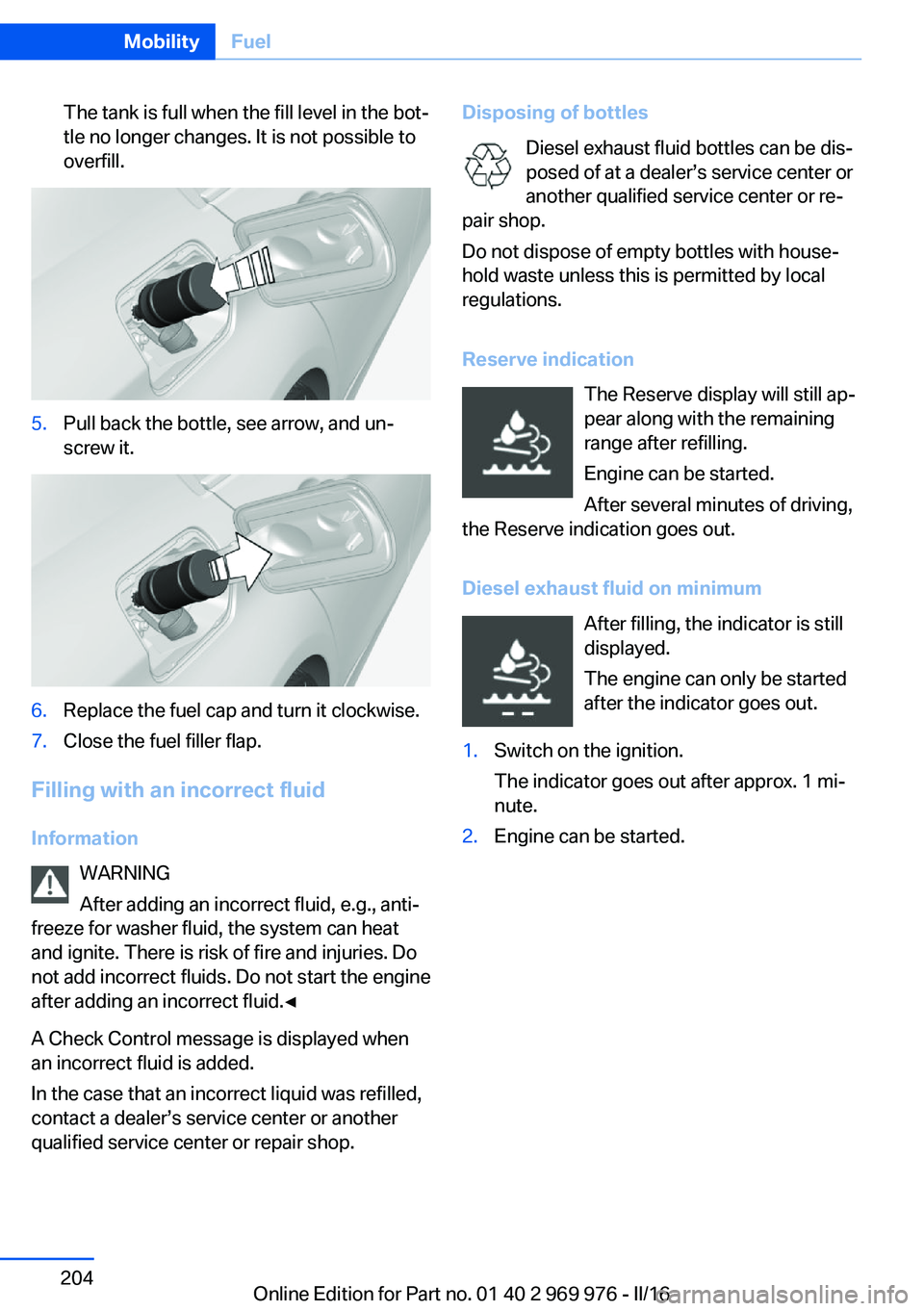
The tank is full when the fill level in the bot‐
tle no longer changes. It is not possible to
overfill.5.Pull back the bottle, see arrow, and un‐
screw it.6.Replace the fuel cap and turn it clockwise.7.Close the fuel filler flap.
Filling with an incorrect fluid
Information WARNING
After adding an incorrect fluid, e.g., anti‐
freeze for washer fluid, the system can heat
and ignite. There is risk of fire and injuries. Do
not add incorrect fluids. Do not start the engine
after adding an incorrect fluid.◀
A Check Control message is displayed when
an incorrect fluid is added.
In the case that an incorrect liquid was refilled,
contact a dealer’s service center or another
qualified service center or repair shop.
Disposing of bottles
Diesel exhaust fluid bottles can be dis‐
posed of at a dealer’s service center or another qualified service center or re‐
pair shop.
Do not dispose of empty bottles with house‐
hold waste unless this is permitted by local
regulations.
Reserve indication The Reserve display will still ap‐
pear along with the remaining
range after refilling.
Engine can be started.
After several minutes of driving,
the Reserve indication goes out.
Diesel exhaust fluid on minimum After filling, the indicator is still
displayed.
The engine can only be started
after the indicator goes out.1.Switch on the ignition.
The indicator goes out after approx. 1 mi‐
nute.2.Engine can be started.Seite 204MobilityFuel204
Online Edition for Part no. 01 40 2 969 976 - II/16
Page 252 of 265

X3 xDrive28dApproved gross vehicle weightlbs/kg5,160/2,341Loadlbs/kg910/413Approved front axle loadlbs/kg2,460/1,116Approved rear axle loadlbs/kg2,830/1,284Approved roof load capacitylbs/kg220/100Cargo area capacitycu ft27.6-63.3Canada: cargo area capacitycu ft/l19.4-56.4/550-1,600
Capacities
US gal/litersNotesFuel tank, approx.17.7/67.0Fuel quality, refer to
page 200Seite 252ReferenceTechnical data252
Online Edition for Part no. 01 40 2 969 976 - II/16
Page 257 of 265

Emergency Request 237
Emergency service, see Roadside Assistance 238
Emergency start function, en‐ gine start 35
Emergency unlocking, trans‐ mission lock 82
Energy Control 90
Energy recovery 90
Engine, automatic Start/Stop function 70
Engine, automatic switch- off 70
Engine compartment 217
Engine compartment, work‐ ing in 217
Engine coolant 224
Engine idling when driving, coasting 193
Engine oil 220
Engine oil, adding 221
Engine oil additives 222
Engine oil change 223
Engine oil filler neck 221
Engine oil temperature 89
Engine oil types, alterna‐ tive 222
Engine oil types, suitable 222
Engine start during malfunc‐ tion 35
Engine start, jump-start‐ ing 238
Engine start, see Starting the engine 69
Engine stop 69
Engine temperature 89
Entering a car wash 243
Equipment, interior 167
Error displays, see Check Control 85
ESP Electronic Stability Pro‐ gram, see DSC 129
Exchanging wheels/tires 210
Exhaust system 183
Exterior mirror, automatic dimming feature 62 Exterior mirrors 61
External start 238
External temperature dis‐ play 89
External temperature warn‐ ing 89
Eyes for securing cargo 187
F
Failure message, see Check Control 85
False alarm, see Unintentional alarm 48
Fan, see Air flow 161, 164
Filler neck for engine oil 221
Fine wood, care 245
First-aid kit 238
Flat tire, changing wheels 235
Flat Tire Monitor FTM 112
Flat tire, repairing 212
Flat tire, Tire Pressure Moni‐ tor TPM 108
Flat tire, warning lamp 110, 113
Flooding 184
Floor carpet, care 246
Floor mats, care 246
Fold-away position, wiper 78
Folding back rear seat backr‐ ests 173
Foot brake 184
Front airbags 105
Front-end collision warning with braking function 118
Front-end collision warning with City Braking func‐
tion 115
Front fog lamps, , LED, bulb replacement 232
Front fog lights 103
Front fog lights, front, bulb re‐ placement 232
Front lights 230 Front-seat passenger airbags,
automatic deactivation 107
Front-seat passenger airbags, indicator lamp 107
FTM Flat Tire Monitor 112
Fuel 200
Fuel cap 198
Fuel consumption, see Aver‐ age fuel consumption 94
Fuel filler flap 198
Fuel gauge 89
Fuel quality 200
Fuel recommendation 200
Fuel, tank capacity 252
Fuse 236
G
Garage door opener, see Uni‐ versal Integrated Remote
Control 167
Gasoline 200
Gear change, Steptronic transmission 80
Gear shift indicator 91
General driving notes 183
Glare shield 169
Glass sunroof, refer to Panor‐ amic glass sunroof 50
Glove compartment 176
GPS location, vehicle posi‐ tion 97
Gross vehicle weight, ap‐ proved 251
H
Halogen headlights, bulb re‐ placement 230
Handbrake, see Parking brake 72
Hand-held transmitter, alter‐ nating code 168
Hazard warning flashers 237
HDC Hill Descent Con‐ trol 131 Seite 257Everything from A to ZReference257
Online Edition for Part no. 01 40 2 969 976 - II/16
Page 261 of 265

Roller sunblinds 50
RON recommended fuel grade 201
Roofliner 17
Roof load capacity 251
Roof-mounted luggage rack 188
RSC Run Flat System Com‐ ponent, see Run-flat
tires 212
Rubber components, care 245
Run-flat tires 212
S Safe braking 184
Safety belt reminder for driv‐ er's seat and front passen‐
ger seat 58
Safety belts 56
Safety belts, care 246
Safety switch, windows 50
Safety systems, airbags 105
Saving fuel 189
Screen, see Control Dis‐ play 18
Screwdriver, see Onboard ve‐ hicle tool kit 228
Sealant 212
Seat and mirror memory 60
Seat belts, see Safety belts 56
Seat heating, front 56
Seat heating, rear 56
Seating position for chil‐ dren 64
Seats 53
Securing cargo 187
Selection list in instrument cluster 93
Selector lever, Steptronic transmission 80
Sensors, care 246
Service and warranty 8 Service requirements, Condi‐
tion Based Service
CBS 226
Service requirements, dis‐ play 91
Service, Roadside Assis‐ tance 238
Services, ConnectedDrive
Servotronic 133
SET button, see Active Cruise Control, ACC 136
SET button, see Cruise con‐ trol 142
Settings, locking/unlock‐ ing 46
Settings on Control Dis‐ play 96
Settings, storing for seat, mir‐ ror 60
Shift paddles on the steering wheel 81
Side airbags 105
Side View 152
Signaling, horn 14
Signals when unlocking 46
Sitting safely 53
Size 250
Ski and snowboard bag 175
Slide/tilt glass roof 50
Snow chains 215
Socket 170
Socket, OBD Onboard Diag‐ nostics 227
Soot particulate filter 183
SOS button 237
Spare fuse 236
Speed, average 94
Speed limit detection 92
Speed limit detection, com‐ puter 95
Speed limits, display 92
Speed warning 96
Split screen 24
SPORT+ - program, Dynamic Driving Control 133 Sport displays, torque dis‐
play, performance dis‐
play 95
SPORT program, Dynamic Driving Control 134
Sport program, transmis‐ sion 80
Sport steering, variable 132
Stability control systems 129
Standard equipment 7
Start/stop, automatic func‐ tion 70
Start/Stop button 68
Start function during malfunc‐ tion 35
Starting the engine 69
Status control display, tires 109
Status of Owner's Manual 7
Steering assistance 133
Steering wheel, adjusting 62
Steering wheel heating 63
Steptronic Sport transmis‐ sion, see Steptronic trans‐
mission 79
Steptronic transmission 79
Stopping the engine 69
Storage compartments 176
Storage compartments, loca‐ tions 176
Storage, tires 212
Storing the vehicle 246
Suitable engine oil types 222
Summer tires, tread 210
Sun visor 169
Supplementary text mes‐ sages 88
Surround View 147
Switch for Dynamic Driv‐ ing 133
Switch-on times, parked-car ventilation 166
Switch, see Cockpit 14
Symbols 6
Symbols in the status field 23 Seite 261Everything from A to ZReference261
Online Edition for Part no. 01 40 2 969 976 - II/16