2017 AUDI TT ROADSTER air condition
[x] Cancel search: air conditionPage 203 of 314
co
co
.... N
" N .... 0
" "' c:o
that are large, heavy, or bulky) on the doors;
never attach then to the doors or the wind
shield; never place them over or near or at
tach them to the area marked ,.AIRBAG" on
the steering wheel, instrument panel or the
seat backrests; never place them between
these areas and you or any other person in
the vehicle.
- Never attach objects to the windshield
above the passenger front airbag, such as
accessory GPS navigation units or music
players. Such objects could cause serious in
jury in a collision, especially when the air bags inflate.
&_ WARNING
A person on the front passenger seat, especially infants and small children, will receive
serious injuries and can even be killed by be
ing too close to the airbag when it inflates.
- Although the Advanced Airbag System in
your vehicle is designed to turn off the front
passenger airbag if an infant or a small child
is on the front passenger seat, nobody can
absolutely guarantee that deployment un
der these special conditions is impossible in
all conceivable situations that may happen
during the useful life of your vehicle.
- The Advanced Airbag System can deploy in
accordance with the "low risk" option under
the U.S. Federal Standard if a child that is
heavier than the typical one-year old child is
on the front passenger seat and the other
conditions for airbag deployment are met.
- For its own safety, a child should always ride
properly restrained for its age and si ze.
Advanced front airbag system
Your vehicle is equipped with a front Advanced
Airbag System in compliance with United States
Federal Motor Vehicle Safety Standard (FMVSS)
208, as well as Canada Motor Vehicle Safety
Standard (CMVSS) 208 as applicable at the time
your vehicle was manufactured.
T he front Advanced Airbag System supplements
the safety belts to provide additional protection
Airbag system
for the driver's and front passenger's heads and
upper bodies in frontal crashes. The airbags in
flate only in frontal impacts when the vehicle de
celeration is high enough.
The front Advanced Airbag System for the front
seat occupants is not a substitute for your safety
belts. Rather, it is part of the overall occupant re
straint system in your vehicle . Always remember
that the airbag system can only help to protect
you, if you are sitting upright, wearing your safe
ty belt and wearing it properly. This is why you
and your passengers must always be properly re
strained, not just because the law requires you to
be.
The Advanced Airbag System in your vehicle has
been certified to meet the "low risk" require
ments for 3 and 6 year-old children on the pas
senger side and very small adults on the driver
side. The low risk deployment criteria are intend
ed to help reduce the risk of injury through inter
action with the front airbag that can occur, for
example, by being too close to the steering wheel
and instrument panel when the airbag inflates.
In addition, the system has been certified to
comply with the "suppression" requirements of
the Safety Standard, to turn off the front airbag
for infants 12 months old and younger who are res trained on the front passenger seat in child re
straints that are listed in the Standard
¢ page 220, Child restraints and Advanced front
airbag system.
"Suppression" requires the front airbag on the
passenger side to be turned off if:
- a child up to about one year of age is restrained
on the front passenger seat in one of the rear
facing or forward-facing infant restraints listed in Federal Motor Vehicle Safety Standard 208
with which the Advanced Airbag System in your
vehicle was certified . For a listing of the child
restraints that were used to certify your vehi
cle's compliance with the US Safety Standard
¢page 220,
-When a person is detected on the front passen
ger seat that has an electrical capacitance that
is more than the total electrical capacitance of
a child that is about 1 year old restrained in one .,.
201
Page 204 of 314
Airbag syste m
of the rear -facing or forward-facing infant re
straints (listed in Federal Motor Vehicle Safety
Standard 208 with wh ich the Advanced Airbag
System in your vehicle was certified), the front a irbag on the passenger side may or may not
deploy .
The
P A SSENGER AIR BAG OFF ~ ; light comes on
when the e lectron ic control un it detects a total
electrical capacitance on the front passenger seat
that requires the front airbag to be turned off. If
the
PASSEN GER AIR BA G OFF ~; light does not
come on, the front airbag on the passenger side has not been turned off by the control u nit and
can dep loy if t he con trol unit senses an impact
that meets the conditions stored in its memory.
If the tota l electrical capac itance registered on
the front passenger seat is more than that of a
typical 1 year-old, but less than the weigh t of a
small adu lt, the front airbag on the passenger
side may deploy (the
PASSENGER AIR BAG OFF
~ ; light does not come on) .
For example, the airbag may deploy if :
- a small child that is heavier than a typical 1
year-old ch ild is on the front passe nger seat
( r ega rdless of whether the child is in one of the
c hi ld se ats l isted
q page 220),
- a chi ld who has outg rown child restraints is on
t h e front passenger seat.
If the front passenger airbag is turned off, the
PASSENGER A IR BA G OFF ~; light in the head
line r will come on and stay on .
If the front passenger airbag deploys, the Feder
al Standard requires the airbag to meet the "low
risk " deployment criteria to help reduce the risk
of injury through inte raction with the airbag.
" Low risk" deployment occu rs in those c rashes
t hat take place at lower dece le rations as defined
in the electronic control unit
q page 207.
Alway s rememb er: Please be su re to read the im
portant information in the sections that follow
and be sure to heed all of t he WARNINGS.
A WARNING
To red uce the risk of inj ury when an airbag in
flates, a lways wear safety belts properly .
202
-If you are un restrained, leaning forward, sit
ting sideways or out of position in any way,
your risk of injury is much higher.
- You will a lso receive ser ious injuries and
could even be killed if you are up against the
airbag or too close to it when it inflates -
even with an Advanced Airbag
¢ page 196 .
A WARNING
A child in a rearward -facing child seat instal
led on the front passenger seat will be seri
ously injured and can be killed if the front air
bag inflates -even with an Advanced Airbag
Sys tem.
- Although the Advanced Airbag System in
your veh icle is designed to turn off the front
airbag when a rearwar d-fac ing ch ild re
straint has been installed on the front pas
senger seat, nobody can absolutely guaran
tee that dep loyment is impossib le in all con
ceivab le situat ions that may happen du ring
the useful life of your vehicle.
- The inflating airbag will h it the ch ild seat or
infant carrier with great force and will
smash the child seat and child against the
backrest, center armrest, doo r, or roof .
- If you must install a rearward facing child
safety seat on the front passenger seat be
cause of excep tional circumstances and the
PASSENGER AIR BAG OFF~; light does not
come on and stay on have the a irbag system
inspected by your Audi dealer.
A WARNING
I f, in ex ceptional ci rcums tances, you must in
stall a forward-facing child restraint on the
front passenger's seat:
- Always make sure the forward-facing sea t
has been des igned and certified by its man
ufacturer for use on a front seat with a pas
senger front and side airbag.
- Never put the forward -facing child restraint
up against or very nea r the instrument pan
el.
- Always move the front passenger seat to
the highest position in the up and down ad
justment range and move it back to the
Page 220 of 314
Child safety
Child safety
Important information
Introduction
The physical principles of what happens when
your vehicle is in a crash apply also to children
¢ page 190, What happens to occupants not
wearing safety belts?.
But unlike adults and
teenagers, their muscles and bones are not fully
developed. In many respects children are at
greater risk of serious injury in crashes than
adults.
Because children's bodies are not fully devel
oped, they require restraint systems especially
designed for their size, weight, and body struc
ture. Many countries and all states of the United
States and provinces of Canada have laws requir
ing the use of approved child restraint systems
for infants and small children .
In a frontal crash at a speed of 20-35 mph (30-56 km/h) the forces acting on a 13 lbs (6 kg)
infant will be more than 20 times the weight of
the child . This means the weight of the child
would suddenly be more than 260 lbs (120 kg).
Under these conditions, only an appropriate child
restraint properly used can reduce the risk of se
rious injury. Child restraints, like adult safety
belts, must be used properly to be effective.
Used improperly, they can increase the risk of se
rious injury in an accident.
If you must install a child restraint on the front
passenger seat in exceptional circumstances, be
sure to read and heed the important information
and warnings ¢
page 197. Infants and other chil
dren who are properly restrained in an appropri
ate child restraint that is for their size and age
can benefit from the protection that supplemen
tal side airbags provide in some kinds of crashes .
For more information please see information
provided by the:
- National Highway Traffic Safety Administration
(NHTSA), currently at: http:/ /www .safe
rcar.gov (for the USA)
- Transport Canada Information Centre, current
ly at: http:/ /www.tc.gc .ca (for Canada)
218
Consult the child safety seat manufacturer's in
structions in order to be sure the seat is right for
your child's size
r:!;> page 221 , Important safety
instructions for using child safety seats.
Please
be sure to read and heed all of the important in
formation and WARNINGS about child safety,
Advanced Airbags, and the installation of child
restraints in this chapter .
There is a lot you need to know about the Ad
vanced Airbags in your vehicle and how they work
when infants and children in child restraints are
on the front passenger seat. Because of the large
amount of important information, we cannot re
peat it all here . We urge you to read the detailed
information in this owner's manual about airbags
and the Advanced Airbag System in your vehicle
and the very important information about trans porting children on the front passenger seat.
Please be sure to heed the WARNINGS -they are
extremely important for your safety and the safe
ty of your passengers, especially infants and
small children .
A WARNING
All vehicle occupants and especially children
must be restrained properly whenever riding
in a vehicle . An unrestrained or improperly re
strained child could be injured by striking the
interior or by being ejected from the vehicle
during a sudden maneuver or impact. An un
restrained or improperly restrained child is al
so at greater risk of injury or death through
contact with an inflating airbag.
A WARNING
Children on the front seat of any car even with
Advanced Airbags can be seriously injured or
even killed when an airbag inflates . A child in
a rearward-facing child safety seat installed
on the front passenger seat will be seriously
injured and can be killed if the front airbag in
flates.
- The inflating airbag will hit the child safety
seat or infant carrier with great force and
will smash the child safety seat and child
against the backrest, center armrest, or
door.
Page 262 of 314
Wheels
NEVER EXCEED XXX KG OR XXX
LBS"on your vehicle's placard
(tire inflation pressure label)
¢ page 256, fig. 190.
2. Determine the combined
weight of the driver and pas
sengers that will be riding in
your vehicle.
3. Subtract the combined weight
of the driver and passengers
from
"XXX" kilograms or "XXX"
pounds shown on the sticker
¢ page 256, fig. 190.
4. The resulting figure equals the
available amount of cargo and
luggage load capacity. For ex
ample, if the "XXX" amount
equals 1400 lbs and there will
be five 150 lbs passengers in
your vehicle, the amount of available cargo and luggage
load capacity is 650 lbs
(1400-750 (5
X 150) = 650 lbs)
5. Determine the combined weight of luggage and cargo
being loaded on the vehicle.
That weight may not safely ex ceed the available cargo and luggage load capacity calculat
ed in Step 4.
6. If your vehicle will be towing a
trailer, load from your trailer
will be transferred to your ve-
260
hicle. Consult this manual to
determine how this reduces
the available cargo and lug
gage load capacity of your vehi
cle.
~check the tire sidewall
(¢ page 246, fig. 188) to deter
mine the designated load rating
for a specific tire.
· Wheel bolts and rims
Wheel bolts
Wheel bolts must be clean and loosen/tighten
easily.
Rims
Rims with a bolted rim ring* or with bolted wheel
covers* consist of multiple pieces. These compo
nents were bolted together using special bolts
and a special procedure. You must not repair or
disassemble them
¢ &..
_8. WARNING
-Wheel bolts that are tightened or repaired in
correctly can become loose and result in loss
of vehicle control, which increases the risk of
an accident. For the correct tightening specifi
cation, see
¢ page 2 78, Finishing.
- Always keep the wheel bolts and the threads in the wheel hub clean and free of
grease .
- Only use wheel bolts that fit the rim.
- Always have damaged rims repaired by an
authorized Audi dealer or authorized Audi
Service Facility . Never repair or disassemble
rims yourself, because this increases the risk
of an accident .
Winter tires
Winter tires significantly improve the vehicle's
handling when driving in winter conditions . Be-
cause of their construction (width, compound, ..,.
Page 263 of 314
co
co
.... N
" N .... 0
" "' c:o
tread pattern), summer tires provide less trac
tion on ice and snow.
.,. Use w inter tires on a ll fo ur wheels.
.,. Only use win ter tires that are approved for your
vehicle.
... Please note that the maximum permitted
speed may be lower with winter tires ¢,& .An
authori zed Aud i dealer or authori zed Aud i Serv
ice F acility can inform you about the maximum
permitted speed for your tires .
... Check the tire pressure after installing wheels
¢ page 256 .
The effectiveness of winter tires is reduced great
ly when the tread is worn down to a depth of
0 .1 57 in (4 mm) . The character istics of winter
tires a lso decrease great ly as t he tire ages, re
ga rdless of the remaining tread .
_& WARNING
-Never dr ive faste r than the maxim um per
mitted speed for your t ires. This cou ld cause
the tires to heat up too much . Th is increases
the risk of an acc ident because it can cause
the tire to burst.
- Always adapt yo ur dr iv ing to the road and
traff ic conditions. Drive carefully and red uce
your speed on icy or slippery roads. Even
winter tires can lose traction on black ice.
@ For the sake of the environment
Reinstall summer ti res at the approp riate
time, because they provide better handling
when roads are free of snow and ice. Summer
tires cause less road noise, t ire wear and fuel
consumption .
You can also use all season tires instead of
w inter t ires . Please note that in some coun
tries where w inter t ires are required, only
w inter t ires with the
& symbol may be per
m itted.
Snow chains
-
Snow chains no t only imp rove the d riving in w in
ter road conditions, but also the braking.
Wh eel s
... On ly install snow chains on the front wheels.
This applies a lso to vehicles with a ll wheel
drive* .
... Check and correct the seating of the snow
chains after driving a few feet, if necessary. Fol
low the instructions from the manufacturer .
... Note the maximum speed of 30 mph (SO km/
h) . Note the local regulations .
Use of snow cha ins is only permitted with certa in
rim/tire comb inat ions due to technical reasons .
Check with an authorized Audi dealer or author
i zed Audi Se rvice Facility to see if you may use
snow c hains.
You must remove the snow chains on roads with out snow . O therwise, you co uld impair driving
ability a nd damage the t ires .
_& WARNING
Using incor rect snow chains or install ing snow
ch ains incor rec tly c an resu lt in loss of veh icle
control, which increases the risk of an acci
dent .
(D Note
-Snow chains can damage the rims/wheel
cove rs* if the chains come into direct con
tact with them . Remove the wheel covers*
first. Use coated snow chains.
- Us ing snow chains that add more tha n O.S3
in (13,S mm) of height can severe ly damage
the whee l housings and other vehicle com
ponents.
(D Tips
When using snow chains, it may be usefu l to
switch on sport mode ¢
page 89.
Low aspect ratio tires
Your Audi is factory-equ ipped with low aspect ra
tio t ires . These tires have been thoroughly tested
and been selected spec ifically for your model for
the ir superb performance, road feel and handl ing
under a var iety of dr iv ing condit ions. Ask your au-
thorized Audi dea le r fo r more details . .,.
261
Page 264 of 314
Wheels
The low aspect ratio of these tires is i ndicated by
a numeral of
55 or less in the tire's si ze designa
tion. The numera l rep resents the rat io o f the
tire's sidewall he ight in relat ion to its tread width
expressed in percentage . Conventional tires have
a height/w idt h rat io of 60 o r more.
The performance of low -aspect-ratio tire s is par ·
ticularly sensitive to improper inflation pres
sure.
It i s therefore important that low aspect
ratio tires ar e inflat ed to the specifi ed pr essure
and that the inflation pre ssure is regularly
checked and maintained . Tire pre ssure s should
be checked at le ast once a month and always
before a long trip¢
page 256.
What you can do to avoid tire and rim
damage
Low aspect rat io tires can be damaged more easi
ly by impact wi th potholes, cu rbs, g ullies or
ridges on the road, pa rt ic ul arly if the tire is un
derinflated .
I n order to minim ize t he oc currence of impac t
d a mage to the t ires of your ve hicle, we recom
mend that you ob5erve the following precau
tions:
- Always mai nta in recommended inf lation pres
s ur es . Che ck your tire p ress ure every 2,000
miles (3, 000 km) and ad d air if necessary .
- Drive caref ully on roads with potho les, deep
gull ies or r idges . The im pact from d riving
th rough or ove r su ch obs tacles can damage
your tires. Impact with a curb may also cause
damage to your tires.
-A fter any impact, immediately inspect your
ti res or have them inspected by the nearest au
thori zed Audi dea ler. Replace a damaged tire as
soon as possib le.
- Inspect yo ur tires every 2,000 miles (3,000 km)
for damage and wear. Damage is not always easy to see. Damage can lead to loss of air and
underinflation, which cou ld eventually cause
ti re failure . If you believe that a tire may have
been damaged, re place the t ire as soon as pos
s ible.
- T hese tires may wear more qu ick ly than othe rs .
- Please a lso remember t hat, w hile these tires
deliver responsive handling, they may r ide less
262
comforta bly and make more noise than o ther
choices .
Reduced performance in winter/cold season
condition s
All tires are des igned for certain purposes . The
l ow aspect ratio , ultra h igh performance tires
o rigina lly installed on your vehicle are intended
for maximum d ry and wet road perfo rmance and
handling. They a re not suitable for co ld, snowy or
i cy weather conditions . If you drive under those
c ircumstances, you should equip you r vehicle
with all-season o r winter tires, which offer better
t ra ct ion unde r th ose condi tio ns. We suggest yo u
u se the recommen ded snow or a ll-season tires
spe cified for your vehicle, o r th e ir equiv alent.
Refer to¢
pag e 260 for more detailed informa
t ion regard ing winter tires.
Uniform tire quality grading
- Tr ea d wea r
- Tr actio n AA ABC
- T empe ratu re ABC
Quality grades can be found where applicable on
the tire side wall between tread shoulder and
max imum section width
¢ page 246, fig . 188.
For example : Tread wear 200 , Traction AA , Tem
perature
A .
All passenge r ca r tir es must conform to Federal
Safety Req uirements in a ddition to these grades.
Tread wear
The tread wear grade is a compa rative rating
based on the wea r ra te o f the tire w hen tested
u nder con trolled cond itions on a specified gov
ernment test course .
Fo r example, a tire g raded 150 wou ld wea r one
a n d one half (1 1/2) times as well o n the govern
ment cou rse as a t ire graded 100.
The re lative pe rformance of tires depends upon
t h e ac tual cond itions of the ir use, however, and
m ay dep art significan tly from the no rm due to
variations in driv ing habi ts, service pract ices and
diffe rences in road characteristics and climate. ..,.
Page 271 of 314
co
co
.... N
" N .... 0
" "' c:o
Care and cleaning
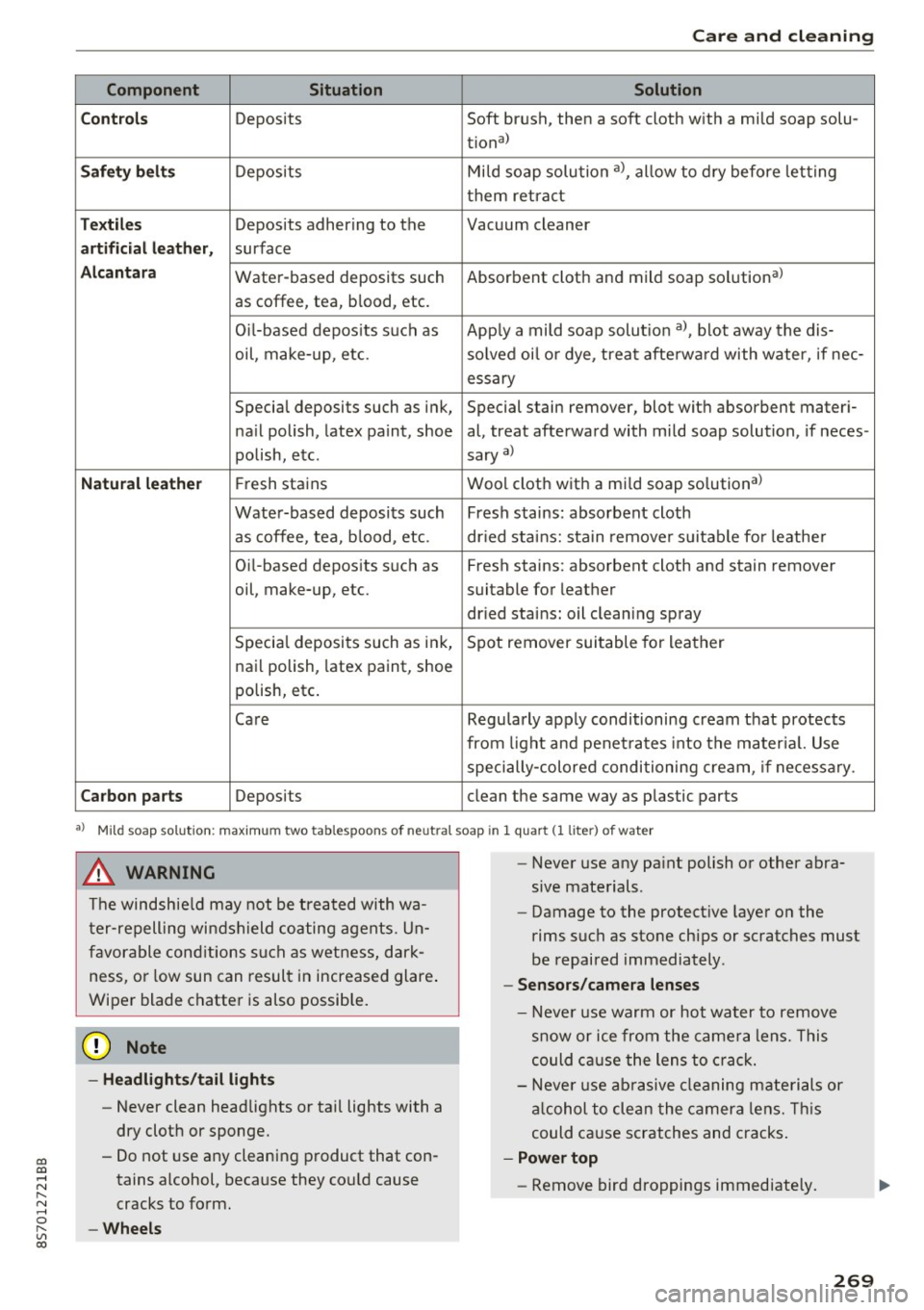
Component Situation Solution
C ont rols
Deposits Soft brush, then a soft cloth with a mild soap solu-
tiona)
Saf ety be lts Deposits Mi
ld soap solution a), allow to dry before letting
them retra ct
T ex til es Deposits adhering to the Vacuum cleaner
artificial l eather, surface
Alcantar a Water-based deposits such Absorbent cloth and mild soap solutiona)
as coffee, tea, blood, etc.
O il-based depos its s uch as App ly a mild soap solut ion a), blot away the dis-
oil, make-up, etc. solved oi l o r dye, treat afterwa rd with water, if nee-
essary
Special deposits such as ink, Special stain remover, blot with absorbent materi-
na il polish, latex paint, shoe al, treat afterward with mild soap solution, if neces-
polish, etc. sary
a)
Natu ral lea the r Fresh stains Wool cloth with a mi
ld soap solutiona >
Water-based deposits such Fresh stains: absorbent cloth
as coffee, tea, b lood, etc. dr ied stains: sta in remove r su itable for leathe r
Oi l-based deposits such as Fresh stains: absorbent cloth and stain remover
oil, make-up, etc. suitable for leather
dr ied stains: oil cleaning spray
Specia l deposits such as ink, Spot remover suitable for leather
nai l polish, latex paint, shoe
polish, etc.
Care Regularly apply conditioning cream that protects
from light and penet ra tes into the mater ial. Use
specially-colored conditioning cream, if necessa ry.
Carbon parts Deposits clean the same way as plastic parts
•> Mild soap solution: maximum two tablespoons of neutral soap in 1 quart (1 liter ) of water
A WARNING
The windshie ld may not be treated with wa
t er-repelling windshield coating agents. Un
favorable cond itions such as wetness, dark
ness, or low sun can result in increased glare .
Wiper blade chatter is also possib le.
{U) Note
- Headligh ts /t ail li ghts
- Never clean headlights or tai l lights with a
dry cloth or sponge.
- Do not use any cleaning product that con
tains alcohol, because they cou ld cause
cracks to form.
-Whe els
-
- Never use any pa int polish or other abra
sive materials.
- Damage to the protect ive layer on the
rims such as stone chips or scratches must
be repaired immediately.
- Sensors /cam era lenses
- Neve r use warm or hot water to remove
s n ow or ice from the came ra lens. This
could ca use the lens to crack.
- Neve r use ab rasive cleaning materials or
a lcohol to clean the camera lens. Th is
could cause scratches and cracks .
-Power top
- Remove bird droppings immediately.
269
Page 295 of 314
co
co
.... N
" N .... 0
" "' c:o
Consumer information
Warranty coverages
Y our Audi is co vered b y the foll owing war ran
tie s:
- New Vehicle Limited Warranty
- Limited Warranty Against Corrosion Perfora-
tion
- Emissions Control System Warranty
- Emissions Performance Warranty
- California Emissions Control Warranty (USA
vehicles only)
- California Emissions Performance Warranty
(USA vehicles only)
Detailed information regard ing your warranties
can be found in yo ur
W arranty & M ainten ance
bookl et.
Operating your vehicle
outside the U.S.A. or
Canada
Government reg ulations in the Un ited States and
Canada require that automobiles meet specific
emission regulations and safety standards.
Therefore, vehicles built for the U .S.A. and Cana
da differ from vehicles sold in other countries.
I f you p lan to take your vehicle outside the conti
nenta l limits of the United States or Canada,
there is the poss ibility that:
- u nleaded fue ls for vehicles with cata lytic con
verter may not be available;
- fuel may have a considerably lower octane rat
i ng. Imprope r fuel may ca use engine damage;
- service may be inadequate due to lack of p roper
service facilities, tools or testing eq uipment;
- r eplacement parts may not be readily ava ilable.
- Navigation systems for veh icles built for the
U .S .A . and Canada will not necessa rily work in
E urope, and may not wo rk in other countries
outside No rth Ame rica.
Con sumer inf ormation
(D Note
Audi cannot be respons ible for mechanical
damage that could resu lt from inadequate
fuel, service or parts ava ilability.
Audi Service Repair
Manuals and Literature
Audi Official Factory Service Manuals and L itera
ture are published as soon as poss ible after mod
el introduction. Service ma nuals and literature
are avai lab le to order from the Audi Tec hni cal Lit
erature Ordering Center at:
www .audi .t e chlit eratur e.com
Maintenance
General
Your vehicle has been designed to he lp keep
maintenance requirements to a min imum. How
ever, a certain amount of regular maintenance is
still necessary to assure your veh icle's safety,
economy and reliab ility . For detailed vehicle
maintenance consult your Wa rranty
& Mainte
nance book let .
Und er diff icult op erating condition s, for exam
ple at extremely low outside temperatures, in
very dusty regions, etc., some se rvice work
sho uld be pe rformed between the intervals speci
fied. This app lies part icu larly to:
- oil changes, and
- cleaning or replacing the a ir filter .
@ For the sake of the environment
By regularly maintaining your vehicle, you
help make sure that emiss ion standards are
maintained, thus min imizing adverse effects
on the enviro nment.
' Important considerations for you and your
vehicle
T he increas ing use of electronics, soph istica ted
f uel injection and emission control systems, and
the genera lly increasing technica l comp lexity of
today's automobiles, have steadily reduced the ""'
293