2017 AUDI TT COUPE ignition
[x] Cancel search: ignitionPage 224 of 322

Child safety
A WARNING
Children on the front seat of any car even with
Advanced Airbags can be seriously injured or
even killed when an airbag inflates. A child in
a rearward-facing child safety seat installed
on the front passenger seat will be seriously
injured and can be killed if the front airbag in
flates.
- The inflating airbag will hit the child safety
seat or infant carrier with great force and
will smash the child safety seat and child
against the backrest, center armrest, or
door.
- Always install rear-facing child safety seats
on the rear seat.
-If you must install a rearward facing child
safety seat on the front passenger seat in
exceptional circumstances and the
PASSEN
GER AIR BAG OFF~;
light does not come
on and stay on, immediately install the rear
facing child safety seat in a rear seating po
sition and have the airbag system inspected
immediately by your Audi dealer.
A WARNING
- Forward-facing child seats installed on the
front passenger seat may interfere with the deployment of the airbag and cause serious
personal injury to the child.
- If exceptional circumstances require the use
of a forward-facing child restraint on the
front passenger's seat, the child's safety and well-being require the following special
precautions to be taken:
- Always make sure that the forward-facing
seat has been designed and certified by its
manufacturer for use on a front passenger
seat with a front and side airbag.
-Always carefully follow the manufacturer's
instructions provided with the child seat
or infant carrier.
- Never install a child restraint without a
properly attached top tether strap if the
child restraint manufacturer's instructions
require the top tether strap to be used.
222
-Never put the forward-facing child re
straint up against or very near the instru
ment panel.
- Always move the front passenger seat to
the highest position in the up and down
adjustment range and move it back to the
rearmost position in the seat's fore and
aft adjustment range, as far away from
the airbag as possible, before installing
the forward-facing child restraint.
-Always make sure that the safety belt up
per anchorage is behind the child restraint
and not next to or in front of the child re
straint so that the safety belt will be prop
erly positioned.
- Always make sure that nothing prevents
the front passenger's seat from being
moved to the rearmost position in its fore
and aft adjustment range.
- Never place objects on the seat (such as a
laptop, CD player, electronic games de
vice, power inverter or seat heater for
child seats). These may influence the elec
trical capacitance measured by the capaci
tive passenger detection system and can
also fly around in an accident and cause
serious personal injury.
- Never place or use any electrical device
(such as a laptop, CD player, electronic
games device, power inverter or seat heat
er for child seats) on the front passenger
seat if the device is connected to the 12-
volt socket or the cigarette lighter socket.
-If a seat heater has been retrofitted or
otherwise added to the front passenger
seat, never install any child restraint sys
tem on this seat.
- Make sure that there are no wet objects
(such as a wet towel) and no water or oth
er liquids on the front passenger seat
cushion.
- Always make sure that the
PASSENGER
AIR BAG OFF~;
light comes on and stays
on all the time whenever the ignition is
switched on.
- If the PASSENGER AIR BAG OFF,;; light
does not come on and stay on, immediate- ly install the forward-facing child seat in a
~
Page 228 of 322

Child safety
-The inflating airbag will hit the child safety
seat or infant carrier with great force and
will smash the child safety seat and child
against the backrest, center armrest, door
or roof .
- Always install rear-facing child safety seats
or infant carriers on the rear seat .
- Make sure there is enough space in front of
the child in the child seat . If necessary, ad
just the angle and position of the seat in front of the child seat.
- Forward -facing child safety seats installed
on the front passenger's seat can interfere
with the airbag when it inflates and cause serious injury to the child . Always install for
ward-facing child safety seats on the rear
seat.
- If exceptional circumstances require the use
of a forward-facing child restraint on the
front passenger's seat, the child's safety and well-being require that the following
special precautions be taken:
- Make sure the forward-facing seat has
been designed and certified by its manu
facturer for use on a front seat with a pas senger front and side airbag .
- Always carefully follow the manufacturer's
instructions provided with the child safety
seat or carrier .
- Always move the front passenger seat into
the rearmost position of the passenger
seat's fore and aft adjustment range, and
as far away from the airbag as possible be
fore installing the child restraint.
- Always make sure that nothing prevents
the front passenger's seat from being
moved to the rearmost position in its fore
and aft adjustment range .
- Always make sure that the backrest is in
the upright position .
- Never place or use any electrical device
(such as a laptop, CD player, electronic
games device, power inverter or seat heat
er for child seats) on the front passenger
seat if the device is connected to the 12-
volt socket or the cigarette lighter socket.
- If a seat heater has been retrofitted or
otherwise added to the front passenger
226
seat, never install any child restraint sys
tem on this seat.
- Make sure that there are no wet objects
(such as a wet towel) and no water or oth
er liquids on the front passenger seat
cushion.
- Never place objects on the seat (such as a
laptop, CD player, electronic games de
vice, power inverter or seat heater for
child seats) . These may influence the elec
trical capacitance measured by the capaci
tive passenger detection system and can
also fly around in an accident and cause
serious personal injury.
- Always buckle the child safety seat firmly in
place even if a child is not sitting in it. A
loose child safety seat can fly around during
a sudden stop or in a collision .
-Always read and heed all WARNINGS when
ever using a child restrained in a vehicle is
being used
c::!;> page 189, Safety belts,
c::!;> page 197, Airbag system and
c::!;> page 221, Child safety .
A WARNING
To reduce the risk of serious injury, make sure
that the
PASSENGER AIR BAG OFF '-i; light
comes on and stays on whenever a child re
straint is installed on the front passenger seat
and the ignition is switched on.
-Take the child restraint off the front passen
ger seat and install it properly at one of the
rear seat positions if the
PASSENGER AIR
BAG OFF
'-i; light does not stay on .
- Have the airbag system inspected by your
authorized Audi dealer immediately.
Page 232 of 322
Child safety
-If a seat heater has been retrof itted or oth
erwise added to the front passenger seat,
never install any child restraint system on
this seat .
- Make sure that there are no wet objects
(such as a wet towe l) and no water or other
liquids on the front passenger seat cushion .
- Never place objects on the seat (such as a
laptop, CD player, electronic games device,
power inverter or seat heater for child
seats) . These may influence the e lectr ica l
capacitan ce measured by the capacitive pas
senger detection system and can also fly
around in an acc ident and ca use serio us pe r
sonal injury .
- Make s ure tha t the
PASSENGER AIR BAG
OFF ~;
light comes on and stays on a ll the
time whenever the ignition is switched on.
- If the PASSENGER AIR BAG OFF 1i; light
does not come on and stay on, immediate ly
insta ll the forward-facing child seat at a
seating position on the rear seat and have
the a irbag system inspected by your author
ized Audi dealer.
- Take the ch ild restraint off the front passen
ger seat and install it properly at one of the
rear seat positions if the
PASSEN GER AIR
BAG OFF ~;
light does not stay on whenever
the ignition is switched on .
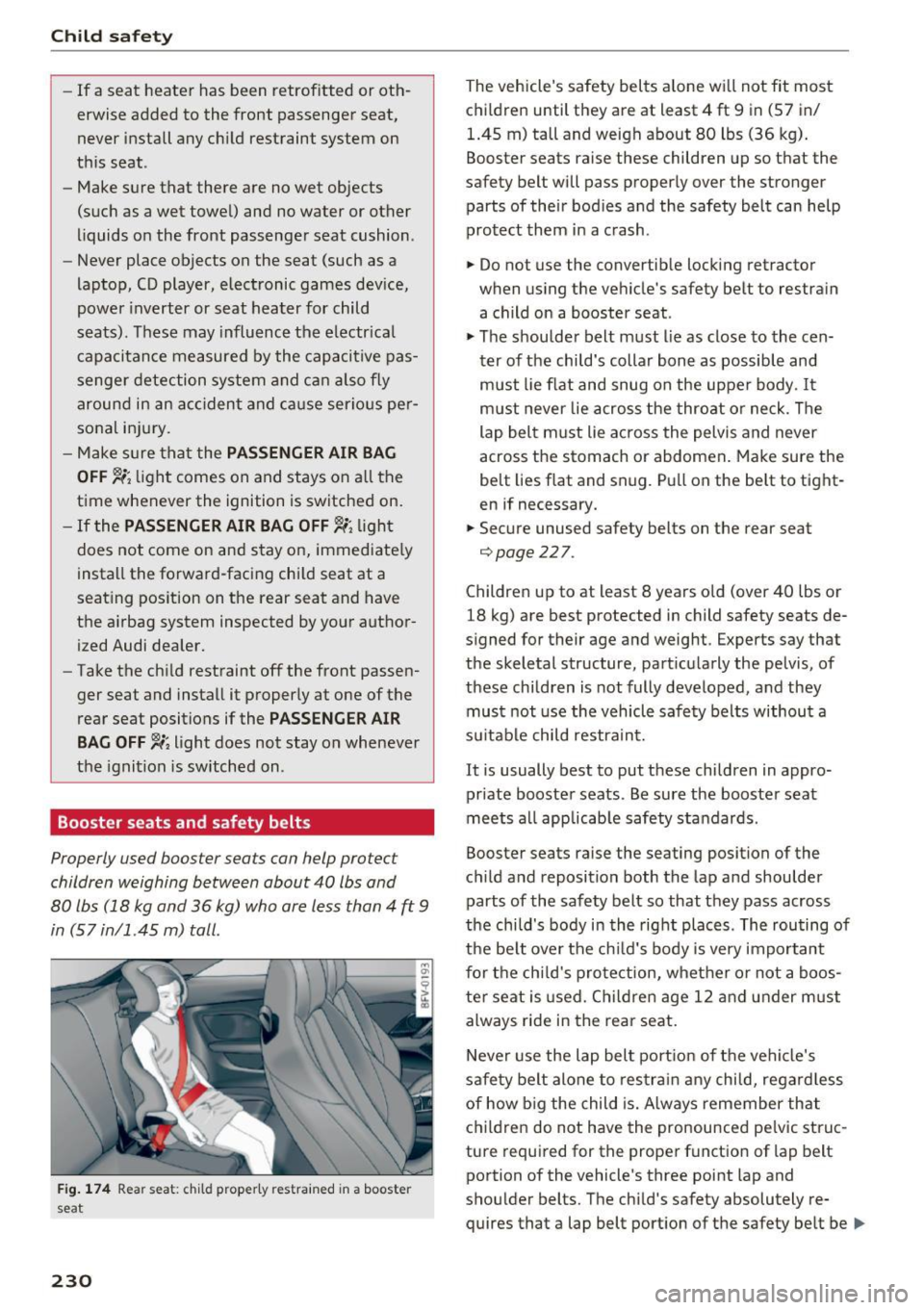
Booster seats and safety belts
Properly used booster sea ts can help protect
children weighing between about 40 lbs and
80 lbs (18 kg and 36 kg) who are less than 4 ft 9
in (57 in/1 .45 m) tall.
F ig . 17 4 Rea r seat: chi ld p roper ly restra ined in a booster
seat
230
The vehicle's safety belts alone wi ll not fit most
children until they are at least 4
ft 9 in (57 in/
1.45 m) tall and weigh about 80 lbs (36 kg) .
Booster seats raise these children up so that the
safety be lt will pass properly over the stronger
parts of their bodies and the safety belt can help
protect them in a crash.
.. Do not use the convertib le locking retractor
when us ing the ve hicle's safety belt to restra in
a child on a booster seat .
.., The shoulder belt must lie as close to the cen
ter of the child's collar bon e as possib le and
must l ie flat and snug on the uppe r body.
It
must never lie across the throat or neck. The
lap belt must lie ac ross the pelvis and never
across t he stomach or abdomen . Make sure the
belt lies flat and snug. Pu ll on the belt to tight
en if necessary.
.. Secure unused safety belts on the rear seat
¢page 227.
Children up to at least 8 years o ld (over 40 lbs or
18 kg) are best protected in child safety seats de
s igned for their age and weight. Experts say that
the skeletal structure, part icu larly the pelvis, of
these children is not fully developed, and they must not use the vehicle safety belts without a
su itab le child restra int.
It is usually best to put these children in appro
pr iate booster seats . Be sure the booster seat
meets a ll applicab le safety standards .
Booster seats raise the seating position of the
c hi ld and reposition both the lap and shoulder
parts of the safety belt so that they pass across
the chi ld's body in the right places . The rou ting of
the be lt over the ch ild's body is very important
fo r the child's protection, whet he r or not a boos
ter seat is used. C hildren age 12 and under m ust
a lways ride in the rear seat.
Never use the lap belt port ion of the vehicle's
safety belt alone to restra in any child, regard less
of how b ig the child is. A lways remember that
c hi ldre n do not have the pronounced pe lvic struc
ture requ ired for the proper function of lap belt
portion of the vehicle 's three point lap and
shou lder belts. The chi ld's safety absolutely re
quires that a lap belt port ion of the safety belt be ...,
Page 233 of 322

co
co
.... N
" N .... 0
0
Vl c:o
fastened snugly and as low as possible around
the pelvis. Never let the lap belt portion of the
safety belt pass over the child's stomach or abdo
men .
I n a crash, a irbags must inflate within a blink of
an eye and with considerable force. In order to do its job, the airbag needs room to inflate so that it
will be there to protect the occupant as the occu
pant moves forward into the a irbag.
A vehicle occupant who is out of position and too
close to the airbag gets in the way of an inflating
airbag. When an occupant is too close, he or she
will be struck v iolently and will receive ser ious or
possibly even fatal injury .
In order for the airbag to offer protection, it is important that all vehicle occupants, especially
any children, who must be in the front seat be
cause of exceptional circumstances, be properly restrained and as far away from the airbag as
possible . By keep ing room between the child's
body and the front of the passenger compart
ment, the airbag can inflate comp letely and pro
vide supp lemental prote ct ion in certain frontal
collisions .
A WARNING
Not using a booster seat, us ing the booster
seat improperly, incorrectly insta lling a boos
ter seat or using the vehicle safety belt im properly increases the risk of serious personal
injury and death in a collision or other emer
gency situat ion. To help reduce the risk of se
r ious personal inju ry and/or death:
- The shoulder belt must lie as close to the
center of the child 's collar bone as possible
and must lie flat and snug on the uppe r
body .
It must neve r lie across the th roat or
neck. The lap belt must lie across the pelv is
and never across the stomach or abdomen.
Make sure that the belt lies flat and snug .
Pull on the belt to tighten if necessary.
- Failure to proper ly route safety belts over a
child's body will cause severe injuries in an
acc ident or other emergency situation
9 page 189 .
Ch ild safety
- The rear side of the ch ild safety seat should
be positioned as close as possible to the
backrest on the veh icle seat.
- Ch ildren on the front seat of any car, even
with Advanced Airbags, can be seriously in
jured or even k illed when an airbag inflates.
- Never let a chi ld stand or kneel on any seat,
for example the front seat.
- Never let a chi ld r ide in the cargo area of
your veh icle.
- Always remember that a chi ld leaning for
ward, sitt ing sideways or o ut of pos ition in
any way du ring an accident can be struck by
a dep loying airbag. Th is w ill resu lt in serious
pe rsonal injury or death.
- If you must install a booster seat on the
front passenger seat because of exceptiona l
circumstances the
PASSENGER AIR BAG
OFF ~;
light must come on and stay on,
wheneve r the ignit ion is swit ched on.
- If the PASSENGER AIR BAG OFF~; light
does not come on and stay on, perform the
checks desc ribed
9 page 209, Monitoring
the Advanced Airbag System.
- T ake the child restra int off the front passen
ge r seat and install it prope rly a t one of the
rear sea t positions i f the
PASSENGER AIR
BAG OFF~;
light does not stay on whenever
the ignition is switched on .
- Always read and heed all WARNINGS when
ever using a child restrained in a vehicle is
being used
¢ page 189, Safety belts,
¢ page 197 , Airbag system and
¢ page 221, Important information.
Booster seats on the rear seat
Children who are about 7 years and older, who
weigh more than 55 lbs (25 kg) and are not tal ler
than 4 ft 9 in (57 in/1.45 m) are best protected
whe n properly restrained on t he rear seat.
Due to limited rear seat head clearance children
4
ft 3 in (51 in/1.30 m) and taller must not use
booster seats o n the rea r seat of your Audi TT
Co upe . The rea r seat of you r Audi TT Coupe has
been specially des igned to pe rm it children who
are between 4 ft 3 in (51 in/1.30 m) and 4
ft 9 in
(57 in/1.45 m) tall (abo ut 7 to 12 years o ld) to ..,.
231
Page 235 of 322

co
co
.... N
" N .... 0
0
Vl c:o
-Always buckle the child safety seat firmly in
place even if a child is not sitting in it. A
loose child safety seat can fly around during
a sudden stop or in a collision.
- Always make sure that the rear seat back
rest is securely latched whenever the rear
safety belt is being used to secure a child re
straint .
- If the backrest is not securely latched, the
child and the child restraint will be thrown
forward together w ith the backrest and will
st rike parts of the vehicle interior. The ch ild
can be se riously inj ured or killed.
- Never install rear-facing chi ld safety seats
o r infant carriers on the front passenger
seat. A child will be serious ly inju red and
can be killed when the passenger airbag in
flates .
- The inflating a irbag will hit the child safety
seat or infant carrier with great force and
will smash the chi ld safety seat and chi ld
against the backrest, center armrest, door
or roof.
- Always install rear-facing child s;:ifety seats
or infant carriers on the rear seat.
- Forward-facing ch ild safety seats or infant
carriers installed on the front passenger's
seat may interfere with the deployment of
the a irbag and cause serious injury to the
child .
- It is safer to install a forward-fac ing ch ild
safety seat on the rear seat.
-Always read and heed all WARNINGS when ever using a child restrained in a veh icle is
being used
¢ page 221. Spec ial precaut ions
apply when installing a child safety seat on
the front passenger seat
¢ page 198, Child
restraints on the front seat -some impor
tant things to know .
A WARNING
Always take spec ial precaut ions if you must
install a forward or rearward-fac ing ch ild re
straint on the front passenger 's seat in excep
tional situations:
- Whenever a forward or rea rward-facing
child restraint is installed on the front pas-
-
Ch ild safety
senger seat, the PASSENGER AIR BAG OFF
,r; light must come on and stay on whenev
er the ign ition is switched on.
- If the
PASS ENGER AIR BAG OF F ,r; light
does not come on and stay on, perform the
checks described
¢ page 209, Monitoring
the Advanced Airbag System .
-Take the child restra int off the front passen
ger seat and install it properly at one of the
rear seat positions if the
PA SSENGER AIR
BAG OFF
,r; light does not stay on whenever
the ignition is switched on.
- Improper installat ion of child restraints can
reduce the ir effectiveness or even prevent
them from providing any protect ion.
- An improperly installed child restra int can
interfere with the airbag as it deploys and
serio usly injure or even kil l the chi ld.
- Always carefully follow the manufacturer's
instr uctions provided wi th the child safety
seat o r ca rr ie r.
- After checking to make su re that the ch ild
rest raint is properly ins talled , make cer tain
that the child restrain t is correctly recog
n ized by the capacitive passenger detection
system in the front passenger seat and that
the
PASSENGER AIR BAG OFF ,r; li ght sig
na ls the correct front passenger fronta l air
bag status.
A WARNING
Forward-facing child restra ints:
- Always make sure the forward-facing seat
has been des igned and certified by its man
ufacturer for use on a front seat with a pas
senger front and side airbag .
- Never put the forward-facing child restraint
up, against or very near the instrument pan
el.
- Always move the passenger seat into its
rearmost posit ion in the seat's fore and aft
ad justment range, as far away from the a ir
bag as possible before installing the fo r
ward-facing ch ild restraint. The backrest
m ust be adjus ted to an upr igh t position .
233
Page 236 of 322

Child safety
-Make sure that the PASSENGER AIR BAG
OFF 11;; light comes on and stays on all the
time whenever the ignition is switched on.
_&. WARNING
Rearward-facing child restraints:
-A child in a rearward-facing child safety seat installed on the front passenger seat will be
seriously injured and can be killed if the
front airbag inflates - even with an Ad
vanced Airbag System.
- The inflating airbag will hit the child safety
seat or infant carrier with great force and
will smash the child safety seat and child
against the backrest, center armrest, door
or roof.
-Always be especially careful if you must in
stall a rearward facing child safety seat on
the front passenger seat in exceptional cir
cumstances.
- Make sure that the
PASSENGER AIR BAG
OFF 11;; light comes on and stays on all the
time whenever the ignition is switched on.
-If the PASSENGER AIR BAG OFF~; light
does not come on and stay on, immediately
install the rear-facing child safety seat in a
rear seating position and have the airbag
system inspected by your Audi dealer.
Activating the convertible locking retractor
Use the convertible locking retractor to secure a
child restraint.
Always heed the child safety seat manufacturer's
instructions when installing a child restraint in
your vehicle. To activate the convertible locking
retractor:
.,. Place the child restraint on a seat, preferably
on the rear seat.
.,. Slowly pull the belt
all the way out.
.,. Route it around or through the child restraint
belt path
¢ _A .
.,. Push the child safety seat down with your full
weight to get the safety belt really tight .
.,. Insert the belt tongue into the buckle for that
seating position .
234
.,. Guide the safety belt back into the retractor un
til the belt lies flat and snug on the child safety
seat.
.,. You should hear a "clicking" noise as the belt
winds back into the inertia reel. Test the con
vertible locking retractor by pulling on the belt .
You should no longer be able to pull the belt
out of the retractor. The convertible locking re
tractor is now activated.
.,. Make sure that the red release button is facing
away from the child restraint so that it can be
unbuckled quickly.
.,. Pull on the belt to make sure the safety belt is
properly tight and fastened so that the seat
cannot move forward and sideways more than
1 in (2.5 cm).
_&. WARNING
Using the wrong child restraint or an improp
erly installed child restraint can cause serious
personal injury or death in a crash.
- Always make sure that the safety belt re
tractor is locked when installing a child
safety seat. An unlocked safety belt retrac
tor cannot hold the child safety seat in place
during normal driving or in a crash.
-Always buckle the child safety seat firmly in
place even if a child is not sitting in it. A
loose child safety seat can fly around during
a sudden stop or in a crash.
- Always make sure the seat backrest to which
the child restraint is installed is in an up
right position and securely latched into
place and cannot fold forward. Otherwise,
the seatback with the child safety seat at
tached to it could fly forward in the event of
an accident or other emergency situation .
- Always read and heed all WARNINGS when
ever using a child restrained in a vehicle is
being used
¢ page 221. Special precautions
apply when installing a child safety seat on
the front passenger seat
¢ page 198, Child
restraints on the front seat -some impor
tant things to know.
Page 246 of 322
Check ing and F illing
Engine compartment
Working in the engine compartment
Special care is required if you are working in the
engine compartment
Fo r wo rk in th e engine compa rtmen t su ch as
c h ec kin g and filli ng flu id s, th ere is a risk of in
j u ry, sc aldin g, ac cide nts, a nd b urn s. For this
rea son, foll ow all the warning s and gener al
s a fe ty p recaution s pr ov ided in the f ollow ing in·
f o rm ation . Th e en gine c omp artmen t is a dan
ger ous are a.
¢ ,&.
_& WARNING
- T urn the engine off.
- Switch the ign ition off .
- Set the parking brake .
- Place the selector lever in the P pos ition.
- let the engine cool down.
- Never open the hood when there is steam or coolant escaping from the engine compart
ment, because there is a risk that you could
be burned . Wait until no steam or coolant is
escaping .
- Keep ch ildren away from the engine com
partment .
- Never spill flu ids on a hot engine. These flu
ids (such as the freeze protection contained
in the coolant) can catch fire .
- Avoid short circu its in the electrical system,
especially to the battery .
- When working in the engine compartment,
remember that the rad iator fan can sw itch
on even if the ign ition is switched off, which
increases the risk of pe rsonal injury .
- Never open the cap on the coolant expan sion tank when the eng ine is warm. The
cooling system is under pressu re .
- To protect your face, hands, and arms from
hot steam or coolant, cover the cap with a
large cloth when opening.
- Do not remove the engine cover under any
circumstances. This increases the risk of
burns.
- If tests need to be performed w ith the en
gine running, there is additional danger d ue
244
to moving components (such as the ribbed
be lt, alternator and rad iator fan) and from
the high voltage ignition system.
- Do not press the acce lerator pedal inadver
tently if a gear is selected when the vehicle
is stationary and the engine is running. Oth
erwise, the vehicle will start to move imme
diately and this could result in an accident .
- Pay attent ion to the following warnings list
ed when work on the fuel system or on the
electrical equipment is required.
- Do not smoke .
- Never work near open flames .
- Always have a working fire extinguisher
nearby
- All work on the battery or elect rical system
in your vehicle can result in injuries, chemi
cal b urns, acc idents or burns . Because of
this, all work must be performed
onl y by an
authorized Audi dealer or authorized Audi
Service Facility.
- To reduce the risk o f electric shock and in
jury, never touch the following components
when the engine is running or is being start•
ed:
- Ign ition cable
- Other components in the electronic high -
vo ltage ign ition system
- If you must check or perform work on the
engine while it is running:
- Set the parking brake and place the selec
tor lever in the P (park) position first .
- Always proceed w ith extreme caution so
that clothing, jewelry or long hair do not
become caught in the radiator fan, fan
belt or other moving components or do
not come into contact with hot compo
nents. Tie back long hair before beginn ing
work and do not wear clothing that can hang down into the engine .
- Lim it your exposure to exhaust and chemi
cals to as short a time as possible
¢ .&. .
A WARNING
California Proposition 65 Warning:
Page 253 of 322

CD
CD
.... N
" N .... 0
0
Ill co
Audi dealer or authorized Audi Service Facility
and have the cooling system inspected. If the
cooling system is not leaking, a loss can come
from the coolant boiling through overheating
and being pushed out of the cooling system.
A WARNING
The cooling system is pressurized and can be
come very hot . To reduce the risk of burns
from hot coolant:
- Do not open the coolant expansion tank cap when the eng ine is hot. This increases the
risk of burns.
- Stop the engine and allow it to cool.
- Protect your face, hands and arms from es-
caping coolant and steam by covering the
coolant tank cap with a large, thick cloth .
- Turn the coolant tank cap counterclockwise
slowly and keep light pressure on the cap .
- To reduce the risk of burns, do not allow any
antifreeze or coolant to drip onto the ex
haust system or hot engine components .
The ethylene g lycol in engine coolant can
catch fire under certain circumstances.
- The coolant add itive and the coolant can be
dangerous to your health. For this reason,
keep the coolant in the original container
and away from children. There is a risk of
poisoning.
- When working in the engine compartment,
remember that the radiator fan can sw itch
on even if the ignition is switched off, which
increases the risk of injury.
(D Note
Do not add coolant if the expansion tank is
empty . Air could enter the cooling system and
damage the engine. If this is the case, do not
cont inue driving. See an authorized Audi deal
er or authorized Audi Service Facility for assis
tance.
Checking and Filling
Brake fluid
Fig. 193 En gi ne compartment: cover on the b rake fluid
rese rvoir
Observe the safety precautions QA in Working
in the engine compartment on page 244 .
Checking the brake fluid level
.,. Read the brake f luid level on the brake fluid
reservoir
Q page 246, fig . 189. The brake fluid
level must be between the MIN and MAX mark
ings
Q A .
The brake fluid level is monitored automatically.
Changing the brake fluid
Have the brake fluid changed regularly by an au
thorized Audi dealer or authorized Audi Service Facility.
.&_ WARNING
- If the brake fluid level is below the MIN
marking, it can impair the brak ing effect
and driving safety, which increase the risk of
an accident. Do not continue driving. See an
authorized Audi dealer or authorized Audi
Serv ice Facility for assistance.
- If the brake fluid is old, bubbles may form
in the brake system during heavy braking.
This would impair braking performance and
driving safety, which increases the risk of an
accident .
- To ensure the brake system functions cor
rectly, only use brake fluids that comply
with VW standard 501 14 or
FMVSS-116 DOT 4.
251