2017 AUDI S3 SEDAN coolant
[x] Cancel search: coolantPage 123 of 400

CXl CXl .... N ,.__
N .... 0 N > 00
tires to trailer and tire manufacturers' specifica
tions.
Lights
Check to make sure both vehicle and trailer lights
are working p roperly.
Safety chains
Be sure trailer safety chains are properly connect
ed from the tra iler to the hitch on the vehicle.
Leave enough slack in the chains to permit turn
in g corners . When you install safety cha ins, ma ke
sure they w ill not drag on the road when yo u are
driving .
The chains shou ld cross under the trailer tongue
to prevent it from dropping in case of separat ion
from the hitch.
Driving instructions
Driving with a trailer always requires extra care
and consideration.
Weight distribution
Towing a loaded trailer w ith an empty car results
in a highly unstable distribution of weight . If this
cannot be avo ided, drive at very low speeds only
to avoid the risk of losing steering control.
A "balanced" rig is easier to operate and control.
This means that the tow vehicle should be loaded
to the extent possible and permissible, while
keep ing the tra iler as light as possib le under the
circumstances. Whenever possib le, t ransfer
some cargo to the luggage compartment of the
tow vehicle whi le observing tongue load require
ments and vehicle loading considerations .
Speed
The higher the speed, the more difficult it be
comes for the driver to control the rig. Do not
drive at the maximum permissible speed. Reduce
your speed even more if load, weather or wind
conditions are unfavorable
-particu larly when
going downhill.
Reduce vehicle speed
immediately if the trailer
shows the s lightest sign of swaying .
Do not try
to stop the swaying by accelerating.
Tra iler towing
Observe speed limits. In some a reas, speeds for
vehicles towing trailers are lower than for regular
vehicles .
Always apply brakes early. When driving down
hill, shift into a lower gear to use the engine
braking effect to slow the vehicle. Use of the
brakes alone can cause them to overheat and fa il.
Coolant temperature
T he coo lant tempe rature gauge ~ page 11 must
be observed carefully . The coolant temperature
can increase if you drive on long inclines in a low
gear at high engine speeds. Reduce your speed
immediately if the LEDs in the top part of the dis
play turn on.
For more information about indicator lights, re
fer
to . ~page 28.
A WARNING ,-
Anyone not properly restrained in a moving
vehicle is at a much greater risk in an acci
dent. Never let anyone ride in your car who is
not properly wearing the restraints provided
by Aud i.
Trailer towing
information
Important to know
Your vehicle handles differently when towing a
trailer because of the addit ional weight and dif
ferent weight distribution . Safety, performance
and economy will g reatly depend on how careful
ly you load your trailer and operate yo ur rig.
Before you actually tow your trailer, pract ice
turning, stopping and backing up in an area away
from traffic. Keep practic ing until you have be
come complete ly familiar w ith the way your vehi
cle-trailer combination behaves and responds.
Backing up is difficult and requires practice.
Backing up with a t railer genera lly requires steer
i ng action opposite to that when backing up your
vehicle without a tra iler.
Maintain a greater distance between your vehicle
and the one in front of you. You will need more
.,,.
121
Page 318 of 400

Check ing and F illing
The pull cable for the emergency release is locat
ed on the cover .
.,. To access t he e mergency release, fold the r ight
bac kres t
forwa rd ¢ page 68 .
.,. Remove the cover from the trim .
.,. Carefully pull the cover toward the center of
the ve hicle at a 45° angle
-arrow- ¢ fig. 268
c>(D . The tab on the cover must point forward
in the direct ion you are pulling when pull ing on
the cover.
.,. Press on the left s ide of the fuel f ille r door to
open it
¢ page 314, fig . 265 .
(D Note
Onl y pull on the loop/cove r unt il you feel re
sistance. You wi ll not hea r it re lease . Other
w ise you cou ld damage t he emergency re
lease mecha nism .
Catalytic converter
The vehicle may o nly be driven with unleaded
g a soline, otherwise the catalyt ic converter will be
destroyed.
Never d rive until the tank is completely empty .
The irregular supp ly of f uel that results from t hat
can cause engine m isfi res. Uncombusted fuel will
ente r the exhaust sys tem, w hich can ca use ove r
heating and damage to the catalyt ic converter .
& WARNING
The tem perature of the ex ha ust system is
high, both when driving and after stopping
the engine.
-
- Never touch the exha ust ta il pipes once t hey
have become hot. This could result in burns.
- Do not park your vehicle over flammable
materials such as g rass or leaves because
the h igh temperat ure of the emiss ions con
trol system cou ld start a f ire.
- Do not apply underbody protectant in the
exhaust system area, because this increases
t h e risk of fire.
316
Engine compartment
· Working in the engine compartment
Special care is required if you are working in the
engine compartment
For work in the engine compartment, such as
checking and fill ing fluids , the re is a risk of in
jury, scalding, accidents , and burns. For this
reason, follow all the warnings and general
safety precaut ions provided in the following in ·
formation . The engine compartment is a dan
gerous area.
c> & .
& WARNING
To reduce the ris k of injur ies, comp lete the
following steps before opening the hood:
- Tur n the engine off.
- S witch the igni tion off.
- Set the park ing brake.
- Move the selector lever into t he P position.
- Never ope n the hood when there is steam o r
coo lant escaping from the engine compart
ment, because there is a risk that yo u could
be burned . Wait unt il no steam or coolant is
escapi ng.
- L et the eng ine cool down .
- Keep children away from the eng ine com-
pa rtment .
- Never sp ill fluids on a hot engine . These flu
ids (such as the anti-freezing agent con
tained in the coolant) ca n ignite.
- Avoid short c ircuits in the electrical system.
- When working in the engine compa rtment,
remember that the radiator fan can switch
on even if t he ignition is switched off, wh ich
increases the r is k of persona l injury.
- Never open the cap on the coolant expan
sion tank when the engine is warm . The
coo ling syste m is under p ressure.
- To protect your face, hands, and a rms from
hot steam or coolant, cover the cap with a
large cloth when opening .
- Do not remove the engine cover under any
circumstances . Th is i ncreases the risk of
burns .
-
Page 320 of 400

Checking and Filling
Opening and closing the hood
The hood is released from inside the vehicle .
M ~
-...::;:;========-d ~
Fi g. 269 Sect ion from th e driver's side footwell: release
l ever
F ig. 270 Rocker switc h under the hood
m
Read and f oll ow all W ARNINGS before checking
anything in the engine compartment
q page 316, Working in the engine comport
ment .
Make sure the wiper arms are not raised up from
the w indshield . Otherwise the paint could be
damaged.
Open ing the ho od
App lies to vehicles w ith plug-in hybrid drive *:
switch the ignition off before re leasing the hood
318
so that the gasoline engine does not start auto
matically .
.,. With the drive r's doo r open, pull the lever be
low the instr ument pane l in the d irection of the
arrow
q fig. 269.
... Raise the hood slightly 9 .&, .
... Press the rocker switch under the hood upward
qfi g. 270. This releases the catch .
... Open the hood .
Closing the hood
... Push the hood down unti l you override the
force of the strut .
... Let the hood fall lightly into the latch . Do not
press it in .
q .&,.
A WARNING
--Never open the hood when there is steam or
coolant escaping from the engine compart
ment, because there is a risk that yo u could
be bu rned. Wait unt il no steam or coolant is
escaping.
- For safety reasons, the hood m ust always be
closed securely while driv ing. Because of
this, always c heck the hood after closing it
to make sure it is latched correctly. The
hood is latched if the front corners cannot
be lifted.
- If you notice that the hood is not latched while you are driving, stop immediate ly and
close it, because driving when the hood is
not latched increases the risk of an accident.
- If the hood is not latched comp letely, it
could f ly up while you are driving and ob
struct your vision.
Page 321 of 400

a, a, ..... N
" N ..... 0 N > 00
Checking and Filling
Engine compartment overview
The most important check points .
-
Fig. 271 Typical location of the reservoir , engine oil dipst ick, and eng ine oil filler opening
(D Coolant expansion tank (-"-) ¢ page 323
@ Engine oil dipstick¢ page 321
® Eng ine oil filling opening ('er.) ¢page 321
@ E ng ine o il label* w ith VW standard
¢ page 319
® Brake fluid reservoir ((0}) ¢ page 325
@ Vehicle battery(+) under a cover
¢ page 326, ¢ page 368
0 Body ground point(-) ¢page 326,
¢page 368
@ Washer fluid reservoir (W) ¢ page 32 7
® Fuse housing ¢ page 364
The o il dipstick( @) and the engine oil f iller
opening( @)
¢fig. 271 can be located in differ
ent posit ions depending on the engine vers ion.
A WARNING
Read and follow all WARN INGS before check
ing anything in the engine compartment
¢page 316.
(D Tips
Plug-in hybrid drive*: read the information re
garding the coolant expansion tank under
¢page 104 and the vehicle battery(+) under
¢page 104 .
Engine oil
Engine oil specifications
The engine oil used must conform to exact speci
fications.
The service interval display in the instrument
cluster of your vehicle will inform you when it is
time for an oil change . We recommend that you
have your oil changed by an authorized Audi Serv
ice Advisor .
If you must add oil between oil changes , use an
oil that matches the Audi oil quality standard
li sted on the sticker. The sticker is located at the
Ill>
319
Page 325 of 400

a, a, ..... N
" N ..... 0 N > 00
@ For the sake of the environment
-Before changing your oil, first make sure
you know where yo u can properly dispose of
the used oil.
- Always dispose of used engine oil prope rly .
Do not dump it on garden soil, wooded
areas, into open streams or down sewage
drains.
- Recycle used engine oil by taking it to a used engine oil collection facility in your area, or
contact a serv ice stat ion.
Cooling system
Coolant
The engine coo ling system is filled with a mixture
of purified water and coolant additive at the fac
tory. This coo lant must not be not changed.
The coolant leve l is monitored through
the . in
d icator
light ¢ page 28. However, we do recom
mend occasionally checking the coo lant level
manually.
I f you m ust add coolant, use a m ixture of water
and coolant addit ive. Mixing the coolant additive
with distilled water is recommended.
Coolant additive
The coolant addi tive is made of anti-freezing and
cor ros ion pro tection agents. Only use the follow
ing coolant additives . These additives may be
mixed with each other.
Coolant additive Specification
G13 TL 774 J
G12++ TL 774 G
The amount of coo lant additive that needs to be
mixed with water depends on the climate where
the vehicle will be operated .
If the coolant addi
tive percentage is too low, the coolan t can freeze
and damage the engine.
Checking and Filling
Coolant Freeze protec-
additive tion
Warm regions min.40% min. -13 °F
max. 45% (-25 °()
Cold reg
ions min. 50% max. -40 °F
max . 55 % (-40
°()
(D Note
-
Before the start of winter, have an a uthor
ized Aud i dea ler o r authorized Audi Serv ice
Facility check if the coo lant additive in your
vehicle matches the percentage appropriate
for the climate. This is especially important
when driving in colder climates.
- If the appropriate coo lant additive is not
available in an emergency, do not add any
other additive. You could damage the en
gine . If this happens, on ly use water and re
store the correct mix tu re ratio with the
specified coolant add it ive as soon as poss i
ble.
- Only refill w ith new coolant.
- Radiator sealant must not be mixed with
the coolant .
Adding coolant
Fig. 27 4 En g in e compa rtment: ma rkings on the coolant
expansion tank
Observe the safety precautions ¢ page 316,
Working in the engine compartment.
Checking the engin e coolant level
.. Park the vehicle on a level su rface .
.. Switch t he ignit ion off.
.. Read the coolant level on the coolant expans ion
tank ¢ fig. 2 74. The coolant leve l must be be -
tween the ma rkings when the engine in cold .
..,
323
Page 326 of 400

Checking and Filling
When the engine is warm it can be slightly above the upper marking.
Adding coolant
Plug-in hybrid drive* : Your vehicle has two cool
ant expansion tanks that are separate from each
other. The smaller of the two expansion tanks
must not be opened
¢ page 104. Read and fol
low the important safety precautions ¢
A in
Coolant on page 105 .
Requirement: there must be a residual amount of
coolant in the expansion tank
¢ (D .
~ Let the engine cool down.
~ Place a cloth over the coolant expansion tank
cap and unscrew the cap counterclockwise
¢_&. .
~ Add coolant mixed in the correct ratio
¢page 323 up to the upper marking.
~ Make sure that the fluid level remains stable.
Add more coolant if necessary.
~ Close the cap securely.
Coolant loss usually indicates there is a leak . Im
mediately drive your vehicle to an authorized
Audi dealer or authorized Audi Service Facility
and have the cooling system inspected.
If the
cooling system is not leaking, a loss can come
from the coolant boiling through overheating
and being pushed out of the cooling system.
.,&. WARNING
The cooling system is pressurized and can be
come very hot. To reduce the risk of burns
from hot coolant:
- Do not open the coolant expansion tank cap
when the engine is hot. This increases the
risk of burns.
- Stop the engine and allow it to cool.
- Protect your face, hands and arms from es-
caping coolant and steam by covering the
coolant tank cap with a large, thick cloth.
- Turn the coolant tank cap counterclockwise
slowly and keep light pressure on the cap.
- To reduce the risk of burns, do not allow any
antifreeze or coolant to drip onto the ex
haust system or hot engine components.
324
The ethylene glycol in engine coolant can
catch fire under certain circumstances.
- The coolant additive and the coolant can be
dangerous to your health. For this reason,
keep the coolant in the original container
and away from children . There is a risk of
poisoning.
- When working in the engine compartment,
remember that the radiator fan can switch
on even if the ignition is switched off, which
increases the risk of injury.
(D Note
Do not add coolant if the expansion tank is
empty . Air could enter the cooling system and
damage the engine . If this is the case, do not
continue driving . See an authorized Audi deal
er or authorized Audi Service Facility for assis
tance.
- Before the start of winter, have an author
ized Audi dealer or authorized Audi Service
Facility check if the coolant additive in your
vehicle matches the percentage appropriate
for the climate. This is especially important
when driving in colder climates.
- If the appropriate coolant additive is not
available in an emergency, do not add any
other additive. You could damage the en
gine. If this happens, only use water and re
store the correct mixture ratio with the
specified coolant additive as soon as possi
ble .
- Only refill with new coolant.
- Radiator sealant must not be mixed with the coolant.
· Radiator fan
The radiator fan switches on automatically by it
self
An auxiliary electric radiator fan switches on and
off depending on coolant temperature and other
vehicle operating conditions.
After you switch the engine off, the auxiliary fan
can continue running for up to 10 minutes
-even
with the ignition off.
It can even switch on again
later by
itself ¢.& , if .,..
Page 327 of 400
a, a, ..... N
" N ..... 0 N > 00
- the temperature of the engine coolant r ises due
to the heat bui ld-up from the engine in the en
gine compartment , or
- the engine compartment heats up because the
vehicle is parked in intense su nlight .
_& WARNING
- To reduce the risk of personal injury never
touch the radiator fan .
- The auxiliary elect ric fan is temperature
contro lled and can switch on suddenly even
w hen the eng ine is not running.
- The auxiliary radiator fan switches on auto matically when the engine coo lant reaches a
certain temperature and will cont inue to run
until the coolant temperat ure drops.
Brake fluid
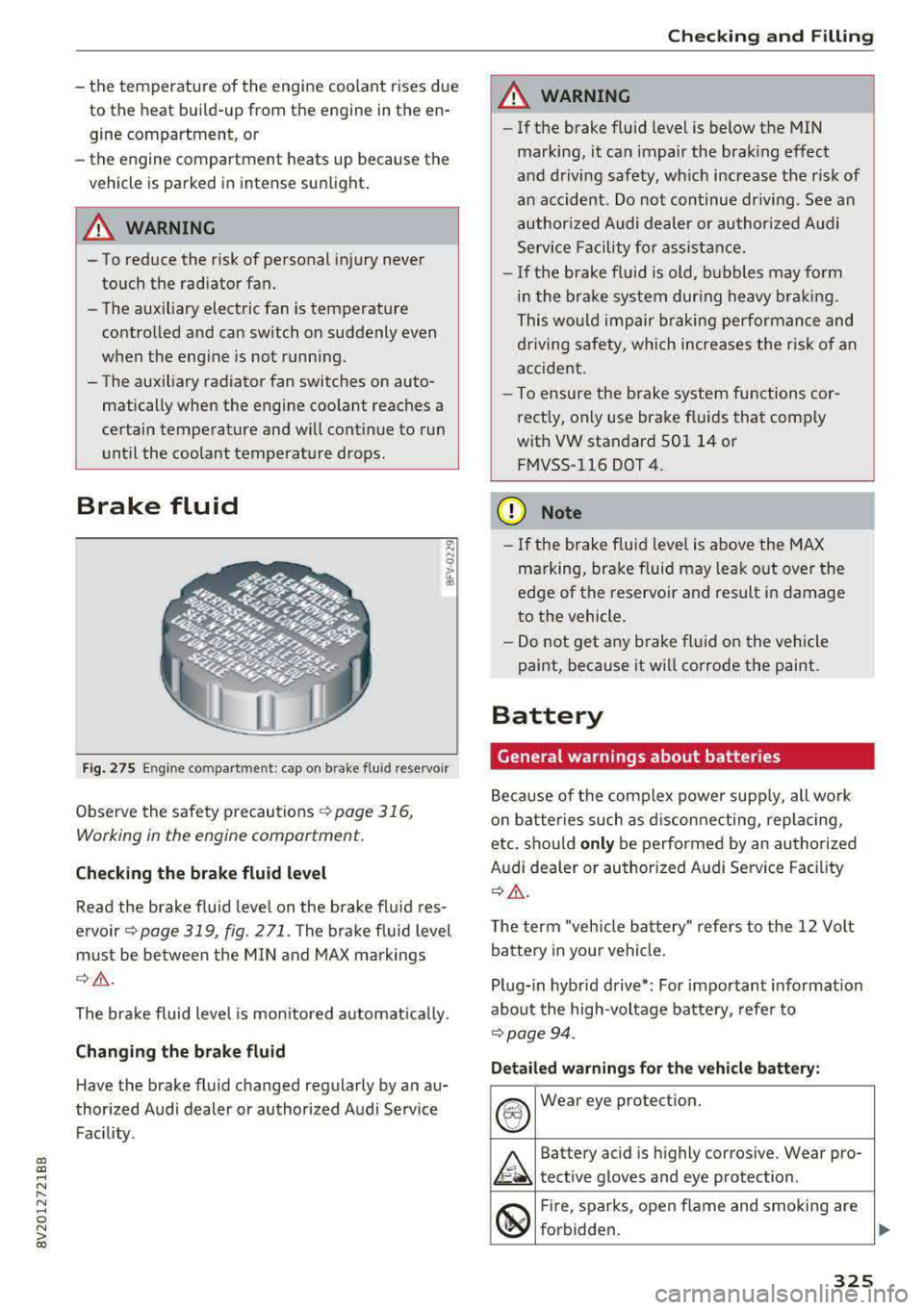
Fi g. 27 5 Engine co mpartment: cap on b rake f lu id reservoir
Observe the safety p recau tions ¢ page 316,
Working in the engine compartment .
Checking the brake fluid level
Read the brake f lu id leve l on the brake fl uid res
e rvo ir
Q page 319 , fig. 271. The bra ke fluid level
must be be tween the M IN and MAX m ark ings
¢ _& .
The brake fluid level is mon itored a utomat ica lly .
Changing the brake fluid H ave the brake fluid changed regularly by an au
thor ized Audi dealer or authorized Audi Service
Facility .
-
Checking and Filling
A WARNING
=
-If the brake fluid level is below the MIN
marking, it can impair the brak ing effect
and d riving safety, wh ich increase the risk of
a n accident . Do no t continue dr iving . See a n
a uthor ized Audi dealer or author ized A udi
Serv ice F acility for a ssistance.
- I f the b rake fl uid is old, b ubbles may form
i n t he bra ke sys tem dur ing heavy bra king.
This wo uld impair braking per formance an d
d riving safety, which increases the r is k of an
accident.
- T o ensu re the brake system fu nctions cor
rectly, only use brake fluids that comp ly
with VW standard 501 14 or F M VSS -116 DOT 4.
(D Note
- If the brake flu id leve l is above the MAX
marking, bra ke f luid may leak o ut over the
edge of the reservo ir and result in damage
to the vehicle.
- Do not get any b rake fl uid on the vehicle
paint, because it wi ll corrode the paint.
Battery
General warnings about batteries
B ecause of the complex power supp ly, all work
o n batter ies such as d iscon necti ng, replac ing,
etc. should only be performed by an authori ze d
Audi dealer or au thor ized A udi Service Fac ility
Q _& .
The term "veh icle batte ry" refe rs to the 1 2 Vol t
battery in your vehicle .
P lug- in hybr id driv e*: For important informat ion
abou t the high-vol tage batte ry, refe r to
Qpage 94.
Detail ed warnings fo r the vehicle battery :
®
Wear eye protect ion.
A
Battery acid is h ighly corros ive. Wear pro-
tect ive gloves and eye protection.
@
F ir e, sparks, open flame and smoking are
forbidden .
325
Page 333 of 400

Bead separa tion
means a breakdown of the bond
between components in the bead.
Cord
means the strands forming the
plies in the tire .
Cold tire inflation pressure
means the tire pressure recom
mended by the vehicle manufac
turer for a tire of a designated size that has not been driven for
more than a couple of miles (kilo
meters) at low speeds in the
three hour period before the tire
pressure is measured or adjusted .
Curb weight
means the weight of a motor ve
hicle with standard equipment in
c luding the maximum capac ity of
fuel, oi l, and coolant, a ir condi
tioning and add itional weight of
optional equipment.
E xtra load tire
means a tire designed to operate
at higher loads and at h igher in
flation pressures than the corre sponding standard tire. Extra load
tires may be identified as
"X L",
:;:;: "xl", "E XTRA LOAD" , or "RF" on ...
~ the s idewal l. ... 0 N > a:,
Wheels
Gross Axle Weight Rating
( " GAWR")
means the load-carrying capacity
of a single axle system, measured
at the tire -ground interfaces.
Gross Vehicle Weight Rating
(" GVWR ")
means the max imum total loaded
weight of the vehicle.
Groove
means the space between two ad
jacent tread ribs .
Load rating (code)
means the maxim um load that a
tire is rated to carry for a given in
flat ion pressure . You may not f ind
this informat ion on all tires be
cause it is not required by law.
Maximum load rating
means the load rating for a tire at
the maximum permissible infla
tion pressure for that tire .
Maximum loaded vehicle
weight
means the sum of:
(a) Curb weight
(b) Accessory weight
(c) Vehicle capacity we ight , and
(d) Production options we ight
33 1