2017 AUDI Q5 fuel
[x] Cancel search: fuelPage 96 of 296

Driving
Automatic transmission
Introduction
The automat ic t ransmission is cont rolled e lec
tron ica lly . The transmission ups hifts or down
shifts au toma tically depending on wh ich drive
p rogram is selected. The power is transferred by
a torque converter .
When a
moderate driving styl e is used , the
t ra nsmission se lects t he most eco nomical d riving
mode.
It will then change up early an d de lay the
downshifts to give better fuel economy .
The transm iss ion switches to a spo rty mode afte r
a kic k-down or when the drive r uses a
sporty
dri ving st yle
character ized by quic k accelerator
pedal movements, heavy acce leration, freq uent
changes in speed and traveling at the maximum
speed.
If desired, the dr iver can also select the gears
manually (tiptronic mode) ¢ page 98.
Selector lever positions
0 ;:!: 0 ci: a, a,
F ig. 109 D is p lay in t he inst rum ent cl uster: se lecto r lever in
p os it ion P
The se lector lever position engaged appears next
to the selector lever as well as in the instrument
cluster display .
P -Park
In th is selector lever pos ition the transm ission is
mechanically locked. Engage P only when the ve
h icle is
completely stopped¢.&. in Driving the
automatic transmission on page
96 .
To shift in or out of position P, you must
first
press and ho ld the brake pedal and then p ress
the re lease button in the selector lever handle
94
whi le moving the selector leve r to o r from P. Yo u
can shift out of this position o nly with the igni
t ion on.
R -Reve rs e
Se lect R only when the veh icle is at a full stop
and t he e ngine is runn ing at idle speed¢ A in
Driving the automatic transmission on
page
96 .
Befo re yo u move the sele ctor leve r to R, p ress
both the but to n in t he hand le of t he selec tor lev
er
and t he brake peda l at the same time .
When the igni tion is on, t he backup lights illumi
na te when the se lector lever is moved into R.
N -Neutral
The tra nsmission is in neutra l in this position .
S hi ft to this pos it io n for s tand ing wi th the b rakes
applied
¢ .&. in Driving the automatic transmis
sion on page
96. The vehicle ca n also ro ll when
t h e e ngine is s topped.
When the vehicle is stationa ry or at speeds be low
1 mph (2 km/h), you must a lways apply th e foot
bra ke befo re and wh ile movi ng the lever out of N.
D /S -Normal position for driving forward
In the D/S position, the transmission can be op
erated either in the normal mode Dor in the
spo rt mode S . T o se lect the sport mode S, pull
t h e se lecto r lever back b rie fly. Pull ing t he leve r
ba ck aga in will selec t the normal mode D. The in
str ument cluster d isp lay shows the selected d riv
ing mode.
I n the
normal mode D , th e transmission auto
mati cally selec ts the s uitable gear ratio .
It de
pends on engine load, veh icle spee d an d dr ivi ng
sty le.
Se lect t he
sport mode S fo r spo rty d rivi ng. The
vehicle makes f ull use of the eng ine 's power.
S hif ting may become no ticeable when acceler at
ing . Hyb rid drive *: electric d riving is not poss ible.
When the vehicle is statio na ry o r at speeds below
1 m ph (2 km/h), you mus t always apply the foot
br ake befo re and wh ile movi ng the lever to D/S
out of N. .,..
Page 103 of 296
Starting the vehicle
Applies to: vehicles with hybrid drive
The vehicle is started and turned off either wi th
the ign ition key <;>
page 81 or with the
IS TAR T ENG INE S TOPI button* 9 page 84 in t he
same way as a conventional vehicle .
W hen start ing the veh icle, the needles in the in
s trument clus ter move upward briefly . When the
ve hicle enters d rive ready mode, the s tatus mes
sage
hybrid ready appears briefly in t he instru
ment cluster display and the needle in the power
meter points to
READY 9 page 101.
Depending on the ope ration mode of the hybrid
sys tem, there are two possible drive ready modes
after the vehicle has been started:
Drive ready mode with combustion engine
If the ope rat ing req uiremen ts
r;!) page 103 for
e lectric dr ive mode are not met, the combust ion
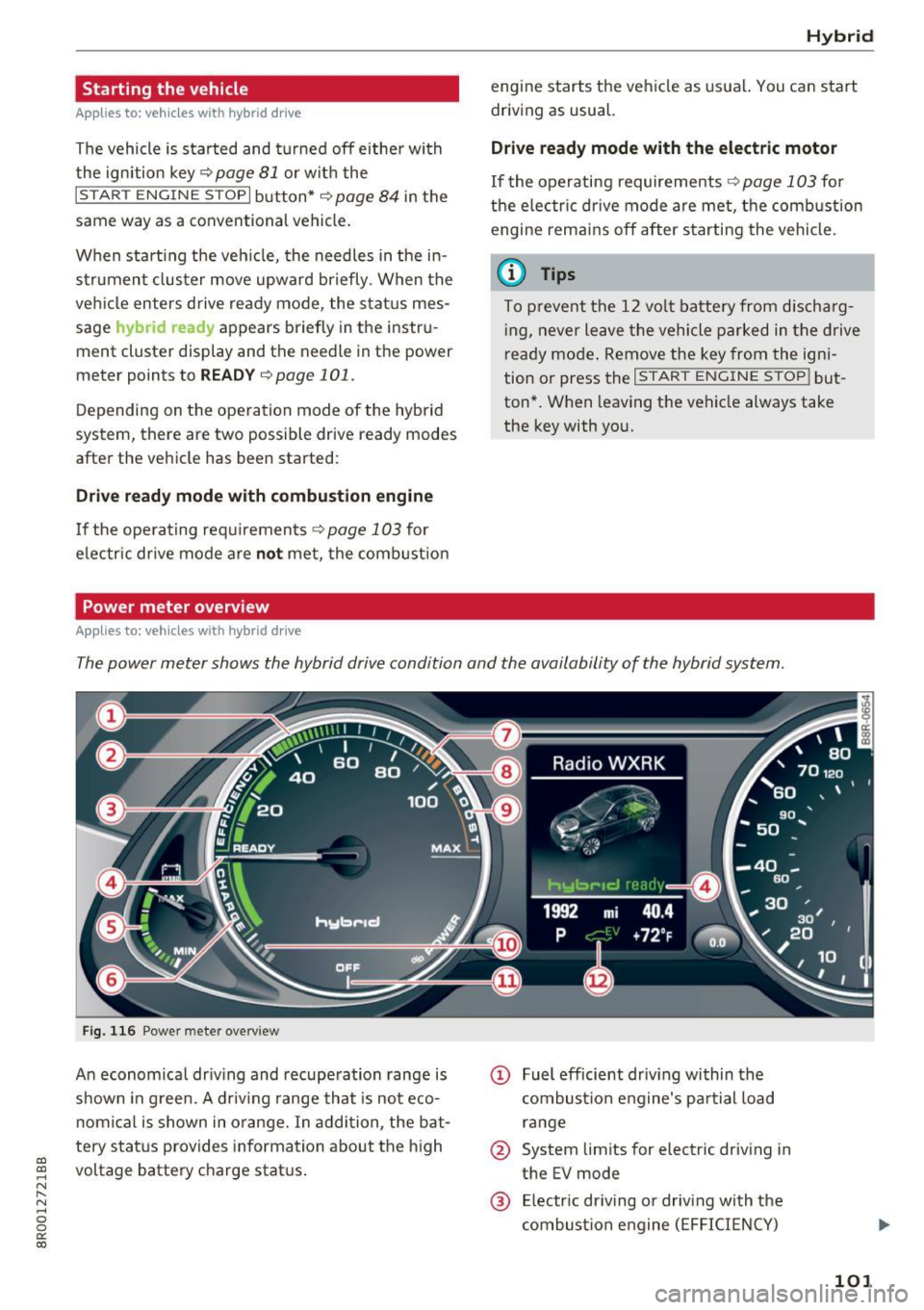
Power meter overview
Applies to: vehicles with hybrid drive
Hybrid
engine starts the veh icle as usual. You can start
driving as usual.
Drive ready mode with the electric motor
If the operating requireme nts
9 page 103 for
the e lectr ic dr ive mode a re met, the comb ustion
engi ne rema ins off after starting the vehicle .
(j) Tips
To p revent the 12 vo lt batte ry from discha rg
i ng, never le ave the vehicle pa rked in the drive
ready mo de. Remove the key from the igni
tion or press the
I START E N GINE STOP ! but
ton* . When leaving the vehicle always take
the key with yo u.
The power meter shows the hybrid drive condition and the availability of the hybrid system.
Fig . 116 Power mete r overv iew
An econom ica l dr iv ing and recupe ra tion range is
shown in g reen. A driv ing range that is no t
eco
nomi cal is shown in o range. In addition , the bat
tery s tat us provides informatio n about the high
a,
~ voltage batte ry c harge stat us.
N r-N ...... 0 0
0:
co
@ Fuel efficient driv ing wi thin the
c ombus tion engine's pa rtial load
r a nge
@ System limits for electric driving in
the EV mode
@ El ectr ic dr iving o r driv ing with the
c ombust ion engine ( EFFICI ENCY)
101
Page 106 of 296

Hybrid
Start-Stop function
The combustion engine is operated on ly as need
ed . Generally, the combustion engine turns off
when the vehicle is stationary and the high volt
age battery powers the electrical vehicle sys
tems.
The purpose o f automatica lly shutting the com
bustion engine off in hybrid drive mode is to save
fuel. All of the important vehicle systems, such
as steering, brakes and the A/C system, continue
to remain active. In some cases , systems may re
qu ire the combustion eng ine to continue running
when the vehicle is stationary . When dr iv ing in
congested traff ic for long per iods of t ime, the
combustion eng ine will cycle on when the veh icle
is stationary to keep the high voltage battery
charged.
Gliding
If the gas pedal is not pressed and the D posit ion
is selected, the combustion engine remains
turned off up to speeds of approximately 99 mph
(160 km/h) . Driving conservative ly like th is can
reduce fuel con5umption .
Energy recovery (recuperation)
When braking, the electric motor will act as a
generator creating e lectr ic energy that is then
sto red in the high voltage battery. This also oc
curs when the vehicle is coasting or driving down
hi ll. The combustion engine is automat ica lly
turned off in this case .
Tips for Driving Efficiently with your Hybrid
Appl ies to: ve hicles w ith hyb rid drive
Driving situa- Conditions
tions
- Shift into the D position .
Starting from a -
Release the brake pedal. The vehicle is braked with
the electric motor by
applying early and even pressure to the brakes
and using short pedal movements
¢ page 101,
fig. 116 @. By doing this, a large amount of the
kinet ic energy is recovered and may be stored as
electric energy in the high voltage battery. Dur
i ng heavy brak ing , the conventional brakes are al
so act ivated
¢ page 101, fig . 116 @.
The energy recovery is shown in the MMI display
¢page 107 .
Automatic start of the combustion engine
Various operating conditions cause the combus
tion eng ine to start automatically:
- Th e high voltage battery charge level is low.
- Th e temperature of the combustion engine is
low .
- Th e temperature of the catalytic converter is
low .
- T he power output needed for the A/C system is
high.
- The vehicle speed is high .
- The vehicle acceleration is high .
- The incline is steep .
- High charge level for the high voltage battery
when coasting. In this case, the high voltage battery cannot absorb any more energy and so
the electric motor cannot slow down the veh i
cle. The combust ion engine turns o n (engine
brake) . In this situation the high voltage bat
t ery w ill show a Max charge.
Vehicle behavior
In the D posit ion, the hybrid system adapts
to the driving situat ion by automatically
stop -
Only press moderately on the ac- sw
itch ing between the combustion engine
and e lectr ic drive types or by combining
celerator pedal.
them.
104
...
Page 107 of 296

CD
CD
.... N ,-... N .... 0 0 C<'. 00
Driving situa -
tion s
Constant driving
and coasting
(gliding)
Energy recovery
(recupe ration)
Driving in city
traffic
Driving on high-
ways and ex- pressways
Driving in cold
weather
Cond itions
- Cautious driving and reserved ac-
celeration.
- Release the accelerator pedal early
and entirely .
- Brake early and evenly with short
pedal movements .
- Reserved acce leration and early
and even braking with short pedal
movements.
- Use the
!<=!VI button sparingly .
- Intentionally take your foot off of
the gas pedal to allow for lengthy
coast ing .
- Reduce the vehicle speed by re-
leasing the acce le rato r peda l and
not by b raking.
- Avoid vehicle speeds above ap-
proximately 99 mph (160 km/h).
- Use the 5 selector lever position
and tiptronic mode sparingly .
- Do not run the combustion erngine
while the vehicle is parked to warm
the engine.
- Use the rear window/exter ior mir-
ror defroster and the seat heating
sparingly .
- Park the vehicle in a garage over-
night.
H yb ri d
Vehicle behav ior
The kinetic energy of the vehicle is used to
move the vehicle .
When you release the accelerator pedal en-
tirely, the combustion engine turns off auto-
mat ica lly and is disengaged. The vehicle
g lides without being propelled .
The electric motor brakes the vehicle . By do-
ing this, a large amount of the kinetic energy
is recovered and may be stored in the h igh
voltage battery in the form of electric energy .
The kinetic energy of the vehicle is used to
move the vehicle .
The battery dra ins quickly when the
!<=!VI but -
ton is turned on, which can increase fuel con-
sumpt ion because electric driv ing is given
priority, even if driv ing with the combustion
engine on wo uld be more efficient.
When you release the accelerator pedal en-
tirely, the combustion engine turns off auto- mat ically and is disengaged . The vehicle
g lides without being propelled .
F ue l consumption can be reduced by coast-
i ng.
It is possible to coast up to a vehicle speed of
approximately 99 mph (160 km/h).
A sporty driving style increases fue l con-
sumption .
The temperature of the combustion engine
rises very s lowly and the fuel consumption in-
creases considerably.
This conserves the energy in the high voltage
battery so that it is available to run the vehi-
cle in electr ic mode .
This reduces exposure of the high voltage
battery to cold temperat ures . The required
temperature range for the high voltage bat-
tery will then be reached more quickly after
you sta rt driving .
105
Page 196 of 296

Driving and th e en vironm ent
Driving and the
environment
Breaking in
New engine
The engine needs to be run-in during the first
1,000 miles (1,500 km).
For the first 600 miles (1 ,000 kilometer s):
.,. Do not use full throttle .
.,. Do not drive at engine speeds that are more
than 2/3 of the max imum permitted RPM .
From 600 to 1,000 miles (1 ,000 to 1 ,500
kilometers ):
.,. Speeds ca n gradually be increased to the maxi
mum perm iss ib le road or eng ine speed .
During and after break-in pe riod
.,. Do not rev the engine up to high speeds when it
is cold. This applies whether the transmission is
in N (Neutral) or in gear .
After the break- in period
.,. Do not exceed maximum engine speed under
any circumstances.
.,. Upshift into the next higher gear
before reach
ing t he red area at the end of the tachometer
sca le
¢page 8.
During the first few hours of driving, the eng ine's
internal friction is higher than later whe n all the
mov ing parts have been broken in. How well this
break- in process is done depends to a considera
b le exte nt on the way the vehicle is d rive n during
the firs t 1,000 miles (1,500 kilometers).
{[) Note
Extremely high eng ine speeds a re au tomati
cally reduced . However, these rpm lim its are
progr ammed for an e ng ine well run -in, not a
new engine.
@ For the sake of the environment
Do not dr ive with u nne cessarily high eng ine
spee ds -upshi fting ea rly saves fuel, reduces
noise and protec ts the enviro nment .
194
· New tires
If your veh icle is runni ng on new tires, d rive very
c ar efu lly fo r the fi rs t 350 miles (500 kilometers)
a fter fi tting.
_& WARNING
New tires tend to be slippe ry and must a lso
be "broken-in". Be sure to remember this dur
ing the first 350 m iles (500 kilometers) .
Brake gent ly. Avoid following closely behind
other ve hicles or ot her situations that might
require sudden, hard braking.
Catalytic converter
App lies to : vehicles wi th gaso line e ngi ne
-
It is very important that your emission control
system (catalytic converter) is functioning prop
erly to ensure that your vehicle is running in an
environmen tally sound manner .
.,. Always use lead-free gasoline¢ page 209,
Gasoline .
.,. Never r un the tank down all the w ay to emp ty.
.,. Never put too much mo to r o il in yo ur engi ne
¢ page 221, Adding engine oil 9::r..
.,. Never try to push- or tow-start your vehicle .
The cata lyt ic converter is an efficie nt "clea n-up"
device b uilt into the exhaus t sys tem o f the ve hi
cle . Th e catalytic converter b urns many of the
po llutants in the exhaust gas before they are re
l eased into the atmosphere.
The exclusive use of un le ad ed fuel is critically im
portan t fo r the life o f the cataly tic converte r and
proper functio ning of the engine .
A WARNING
The temperature o f the exhaust system is
h igh, both when driv ing and after stopp ing
the eng ine.
-
- Never touch the exhaust tail pipes once they
have become hot. This could resu lt in burns.
- Do not park or operate the vehicle in a reas
where the hot exhaust system may come in
contact with dry grass, b rush, fuel sp ill or
other mate rial which can cause a fire.
Page 197 of 296

CD
CD
.... N ,-... N .... 0 0 c:<: 00
-Do not apply additional undercoating or
rustproofing on or near the exhaust mani
fold, exhaust pipes, catalytic converter or heat shields. During dr iv ing, the substance
used for undercoating could overheat and
cause a fire.
Q) Note
- Be aware that just one tank filling with
leaded fuel will already ser iously degrade
t h e pe rformance of the catalytic converter .
- Do not exceed the correct eng ine o il level
c:> page 221.
-Do not drive until the fuel tank becomes
complete ly empty. The engine could mis
fire. Unburned fuel could also get into the
exhaust system and this cou ld cause the
catalytic conve rte r to overheat.
- Do not tur n off the ignition whi le the vehicle
i s mov ing.
- Do not continue to operate your vehicle un
der these cond it ions, as otherwise fuel can
r each the catalytic converte r. This cou ld re
su lt in ove rheating of the converte r, req uir
i ng its replacement.
- To assu re efficient operation of the Emis
s ion Control System:
- Have your vehicle maintained properly and
in accordance with the service recommen
dations in your Warranty
& Maintenance
booklet.
- Lack of proper maintenance as well as im
proper use of the vehicle will impair the
function of the em ission control system
and co uld lead to damage.
@) For the sake of the environment
Even when the Em ission Control System is op
erat ing properly, the exhaust gas can have a
sulfur-like exhaust gas smell under some op
erat ing states. This depends on the su lfu r
conten t of the fuel being used. Using a differ
ent brand of fue l may he lp, or filling the tan k
with lead -free s uper grade gasoline.
Driving and the envir onment
Diesel particulate filter
App lies to : veh icles w ith diesel en gine
The diese l particu late filter filters near ly all of
the soot particles out of the exhaust. The filter
cleans itself automatica lly under norma l driving
condit ions. If the filter cannot clean itself (for ex
amp le, because you are only driving short distan
ces), the filter becomes clogged with soot and
the m symbol for the d iesel part icu late filter il
luminates
c:> page 31 .
_&. WARNING
-Do not park your veh icle over flammab le
mate ria ls s uch as grass or leaves because
the high temperature of the diesel particu
late filter cou ld start a fi re.
-
- Do not app ly an underbody pro te ctant in the
exhaust system area or a fire could sta rt .
Avoid damaging the
vehicle
When you are driving on poor roads, or over
curbs, steep ramps, etc., make certain that low
ly ing parts such as spo ilers and exhaust system
parts do not bottom out and get damaged .
This is especially true for vehicles with low-s lung
chassis (sports chass is)* and fully loaded
vehicles.
Economical and environ
mentally-friendly driving
General
Your personal style of driving will determine the
economy of your vehicle, as well as exhaust and
noise levels .
Fuel economy, env ironmental impact, and wear
o n your engine, brakes and tires large ly depend
on three factors :
- your pe rsonal d riving s tyle
- operat ing cond itions
- technical limitat ions
If you ant ic ipate what you need to do next and
drive economically, you can easily cut your fuel
195
Page 198 of 296

Driving and th e en vironm ent
consumption by 10-15 percent. This section will
give you some tips on how you can help the envi
ronment and your pocketbook.
(D Tips
The consumption estimates as published by
ENVIRONMENTAL PROTECTION AGENCY
(EPA) and Transport Canada may not corre
spond to your actual consumption on the
road, which will vary depend ing upon vehicle
load and speed, road and weather conditions,
trip length, etc .
Drive smoothly and keep a lookout ahead
Vehicles use the most fuel when they are acceler
ating .
"'Avo id unnecessary accelerating and braking.
Vehicles use the most fuel when they are acceler
ating . If you anticipate what is going to happen
next, you will need to brake less and, thus, accel
erate less . Let the vehicle coast whenever possi
ble -for example when you see that the next traf
fic light is red .
Avoid full throttle
Driving a t moderate speeds saves fuel and im
proves your mileage .
"'Try and keep well below your car 's maximum
speed .
Accelerating gent ly reduces fuel consumption,
engine wear, and does not disturb the environ
ment.
Fue l cons umption, exhaust emissions and engine
noise increase d isproportionately at high speeds .
If you drive at approximately three q uarters of
top speed, fuel consumpt ion w ill be reduced by
one half. Never drive faster than the posted
speed limit and weather conditions permit.
196
· Reducing unnecessary idling
E ven when your car is just idling it burns up fuel .
"'Shut the engine off when you are not driving
the vehicle.
"' Do not warm up the vehicle by letting the en-
gine run at idle .
The idling phase is automatically reduced for
vehicles with the Start-Stop-System*. It is effi c ient to sw itch off the engine in vehicles without
the Start-Stop-System* when stopped at ra ilroad
cross ings and long red lights. Turning the engine
off fo r just 30-40 seconds saves more fuel than is
bur ned by s tarting the engine again .
It takes a long time for the engine to warm up
fully when it is runn ing at id le . However, wea r
and noxious emissions are especially high when
the engine is warming up . So yo u should dr ive
away as soon as you sta rt the eng ine and avo id
running at hig h rpms whi le the engine is st ill
warming up .
Q) Note
Do not leave eng ine idling una ttended after
starting. If warning lights shou ld come on to
indicate improper operation, they would go
unheeded. Extended idling also prod uces
heat, which could result in overheating or
other damage to the vehicle or other proper
ty .
· Regular maintenance
A badly tuned engine unnecessarily wastes a lot
of fuel .
"' Have your vehicle serviced at regular interva ls.
By having your vehicle regular ly serv iced by an
authorized Audi dea le r helps to ensure that it
r uns prope rly and economically . The condition of
your vehicle not on ly affects its safety and ability
to hold its value, it also affects
fuel consump
t ion .
Check your oil each time you fill your tank.
The amou nt o f oi l used is related to engine load
and speed. ..,
Page 199 of 296

CD
CD
.... N ,-... N .... 0 0 C<'. 00
It is normal for the oil consumption of a new en
gine to reach its lowest value after a certain mile
age has been driven .
You must drive your vehicle abo ut 3,000 miles
(5,000 k ilometers) before you can proper ly as
sess oi l cons umption.
This a lso applies to fuel consumption and engine
ou tput.
(y Note
- Have your vehicle maintained properly and
in accordan ce with the servi ce recommend a
tions in yo ur Warranty
& Ma intenance book
l et. Lack of proper maintenance as well as
i mproper use of the vehicle will impair the
funct ion of the emission control system and
could lead to damage.
- Do not alter or remove any component of
the Em ission Control System unless ap
proved by the manufacturer.
- Do not a lter or remove any device, such as
heat shie lds, sw itches, ignition wires,
valves, which are designed to protect your
vehicle's Em ission Control System and other
i mportant vehicle components .
Fewer short trips
Fuel consumption will always be relatively high
on short trips .
.. Try to avoid driving short distances with a cold
engine.
The engine and catalyt ic converter have to reach
their optimal
ope rating temperature to reduce
fuel consumption and noxious emissions effec
t ively .
Just after starting, a co ld engine in a mid-size car
only achieves a fuel economy of 6-8 miles per
ga llon (30-40 l/100 km). After about a half a
mile, fuel economy cl imbs to 12 mpg (20 l/100
km). After about
2 .5 miles (4 km), the engine is
at its proper operating temperature and fuel
economy has reac hed a norma l level. So you can
see that you sho uld avo id short t rips w henever
possib le.
Driving and the envir onment
The out side tempe rature is a lso crit ica l in this re
gard . Your car consumes more fuel in the winter
than in the summer .
197