2017 AUDI Q5 seats
[x] Cancel search: seatsPage 70 of 296

Seats and storage
the luggage compartment to help prevent
items from flying forward into the passen
ger compartment.
- Never attach a child safety seat tether strap
to a tie-down.
Luggage compartment cover
Fig. 75 Luggage compartment: cover attached
Fig. 76 Luggage compartment: storing the cover
Removing
• Unhook the straps@ c::> fig. 75.
• Pull the cover @out of the retainers @ in the
direction of the arrow.
Installing
• Slide the cover into the retainers @.
• Attach the straps
(D c::> & .
Storing
• Slide the rear seat forward <=> page 63.
• Fold the cover together and store it behind the
rear seat
c::> fig. 76 .
_&. WARNING
-To prevent accidents, never install the lug
gage compartment cover unsecured.
68
-
-Whenever driving, never place any hard or
heavy objects on the luggage compartment
or allow pets to sit on the luggage compart
ment cover. They could become a hazard to
vehicle occupants in the event of sudden braking or in an accident.
(D Note
You could damaged a stored luggage com
partment cover when you move the rear seat
or rear seat backrest.
@ Tips
- You can use the luggage compartment cov
er to store light weight clothing or articles
but do not leave any heavy or sharp objects
in the pockets of the clothing.
- Remember that placing clothing or articles on the luggage compartment cover can
block the driver's vision in the rear view mir
ror. This also applies especially when you
have to transport large objects.
- So that stale air can escape from the vehicle
be sure not to cover the ventilation slot be
tween the rear lid and the luggage compart
ment cover.
Double cargo floor
You can store dirty or wet objects under the car
go floor.
Fig. 77 Luggage compartment: cargo floor folded toget her
wit h protective tray
Folding the cargo floor together
• Lift the cargo floor by the handle c::> fig. 77 (D
and fold it up.
• Place your item in the protective tray.
Page 71 of 296

a,
a,
..... N r-N ..... 0 0
0:
co
Removing the cargo floor , installing
• To remove, lift t he cargo floor folded together
and pull it toward the rear lid .
• To install, place the folded cargo floor into
both retainers and unfold it.
Grab the protective tray on the ha ndles and pu ll
it out. You can also install a divider to divide @
the storage area. Depending on the vehicle
equipment level, the protective tray can have dif
ferent sizes and shapes .
Cargo net and storage hooks
Fig. 78 Luggage compartment:
F ig . 79 Luggage compartment: Storage hooks
Storage net
The storage net on the right side trim can be
moved lower on the side guides, if needed
c:>fig. 78.
Storage hook s
The storage hooks can be used to secure shop
ping bags from falling over
c:> fig. 79.
A WARNING
Do not use the storage hooks to secure heavy
objects. Heavier objects are not adequately
secured. There is risk of pe rsonal injury.
Seats and storag e
Roof rack
Description
Additional cargo can be carried with a roof lug
gage rack .
If luggage or cargo is to be carried on the roof,
you must observe the following:
- On ly a specially designed roof rack may be used
on your vehicle roof. This is provided with your
veh icle .
- These roof racks are the basis for a complete
roof rack system . Additional attachments are
necessary if you want to transport luggage, bi
cycles, surf boards and skis. All these compo
nents are ava ilable at your a uthorized Aud i
dea le r.
(D Note
If you use other roof luggage rack systems or
do not install the racks as intended, any dam
age to the vehicle is not covered by the war
r anty. Always read the ma nufactu rer installa
tion ins tructions that came with yo ur roof
rack system when yo u install the atta ch
ments.
(D Tips
When ins tall ing a factory-supp lied roof rac k
system on the roof railing, the ESC will adapt
i tself to a differe nt center of gravity .
Attachment points
The roof rack can only be attached at the
marked locations .
Fig . 80 Roof rack attachment points
69
Page 72 of 296

Seats and storage
Attach the roof rack only at the attachment
points on the roof railing. On the inside of the
roof railing there are two holes for attaching the
rear end of the roof rack. To prevent confusing
the front and rear roof rack attachments, there
are three holes on the left and two holes on the
right for mounting the front part of the roof rack
~ fig . 80.
The roof racks have a sticker on the left side un
derneath to identify front and rear .
A WARNING
When installing the roof rack, make sure the
sticker is on the left side of the vehicle and
faces the stamped arrow in the drive direc
tion.
Installing a roof rack
Fig . 81 Roof ra iling : pos ition ing the roof rack
Fig . 82 Roof railing : installing a roof rack
The roof rack set consists of a front and rear roof
rack, the
cover profile and a socket wrench.
~ Open the cap (D c:> fig. 82.
~ Before mounting the roof rack, use the socket
wrench @and loosen the left and right screw
in the direction of@ .
70
~ Clean the attachment points on the roof railing
as well as the roof rack rubber washers@.
~ Carefully place the roof rack over the holes in
the roof railing
c:> fig. 81.
~ Place the pins@ into the holes. The claw®
must engage into the edge of the roof railing .
~ Make sure the rubber washer© lays flat on the
roof railing .
~ Tighten the left and right screws using the
socket wrench @ in direction @.
~ To reach the 4 ft lb (6 Nm) tightening specifi
cation needed, both arrows on the socket
wrench must align .
~ Repeat this procedure on the second roof rack.
A WARNING
Check all the roof rack connections each time
before each trip and re-tighten or re-adjust if
necessary .
If you are going to be driving or
rough terrain, you will have to check the at
tachments more often. If you do not do this,
the risk of your luggage coming loose and
falling off is greater.
(D Note
The pins and the roof rack claws must engage
securely into the holes and into the edge of
the roof railing when you tighten the screws!
(D Tips
You can adjust the width of the roof rack by
using a hexagon wrench and turning the
screws on the top. Let your authorized Audi
dealer help you with this.
Installing the attachments
Fig. 83 Roof railing: installing cove r profile into the roof
rack
co
"' ~ er co a,
Page 73 of 296
a,
a,
..... r-1 ,-... r-1 ..... 0 0
0:
co
Installing the attachments
• Remove the ca p @ q fig . 83 .
• Slide the attachment into the T-groove 0-
• Tighten the attachment according to the roof
rack installation inst ructions .
• Close the cap.
Install ing the cov er profile
• Seal the openings in the T-groove 0 with the
cover profile @ after hav ing installing the at
tachments.
• If you not want to use th e attachment, seal the
whole T-groove
0 with the cover profile @.
• Cut t he cover profile to the length needed, if
necessary .
Roof load
The cargo on the roof mus t be securely attached.
Handling charac teristics change when cargo is
transported .
The permissible roof load for your veh icle is
165 lbs (75 kg ). The roof load is the total of the
weight of the roof rack, the attachme nts and the
cargo you are carrying .
_&, WARNING
- The cargo m ust be sec urely attached on the
roof rack, otherwise yo u risk a n accide nt.
- Dist ribute the load as evenly as possible and
do not make the roof rack wider than the
m ax imum permitted.
- Yo u must unde r no circumstances exceed
t he perm iss ible roof load, the permiss ible
ax le loads and the pe rm issib le overa ll
we ight of yo ur vehicle -risk of an accident.
- M ount the a ttachments to the roof rack only
after you have placed the roof rack on the
vehicle .
- C onsider that whe n transpo rting heavy ob
je cts or one wi th a large s urf ac e, the han
dling characterist ics c hange due to shift in
the cente r of gravity or the greater s urface
exposed to the w ind. So adapt your driving
and your speed to prevailing conditions. We
recommend that you do not dr ive faster
than 80 mp h (130 km/h) .
Seats and storag e
-Mounting a roof rack changes the height of
your veh icle. Keep t his in m ind when parking
your veh icle in your garage, or when dr iving
through a tunnel o r under a n overpass.
(D Note
- Ma ke sure the rea r lid does not hit the cargo
on the roof rack when you open it. On
vehicles with automatic rear lid/trunk lid
operation* you may have to adjust the open
position of the rear lid
~ page 41.
- Remove the roof rack and attachment be
fore taking your vehicle th rough an auto
matic car wash to avoid damage .
@ For the sake of the environment
As a result of the increased wind res istance
created by a roof rack, your vehicle is using
fuel u nnecessarily . So remove the roof rack
aft er using it.
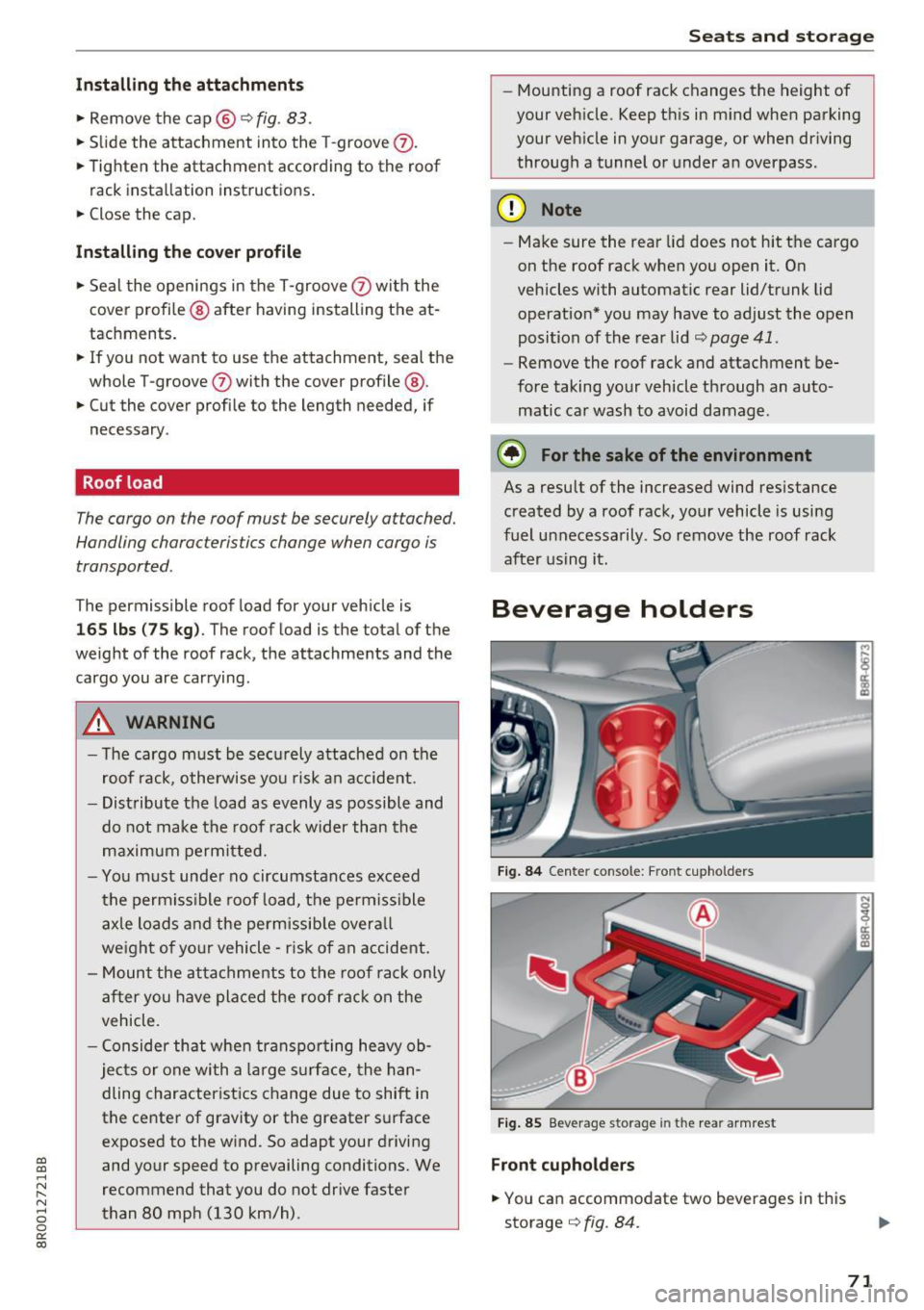
Beverage holders
Fig . 84 Cente r conso le: Fro nt c upho lders
Fig. 85 Beverage storage in th e rea r arm rest
Front cupholders
• You ca n accommo date two beverages in this
storage
q fig . 84 .
71
Page 75 of 296

a,
a,
..... N r-N ..... 0 0
0:
co
@ Tips
Do not cover the venti lation gri lle -arrow- be
cause that could prevent the beverage holder
from functioning correctly.
Cupholders in the door pockets
There is a cupholder in all four doors.
Fig . 87 Section of door panel: (upholder
The cupholders in the door pockets are suitab le
for
l to 1.5-liter bottles.
.&_ WARNING
Spilled hot liquid can cause an accident and
personal injury.
- Never carry any beverage containers with
hot liquids, such as hot coffee or hot tea, in
the vehicle while it is moving . In case of an
acc ident, sudden braking or other veh icle
movement, hot liq uid could spill, causing
s ca ld ing burns. Spilled hot liquid can also
c a use a n accident and personal i njury.
- Use only soft cups in the c upholder. Hard
c u ps and g lasses can ca use inj ury in an acci
dent.
(D Note
Only dr ink containe rs with lids should be car
r ied in the cupholder. Liquid co uld sp ill out
and damage your vehicle's e lectronic equip
ment or s tain t he upho lstery, etc.
-
Seats and storag e
Ashtray
Fig. 88 Center console: front ashtray
Opening the ashtray
.,. Slide the cover open .
Clo sing the ashtray
.. Tap the lid to close the ashtray automat ica lly.
Removing ashtray insert
.,. Release the asht ray insert by slid ing the switch
@ ¢fig. 88 to the r ight.
.. Remove the ashtray insert@¢
fig. 88.
Reinstalling ashtray insert
.,. Press the ash tray insert into its holder.
.&_ WARNING
-
Never put waste paper in t he ashtray. Hot
ashes or other hot objects in the ashtray co uld
set waste paper on fire.
Cigarette lighter/socket
Cigarette lighter
F ig. 89 Center console: cigarette lighter
.. Press the cigarette lighter in .
73
Page 77 of 296

a,
a,
..... N r-N ..... 0 0
0:
co
when accelerating or when applying the brakes or when driving around a corner.
- When you are driving make sure that any
thing you may have placed in the center con
sole or other storage locations cannot fall out into the footwells. In case of sudden
braking you would not be able to brake or
accelerate.
- Any pieces of clothing that you have hung
up must not interfere with the driver's view.
The coat hooks are designed only for light
we ight cloth ing. Never hang any clothing
with hard, pointed or heavy objects in the
pockets on the coat hooks. During sudden
braking or in an accident -especially if the
airbag is deployed -these objects could in
jure any passengers inside the vehicle.
Glove compartment
The glove comportment is illuminated and can
be locked.
Fig. 92 Glove compartment
To open glove compartment
.,. Pull the handle in the direction of the arrow
c:> fig. 92 and swing the cover down to open .
To close glove compartment
.,. Push the glove compartment lid upward until
the lock engages.
There are holders for a pen and a pad of paper in
the glove compartment lid.
On the right side in the glove compartment is a holder with the key body into which the emergen
cy key must be clipped to be able to start the ve
hicle.
Seats and storage
A WARNING
-To reduce the risk of personal injury in an acci-
dent or sudden stop, always keep the glove
compartment closed while driving.
Cooling box in glove compartment
The cooling box works only when the air-condi
tioning is in cooling mode.
Fig. 93 Glove box with cooling box open and switched on
.,. Open the glove compartment c:> page 75,
fig.
92 .
.,. Turn the rotary switch @counter-clockwise to
switch the cooling on. The symbols on the rota
ry switch must be displayed
c:> fig. 93 accord
ing ly .
.,. Turn the rotary switch @clockwise to switch
the cooling off.
The cooling box works only in the cooling mode.
If the climate control is in the heating mode, we
recommend switching the cooling box off .
Storage compartment in the roof
""'
11111
.3
0 .. ~O
~-__;,:~ ~~lr.;...__--1
Fig. 94 Storage pocket in the roof
.,. To open the lid you have to touch the bar
c:> fig. 94 (Arrow) . The lid opens automatically. Ill>
75
Page 81 of 296
![AUDI Q5 2017 Owners Manual CD
CD
.... N ,-... N .... 0 0 C<. 00
[i] Adjusting seat heating*
Pressing the button switches the seat heating on
at the highest setting (level 3) . The LEDs indicate
the temperat](/manual-img/6/57633/w960_57633-80.png "AUDI Q5 2017 Owners Manual CD
CD
.... N ,-... N .... 0 0 C<. 00
[i] Adjusting seat heating*
Pressing the button switches the seat heating on
at the highest setting (level 3) . The LEDs indicate
the temperat")
CD
CD
.... N ,-... N .... 0 0 C<'. 00
[i] Adjusting seat heating*
Pressing the button switches the seat heating on
at the highest setting (level 3) . The LEDs indicate
the temperature level. To reduce the tempera
ture, press the button again. To switch the seat heating off, press the button repeatedly until the
LED turns off.
After 10 minutes, the seat heating automatically
switches from level 3 to level 2.
lil Adjusting seat ventilation*
Pressing the button switches the seat ventilation
on at the highest sett ing (level 3). The LEDs indi
cate the venti lation level. To reduce the ventila
tion level, press the button again. To switch the
seat v entilation off, press the button repeatedly
until the LED turns off.
I ..., FRONT I Switch the defroster on/off
The windshield and side windows are defrosted
or cleared of condensation as quickly as possib le.
The maximum amount of air flows mainly from
the vents below the windshield. Recirculation
mode switches off. The temperature should be
set to 72 °F (22 °() or higher. The temperature is
controlled automatically .
T he
IAUTOI button switches the defroster off.
llliil REARI Switching rear window heater on/
off
The rear window heater on ly operates when the
engine is running. It switches off automatica lly
after a few minutes, depending on the outs ide
temperature.
To prevent the rear window heater from switching off automatically, press and hold the
!llil> REAR I
button for more than 2 seconds . This remains
s tored until the ignition is switched off .
Air vents
You can open and close the center and rear air
vents using the thumbwheels . The levers adjust
the direction of the airflow from the vents.
You can adjust the air temperature in the rear by
turning the thumbwheel toward the red side to
Warm and cold
make it warmer or toward the blue s ide to make
it coo ler.
A WARNING
-~
- Do not use the recirculation for extended
periods of time. The windows could fog up
since no fresh air can enter the vehicle . If
the windows fog up, press the air rec ircula
tion button again immed iately to switch off
the air rec irculat ion function or select de
frost.
- Individuals with reduced sensit ivity to pain
or temperature could develop burns when
using the seat heating* function. To reduce
the risk of injury, these individua ls should
not use seat heating.
(D Note
To avoid damage to the heating elements* in
the seats, do not kneel on the seats or place heavy loads on a small area of the seat.
Setup
The basic climate control settings can be adjust
ed in the radio or MMI*.
"'Select: !CAR I function button> A/C control but
ton. Or
"' Select:
!CAR ! function button> Car systems*
control button >
A/C.
Automatic recirculation
When switched on, automat ic rec irculat ion con
trols the recirculation mode automatically. If the
windows fog up, press the
I@ F RON T I button.
Synchronization
When synchronization is switched on, the same
settings are appl ied to both the driver and front
passenger , except for the seat heating/ventila
t ion* . Synchronization switches off when you ad
just the settings on the front passenger's sid e.
You can also sw itch synchronizat ion on by press-
i ng and holding the knob on the driver's side. ..,.
79
Page 133 of 296

CD
CD
.... N ,-... N ,....,
0 0 C<'. 00
Driving safety
Basics
Safe driving habits
Please remember -safety first!
This chapter contains important information,
tips, instructions and warnings that you need to
read and observe for your own safety, the safety
of your passengers and others . We have summar
ized here what you need to know about safety
belts, airbags, child restraints as well as child
safety. Your safety is for us
priority number 1. Al
ways observe the information and warnings in
this section - for your own safety as well as that
of your passengers.
The information in this section applies to all
model versions of your vehicle. Some of the fea
tures descr ibed in this sections may be standard
equipment on some models, or may be optional
equipment on others. If you are not sure, ask
your authorized Audi dealer.
A WARNING
- Always make sure that you follow the in
structions and heed the WARNINGS in this
Manual. It is in your interest and in the in
terest of your passengers .
-
-Always keep the complete Owner's Litera
ture in your Audi when you lend or sell your
vehicle so that this important information
will always be available to the driver and
passengers.
- Always keep the Owner's literature handy so
that you can find it easily if you have ques
tions.
Safety equipment
The safety features are part of the occupant re
straint system and work together to help reduce
the risk of injury in a wide variety of accident sit
uations.
Your safety and the safety of your passengers
should not be left to chance. Advances in tech
nology have made a var iety of features available
to help reduce the risk of injury in an accident.
Driving safety
The following is a list of just a few of the safety
features in your Audi:
- sophisticated safety belts for driver and all pas-
senger seat ing pos itions,
- be lt force limiters for the front seats,
- belt pretensioners for the seats,
- belt height adjustment for the front seats,
- head restraints for each seating position,
- front airbags,
- side airbags in the front seats and outer rear
seats *,
- side curtain airbags,
- special LATCH anchorages for child restraints,
- adjustab le steering column.
These individual safety features, can work to gether as a system to help protect you and your
passengers in a wide range of accidents . These
features cannot work as a system if they are not
always correctly adjusted and correctly used.
Safety is everybody's responsibility!
Important things to do before driving
Safety is everybody 's job! Vehicle and occupant
safety always depends on the informed and care
ful driver .
For your safety and the safety of your passen
gers,
before driving always:
.,. Make sure that all lights and signals are operat
ing correctly.
.,. Make sure that the tire pressure is correct .
.,. Make sure that all windows are clean and afford
good visibility to the outside .
.,. Secure all luggage and other items carefully
~page 74 .
.,. Make sure that nothing can interfere with the
pedals.
.,. Adjust front seat, head restraint and mirrors
correctly for your height.
.,. Instruct passengers to adjust the head re
straints according to their height.
.,. Make sure to use the right child restraint cor
rectly to protect children
¢ page 168, Child
safety. ..,.
131