2017 AUDI A3 SEDAN fuel cap
[x] Cancel search: fuel capPage 316 of 400

Checking and Filling
Fueling
Fig . 265 -Applies to: veh icles wi tho ut p lug -in hybrid dr ive
ri ght rea r side of t he veh icle: ope nin g the fuel filter door
Fig. 266 Fue l fi ll er doo r w it h attached fuel cap
Plug-in hybrid drive* : Please a lso read the infor
matio n under
¢page 105, Refueling.
The fuel filler door is unlocked or locked by the
central locking system.
Op en ing th e fuel cap
"' Applies to : vehicles with p lug-in hybri d drive :
Also read the information found
in c> page 105,
Opening the fuel filler door .
"'Applies to : vehicles wi tho ut plug-in hybrid
dr ive: Press the left side of the fuel filler door
to open it-arrow-
¢ fig . 265.
"' Unscrew the tank cap counterclockw ise.
"' Place the cap from above on the open fue l filler
door ¢ fig. 266.
Closing th e fu el cap
"' Turn the fuel cap clockwise until you hear it
lock.
"' Close the fuel fille r door unt il it l atches.
Once the pump nozzle sw itches off, the fuel tank
is
" full" . Do not fi ll the tank more . Otherw ise the
expansion space in the tank will be f illed.
314
The correct fuel type for your vehicle can be
found on a label located on the inside of the fuel
filler door. For additional informat ion on fuel,
see
¢ page 312.
The fuel tank capacity of your ve hicle is listed in
the
T echn ical Dat a section ¢ page 375.
To avoid fuel spilling or evaporat ing from the fuel
tank always close fue l fi ller cap properly and
completely . An improperly closed fuel fi ller cap
may also cause the MIL
l amp ¢ page 23 to come
on .
_& WARNING
Not pay ing attention when fueling or han
dling fuel incorrectly can lead to fires, explo
sions or serious injur ies.
-Fue l ignites easily and can cause serious
burns and other injur ies.
-
-If you do not switch the engine off when fu
eling and/or do not insert the fuel nozzle
completely into the tank open ing, fuel can
leak out or run over . Leaked fuel ca n ign ite
and start a fire.
-Do not use the telephone while f ueling. The
elec tromagnetic rays ca n cause sparks,
which can ignite fue l vapors and start a fire.
- Do not sit in your vehicle wh ile fue ling. If
you must make an exception and ente r your
veh icle agai n while fueling, close the door
an d touch me tal to d ischarge stat ic elect ric
ity before to uching the f uel nozz le . Static
electricity can create spa rks, which can ig
nite vapors when fueling.
-Do not smoke or have an open flame in the
area when fueling your vehicle or fi lling a
fue l container because this increases the
risk of an explosion.
-For your safety, carrying fuel containers in
your vehicle is not recommended. W hether
fu ll or empty, the container can leak and
cause a fire in the event of an acc ident.
- If you must make an exception and trans- port a fuel container, note the fo llow ing:
- Never fill the fuel container with fuel
while i t is in o r on the vehicle. Static e lec
tricity is discharged whe n filling w hich can
.,._
Page 318 of 400

Check ing and F illing
The pull cable for the emergency release is locat
ed on the cover .
.,. To access t he e mergency release, fold the r ight
bac kres t
forwa rd ¢ page 68 .
.,. Remove the cover from the trim .
.,. Carefully pull the cover toward the center of
the ve hicle at a 45° angle
-arrow- ¢ fig. 268
c>(D . The tab on the cover must point forward
in the direct ion you are pulling when pull ing on
the cover.
.,. Press on the left s ide of the fuel f ille r door to
open it
¢ page 314, fig . 265 .
(D Note
Onl y pull on the loop/cove r unt il you feel re
sistance. You wi ll not hea r it re lease . Other
w ise you cou ld damage t he emergency re
lease mecha nism .
Catalytic converter
The vehicle may o nly be driven with unleaded
g a soline, otherwise the catalyt ic converter will be
destroyed.
Never d rive until the tank is completely empty .
The irregular supp ly of f uel that results from t hat
can cause engine m isfi res. Uncombusted fuel will
ente r the exhaust sys tem, w hich can ca use ove r
heating and damage to the catalyt ic converter .
& WARNING
The tem perature of the ex ha ust system is
high, both when driving and after stopping
the engine.
-
- Never touch the exha ust ta il pipes once t hey
have become hot. This could result in burns.
- Do not park your vehicle over flammable
materials such as g rass or leaves because
the h igh temperat ure of the emiss ions con
trol system cou ld start a f ire.
- Do not apply underbody protectant in the
exhaust system area, because this increases
t h e risk of fire.
316
Engine compartment
· Working in the engine compartment
Special care is required if you are working in the
engine compartment
For work in the engine compartment, such as
checking and fill ing fluids , the re is a risk of in
jury, scalding, accidents , and burns. For this
reason, follow all the warnings and general
safety precaut ions provided in the following in ·
formation . The engine compartment is a dan
gerous area.
c> & .
& WARNING
To reduce the ris k of injur ies, comp lete the
following steps before opening the hood:
- Tur n the engine off.
- S witch the igni tion off.
- Set the park ing brake.
- Move the selector lever into t he P position.
- Never ope n the hood when there is steam o r
coo lant escaping from the engine compart
ment, because there is a risk that yo u could
be burned . Wait unt il no steam or coolant is
escapi ng.
- L et the eng ine cool down .
- Keep children away from the eng ine com-
pa rtment .
- Never sp ill fluids on a hot engine . These flu
ids (such as the anti-freezing agent con
tained in the coolant) ca n ignite.
- Avoid short c ircuits in the electrical system.
- When working in the engine compa rtment,
remember that the radiator fan can switch
on even if t he ignition is switched off, wh ich
increases the r is k of persona l injury.
- Never open the cap on the coolant expan
sion tank when the engine is warm . The
coo ling syste m is under p ressure.
- To protect your face, hands, and a rms from
hot steam or coolant, cover the cap with a
large cloth when opening .
- Do not remove the engine cover under any
circumstances . Th is i ncreases the risk of
burns .
-
Page 323 of 400

a, a, ..... N
" N ..... 0 N > 00
@ Tips
- The oil pre ssure w arning display. i s not
an indicator of the oil level. Do not rel y on
it. Instead , check the oil level in your en
gine at regular inte rval s, preferably each
t ime you refuel , and alway s befo re going
on a long trip.
- If you have the impression your engine con
sumes excessive amounts of oil, we recom
mend that you cons ult an autho rized Aud i
dealer to have the cause of your concern
properly d iagnosed . Keep in mind that the
accurate measurement of oil consump tion
requi res great care and may take some
time. An a uthorized Audi dea ler has instruc
tions about how to measure oil consump
tion accurately .
Checking the engine oil level and adding
engine oil
The engine oil dips tick varies depending on the
engine type .
Fig. 272 Oil dipst ic k: checking t he e ngin e oi l leve l (exa m
p le)
F ig. 273 Engine co mpartment : engin e o il fil ling opening
cover (examp le )
I
>
"' IX)
Checking and Filling
Observe the safety precautions ¢ page 316,
Working in the engine compartment.
C hecking the engine oil level
- Park the vehicle o n a level su rface .
- Shut the eng ine off when it is warm . Wait ap-
proximate ly two minutes so tha t the eng ine oil
can flow back into the oil pan .
- Open the hood
¢ page 318 .
-Remove the oil d ipst ick ¢ page 319, fig . 271,
w ipe it off w ith a clean cloth and insert it all the
way in aga in .
- Remove the oil d ipst ick again and then read the
oil leve l ¢
table on page 321 .
- Add engine oil if necessary .
Areas o n the o il
d ipstick ¢ fig. 272.
CD If the engine oil level is just before the
marking
(D , then eng ine oil must be added .
See
¢ (I).
@ Do not add engine oil.
Adding engine oil
-Unscrew the cap "I=:?: ¢ fig . 2 7 3 for the eng ine
oil fill ing opening
¢ page 319, fig. 271.
-Carefully add 0 .5 quart (0.5 lite r) of the co rrect
oil
¢ pag e 319.
-Check the oil level aga in after two minutes .
- Add a smaller amo unt of engine oil if necessa-
ry. The
mar king@ ¢fig. 272 mus t not be ex
ceeded
¢ (I).
-Screw the eng ine oi l filler cap 'l=:71 and s lide the
d ipstick a ll the way in .
_& WARNING
-When adding eng ine oi l, do not let oil d rip
onto hot engine components. This increases
the risk of a fire.
-You must sea l the cap on the oil filler open
ing correct ly so that oi l does not leak out
onto the hot engine and exhaust system
when the engine is running, beca use this is
a fire hazard.
- Always clean skin thoroughly if it comes into
contact with eng ine oil.
,..
321
Page 333 of 400

Bead separa tion
means a breakdown of the bond
between components in the bead.
Cord
means the strands forming the
plies in the tire .
Cold tire inflation pressure
means the tire pressure recom
mended by the vehicle manufac
turer for a tire of a designated size that has not been driven for
more than a couple of miles (kilo
meters) at low speeds in the
three hour period before the tire
pressure is measured or adjusted .
Curb weight
means the weight of a motor ve
hicle with standard equipment in
c luding the maximum capac ity of
fuel, oi l, and coolant, a ir condi
tioning and add itional weight of
optional equipment.
E xtra load tire
means a tire designed to operate
at higher loads and at h igher in
flation pressures than the corre sponding standard tire. Extra load
tires may be identified as
"X L",
:;:;: "xl", "E XTRA LOAD" , or "RF" on ...
~ the s idewal l. ... 0 N > a:,
Wheels
Gross Axle Weight Rating
( " GAWR")
means the load-carrying capacity
of a single axle system, measured
at the tire -ground interfaces.
Gross Vehicle Weight Rating
(" GVWR ")
means the max imum total loaded
weight of the vehicle.
Groove
means the space between two ad
jacent tread ribs .
Load rating (code)
means the maxim um load that a
tire is rated to carry for a given in
flat ion pressure . You may not f ind
this informat ion on all tires be
cause it is not required by law.
Maximum load rating
means the load rating for a tire at
the maximum permissible infla
tion pressure for that tire .
Maximum loaded vehicle
weight
means the sum of:
(a) Curb weight
(b) Accessory weight
(c) Vehicle capacity we ight , and
(d) Production options we ight
33 1
Page 339 of 400
CX> CX> ... N .... N ... 0 N > a:,
When the vehicle is partially loaded (up to 3 peop le), use the tire
pressure specified for normal
loads
c::> table on page 338. If
driving the vehicle when fully
loaded, you m ust increase the t ire
pressure to the maximum speci
fied pressure
c::> ,A .
Checking /correcting ti re
pressure
.,.. Check the tire pressure at least
once per month and also check it before every long drive.
.,.. Always check the tire pressure
when the tires are
cold. Do not
reduce the pressure if it increas
es when the tires are warm .
.,..Check the label c::> fig. 281 for
the correct tire pressure based
on vehicle load.
.,.. Correct the tire pressure if nec
essary.
.,.. Vehicles with Tire P ressure Mon
itoring System*: store the modi
fied tire pressure in the Infotain ment system
c::> page 346.
.,.. Check the pressure in the emer
gency tire*/spare tire*. Always
maintain the maximum temper
ature that is specified for the
tire .
Wheels
.&_ WARNING
Always adapt the tire pressure
to your driving style and vehicle
load.
- Overloading can lead to loss of
vehicle control and increase the risk of an accident. Read
and follow the important safe
ty precautions in
c::> page 339,
Tires and vehicle load limits.
- The tire must flex more if the
tire pressure is too low or if
the vehicle speed or load are
too high. This heats the tire up
too much. This increases the
risk of an accident because it
can cause the tire to burst and
result in loss of vehicle con
trol.
-Incorrect tire pressure in
creases tire wear and has a negative effect on driving and
braking behavior, which in
creases the risk of an accident .
(D Note
Replace lost valve caps to re
duce the risk of damage to the
tire valves .
@) Fo r th e sa ke of t he e nvi ro nm ent
Tire pressure that is too low in-
creases fuel consumption.
.,.
337
Page 342 of 400
Wheels
The "GVWR" includes the weight of the basic vehicle, all factory in
stalled accessories, a full tank of
fuel, oil, coolant and other fluids plus maximum load. The maxi
mum load includes the number of
passengers that the vehicle is in
tended to carry ("seating capaci ty") with an assumed weight of 150 lbs. (68 kg) for each passen
ger at a designated seating posi
tion and the total weight of any luggage in the vehicle. If you tow
a trailer , the weight of the trailer
hitch and the tongue weight of
the loaded trailer must be includ
ed as part of the vehicle load.
The Gross Axle Weight Rating
("GAWR") is the maximum load
that can be applied at each of the
vehicle's two axles.
The fact that there is an upper limit to your vehicle's Gross Vehi
cle Weight Rating means that the
total weight of whatever is being
carried in the vehicle (including
the weight of a trailer hitch and
the tongue weight of the loaded
trailer) is limited. The more pas
sengers in the vehicle or passen
gers who are heavier than the
standard weights assumed mean
340
that less weight can be carried as luggage.
The Gross Vehicle Weight Rating
and the Gross Axle Weight Rating
are listed on the safety compli
ance sticker label located on the
driver's side B-pillar
c::> page 336,
fig. 280.
A WARNING
=
Overloading a vehicle can cause
loss of vehicle control, a crash
or other accident, serious per
sonal injury, and even death.
-Carry ing more weight than
your vehicle was designed to
carry will prevent the vehicle
from handling properly and increase the risk of the loss of
vehicle control.
-The brakes on a vehicle that has been overloaded may not
be able to stop the vehicle
within a safe distance.
-Tires on a vehicle that has
been overloaded can fail sud
denly, including a blowout and
sudden deflation, causing loss
of control and a crash.
-Always make sure that the to- tal load being transported
-.,.
Page 377 of 400

CXl CXl .... N ,.__
N .... 0 N > 00
Gross Axle Weight Rating
The G ross Axle We igh t Rating is the max imum
l oad that can be applied at each axle of the vehi
cle~.& .
Vehicle capacity weight
The vehicle capac ity we ight (max. load) is listed
e ithe r o n the dr iver's side B-pillar o r inside the
f u el fi ller flap.
& WARNING
-T he actual Gross Ax le Weight Rating at the
front and rear axles sho uld not exceed the
permissible weights, and their comb inat ion
must not exceed the Gross Vehicle We ight
Rat ing.
Dimensions
Techn ical data
-Exceeding permissible weight ratings can
res ult in vehicle damage, accidents and per
sonal injury.
(D Note
-T he vehi cle capacity weig ht figu res apply
when the load is d istributed evenly in the
vehicle (passengers and luggage). When
transport ing a heavy load in the luggage
compartment, ca rry the load as near to the
rear axle as possib le so that t he veh icle's
hand ling is no t impaired .
-Do not exceed the maximum perm iss ible
ax le loads or the maximum gross vehicle
we igh t. Always remember that the veh icle's
han dling will be affe cted by the extra load.
Th erefore, adjust your spee d accordingly.
-Always observe local regulations.
Length (in (mm)) Width (in (mm )) Width across the Height at curb
mirrors (in (mm )) weight (in (mm))
A3 Sportback e-t ron 169.6 (4,31
1) 7 0.2 ( 1,785) 77.4 ( 1,966) 56.1 (1, 426)
A3 sedan 175.8 (4,465) 70.7 (1,796) 77.1 (1,960) 55.7 (1,416)
A3 Cabriole t 174
.4 (4,430) 7 0.5 ( 1,793) 77 .1 ( 1,960) 55.4 ( 1,409)
53 seda n 176.1 (4,472) 70.7 (1,796) 77.1 (1,960) 54 .8 (1,392)
Capacities
Appro ximate capacities
Fuel ta nk, front w heel d rive 13
.2 (50.0) ga l (L )
Fuel tank, all wheel drive 14.S (55.0) gal
(L)
Fuel tank, plug -in hybr id drive* 10
.5 (40.0) g al (l)
Windshield washer system 3.2 (3.0) qt (L)
Winds hield and headlamp washer sys tem*, S mode ls 5.0 (4.7) qt
(L)
Gasoline engines
A3 Cabriolet 2.0, 4 cylinder
Maximum output SA
E net hp@rpnn 186@ 4400 -6000
Maximum torque SAE net lb-ft@ rpm 221@ 1600
-4300
Displacement C
ID (cm
3
) 12 1 (1984)
375
Page 379 of 400
CXl CXl .... N ,.__
N .... 0 N > 00
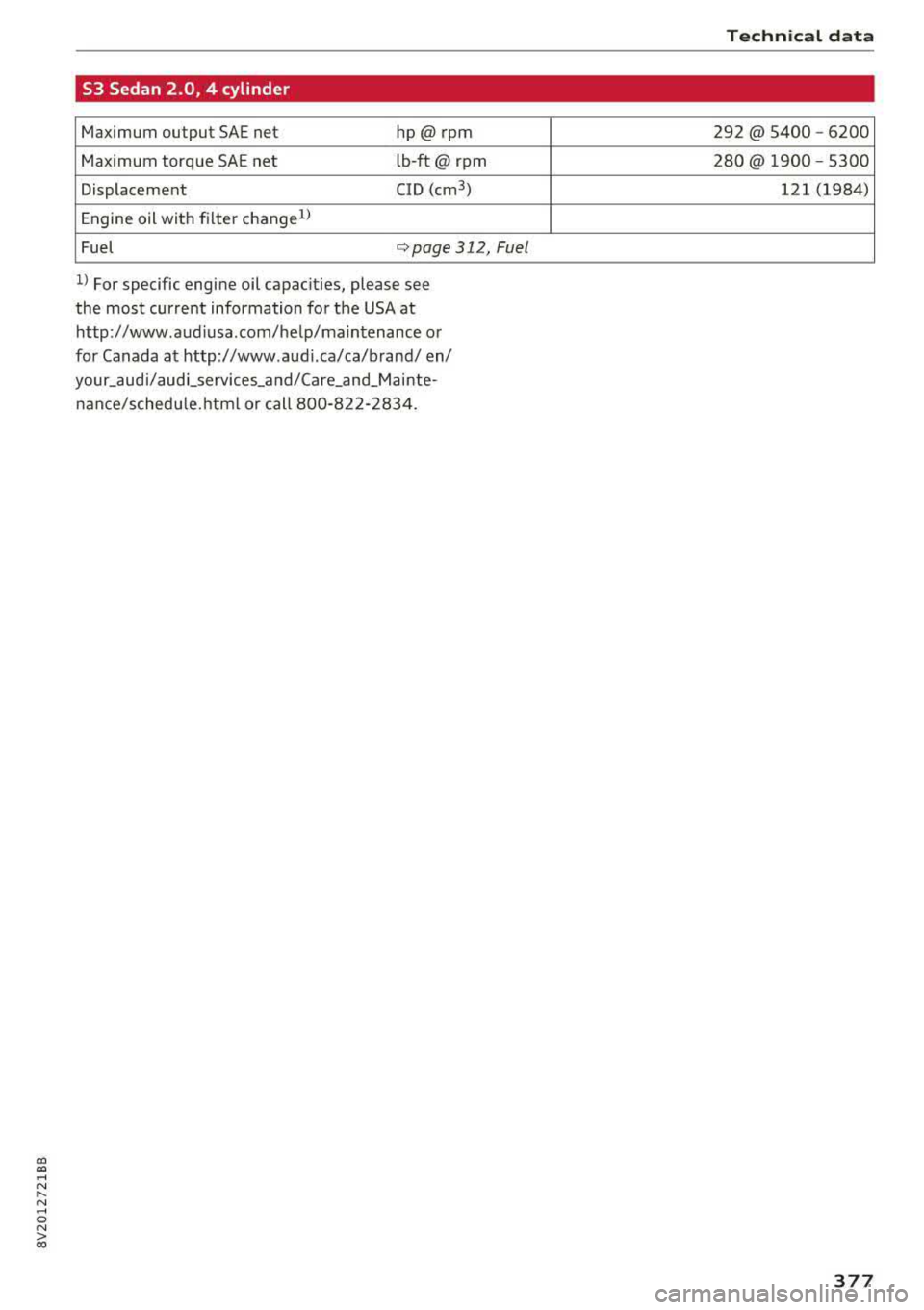
53 Sedan 2.0, 4 cylinder
Maximum output SAE net hp@rpnn
Maximum torque SAE net lb
-ft@ rpm
Displacement CID (cm
3
)
Engine oil with f ilter change1>
Fuel <=> page 312, Fuel
ll For specific engine oil capacities, please see
the most current information for the USA at
http:/ /www.audiusa.com/help/ma intenance or
for Canada at http:/ /www.audi.ca/ca/brand/ en/
your _aud i/ aud i_services_a nd/Ca re_and_M a i nte
na nce/ schedu le.html or call 800-822-2834.
Techn ical dat a
292 @ 5400 -6200
280@ 1900 - S300
121 (1984)
377