2017 Alfa Romeo MiTo spark
[x] Cancel search: sparkPage 125 of 212
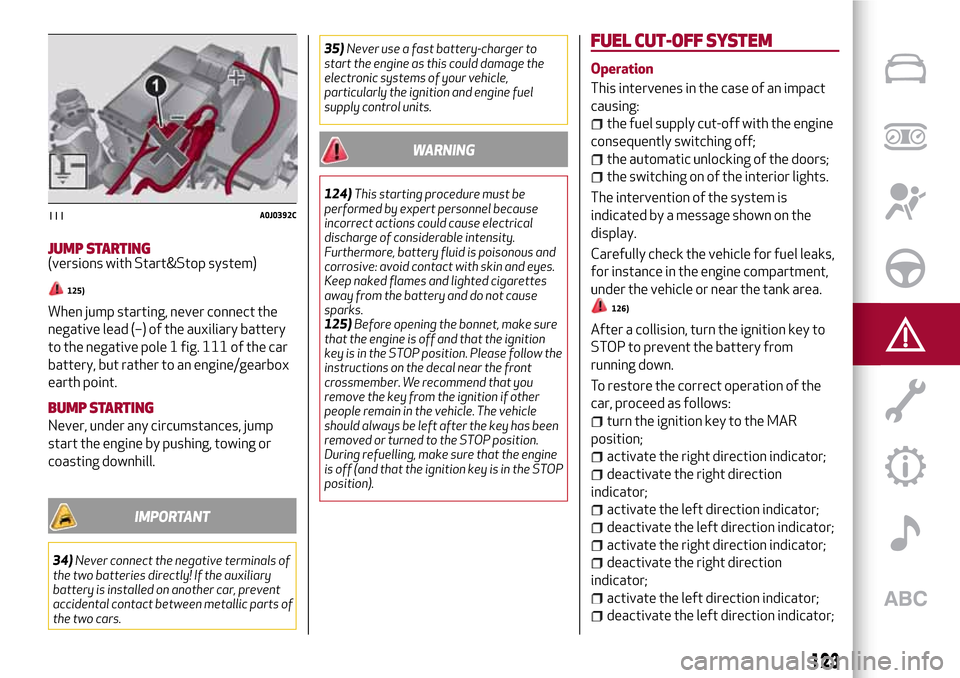
JUMP STARTING(versions with Start&Stop system)
125)
When jump starting, never connect the
negative lead (–) of the auxiliary battery
to the negative pole 1 fig. 111 of the car
battery, but rather to an engine/gearbox
earth point.
BUMP STARTING
Never, under any circumstances, jump
start the engine by pushing, towing or
coasting downhill.
IMPORTANT
34)Never connect the negative terminals of
the two batteries directly! If the auxiliary
battery is installed on another car, prevent
accidental contact between metallic parts of
the two cars.35)Never use a fast battery-charger to
start the engine as this could damage the
electronic systems of your vehicle,
particularly the ignition and engine fuel
supply control units.
WARNING
124)This starting procedure must be
performed by expert personnel because
incorrect actions could cause electrical
discharge of considerable intensity.
Furthermore, battery fluid is poisonous and
corrosive: avoid contact with skin and eyes.
Keep naked flames and lighted cigarettes
away from the battery and do not cause
sparks.
125)Before opening the bonnet, make sure
that the engine is off and that the ignition
key is in the STOP position. Please follow the
instructions on the decal near the front
crossmember. We recommend that you
remove the key from the ignition if other
people remain in the vehicle. The vehicle
should always be left after the key has been
removed or turned to the STOP position.
During refuelling, make sure that the engine
is off (and that the ignition key is in the STOP
position).
FUEL CUT-OFFSYSTEM
Operation
This intervenes in the case of an impact
causing:
the fuel supply cut-off with the engine
consequently switching off;
the automatic unlocking of the doors;
the switching on of the interior lights.
The intervention of the system is
indicated by a message shown on the
display.
Carefully check the vehicle for fuel leaks,
for instance in the engine compartment,
under the vehicle or near the tank area.
126)
After a collision, turn the ignition key to
STOP to prevent the battery from
running down.
To restore the correct operation of the
car, proceed as follows:
turn the ignition key to the MAR
position;
activate the right direction indicator;
deactivate the right direction
indicator;
activate the left direction indicator;
deactivate the left direction indicator;
activate the right direction indicator;
deactivate the right direction
indicator;
activate the left direction indicator;
deactivate the left direction indicator;
111A0J0392C
123
Page 133 of 212
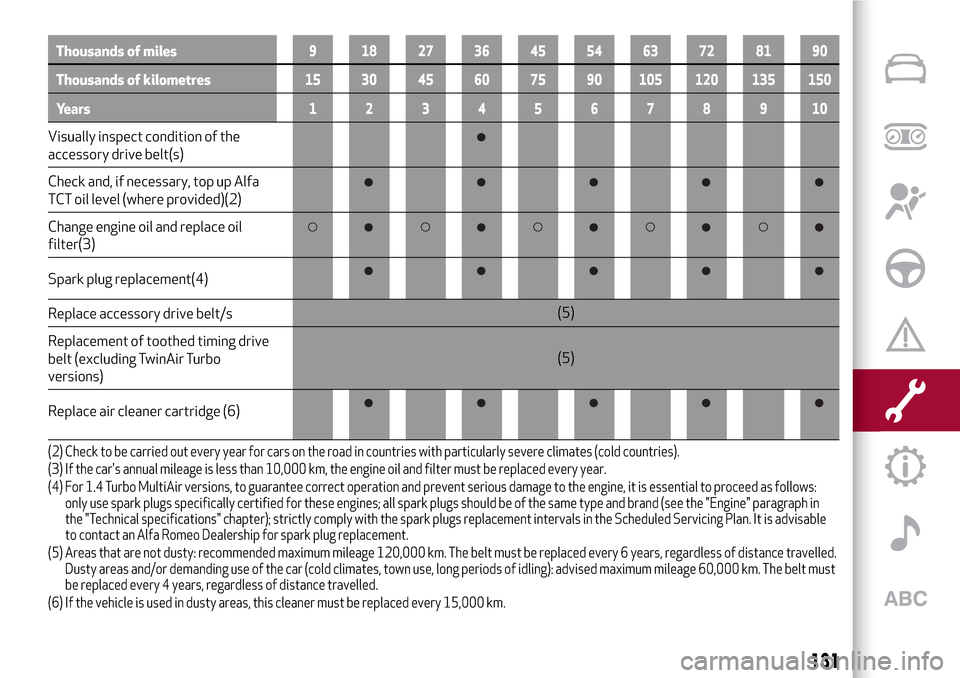
Thousands of miles9 182736455463728190
Thousands of kilometres15 30 45 60 75 90 105 120 135 150
Years12345678910
Visually inspect condition of the
accessory drive belt(s)
Check and, if necessary, top up Alfa
TCT oil level (where provided)(2)
Change engine oil and replace oil
filter(3)
Spark plug replacement(4)
Replace accessory drive belt/s(5)
Replacement of toothed timing drive
belt (excluding TwinAir Turbo
versions)(5)
Replace air cleaner cartridge (6)
(2) Check to be carried out every year for cars on the road in countries with particularly severe climates (cold countries).
(3) If the car's annual mileage is less than 10,000 km, the engine oil and filter must be replaced every year.
(4) For 1.4 Turbo MultiAir versions, to guarantee correct operation and prevent serious damage to the engine, it is essential to proceed as follows:
only use spark plugs specifically certified for these engines; all spark plugs should be of the same type and brand (see the "Engine" paragraph in
the "Technical specifications" chapter); strictly comply with the spark plugs replacement intervals in the Scheduled Servicing Plan. It is advisable
to contact an Alfa Romeo Dealership for spark plug replacement.
(5) Areas that are not dusty: recommended maximum mileage 120,000 km. The belt must be replaced every 6 years, regardless of distance travelled.
Dusty areas and/or demanding use of the car (cold climates, town use, long periods of idling): advised maximum mileage 60,000 km. The belt must
be replaced every 4 years, regardless of distance travelled.
(6) If the vehicle is used in dusty areas, this cleaner must be replaced every 15,000 km.
131
Page 148 of 212
BATTERY
The battery 6 (see previous pages) does
not require the electrolyte to be topped
up with distilled water. A periodic check
carried out at an Alfa Romeo Dealership
is, however, necessary to check
efficiency.
INSPECTING THE CHARGE AND THE
ELECTROLYTE LEVEL
139) 140) 141) 142)
43)
4)
If necessary, replace the battery with
another original battery with the same
specifications. Follow the battery
manufacturer's instructions for
maintenance.
USEFUL ADVICE FOR EXTENDING THE
LIFE OF YOUR BATTERY
To avoid draining your battery and make
it last longer, observe the following
instructions:
when you park the car, ensure that the
doors, tailgate and bonnet are closed
properly, to prevent any lights from
remaining on inside the passenger's
compartment;
switch off all roof lights inside the car:
the car is however equipped with a
system which switches all internal lights
off automatically;
do not keep accessories (e.g. radio,
hazard warning lights, etc.) switched on
for a long time when the engine is not
running;
before performing any operation on
the electrical system, disconnect the
negative battery cable.
IMPORTANT If the charge level remains
under 50% for a long time, the battery is
damaged by sulphation, reducing its
capacity and efficiency at start-up.
The battery will also be more at risk of
freezing (this can happen as early as
-10°C). Refer to the "Vehicle inactivity"
paragraph in "Starting and driving"
chapter if the vehicle is left parked for a
long time.
If, after purchasing the car, you wish to
install electrical accessories which
require permanent electrical supply (e.g.
alarm, etc.) or accessories which
influence the electrical supply
requirements, contact an Alfa Romeo
Dealership, whose qualified staff will
evaluate the overall electrical
consumption.
WARNING
139)Battery fluid is poisonous and
corrosive. Avoid contact with the skin and
eyes. Keep open flames away from the
battery and do not use objects that might
create sparks: risk of explosion and fire.
140)Using the battery with insufficient
fluid irreparably damages the battery and
may cause an explosion.
141)If the vehicle must remain unused for a
long time at a very low temperature, remove
the battery and take it to a warm place, to
avoid freezing.
142)When performing any operation on the
battery or near it, always protect your eyes
with special goggles.
IMPORTANT
43)Incorrect installation of electric and
electronic devices may cause severe damage
to your car. After purchasing your vehicle, if
you wish to install any accessories (e.g.
anti-theft, radio phone, etc.), go to an Alfa
Romeo Dealership, which will suggest the
most suitable devices and advise you
whether a higher capacity battery needs to
be installed.
146
SERVICING AND MAINTENANCE
Page 156 of 212

ENGINE
GENERAL INFORMATION Turbo TwinAir 105 HP Turbo TwinAir 100 HP(*)
Engine code 199B6000 199B7000
CycleOtto Otto
Number and position of cylinders 4 in line 4 in line
Piston bore and stroke (mm) 80.5 × 86 72.0 × 84.0
Total displacement (cm³) 875 875
Compression ratio 10 10
NATURAL DYNAMIC
Maximum power (EC) (kW) 72 77 73.5
Maximum power (EEC) (HP) 98 105 100
corresponding engine speed (rpm) 5750 5500 5500
Maximum torque (EC) (Nm) 120 145 145
Maximum torque (EC) (kgm) 12.2 14.8 14.8
corresponding engine speed (rpm) 1750 2000 2100
Spark plugs NGK ILKR9G8 NGK ILKR9G8
FuelUnleaded petrol 95 R.O.N. (EN
228 specifications)Unleaded petrol 95 R.O.N. (EN
228 specifications)
(*) Version for specific markets
154
TECHNICAL SPECIFICATIONS
Page 157 of 212

GENERAL INFORMATION 1.4 Petrol 8V 78 HP 1.4 Turbo Petrol/LPG 120 HP
Engine code 350A1000 198A4000
Cycle Otto Otto
Number and position of cylinders 4 in line 4 in line
Piston bore and stroke (mm) 72.0 × 84.0 72.0 × 84.0
Total displacement (cm³) 1368 1368
Compression ratio 11.1 9.8
LPG PETROL
Maximum power (EC) (kW) 57 88 88
Maximum power (EEC) (HP) 78 120 120
corresponding engine speed (rpm) 6000 5000 5000
Maximum torque (EC) (Nm) 115 206 206
Maximum torque (EC) (kgm) 11.7 21 21
corresponding engine speed (rpm) 3000 1750 2000
Spark plugs NGK ZKR7AI-8 NGK IKR9J8
Fuel Unleaded petrol 95 R.O.N.
(EN 228 specifications)LPG
(EN589Unleaded
petrol
95 R.O.N. (EN
228 specifications)
155
specification)
Page 158 of 212

GENERAL INFORMATION 1.4 Turbo MultiAir 135 HP 1.4 Turbo Multi Air 135/140 HP TCT
Engine code 955A2000955A7000 (*)
955B1000 (**)
Cycle Otto Otto
Number and position of cylinders 4 in line 4 in line
Piston bore and stroke (mm) 72.0 × 84.0 72.0 × 84.0
Total displacement (cm³) 1368 1368
Compression ratio 9.8 9.8
Maximum power (EC) (kW) 99 99 (*) / 103 (**)
Maximum power (EEC) (HP) 135 135 (*) / 140 (**)
corresponding engine speed (rpm) 5000 5000
NATURAL DYNAMIC NATURAL DYNAMIC
Maximum torque (EC) (Nm) 190 206 230 250
Maximum torque (EC) (kgm) 19.3 21 23.4 25.5
corresponding engine speed (rpm) 4250 1750 2250 2500
Spark plugs NGK IKR9F8 NGK IKR9J8
FuelUnleaded petrol 95 R.O.N. (EN
228 specifications)Unleaded petrol 95 R.O.N. (EN
228 specifications)
(*) 1.4 Turbo Multi Air 135 HP TCT version (where provided)
(**) 1.4 Turbo Multi Air 140 HP TCT version
156
TECHNICAL SPECIFICATIONS
Page 159 of 212

GENERAL INFORMATION 1.4 Turbo MultiAir 170 HP 1.4 Turbo MultiAir 170 HP TCT
Engine code 940A2000 940A2000
Cycle Otto Otto
Number and position of cylinders 4 in line 4 in line
Piston bore and stroke (mm) 72.0 × 84.0 72.0 × 84.0
Total displacement (cm³) 1368 1368
Compression ratio 9.8 9.8
Maximum power (EC) (kW) 125 125
Maximum power (EEC) (HP) 170 170
corresponding engine speed (rpm) 5000 5000
NATURAL DYNAMIC NATURAL DYNAMIC
Maximum torque (EC) (Nm) 230 250 230 250
Maximum torque (EC) (kgm) 23.4 25.5 23.4 25.5
corresponding engine speed (rpm) 2250 2500 2250 2500
Spark plugs NGK IKR9J8 NGK IKR9J8
FuelUnleaded petrol 95 R.O.N. (EN
228 specifications)Unleaded petrol 95 R.O.N. (EN
228 specifications)
157