2017 Alfa Romeo MiTo air
[x] Cancel search: airPage 46 of 212

Rain sensor
(where provided)
Adjustment (4 levels) of the sensitivity of
the rain sensor.
TripB activation
Activation (“On”) and deactivation (“Off”)
of Trip B display (partial trip counter). For
more information see the "Trip computer"
section.
Set time
Clock setting through two sub-menus:
“Time” and “Format”.
Set date
Date setting (day - month - year).
First page
(where provided)
Selection of the information you would
like to see on the main screen. You can
view the date or the trip distance.
See radio
On the instrument panel display, the
information onUconnect™system is
shown.
Autoclose
Activation of the automatic locking of the
doors on exceeding the speed of
20 km/h.
Measurement unit
Unit of measurement setting via three
submenus: “Distances”, “Fuelconsumption” and “Temperature”. If the
set distance unit is “km”, the display
allows the fuel consumption unit to be set
as km/l or l/100km. If the set distance
unit is “mi” the fuel consumption unit will
be displayed in “mpg”.
Language
Display language selection.
Warning volume
Adjustment (8 levels) of the volume of
the buzzer which accompanies the
display of failures/warnings.
Seat belt beep
This function can be displayed only after
an Alfa Romeo Dealership has
deactivated the SBR system (see
paragraph “SBR system” in the “Safety”
chapter).
Service
Display of information about km/mileage
intervals or, for versions/markets, where
provided, time intervals for car servicing.
Passenger airbag
Activation/deactivation of front
passenger side airbag and side air bag for
pelvis, chest and shoulder protection -
Side bag
Daytime running lights
Activation/deactivation of Daytime
Running Lights (DRL).Courtesy lights
This function turns on the internal
courtesy lights for approximately
25 seconds when the doors or luggage
compartment are opened using the
remote control. The courtesy lights are
turned off when the doors are closed or
locked using the remote control.
Exit Menu
Return to standard display screen.
44
KNOWING THE INSTRUMENT PANEL
Page 49 of 212
Warning lights on
panelWhat it means What to do
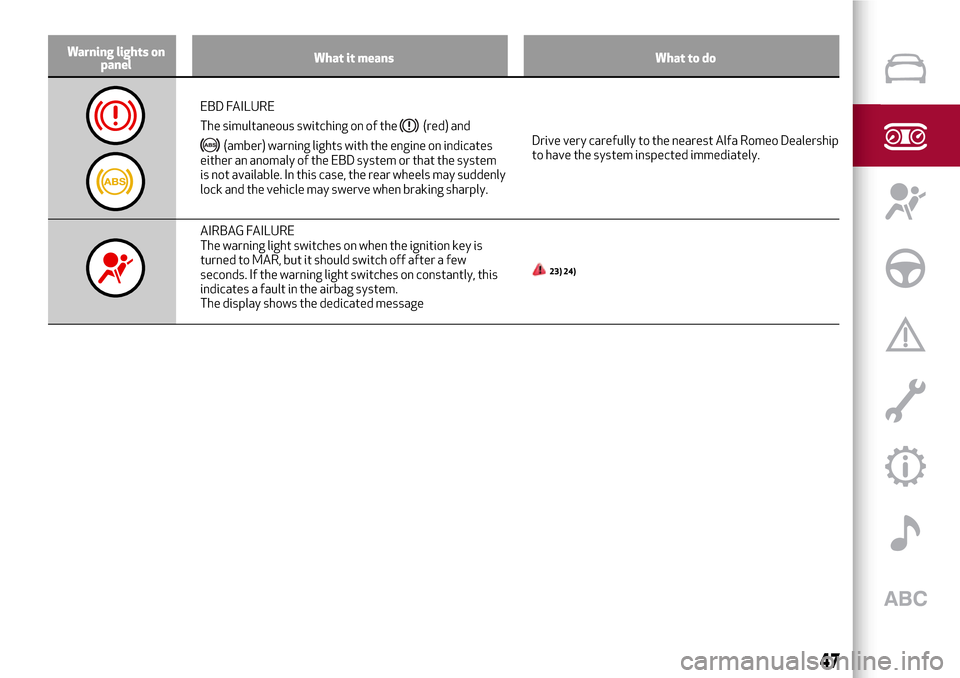
EBD FAILURE
The simultaneous switching on of the
(red) and
(amber) warning lights with the engine on indicates
either an anomaly of the EBD system or that the system
is not available. In this case, the rear wheels may suddenly
lock and the vehicle may swerve when braking sharply.Drive very carefully to the nearest Alfa Romeo Dealership
to have the system inspected immediately.
AIRBAG FAILURE
The warning light switches on when the ignition key is
turned to MAR, but it should switch off after a few
seconds. If the warning light switches on constantly, this
indicates a fault in the airbag system.
The display shows the dedicated message
23) 24)
47
Page 56 of 212

Warning lights on
panelWhat it means What to do
TPMS SYSTEM
Low tyre pressure
The warning light (or symbol on the display) switches on (on some
versions together with a message on the display) (together with
an acoustic signal) if the pressure in one or more tyres drops
below a preset threshold.
In this way the TPMS warns the driver that one or more tyres may
be dangerously flat and liable to puncture.In any situation in which the message on the
display is "See manual", it is ESSENTIAL to refer
to the contents of the "Wheels" paragraph in the
"Technical specifications" section, strictly
complying with the indications that you find
there.
IMPORTANT Do not continue driving with one or
more flat tyres as handling may be
compromised. Stop the vehicle, avoiding sharp
braking and steering. Replace the wheel
immediately with the spare wheel (where
provided) or carry out a prompt repair using the
dedicated kit (see the paragraph on “Replacing a
wheel” in chapter “In an emergency”) and contact
Alfa Romeo Dealership as soon as possible.
TPMS failure
This warning light switches on (on some versions together with a
message on the display) when a TPMS fault is detected.
Should one or more wheels be fitted without sensors, the display
will show a warning message until initial conditions are restored.Contact an Alfa Romeo Dealership as soon as
possible.
Check tyre pressure
The warning light switches on (on some versions together with a
message in the display) to indicate that the tyre pressure is below
the value recommended to guarantee long tyre life and low fuel
consumption. It may also indicate a slow loss of pressure.
Should two or more tyres be in the condition mentioned above,
the display will show the indications corresponding to each tyre in
sequence. In this case it is advisable to restore the correct
pressure value
54
KNOWING THE INSTRUMENT PANEL
Page 65 of 212
WARNING
23)If thewarning light does not switch on when the ignition device is moved to ON or if it stays on when driving (together with the message on
the display), there might be a fault in the restraint systems; in this case, the airbags or pretensioners may not deploy in the event of an accident or,
in a lower number of cases, they could deploy erroneously. Before proceeding, contact an Alfa Romeo Dealership to have the system checked
immediately.
24)A fault with the warning light
is signalled by illumination of the iconon the instrument panel display and by the flashing of passenger
airbag disabled warning light on the rearview mirror. In addition, the airbag system automatically disables the passenger side airbag (where
provided). In this case, the warning light may not indicate any faults with the restraint systems. Before proceeding, contact an Alfa Romeo
Dealership to have the system checked immediately.
25)If the warning light comes on, the exhausted engine oil should be changed as soon as possible, never drive more than 500 km from the first
switching-on of this warning light. Failure to observe the above may result in severe damage to the engine and invalidate the warranty. Remember
that when this warning light comes on, it does not mean that the level of engine oil is low, so if it flashes you must not top up the engine oil.
26)If the warning light flashes with the car in motion, contact an Alfa Romeo Dealership.
27)Always drive at a speed appropriate to the traffic conditions, the weather and traffic regulations. The engine may be switched off even if the
warning light is on: repeated interruptions of the regeneration process could cause an early deterioration of engine oil. For this reason it is
always advisable to wait for the symbol to go off before turning off the engine, following the instructions above. Do not complete the DPF
regeneration process when the vehicle is stopped.
IMPORTANT
13)If thewarning light switches on when driving, stop the engine immediately and contact an Alfa Romeo Dealership.
14)If, turning the ignition device to MAR, the warning lightdoes not turn on or if it turns on steadily or flashing when travelling (on some
versions together with the message on the display), contact an Alfa Romeo Dealership as soon as possible.
15)The presence of water in the fuel system circuit may cause severe damage to the injection system and irregular engine operation. If the
symbol is displayed contact an Alfa Romeo Dealership as soon as possible to bleed the system. If the above indications come on immediately
after refuelling, water has probably been introduced into the tank: stop the engine immediately and contact an Alfa Romeo Dealership.
63
Page 67 of 212
The chapter that you are about to read is very important: it
describes the safety systems with which the car is equipped and
provides instructions on how to use them correctly.
SAFETY
ACTIVE SAFETY SYSTEMS . . . . . . . . ................66
TPMS (Tyre Pressure Monitoring System) ................68
SEATBELTS .................................70
SBR SYSTEM (Seat Belt Reminder) . . . . ...............72
PRE-TENSIONERS . .............................73
CARRYING CHILDREN SAFELY . . . . . .................75
FITTING "UNIVERSAL" CHILD RESTRAINT SYSTEM (with seat
belts)......................................76
ISOFIX CHILD RESTRAINT SYSTEM SETUP . . . . . . . . . . . . . .79
FRONT AIRBAGS . . .............................81
SIDE AIRBAGS (SIDE BAG - WINDOW BAG) . . . . . . .........86
Page 71 of 212

In order to use the system properly, refer to the following table when you have to change wheels/tyres:
Operation Sensor Failure indication Alfa Romeo Dealership
intervention
– – YES Contact an Alfa Romeo Dealership
Wheel change with space-saver
wheelNO YES Repair damaged wheel
Wheel change with winter tyres NO YES Contact an Alfa Romeo Dealership
Wheel change with winter tyres YES NO –
Wheel change with others of a
different size (*)YES NO –
Switching wheels (front/rear) (**) YES NO –
(*) Given as an alternative in the Owner Handbook and available from Lineaccessori Alfa Romeo.
(**) Not cross-swapped (tyres must stay on the same side).
69
Page 72 of 212

WARNING
47)The presence of the TPMS does not
permit the driver to neglect regular checks
of the tyre pressure, including for the spare
wheel.
48)Tyre pressure must be checked with
tyres cold. Should it become necessary for
whatever reason to check pressure with
warm tyres, do not reduce pressure even
though it is higher than the prescribed value,
but repeat the check when tyres are cold.
49)Should one or more wheels be fitted
without sensors, the system will no longer be
available and, in addition to the TPMS
warning light flashing for less than one
minute before becoming constant, a warning
message will be shown on the display, until
4 wheels with sensors are fitted again.
50)The TPMS cannot warn of sudden
decreases in tyre pressure (for example
when a tyre bursts). In this case, stop the car,
braking with caution and avoiding abrupt
steering.
51)Replacing standard tyres with winter
tyres (and vice versa) requires TPMS
adjustment that must only be performed by
a dedicated Alfa Romeo Dealership.
52)Changes in outside temperature may
cause tyre pressures to vary. The TPMS
system may temporarily indicate
insufficient pressure. In this case, check the
tyre pressure when cold and, if necessary,
restore the inflation values.53)When a tyre is removed, it is advisable
to replace the rubber valve seal as well:
contact a dedicated Alfa Romeo Dealership.
Tyre and/or rim fitting/removal operations
require specific precautions; to avoid
damaging or fitting the sensors incorrectly,
tyre and/or rim fitting/removal operations
should only be carried out by specialised
staff. Contact a dedicated Alfa Romeo
Dealership.
54)Intense radio-frequency interference
may prevent the correct operation of the
TPMS. This condition will be indicated by a
message on the display. The message will
disappear automatically as soon as the
radio-frequency interference ceases to
affect the system.
55)The tyre repair kit (Fix&Go) provided
with the vehicle (for versions/markets,
where provided) is compatible with the
TPMS sensors; using sealants not equivalent
with that in the original kit may adversely
affect its operation. If sealants not
equivalent with the original one are used, it is
recommended to have the TPMS sensors
checked by a qualified repair centre.
SEAT BELTS
USING THE SEAT BELTS
56) 57) 58)
All vehicle seats are equipped with seat
belts with three anchor points and a
retractor.
The retractor mechanism operates
locking the belt in the event of sharp
braking or strong deceleration due to an
impact. This allows the belt strap to slide
freely and to adapt to the body of the
occupant. In the event of an accident, the
belt will lock reducing the risk of impact
inside the passenger compartment and
of being projected outside the vehicle.
The driver is responsible for respecting,
and ensuring that all the other occupants
of the vehicle also respect, the local laws
in force in relation to the use of the seat
belts.
Always fasten the seat belts before
setting off.
Using the seat belts
The belt should be worn keeping the
torso straight and rested against the
backrest.
To fasten the safety belts, hold the
tongue 1 fig. 43 and insert it into the
buckle 2, until it clicks into place. If the
seat belt jams during removal, let it
rewind for a short stretch, then pull it out
70
SAFETY
again without jerking.
Page 77 of 212
CARRYING CHILDREN SAFELY
For optimal protection in the event of an
impact, all occupants must be seated and
wearing adequate restraint systems,
including newborn and other children!
This prescription is compulsory in all EC
countries according to EC Directive
2003/20/EC.
Children below the height of 1.50 metres
and up to 12 years must be protected
with suitable restraint systems and be
seated on the rear seats. Statistics on
accidents indicate that the rear seats
offer greater safety for children.
Compared with an adult, a child's head is
larger and heavier in proportion to their
body and the child's muscular and bone
structures are not fully developed.
Therefore, correct restraint systems
other than adult seat belts are necessary
to reduce as much as possible the risk of
injuries in case of accident, braking or
sudden manoeuvre.
Children must be seated safely and
comfortably. Depending on the
characteristics of the child restraint
systems used, you are advised to keep
children in rearward facing child restraint
systems for as long as possible (at least
until 3-4 years old), since this is the most
protected position in the event of an
impact.
63) 64) 65) 66)
The choice of the most suitable child
restraint device depends on the weight of
the child; there are various types of child
restraint systems and you are advised
always to choose the one that is most
suitable for the child.
When over 1.50 m in height, from the
point of view of restraint systems,
children are considered as adults and
wear seat belts normally.
In Europe the characteristics of child
restraint systems are ruled by the
regulation ECE-R44, dividing them into
five weight groups:
Group Weight groups
Group 0up to 10 kg in
weight
Group 0+up to 13 kg in
weight
Group 1 9 - 18 kg
Group 2 15 - 25 kg
Group 3 22 - 36 kg
All restraint devices must bear the
certification data, together with the
control mark, on a label solidly fixed to
the child restraint system which must
never be removed.
Lineaccessori MOPAR® includes child
restraint systems for each weight group.These devices are recommended having
been specifically tested for Alfa Romeo
cars.
WARNING
63)SEVERE DANGER When a front
passenger airbag is fitted, do not install
rearward facing child restraint systems on
the front passenger seat. Deployment of the
airbag in an accident could cause fatal
injuries to the child regardless of the
severity of the collision. It is advisable to
always carry children in a child restraint
system on the rear seat, which is the most
protected position in the event of a collision.
64)On the sun visor there is a label with
suitable symbols reminding the user that it is
compulsory to deactivate the airbag if a
rearward facing child restraint system is
fitted. Always comply with the instructions
on the passenger side sun visor (see the
"Supplementary Restraint System (SRS) -
Airbag" paragraph).
65)Should it be necessary to carry a child on
the passenger side front seat in a rear facing
child restraint system, the passenger side
front airbag and side bag must be
deactivated through the display main menu
(see the "Display" paragraph, "Knowing the
instrument panel" chapter), verifying
deactivation by checking whether the
OFF LED has switched on in the trim
located on the dashboard. Move the
passenger's seat as far back as possible to
avoid contact between the child seat and the
dashboard.
75