Page 54 of 212

Warning lights on
panelWhat it means What to do
CRUISE CONTROL (for versions/markets, where
provided)
This warning light switches on when the ignition key is
turned to MAR, but it should switch off after a few
seconds, if the Cruise Control is deactivated. The
warning light switches on when the Cruise Control ring is
turned to the ON position (see the “Cruise Control”
paragraph in the "Knowing your vehicle" section).
SIDE LIGHTS
The warning light switches on when the side lights are
activated.
FOLLOW ME HOME
The warning light will turn on when this device is active
(see “Exterior lights”in the section “Knowing your car”).
DIPPED HEADLIGHTS
The warning light switches on when the dipped beam
headlights are turned on.
FRONT FOG LIGHTS
The warning light comes on when the front fog lights are
turned on.
LEFT DIRECTION INDICATOR
The warning light switches on when the direction
indicator control lever is moved downwards or, together
with the right direction indicator, when the hazard
warning light button is pressed.
52
KNOWING THE INSTRUMENT PANEL
Page 55 of 212
Warning lights on
panelWhat it means What to do
RIGHT DIRECTION INDICATOR
The warning light turns on when the direction indicator
control lever is moved upwards or, together with the left
direction indicator, when the hazard warning light button
is pressed.
Warning lights on
panelWhat it means What to do
MAIN BEAM HEADLIGHTS
The warning light switches on when the main beam
headlights are turned on.
53
Page 98 of 212

HAZARD WARNING LIGHTS
Operation
Press switch 1 fig. 71 to turn the lights
on/off.
Warning lights
andcome on and
the switch 1 will blink when the lights are
on.
Emergency braking
In the event of emergency braking the
hazard warning lights switch on
automatically as well as warning lights
andin the instrument panel.
The lights are switched off automatically
when the nature of braking changes.
108)
WARNING
108)The use of hazard warning lights is
governed by the highway code of the country
you are driving in: comply with legal
requirements.
REPLACING A BULB
32)109) 110) 111)
GENERAL INSTRUCTIONS
Check that the corresponding
contacts are not oxidised and that the
corresponding fuse is intact before
changing the bulb. For the location of
fuses, refer to the paragraph “If a fuse
blows” in this chapter.
replace blown bulbs with others of the
same type and power;
after replacing a headlight bulb,
always check its alignment;
IMPORTANT When the weather is cold or
damp or after heavy rain or washing, the
surface of headlights or rear lights may
steam up and/or form drops of
condensation on the inside. This is a
natural phenomenon due to the
difference in temperature and humidity
between the inside and the outside of the
glass which does not indicate a fault and
does not compromise the normal
operation of lighting devices. The mist
disappears quickly when the lights are
turned on, starting from the centre of the
diffuser, extending progressively
towards the edges.71A0K0622C
96
IN AN EMERGENCY
Page 100 of 212
Light bulbs Type Power Ref. Figure
Front side lights/Daytime running lights (DRL) LED – –
Rear
side lights LED – –
Dipped headlights H7 55 W D
Main beams H1 55 W E
Dipped/Main beam headlights (versions with Bi-Xenon
headlights) (for versions/markets, where provided)F D1S -
Front direction indicators PY24W 24W B
Rear direction indicators R10W 10 W B
Side direction indicators LED – –
Stop LED – –
3rd brake light LED – –
Number plate W5W 5 W A
Fog lights H3 55 W E
Rear fog light H21W 21 W B
Reversing light P21W 21 W B
Front ceiling light C10W 10 W C
Luggage compartment light W5W 5 W A
Glove compartment light C5W 5 W C
IMPORTANT
32)Halogen bulbs must be handled holding the metallic part only. Touching the transparent part of the bulb with your fingers may reduce the
intensity of the emitted light and even reduce the lifespan of the bulb. In the event of accidental contact, wipe the bulb with a cloth moistened with
alcohol and let the bulb dry.
98
IN AN EMERGENCY
Page 102 of 212
REPLACING AN EXTERIOR BULB
FRONT LIGHT CLUSTERS
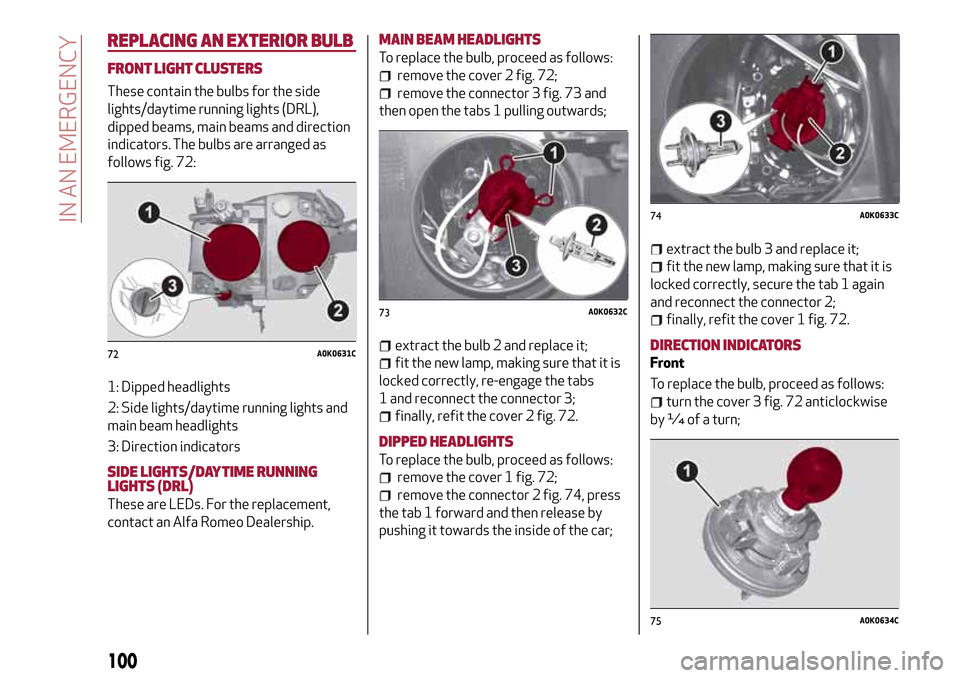
These contain the bulbs for the side
lights/daytime running lights (DRL),
dipped beams, main beams and direction
indicators. The bulbs are arranged as
follows fig. 72:
1: Dipped headlights
2: Side lights/daytime running lights and
main beam headlights
3: Direction indicators
SIDE LIGHTS/DAYTIME RUNNING
LIGHTS (DRL)
These are LEDs. For the replacement,
contact an Alfa Romeo Dealership.
MAIN BEAM HEADLIGHTS
To replace the bulb, proceed as follows:
remove the cover 2 fig. 72;
remove the connector 3 fig. 73 and
then open the tabs 1 pulling outwards;
extract the bulb 2 and replace it;
fit the new lamp, making sure that it is
locked correctly, re-engage the tabs
1 and reconnect the connector 3;
finally, refit the cover 2 fig. 72.
DIPPED HEADLIGHTS
To replace the bulb, proceed as follows:
remove the cover 1 fig. 72;
remove the connector 2 fig. 74, press
the tab 1 forward and then release by
pushing it towards the inside of the car;
extract the bulb 3 and replace it;
fit the new lamp, making sure that it is
locked correctly, secure the tab 1 again
and reconnect the connector 2;
finally, refit the cover 1 fig. 72.
DIRECTION INDICATORS
Front
To replace the bulb, proceed as follows:
turn the cover 3 fig. 72 anticlockwise
by ¼ of a turn;
72A0K0631C
73A0K0632C
74A0K0633C
75A0K0634C
100
IN AN EMERGENCY
Page 108 of 212
Dashboard fuse boxfig. 86
DEVICE PROTECTEDFUSE AMPERE
Right main beam headlightF91
7.5
Left main beam headlightF90 7.5
Right dipped beam headlight (versions with halogen headlights) F12 7.5
Left dipped beam headlight (versions with halogen headlights) F13 7.5
Right dipped beam headlight (versions with Bi-Xenon headlights) F12 15
Left dipped beam headlight (versions with Bi-Xenon headlights) F13 15
Right fog lightF93 7.5
Left fog lightF92 7.5
Luggage compartment courtesy light/Sun visor courtesy light/Glove compartment courtesy
light/Front and rear roof lightsF32 10
Various devicesF31 5
Rear electric window (left side) F33 20
Rear electric window (right side) F34 20
+30F36 10
Various devicesF37 7.5
Centralised locking systemF38 20
106
IN AN EMERGENCY
Page 123 of 212
Correct maintenance permits the performance of the car to be
maintained over time, as well as limited running costs and
safeguarding the efficiency of the safety systems.
This chapter explains how.
SERVICING AND MAINTENANCE
SCHEDULED SERVICING.........................122
SCHEDULED MAINTENANCE PLAN..................123
PERIODIC CHECKS............................130
DEMANDING USE OF THE CAR.....................130
CHECKING LEVELS ............................131
BATTERY RECHARGING .........................136
AIR CLEANER/POLLEN FILTER/DIESEL FILTER...........137
NOZZLES..................................137
HEADLIGHT WASHERS..........................138
BATTERY..................................138
LIFTING THE VEHICLE . .........................140
BODYWORK.................................140
INTERIOR..................................141
Page 125 of 212

SCHEDULED MAINTENANCE PLAN
PETROL VERSIONS
The checks listed in the Service Schedule, after reaching 150,000 km (90,000 mi)/10 years, must be cyclically repeated starting
from the first interval, thus following the same intervals as before.
Thousands of miles9 182736455463728190
Thousands of kilometres15 30 45 60 75 90 105 120 135 150
Years12345678910
Check tyre condition/wear and adjust pressure, if necessary;
check the condition/expiry date of the “Fix&Go” repair kit
(for versions/markets, where provided)
Check operation of lighting system (headlights, direction
indicators, hazard warning lights, boot, passenger
compartment, glove compartment, instrument panel warning
lights, etc.)
Check and, if necessary, top up fluid levels (1)
Check exhaust emissions
Use the diagnosis socket to check supply/engine
management systems operation, emissions and, for
versions/markets, where provided, engine oil degradation
(1) Always only use the liquids shown in the handbook for topping up after having checked that the system is not damaged.
123


