2017 Alfa Romeo 4C Spider light
[x] Cancel search: lightPage 137 of 297
NOTE:The internal air recirculation system makes it
possible to reach the required heating or ventilation
conditions more quickly. Do not use the internal air
recirculation function on rainy/cold days to avoid the
possibility of the windows misting.
Climate Control
Proceed as follows:
1. Rotate the Temperature Control to the blue section.
2. Turn the Blower Control to 1 (1st fan speed). For rapid cooling, turn Blower Control to 4 (maximum
fan speed).
3. Move the Recirculation Control to
.
4. Turn the Mode Control to.
5. Press the A/C button.
Cooling Adjustment
Proceed as follows:
1. Move the Recirculation Control to
.
2. Rotate the Temperature Control towards the red section to increase the temperature. 3. Turn the Blower Control counterclockwise to reduce
the fan speed.
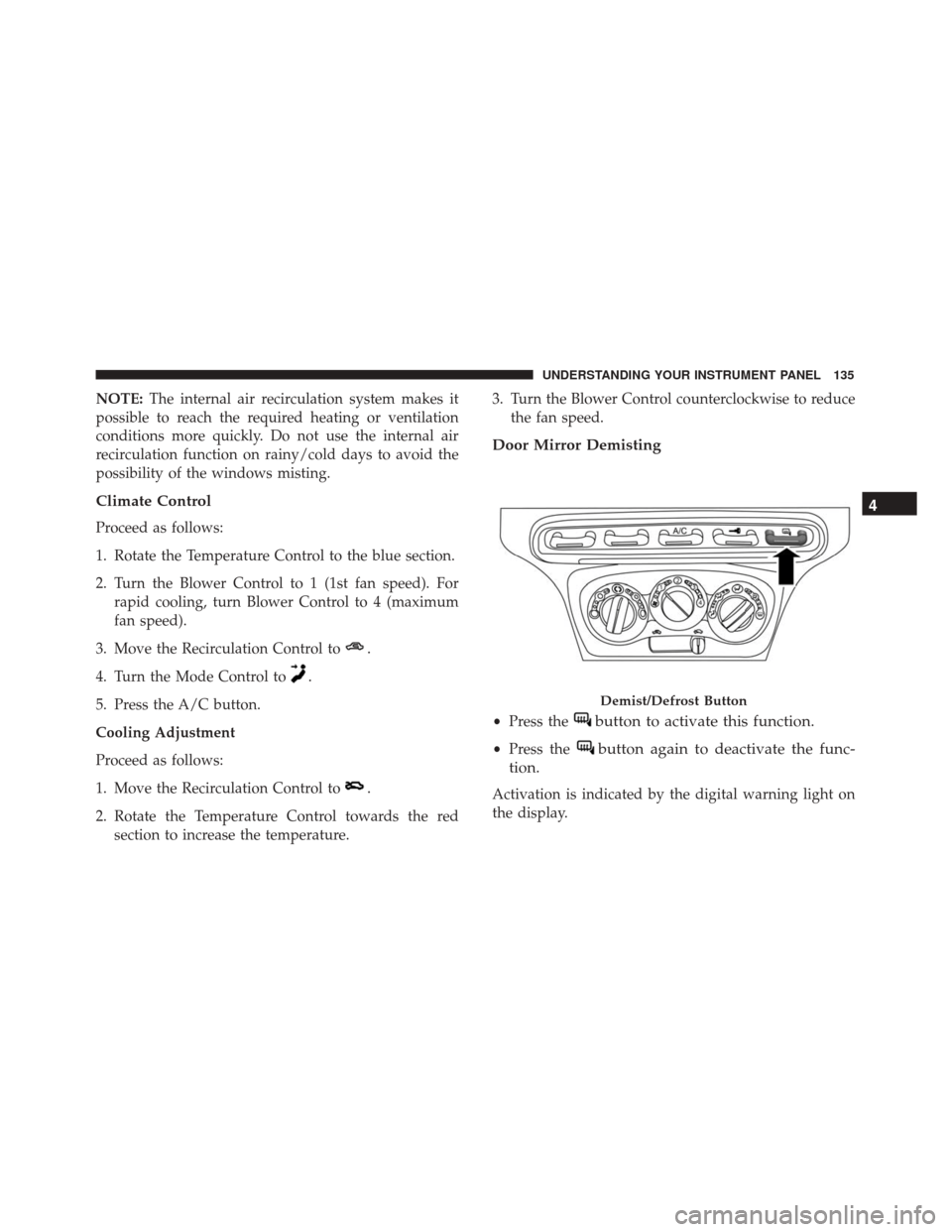
Door Mirror Demisting
•Press thebutton to activate this function.
•Press thebutton again to deactivate the func-
tion.
Activation is indicated by the digital warning light on
the display.
Demist/Defrost Button
4
UNDERSTANDING YOUR INSTRUMENT PANEL 135
Page 150 of 297

This also acts on the dynamic vehicle control systems
(engine, gearbox/transmission, ESC system).
Driving Modes
The Alfa DNA system lever will always return to the
center position after use.
The selected driving mode is indicated by the corre-
sponding LED switching in the panel and by an indi-
cation on the display.
Dynamic Mode
Activation
Move the Alfa DNA system lever upwards (to the letter
“D”) and hold in this position for half a second, until
the corresponding LED lights up and the Dynamic
mode activation indicator appears on the display.
When Dynamic mode is activated, the turbocharger
pressure and engine oil temperature screen is displayed
automatically. When released, the Alfa DNA system
lever will return to the central position.
NOTE:Dynamic Mode will be inhibited until the
vehicle has accumulated 155 miles (250 km).
Electronic Stability Control (ESC) and Anti-Slip Regu-
lation (ASR) systems:
The ESC and ASR system ensures more enjoyable,
sportier driving while guaranteeing the stability of the
vehicle.
Electronic Q2 system:
The system increases vehicle stability while accelerating
on bends, improving the agility of the vehicle.
Alfa DNA Mode Selector
148 STARTING AND OPERATING
Page 151 of 297

Engine And Gearbox/Transmission:
The system adjusts the transmission shift calibration for
sportier shifting.
NOTE:In Dynamic mode, the engine response to the
accelerator pedal position increases considerably. Con-
sequently, driving is less fluid and comfortable.
Deactivation
To deactivate Dynamic mode and return to Natural,
move lever downwards (to letter “A”) and hold for half
a second.
The LED corresponding to Natural mode will light up
and the Natural mode activation indication will appear
on the display.
Race Mode
Activation
Starting in Dynamic mode, move the Alfa DNA system
lever upwards (to the letter “D”) and hold in this
position for five seconds, until the Race mode activation
indicator appears on the display. When Race mode is activated, the longitudinal/lateral
accelerometer indicator screen (G-meter information) is
displayed automatically. This considers gravitational
acceleration (G).
Electronic Stability Control (ESC) and Anti-Slip Regu-
lation (ASR) systems:
These systems are deactivated in order to ensure the
fullest sensation of sport, leaving the driver in full
control of the vehicle. When the vehicle is in unstable
conditions, the ESC reactivates automatically when the
brake pedal is pressed until the ABS intervenes, thus
returning the vehicle to stable conditions. To deactivate
the ESC and ASR systems, reactivate Race mode.
Electronic Q2 system:
The system increases vehicle stability while accelerating
on bends, improving the agility of the vehicle.
Engine And Gearbox/Transmission:
The system adjusts the transmission shift calibration for
sportier shifting.5
STARTING AND OPERATING 149
Page 152 of 297

NOTE:In Race mode, the sensitivity of the accelerator
pedal increases considerably. Consequently, driving is
less fluid and comfortable.
In Race mode, the transmission only works in MANUAL
mode.
Deactivation
To deactivate Race mode and return to Dynamic mode,
move the Alfa DNA system lever downwards (to letter
“A”) and keep it in this position for half a second.
The LED corresponding to Dynamic mode will light up
and the Dynamic mode activation indication will ap-
pear on the display.
Natural Mode
Electronic Stability Control (ESC) and Anti-Slip Regu-
lation (ASR) systems:
ESC and ASR system thresholds are aimed at providing
comfort and safety in normal grip and driving condi-
tions.
Electronic Q2 system:
The system is calibrated to ensure the best driving
comfort. Engine And Gearbox/Transmission:
Standard response shifting.
All Weather Mode
Activation
Move the Alfa DNA system lever downwards (to the
letter “A”) and hold in this position for half a second,
until the corresponding LED lights up and the All
Weather mode activation indicator appears on the dis-
play.
Electronic Stability Control (ESC) and Anti-Slip
Regulation (ASR) systems:
ESC and ASR system thresholds are aimed at ensuring
maximum safety in low-grip driving conditions. It is
advisable to select All Weather mode in the presence of
low-grip road surfaces.
Electronic Q2 System:
The system is deactivated.
Engine And Gearbox/Transmission:
Standard response shifting.
150 STARTING AND OPERATING
Page 155 of 297

•Replace tires when tread wear indicators first become
visible.
• Keep tires properly inflated.
• Maintain sufficient distance between your vehicle
and the vehicle in front of you to avoid a collision in
a sudden stop.
Your vehicle may be equipped with a Limited Slip
Differential (LSD) that reduces, but does not eliminate,
the amount of wheel slip across a given axle for
improved handling.
DRIVING THROUGH WATER
Driving through water more than a few inches/
centimeters deep will require extra caution to ensure
safety and prevent damage to your vehicle.
Flowing/Rising Water
WARNING!
Do not drive on or across a road or path where water
is flowing and/or rising (as in storm run-off). Flow-
ing water can wear away the road or path’s surface
(Continued)
WARNING! (Continued)
and cause your vehicle to sink into deeper water.
Furthermore, flowing and/or rising water can carry
your vehicle away swiftly. Failure to follow this
warning may result in injuries that are serious or
fatal to you, your passengers, and others around
you.
Shallow Standing Water
Although your vehicle is capable of driving through
shallow standing water, consider the following Cau-
tions and Warnings before doing so.
WARNING!
•Driving through standing water limits your vehi-
cle’s traction capabilities. Do not exceed 5 mph
(8 km/h) when driving through standing water.
• Driving through standing water limits your vehi-
cle’s braking capabilities, which increases stop-
ping distances. Therefore, after driving through
standing water, drive slowly and lightly press on
the brake pedal several times to dry the brakes.
(Continued)
5
STARTING AND OPERATING 153
Page 156 of 297

WARNING!(Continued)
•Failure to follow these warnings may result in
injuries that are serious or fatal to you, your
passengers, and others around you.
CAUTION!
•Always check the depth of the standing water
before driving through it. Never drive through
standing water that is deeper than the bottom of
the tire rims mounted on the vehicle.
• Determine the condition of the road or the path
that is under water and if there are any obstacles
in the way before driving through the standing
water.
• Do not exceed 5 mph (8 km/h) when driving
through standing water. This will minimize wave
effects.
• Driving through standing water may cause dam-
age to your vehicle’s drivetrain components. Al-
ways inspect your vehicle’s fluids (i.e., engine oil,
transmission, axle, etc.) for signs of contamination
(i.e., fluid that is milky or foamy in appearance)
(Continued)
CAUTION! (Continued)
after driving through standing water. Do not
continue to operate the vehicle if any fluid ap-
pears contaminated, as this may result in further
damage. Such damage is not covered by the New
Vehicle Limited Warranty.
• Getting water inside your vehicle’s engine can
cause it to lock up and stall out, and cause serious
internal damage to the engine. Such damage is
not covered by the New Vehicle Limited War-
ranty.
PARKING BRAKE
Before leaving the vehicle, make sure that the parking
brake is fully applied. Also, be certain to leave manual
transmission in REVERSE (R) or FIRST (1st) gear.
The parking brake lever is located in the central tunnel.
To apply the parking brake, pull the parking brake lever
up as firmly as possible. To release the parking brake,
pull the parking brake lever up slightly, push the center
button, then lower the parking brake lever completely.
154 STARTING AND OPERATING
Page 157 of 297

When the parking brake is applied with the ignition
switch in the MAR (ACC/ON/RUN) position, the
Brake Warning Light in the instrument cluster will
illuminate.
When parking on a hill, it is important to turn the front
wheels toward the curb on a downhill grade and away
from the curb on an uphill grade. The parking brake
should always be applied whenever the driver is not in
the vehicle.
WARNING!
•Never leave children alone in a vehicle, or with
access to an unlocked vehicle.
• Allowing children to be in a vehicle unattended is
dangerous for a number of reasons. A child or
others could be seriously or fatally injured. Chil-
dren should be warned not to touch the parking
brake, brake pedal or the transmission gear selec-
tor.
• Do not leave the key fob in or near the vehicle or
in a location accessible to children. A child could
operate power windows, other controls, or move
the vehicle.
• Be sure the parking brake is fully disengaged
before driving; failure to do so can lead to brake
failure and a collision.
• Always fully apply the parking brake when leav-
ing your vehicle, or it may roll and cause damage
or injury. Also be certain to leave a manual
transmission in REVERSE or FIRST gear. Failure
to do so may allow the vehicle to roll and cause
damage or injury.
Parking Brake Lever
5
STARTING AND OPERATING 155
Page 158 of 297

CAUTION!
If the Brake Warning Light remains on with the
parking brake released, a brake system malfunction
is indicated. Have the brake system serviced by an
authorized dealer immediately.
BRAKE SYSTEM
Your vehicle is equipped with dual hydraulic brake
systems. If either of the two hydraulic systems loses
normal capability, the remaining system will still func-
tion. However, there will be some loss of overall brak-
ing effectiveness. You may notice increased pedal travel
during application, greater pedal force required to slow
or stop, and potential activation of the “Brake System
Warning Light”.
In the event power assist is lost for any reason (i.e.,
repeated brake applications with the engine off), the
brakes will still function. However, the effort required
to brake the vehicle will be much greater than that
required with the power system operating.
ESC (ELECTRONIC STABILITY CONTROL)
SYSTEM
The ESC system improves the directional control and
stability of the vehicle in various driving conditions.
The ESC system corrects the vehicle understeer and
oversteer, distributing the brake force on the appropri-
ate wheels. The torque supplied by the engine can also
be reduced in order to maintain control of the vehicle.
WARNING!
•Electronic Stability Control (ESC) cannot prevent
the natural laws of physics from acting on the
vehicle, nor can it increase the traction afforded
by prevailing road conditions. ESC cannot pre-
vent all collisions, including those resulting from
excessive speed in turns, driving on very slippery
surfaces, or hydroplaning. ESC also cannot pre-
vent collisions resulting from loss of vehicle
control due to inappropriate driver input for the
conditions. Only a safe, attentive, and skillful
driver can prevent collisions.The capabilities of
an ESC equipped vehicle must never be exploited
(Continued)
156 STARTING AND OPERATING