Page 224 of 297

Engine Air Cleaner Filter Selection
The quality of replacement engine air cleaner filters
varies considerably. Only high quality filters should be
used to assure most efficient service. MOPAR engine air
cleaner filters are a high quality filter and are recom-
mended.
Engine Cover
To avoid possible damage to the engine cover, please
disconnect each of the four mounting studs by pulling
the engine cover upward, and then lift off the complete
cover. Tilting the engine cover when one or more studs
are still engaged will lead to premature failure of the
couplers.
To reassemble the cover back onto the engine, first make
sure it is properly aligned, the oil cap is centered, and
that all four studs are lined up with their couplers. Then
gently push on the four corners of the engine cover to
snap the stud back into position.
No tools are required to remove or reassemble the
engine cover.
Maintenance-Free Battery
Your vehicle is equipped with a maintenance-free bat-
tery. You will never have to add water, nor is periodic
maintenance required.
WARNING!
•Battery fluid is a corrosive acid solution and can
burn or even blind you. Do not allow battery
fluid to contact your eyes, skin, or clothing. Do
not lean over a battery when attaching clamps. If
acid splashes in eyes or on skin, flush the area
immediately with large amounts of water. Refer
to “Jump-Starting Procedures” in “What To Do In
Emergencies” for further information.
• Battery gas is flammable and explosive. Keep
flame or sparks away from the battery. Do not use
a booster battery or any other booster source with
an output greater than 12 Volts. Do not allow
cable clamps to touch each other.
• Battery posts, terminals, and related accessories
contain lead and lead compounds. Wash hands
after handling.
(Continued)
222 MAINTAINING YOUR VEHICLE
Page 225 of 297

WARNING!(Continued)
•The battery in this vehicle has a vent hose that
should not be disconnected and should only be
replaced with a battery of the same type (vented).
CAUTION!
•It is essential when replacing the cables on the
battery that the positive cable is attached to the
positive post and the negative cable is attached to
the negative post. Battery posts are marked posi-
tive (+) and negative (-) and are identified on the
battery case. Cable clamps should be tight on the
terminal posts and free of corrosion.
•
If a “fast charger” is used while the battery is in the
vehicle, disconnect both vehicle battery cables be-
fore connecting the charger to the battery. Do not
use a “fast charger” to provide starting voltage.
Air Conditioner Maintenance
For best possible performance, your air conditioner
should be checked and serviced by an authorized dealer
at the start of each warm season. This service should include cleaning of the condenser fins and a perfor-
mance test. Drive belt tension should also be checked at
this time.
NOTE:
•
Use only refrigerants and compressor lubricants ap-
proved by the manufacturer for your air conditioning
system. Some unapproved refrigerants are flam-
mable and can explode, injuring you. Other unap-
proved refrigerants or lubricants can cause the sys-
tem to fail, requiring costly repairs. Refer to Warranty
Information Book, located on the USB card, for
further warranty information.
• The air conditioning system contains refrigerant un-
der high pressure. To avoid risk of personal injury or
damage to the system, adding refrigerant or any
repair requiring lines to be disconnected should be
done by an experienced technician.
CAUTION!
Do not use chemical flushes in your air condition-
ing system as the chemicals can damage your air
conditioning components. Such damage is not cov-
ered by the New Vehicle Limited Warranty.
7
MAINTAINING YOUR VEHICLE 223
Page 249 of 297

FUSES
WARNING!
•When replacing a blown fuse, always use an
appropriate replacement fuse with the same amp
rating as the original fuse. Never replace a fuse
with another fuse of higher amp rating. Never
replace a blown fuse with metal wires or any
other material. Failure to use proper fuses may
result in serious personal injury, fire and/or prop-
erty damage.
• Before replacing a fuse, make sure that the igni-
tion is off and that all the other services are
switched off and/or disengaged.
• If the replaced fuse blows again, contact an au-
thorized dealer.
• If a general protection fuse for safety systems (air
bag system, braking system), power unit systems
(engine system, gearbox system) or steering sys-
tem blows, contact an authorized dealer.
Engine Compartment Fuses
The engine compartment fuse box is located on the left
side of the engine compartment, next to the battery. To
access the fuses, remove screws and then remove the
cover.
Engine Compartment Fuse Box
1 — Forward Screw
2 — Fuse Box Cover
3 — Rearward Screw
7
MAINTAINING YOUR VEHICLE 247
Page 253 of 297
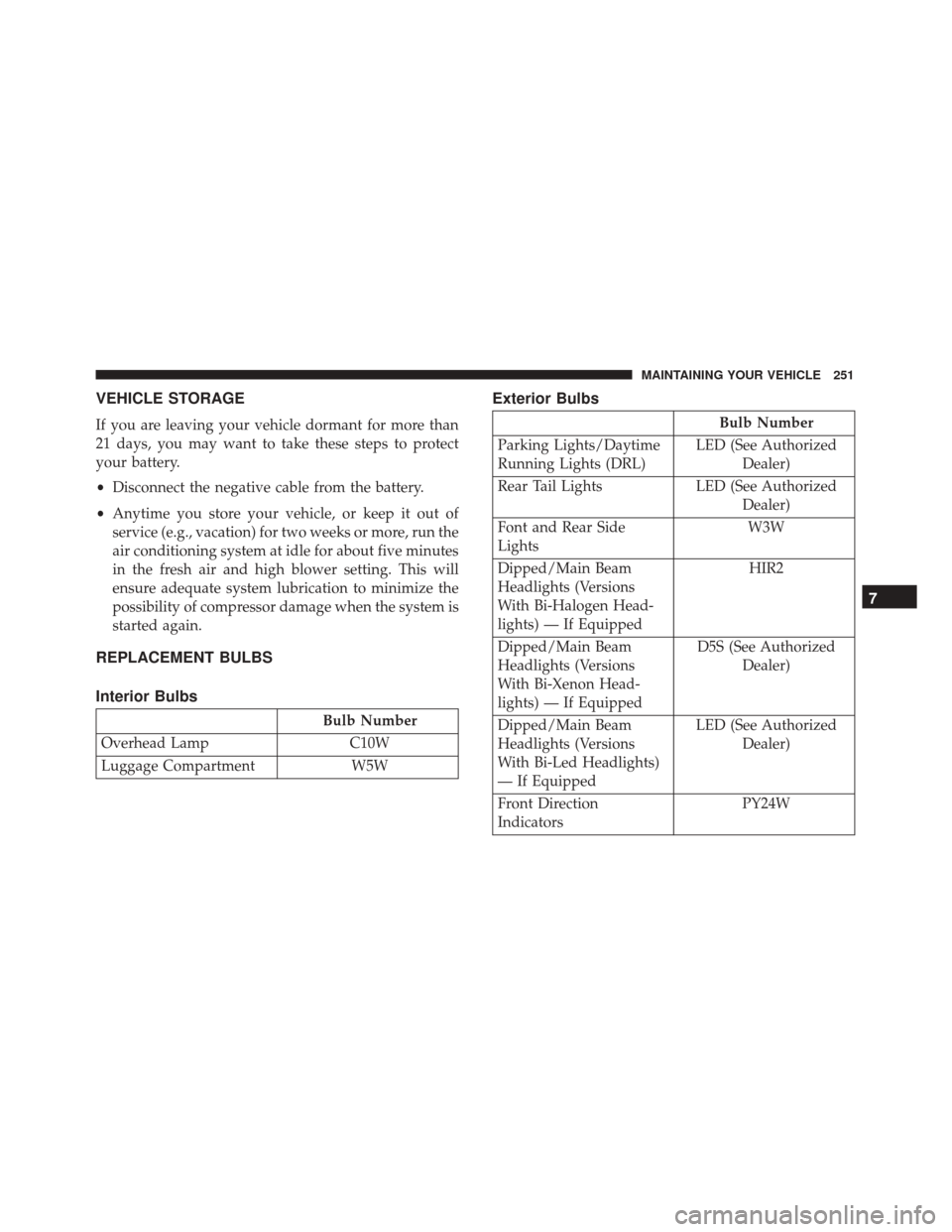
VEHICLE STORAGE
If you are leaving your vehicle dormant for more than
21 days, you may want to take these steps to protect
your battery.
•Disconnect the negative cable from the battery.
• Anytime you store your vehicle, or keep it out of
service (e.g., vacation) for two weeks or more, run the
air conditioning system at idle for about five minutes
in the fresh air and high blower setting. This will
ensure adequate system lubrication to minimize the
possibility of compressor damage when the system is
started again.
REPLACEMENT BULBS
Interior Bulbs
Bulb Number
Overhead Lamp C10W
Luggage Compartment W5W
Exterior Bulbs
Bulb Number
Parking Lights/Daytime
Running Lights (DRL) LED (See Authorized
Dealer)
Rear Tail Lights LED (See Authorized
Dealer)
Font and Rear Side
Lights W3W
Dipped/Main Beam
Headlights (Versions
With Bi-Halogen Head-
lights) — If Equipped HIR2
Dipped/Main Beam
Headlights (Versions
With Bi-Xenon Head-
lights) — If Equipped D5S (See Authorized
Dealer)
Dipped/Main Beam
Headlights (Versions
With Bi-Led Headlights)
— If Equipped LED (See Authorized
Dealer)
Front Direction
Indicators PY24W
7
MAINTAINING YOUR VEHICLE 251
Page 271 of 297

Under any of the above circumstances, the following
checks need to be performed more frequently than
indicated in the Maintenance Schedule:
•Check front and rear disc brake pad condition and
wear.
• Check cleanliness of tailgate locks.
• Check cleanliness and lubrication of chassis and
steering linkage.
• Visually inspect condition of: engine, gearbox, trans-
mission, pipes and hoses (exhaust - fuel system -
brakes) and rubber elements (gaiters - sleeves -
bushes - etc.).
• Check battery charge and battery fluid level (electro-
lyte).
• Visually inspect condition of the auxiliary drive belts.
• Check and, if necessary, change engine oil and re-
place oil filter.
• Check and, if necessary, replace air cleaner filter. Using the vehicle on a track should be regarded as an
exception. The vehicle has been designed and manufac-
tured for road use.
Change Engine Oil at 4,000 miles (6,500 km) if the
vehicle is operated in a dusty and off road environment.
This type of vehicle use is considered Severe Duty.
If the vehicle is operated in a dusty or dirty environ-
ment the engine air filter has to be changed every
6,500 miles (10,000 km).
Once A Month Or Before A Long Trip/Periodic Checks
Every 600 miles (1,000 km) or before long trips, check
and, if necessary, top off the following:
•
Check engine oil level.
• Check brake fluid level.
• Check windshield washer fluid level.
• Check the tire inflation pressures and look for un-
usual wear or damage.
• Check the fluid levels of the coolant reservoir and
brake master cylinder reservoir, and add as needed
• Check function of all interior and exterior lights.8
MAINTENANCE SCHEDULES 269
Page 272 of 297
•Check screen wash/wipe system and positioning/
wear of windshield.
Every 2,000 miles (3,000 km) check and, if necessary, top
up: engine oil level.
Maintenance Chart
Required Maintenance Intervals
Refer to the maintenance schedules on the following
page for the required maintenance intervals.
At Every Oil Change Interval As Indicated By Oil Change Indicator System:
Change oil and filter.
Inspect battery and clean and tighten terminals as required.
Inspect brake pads, shoes, rotors, drums, and hoses. Inspect engine cooling system protection and hoses. Check and adjust hand brake.Inspect exhaust system.
Inspect engine air cleaner filter if using in dusty or off-road conditions.
270 MAINTENANCE SCHEDULES
Page 273 of 297
Mileage or time passed
(whichever comes first)
12,000
24,000
36,000
48,000
60,000
72,000
84,000
96,000
108,000
120,000
132,000
144,000
156,000
Or Months: 12 24 36 48 60 72 84 96 108 120 132 144 156
Or Kilometers:
20,000
40,000
60,000
80,000
100,000
120,000
140,000
160,000
180,000
200,000
220,000
240,000
260,000
Check battery charge
status and possibly re-
charge # XXXXXXXXXXXXX
Check tire condition/wear
and adjust pressure if
required XXXXXXXXXXXXX
Check lighting system
operation (headlights, di-
rection indicators, hazard
lights, passenger compart-
ment lights, boot lights,
instrument panel warning
lights, etc.) XXXXXXXXXXXXX
Check vehicle fasteners X X X X X X X
Check mechanical
components fasteners XXXXXXXXXXXXX
Check windscreen wiper/
washer operation, adjust
nozzles XXXXXXXXXXXXX
8
MAINTENANCE SCHEDULES 271
Page 275 of 297
Mileage or time passed
(whichever comes first)
12,000
24,000
36,000
48,000
60,000
72,000
84,000
96,000
108,000
120,000
132,000
144,000
156,000
Or Months: 12 24 36 48 60 72 84 96 108 120 132 144 156
Or Kilometers:
20,000
40,000
60,000
80,000
100,000
120,000
140,000
160,000
180,000
200,000
220,000
240,000
260,000
Check condition and wear
of rear brake pads and
discs, and operation of
pad wear indicator XXXXXXXXXXXXX
Check and top off, if re-
quired, fluid levels (engine
coolant, brake/hydraulic
clutch fluid, windscreen
washer fluid, battery fluid,
etc) XXXXXXXXXXXXX
Visually inspect the condi-
tion of accessory drive
belt(s) XX X X
Check condition of timing
belt XX X
Check handbrake lever
travel and adjust, if neces-
sary (or every 12 months) XXXXXXXXXXXXX
8
MAINTENANCE SCHEDULES 273


