2017 Alfa Romeo 4C Spider warning
[x] Cancel search: warningPage 208 of 297

Drive Vehicle
Immediately after injecting sealant and inflating the
tire, drive the vehicle 5 miles (8 km) or 10 minutes to
ensure distribution of the Tire Service Kit Sealant within
the tire. Do not exceed 50 mph (80 km/h).
WARNING!
Tire Service Kit is not a permanent flat tire repair.
Have the tire inspected and repaired or replaced
after using Tire Service Kit. Do not exceed 50 mph
(80 km/h) until the tire is repaired or replaced.
Failure to follow this warning can result in injuries
that are serious or fatal to you, your passengers, and
others around you.
After Driving
1. Attach the air pump hose (black) to the repaired tire.
2. Check the pressure in the tire by reading the pressure gauge. If the pressure is less than 19 psi (1.3 Bar), the
tire is too badly damaged. Do not attempt to drive
the vehicle further. Call for assistance.
NOTE: A replacement sealant cartridge is available at
your authorized dealer.
JUMP-STARTING
If your vehicle has a discharged battery it can be
jump-started using a set of jumper cables and a battery
in another vehicle or by using a portable battery booster
pack. Jump-starting can be dangerous if done improp-
erly so please follow the procedures in this section
carefully.
NOTE: When using a portable battery booster pack
follow the manufacturer’s operating instructions and
precautions.
WARNING!
Do not attempt jump-starting if the battery is fro-
zen. It could rupture or explode and cause personal
injury.
CAUTION!
Do not use a portable battery booster pack or any
other booster source with a system voltage greater
than 12 Volts or damage to the battery, starter motor,
alternator or electrical system may occur.
206 WHAT TO DO IN EMERGENCIES
Page 209 of 297

Preparations For Jump-Start
The battery in your vehicle is located on the left side of
the engine compartment. To access the battery remove
the protective cover.
WARNING!
•Remove any metal jewelry such as rings, watch
bands and bracelets that could make an inadver-
tent electrical contact. You could be seriously
injured.
(Continued)
WARNING! (Continued)
•Batteries contain sulfuric acid that can burn your
skin or eyes and generate hydrogen gas which is
flammable and explosive. Keep open flames or
sparks away from the battery.
NOTE: Be sure that the disconnected ends of the cables
do not touch while still connected to the other vehicle.
1. Firmly apply the parking brake, and turn the ignition OFF.
2. Turn off the heater, radio, and all unnecessary elec- trical accessories.
3. To remove the protective cover off the battery, pull upward on the cover.
4. If using another vehicle to jump-start the battery, park the vehicle within the jumper cables reach, set
the parking brake and make sure the ignition is OFF.
WARNING!
Do not allow vehicles to touch each other as this
could establish a ground connection and personal
injury could result.
Battery Location
6
WHAT TO DO IN EMERGENCIES 207
Page 210 of 297

Jump-Starting Procedure
WARNING!
Failure to follow this jump-starting procedure
could result in personal injury or property damage
due to battery explosion.
CAUTION!
Failure to follow these procedures could result in
damage to the charging system of the booster ve-
hicle or the discharged vehicle.Connecting The Jumper Cables
1. Connect the positive(+)end of the jumper cable to
the positive (+)post of the vehicle with the dis-
charged battery.
2. Connect the opposite end of the positive (+)jumper
cable to the positive (+)post of the booster battery.
3. Connect the negative end (-)of the jumper cable to
the negative (-)post of the booster battery.
Positive (+) Battery Post
208 WHAT TO DO IN EMERGENCIES
Page 211 of 297

4. Connect the opposite end of the negative(-)jumper
cable to a good engine ground of the vehicle with the
discharged battery (exposed metal part of the en-
gine) away from the battery and the fuel injection
system.
WARNING!
Do not connect the jumper cable to the negative (-)
post of the discharged battery. The resulting elec-
trical spark could cause the battery to explode and
could result in personal injury. Only use the spe-
cific ground point, do not use any other exposed
metal parts.
5. Start the engine in the vehicle that has the booster battery, let the engine idle a few minutes, and then
start the engine in the vehicle with the discharged
battery.
6. Once the engine is started, remove the jumper cables in the reverse sequence:
Disconnecting The Jumper Cables
1. Disconnect the negative (-)jumper cable from the
engine (-)ground of the vehicle with the discharged
battery. 2. Disconnect the negative end
(-)of the jumper cable
from the negative (-)post of the booster battery.
3. Disconnect the opposite end of the positive (+)
jumper cable from the positive (+)post of the booster
battery.
4. Disconnect the positive (+)end of the jumper cable
from the positive (+)post of the vehicle with the
discharged battery.
If frequent jump-starting is required to start your ve-
hicle you should have the battery and charging system
inspected at your authorized dealer.
CAUTION!
Accessories plugged into the vehicle power outlets
draw power from the vehicle’s battery, even when
not in use (i.e., cellular devices, etc.). Eventually, if
plugged in long enough without engine operation,
the vehicle’s battery will discharge sufficiently to
degrade battery life and/or prevent the engine from
starting.
6
WHAT TO DO IN EMERGENCIES 209
Page 213 of 297
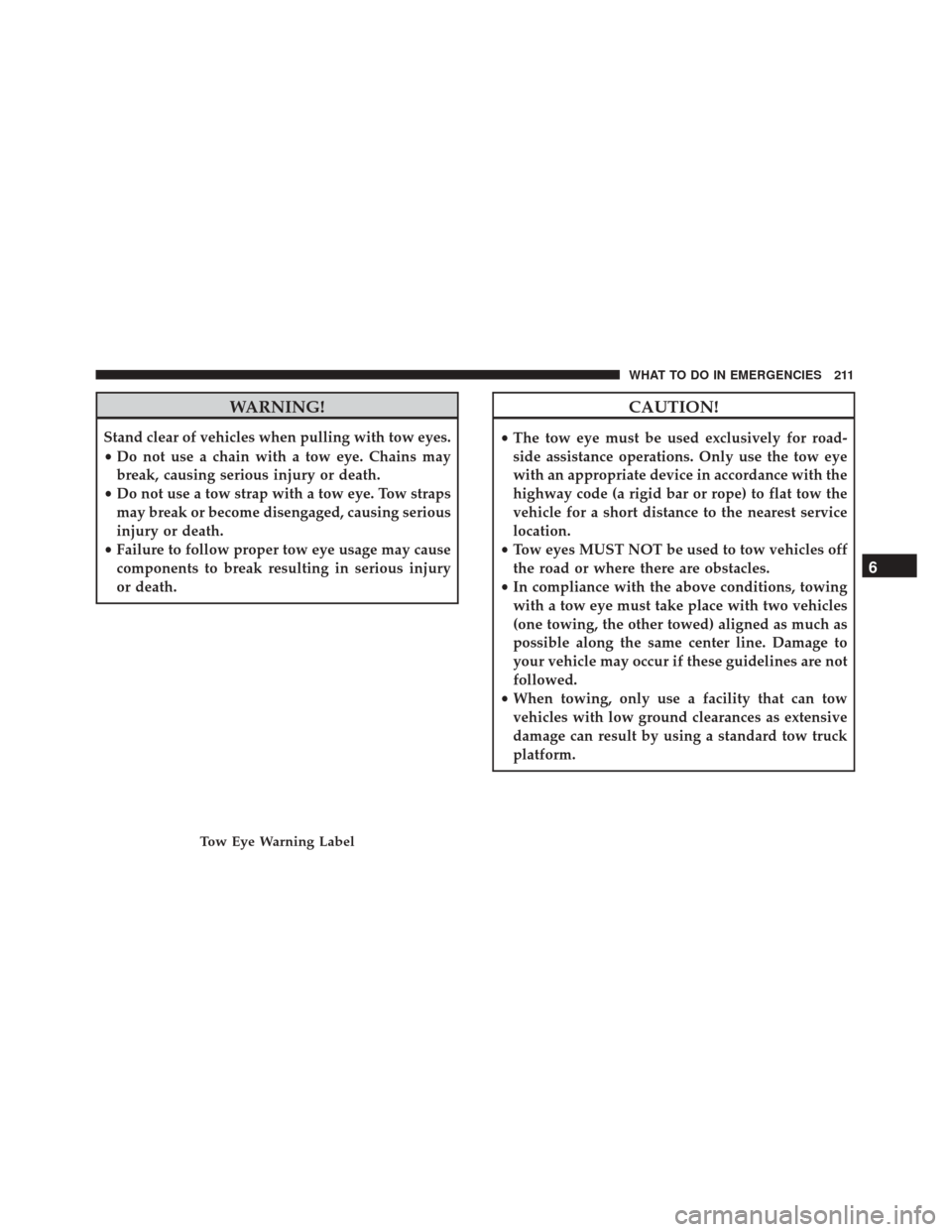
WARNING!
Stand clear of vehicles when pulling with tow eyes.
•Do not use a chain with a tow eye. Chains may
break, causing serious injury or death.
• Do not use a tow strap with a tow eye. Tow straps
may break or become disengaged, causing serious
injury or death.
• Failure to follow proper tow eye usage may cause
components to break resulting in serious injury
or death.
CAUTION!
•The tow eye must be used exclusively for road-
side assistance operations. Only use the tow eye
with an appropriate device in accordance with the
highway code (a rigid bar or rope) to flat tow the
vehicle for a short distance to the nearest service
location.
• Tow eyes MUST NOT be used to tow vehicles off
the road or where there are obstacles.
• In compliance with the above conditions, towing
with a tow eye must take place with two vehicles
(one towing, the other towed) aligned as much as
possible along the same center line. Damage to
your vehicle may occur if these guidelines are not
followed.
• When towing, only use a facility that can tow
vehicles with low ground clearances as extensive
damage can result by using a standard tow truck
platform.
Tow Eye Warning Label
6
WHAT TO DO IN EMERGENCIES 211
Page 219 of 297

WARNING!
•ONLY an authorized service technician should
connect equipment to the OBD II connection port
in order to diagnose or service your vehicle.
• If unauthorized equipment is connected to the
OBD II connection port, such as a driver-behavior
tracking device, it may:
• Be possible that vehicle systems, including
safety related systems, could be impaired or a
loss of vehicle control could occur that may
result in an accident involving serious injury or
death.
• Access, or allow others to access, information
stored in your vehicle systems, including per-
sonal information.
For further information, refer to “Cybersecurity” in the
“Understanding Your Instrument Panel” section.
EMISSIONS INSPECTION AND MAINTENANCE
PROGRAMS
In some localities, it may be a legal requirement to pass
an inspection of your vehicle’s emissions control sys-
tem. Failure to pass could prevent vehicle registration. For states that require an Inspection and Main-
tenance (I/M), this check verifies the “Malfunc-
tion Indicator Light (MIL)” is functioning and is
not on when the engine is running, and that the OBD II
system is ready for testing.
Normally, the OBD II system will be ready. The OBD II
system may notbe ready if your vehicle was recently
serviced, recently had a dead battery or a battery
replacement. If the OBD II system should be deter-
mined not ready for the I/M test, your vehicle may fail
the test.
Your vehicle has a simple ignition actuated test, which
you can use prior to going to the test station. To check
if your vehicle’s OBD II system is ready, you must do
the following:
1. Cycle the ignition switch to the ON position, but do not crank or start the engine.
7
MAINTAINING YOUR VEHICLE 217
Page 221 of 297

NOTE:Intentional tampering with emissions control
systems may void your warranty and could result in
civil penalties being assessed against you.
WARNING!
You can be badly injured working on or around a
motor vehicle. Only do service work for which you
have the knowledge and the proper equipment. If
you have any doubt about your ability to perform a
service job, take your vehicle to a competent me-
chanic.
MAINTENANCE PROCEDURES
The pages that follow contain the requiredmaintenance
services determined by the engineers who designed
your vehicle.
Besides those maintenance items specified in the fixed
maintenance schedule, there are other components
which may require servicing or replacement in the
future.
CAUTION!
• Failure to properly maintain your vehicle or per-
form repairs and service when necessary could
result in more costly repairs, damage to other
components or negatively impact vehicle perfor-
mance. Immediately have potential malfunctions
examined by an authorized dealer or qualified
repair center.
• Your vehicle has been built with improved fluids
that protect the performance and durability of
your vehicle and also allow extended mainte-
nance intervals. Do not use chemical flushes in
these components as the chemicals can damage
your engine, transmission, or air conditioning.
Such damage is not covered by the New Vehicle
Limited Warranty. If a flush is needed because of
component malfunction, use only the specified
fluid for the flushing procedure.
Engine Oil
Checking Oil Level
To assure proper engine lubrication, the engine oil must
be maintained at the correct level. Check the oil level at
7
MAINTAINING YOUR VEHICLE 219
Page 222 of 297

regular intervals. The best time to check the engine oil
level is before starting the engine after it has sat
overnight.
Do not check oil level when the engine is warm.
Checking engine oil level when the engine is warm will
give you an incorrect reading.
Checking the oil while the vehicle is on level ground,
and has sat overnight, will improve the accuracy of the
oil level readings. Maintain the oil level between the
range markings on the dipstick. The safe range is
indicated by a crosshatch zone. Adding 1 quart of oil
when the reading is at the low end of the indicated
range will result in the oil level at the full end of the
indicator range.
CAUTION!
Do not overfill the engine with oil. Overfilling the
engine with oil will cause oil aeration, which can
lead to loss of oil pressure and an increase in oil
temperature. This loss of oil pressure and increased
oil temperature could damage your engine.
Change Engine Oil
The oil change indicator system will remind you that it
is time to take your vehicle in for scheduled mainte-
nance. Refer to the “Maintenance Schedule” for further
information.
NOTE:The actual interval for changing the oil and
replacing the engine oil filter depends on the vehicle
usage conditions and is signalled by the warning light
or message (if present) on the instrument panel or every
12 months.
Engine Oil Selection
For best performance and maximum protection for
turbocharged engines under all types of operating
conditions, the manufacturer recommends synthetic
engine oils that are API Certified and meet the require-
ments of FCA Material Standard MS-12991.
Engine Oil Viscosity — 1750 Turbo Engine (SAE
Grade)
SAE 5W-40 full synthetic engine oil is recommended for
all operating temperatures. This engine oil improves
low temperature starting and vehicle fuel economy.
220 MAINTAINING YOUR VEHICLE