2017.5 VAUXHALL MOVANO_B clock
[x] Cancel search: clockPage 193 of 259
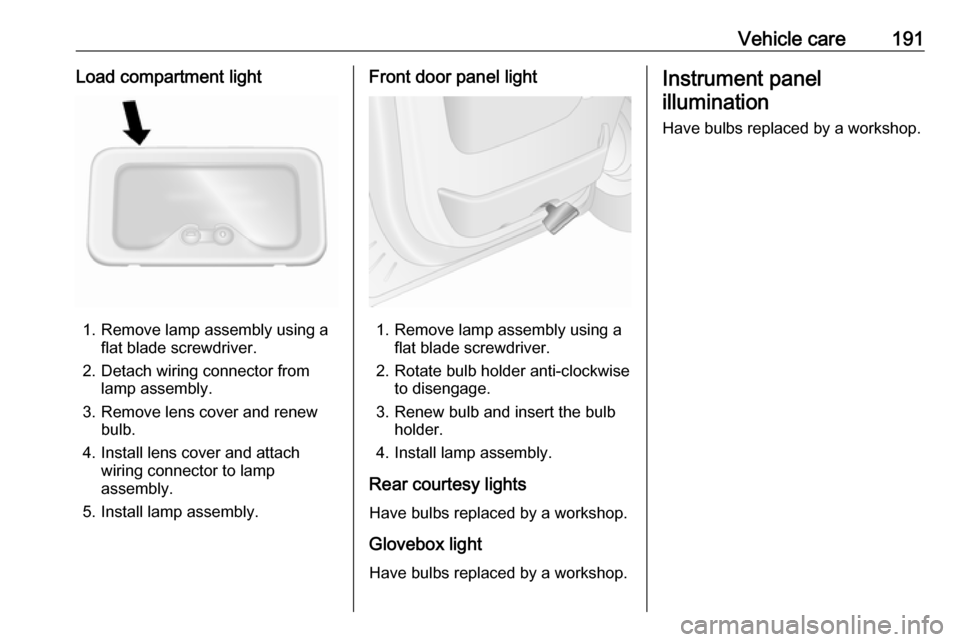
Vehicle care191Load compartment light
1. Remove lamp assembly using aflat blade screwdriver.
2. Detach wiring connector from lamp assembly.
3. Remove lens cover and renew bulb.
4. Install lens cover and attach wiring connector to lamp
assembly.
5. Install lamp assembly.
Front door panel light
1. Remove lamp assembly using a flat blade screwdriver.
2. Rotate bulb holder anti-clockwise to disengage.
3. Renew bulb and insert the bulb holder.
4. Install lamp assembly.
Rear courtesy lights
Have bulbs replaced by a workshop.
Glovebox light
Have bulbs replaced by a workshop.
Instrument panel illumination
Have bulbs replaced by a workshop.
Page 210 of 259
208Vehicle careNotice
If applicable, fit anti-theft bolts
nearest the tyre valve (otherwise it
may not be possible to refit the wheel cover).
10. Stow the replaced wheel 3 208
and the vehicle tools 3 196.
11. Have the new wheel balanced on the vehicle. Check the tyre
pressure of the installed tyre
3 243 and also the wheel bolt/nut
torque as soon as possible.
Have the defective tyre renewed or
repaired.
Spare wheel Some vehicles are equipped with atyre repair kit instead of a spare wheel
3 202.
If mounting a spare wheel which is
different from the other wheels, this
wheel might be classified as a
temporary spare wheel and the
corresponding speed limits apply,
even though no label indicates this.
Seek the assistance of a workshop to
check the applicable speed limit.Caution
The use of a spare wheel that is smaller than the other wheels or in combination with winter tyres
could affect driveability. Have the defective tyre replaced as soon as
possible.
The spare wheel is held under the
vehicle frame using a winch and
secured by tightening a cable using
the wheel wrench and adapters
(depending on vehicle).
It may be necessary to jack the
vehicle up to gain access to the spare
wheel on a fully loaded vehicle with a flat rear tyre.
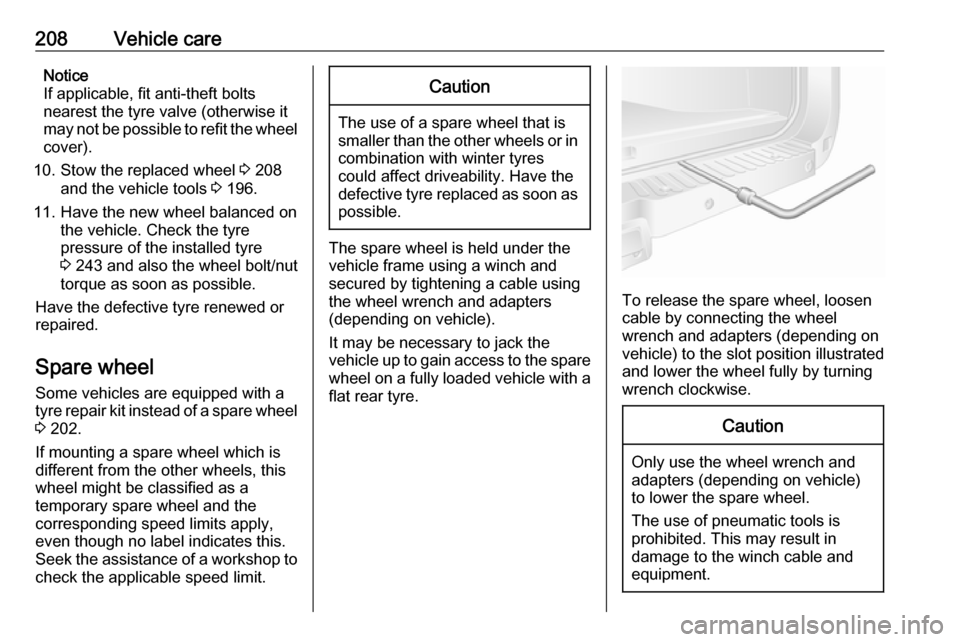
To release the spare wheel, loosen
cable by connecting the wheel
wrench and adapters (depending on
vehicle) to the slot position illustrated
and lower the wheel fully by turning
wrench clockwise.
Caution
Only use the wheel wrench and
adapters (depending on vehicle)
to lower the spare wheel.
The use of pneumatic tools is
prohibited. This may result in
damage to the winch cable and
equipment.
Page 212 of 259

210Vehicle careThen tighten cable using the wheel
wrench and adapters by connecting
to the slot position illustrated above
and turning wrench anticlockwise
until the wheel is secured in the fully
raised position.9 Warning
Ensure the front of the wheel (side
with tyre valve) is facing upwards
when the spare wheel is
reinstalled below the vehicle
frame.
Temporary spare wheel
Caution
The use of a spare wheel that is smaller than the other wheels or in combination with winter tyres
could affect driveability. Have the defective tyre replaced as soon as
possible.
Only mount one temporary spare
wheel. Do not drive faster than
50 mph. Take curves slowly. Do not
use for a long period of time.
If your vehicle gets a flat tyre on the
rear while towing another vehicle,
mount the temporary spare wheel in
the front and the full tyre in the rear.
Tyre chains 3 202.
Summer and winter tyres
If you use winter tyres, the spare
wheel may still be fitted with a
summer tyre.
If you use the spare wheel when it is
fitted with a summer tyre the vehicle's driveability may be affected,
especially on slippery road surfaces.
Directional tyres Fit directional tyres such that they rollin the direction of travel. The rolling
direction is indicated by a symbol
(e.g. an arrow) on the sidewall.
The following applies to tyres fitted
opposing the rolling direction:
● Driveability may be affected. Have the defective tyre renewed
or repaired as soon as possible
and fit it instead of the spare
wheel.● Do not drive faster than 50 mph.
● Drive particularly carefully on wet
and snow-covered road
surfaces.
Page 215 of 259
Vehicle care213far away from the discharged
vehicle battery as possible,
however at least 60 cm.
Route the leads so that they cannot
catch on rotating parts in the engine
compartment.
To start the engine: 1. Start the engine of the vehicle providing the jump start.
2. After five minutes, start the other engine. Start attempts should be
made for no longer than
15 seconds at an interval of
one minute.
3. Allow both engines to idle for approx. three minutes with the
leads connected.
4. Switch on electrical consumers (e.g. headlights, heated rear
window) of the vehicle receiving
the jump start.
5. Reverse above sequence exactly when removing leads.Towing
Towing the vehicle The towing eye and wheel wrench are
stowed with the vehicle tools 3 196.
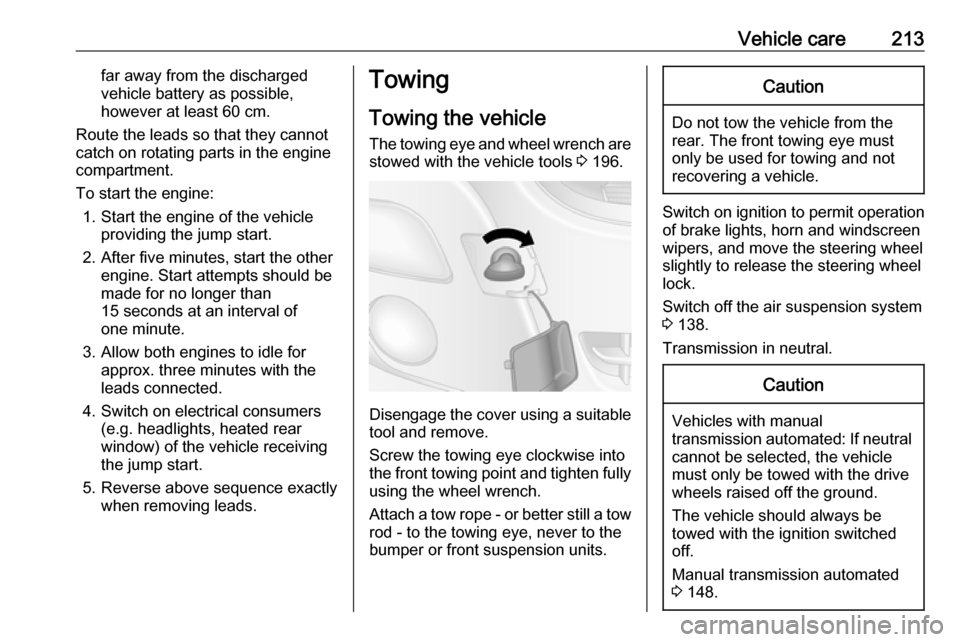
Disengage the cover using a suitable
tool and remove.
Screw the towing eye clockwise into
the front towing point and tighten fully using the wheel wrench.
Attach a tow rope - or better still a tow
rod - to the towing eye, never to the
bumper or front suspension units.
Caution
Do not tow the vehicle from the
rear. The front towing eye must
only be used for towing and not
recovering a vehicle.
Switch on ignition to permit operation
of brake lights, horn and windscreen
wipers, and move the steering wheel
slightly to release the steering wheel
lock.
Switch off the air suspension system 3 138.
Transmission in neutral.
Caution
Vehicles with manual
transmission automated: If neutral cannot be selected, the vehiclemust only be towed with the drive
wheels raised off the ground.
The vehicle should always be
towed with the ignition switched
off.
Manual transmission automated
3 148.
Page 253 of 259

251Changing tyre and wheel size ...201
Charging system .......................... 95
Child locks ................................... 26
Child restraint installation locations ................................... 63
Child restraints.............................. 61
Child restraint systems ................61
Cigarette lighter ........................... 87
Cleaning the vehicle ...................215
Climate control ............................. 15
Climate control systems .............114
Clock ............................................ 85
Coat hooks ................................... 71
Collision damage repair ..............247
Control indicators.......................... 91
Control of the vehicle .................131
Controls ........................................ 82
Convex shape .............................. 34
Coolant ....................................... 176
Coolant and antifreeze ...............219
Coolant heater ............................ 121
Cornering light ....................109, 185
Coupling ball bar ........................170
Cruise control ...................... 99, 157
Cupholders .................................. 71
D Danger, Warnings and Cautions ...4
Dashboard .................................... 10
Daytime running lights ...............108Declaration of conformity ............245
DEF ............................................ 141
Demisting and defrosting ..............15
Diesel exhaust fluid ....................141
Diesel fuel ................................... 166
Diesel fuel filter .......................... 181
Diesel fuel system bleeding .......181
Diesel particle filter ....................140
Door locks..................................... 21
Door open .................................... 99
Doors ............................................ 27
DPF (diesel particle filter) ...........140
Drink holders ................................ 71
Driver assistance systems ..........157
Driver Information Centre ...........100
Driving characteristics and towing tips .............................. 169
Driving economically................... 131
Driving hints ................................ 131
E ECO mode .................................. 131
ecoScoring.................................. 102
Electric adjustment ......................35
Electrical accessories ...................85
Electrical system......................... 192
Electronic climate control system 116
Electronic driving programmes ..150
Electronic Stability Program 97,
155, 170Electronic Stability Program off ...97
Emergency exit .......................38, 40
End-of-life vehicle recovery .......174
Engine compartment fuse box ...193
Engine coolant ........................... 176
Engine coolant temperature ........97
Engine coolant temperature gauge ....................................... 89
Engine data ............................... 224
Engine Drag Torque Control ......155
Engine exhaust .......................... 140
Engine identification ...................222
Engine oil ...........175, 219, 223, 242
Engine oil additives ....................219
Engine oil level monitor ................90
Engine oil pressure ......................98
Engine oil viscosity grades .........219
Enhanced Traction function....... ................................ 154, 155, 157
Event data recorders ..................247
Exhaust gases ............................ 140
Exit lighting ................................ 113
Exterior care .............................. 215
Exterior light ................................. 99
Exterior lighting ....................12, 106
Exterior mirrors ............................. 34
F Fault ........................................... 151
Fire extinguisher ........................... 78