CHASSIS
3-33
Compression damping (for slow compres-
sion damping)
ECA@
NOTICE
Do not turn the adjuster forcibly beyond its
adjusting range.
1. Adjust:
• Compression damping (for slow compres-
sion damping)
▼▼▼▼▼▼▼▼▼▼▼▼▼▼▼▼▼▼▼▼▼▼▼▼▼▼▼▼▼▼▼▼
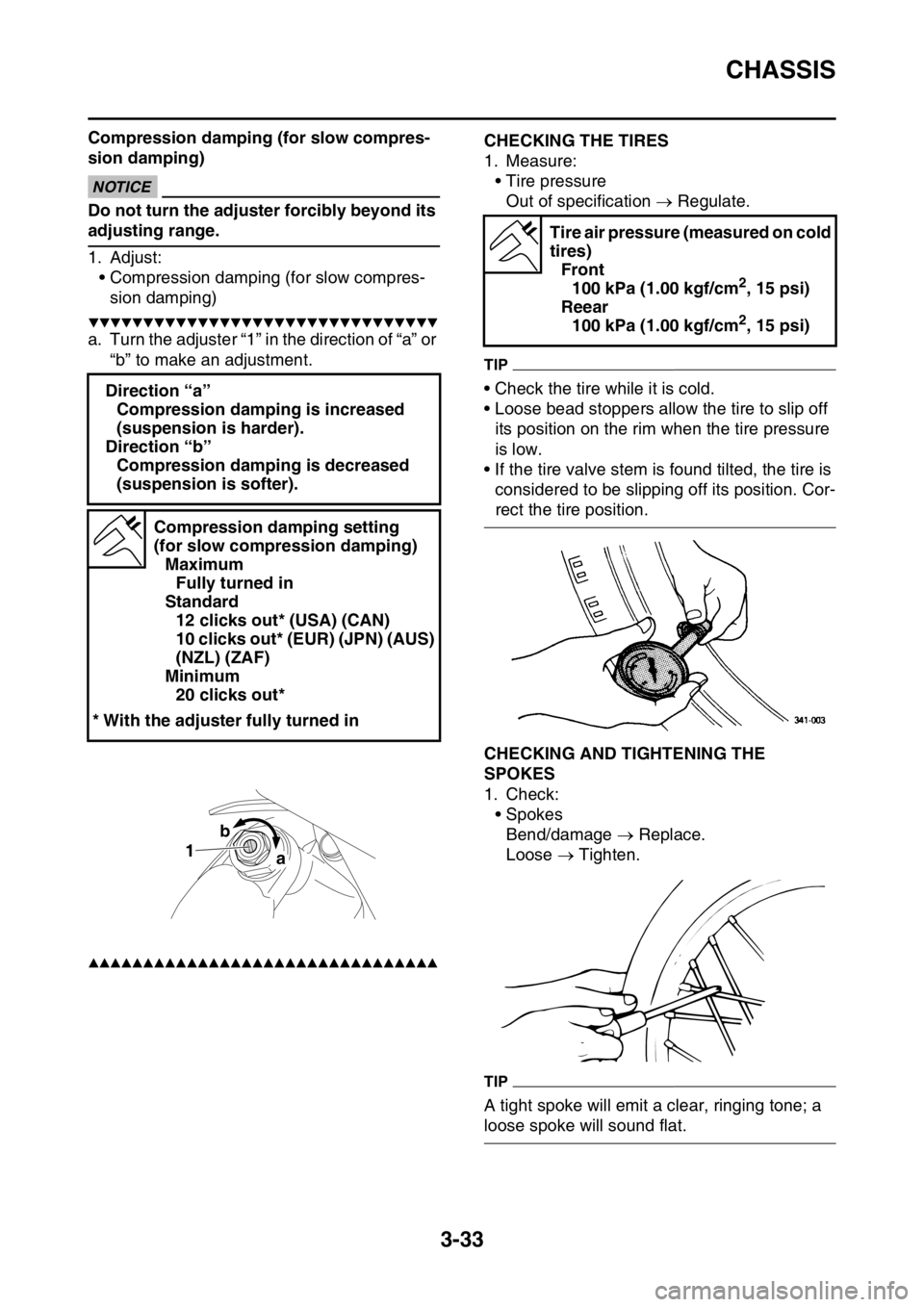
a. Turn the adjuster “1” in the direction of “a” or
“b” to make an adjustment.
▲▲▲▲▲▲▲▲▲▲▲▲▲▲▲▲▲▲▲▲▲▲▲▲▲▲▲▲▲▲▲▲
EAS1SM9105CHECKING THE TIRES
1. Measure:
• Tire pressure
Out of specification Regulate.
TIP
• Check the tire while it is cold.
• Loose bead stoppers allow the tire to slip off
its position on the rim when the tire pressure
is low.
• If the tire valve stem is found tilted, the tire is
considered to be slipping off its position. Cor-
rect the tire position.
EAS1SM9106CHECKING AND TIGHTENING THE
SPOKES
1. Check:
• Spokes
Bend/damage Replace.
Loose Tighten.
TIP
A tight spoke will emit a clear, ringing tone; a
loose spoke will sound flat. Direction “a”
Compression damping is increased
(suspension is harder).
Direction “b”
Compression damping is decreased
(suspension is softer).
Compression damping setting
(for slow compression damping)
Maximum
Fully turned in
Standard
12 clicks out* (USA) (CAN)
10 clicks out* (EUR) (JPN) (AUS)
(NZL) (ZAF)
Minimum
20 clicks out*
* With the adjuster fully turned in
1ba
Tire air pressure (measured on cold
tires)
Front
100 kPa (1.00 kgf/cm
2, 15 psi)
Reear
100 kPa (1.00 kgf/cm
2, 15 psi)
FRONT WHEEL
4-4
EAS1SM9121REMOVING THE FRONT WHEEL
1. Use a suitable stand to raise the front wheel
off the ground.
EWA
WARNING
Securely support the vehicle so that there is
no danger of it falling over.
2. Remove:
• Front wheel
EAS1SM9122CHECKING THE FRONT WHEEL
1. Check:
• Front wheel axle
Roll the front wheel axle on a flat surface.
Bends Replace.
EWA
WARNING
Do not attempt to straighten a bent wheel
axle.
2. Check:
•Tire(s)
• Front wheel
Damage/wear Replace.
Refer to “CHECKING THE TIRES” on page
3-33 and “CHECKING THE WHEELS” on
page 3-34.
3. Check:
• Spokes
Bend/damage Replace.
Loose Tighten.
Tap the spokes with a screwdriver.
TIP
A tight spoke will emit a clear, ringing tone; a
loose spoke will sound flat.
4. Tighten:
• Spokes
Refer to “CHECKING AND TIGHTENING
THE SPOKES” on page 3-33.
TIP
After tightening the spokes, measure the wheel
runout.
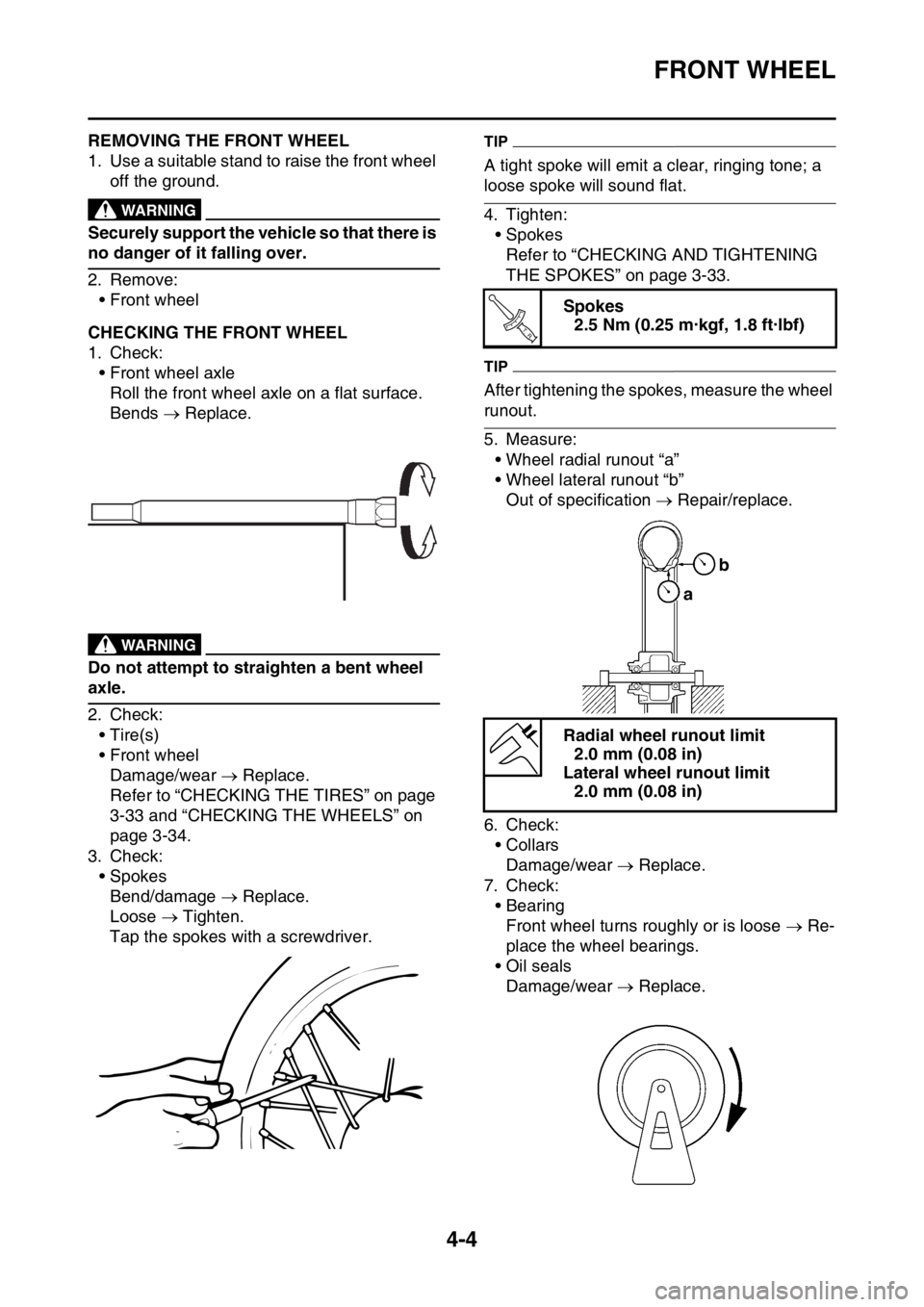
5. Measure:
• Wheel radial runout “a”
• Wheel lateral runout “b”
Out of specification Repair/replace.
6. Check:
•Collars
Damage/wear Replace.
7. Check:
• Bearing
Front wheel turns roughly or is loose Re-
place the wheel bearings.
• Oil seals
Damage/wear Replace.
Spokes
2.5 Nm (0.25 m·kgf, 1.8 ft·lbf)
Radial wheel runout limit
2.0 mm (0.08 in)
Lateral wheel runout limit
2.0 mm (0.08 in)
T R..
ab
CHASSIS
10-2
EAS1SM9369TIRE PRESSURE
Tire pressure should be adjusted to suit the
road surface condition of the circuit.
• Under a rainy, a muddy, a sandy, or a slippery
condition, the tire pressure should be lower
for a larger area of contact with the road sur-
face.
• Under a stony or a hard road condition, the
tire pressure should be higher to prevent a flat
tire.
EAS1SM9370FRONT FORK SETTING
The front fork setting should be made depend-
ing on the rider’s feeling of an actual run and
the circuit conditions.
The front fork setting includes the following
three factors:
1. Setting of air spring characteristics
• Change the fork oil amount.
2. Setting of spring preload
• Change the spring.
3. Setting of damping force
• Change the compression damping force.
• Change the rebound damping force.
The spring acts on the load and the damping
force acts on the cushion travel speed.
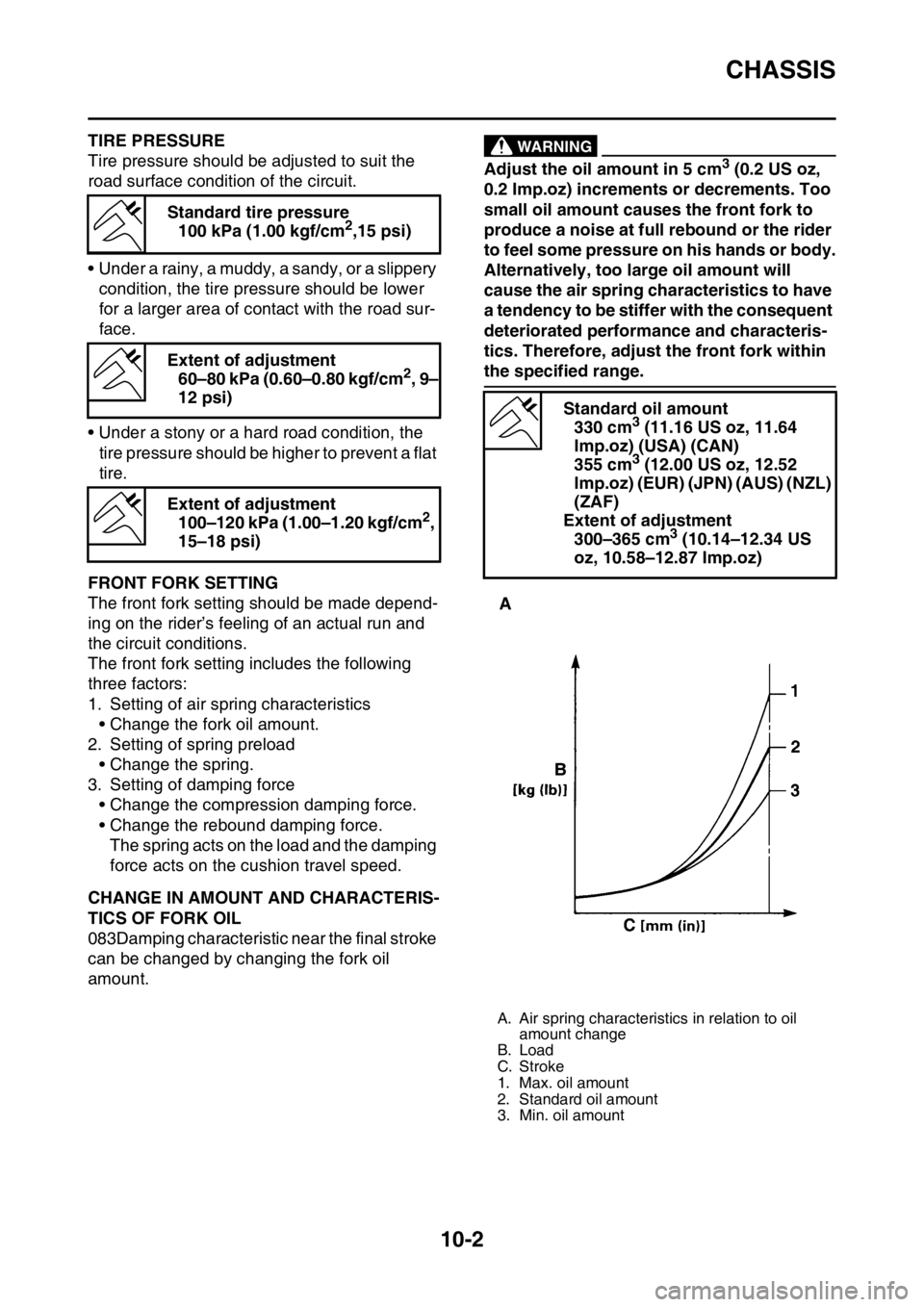
EAS1SM9371CHANGE IN AMOUNT AND CHARACTERIS-
TICS OF FORK OIL
083Damping characteristic near the final stroke
can be changed by changing the fork oil
amount.
EWA1DX4001
WARNING
Adjust the oil amount in 5 cm3 (0.2 US oz,
0.2 Imp.oz) increments or decrements. Too
small oil amount causes the front fork to
produce a noise at full rebound or the rider
to feel some pressure on his hands or body.
Alternatively, too large oil amount will
cause the air spring characteristics to have
a tendency to be stiffer with the consequent
deteriorated performance and characteris-
tics. Therefore, adjust the front fork within
the specified range. Standard tire pressure
100 kPa (1.00 kgf/cm
2,15 psi)
Extent of adjustment
60–80 kPa (0.60–0.80 kgf/cm
2, 9–
12 psi)
Extent of adjustment
100–120 kPa (1.00–1.20 kgf/cm
2,
15–18 psi)
Standard oil amount
330 cm3 (11.16 US oz, 11.64
lmp.oz) (USA) (CAN)
355 cm
3 (12.00 US oz, 12.52
lmp.oz) (EUR) (JPN) (AUS) (NZL)
(ZAF)
Extent of adjustment
300–365 cm
3 (10.14–12.34 US
oz, 10.58–12.87 Imp.oz)
A. Air spring characteristics in relation to oil
amount change
B. Load
C. Stroke
1. Max. oil amount
2. Standard oil amount
3. Min. oil amount