2016 YAMAHA XVS1300CU fuel
[x] Cancel search: fuelPage 68 of 88

Periodic maintenance an d a djustment
6-28
6
NOTICE
ECA10621
Never attempt to remove the battery
cell seals, as this woul d permanently
d amag e the battery.To char ge the battery
Have a Yamaha dealer charge the bat-
tery as soon as possible if it seems to
have discharged. Keep in mind that the
battery tends to discharge more quick-
ly if the vehicle is equipped with op-
tional electrical accessories.NOTICE
ECA16522
To char ge a VRLA (Valve Re gulate d
Lea d Aci d) battery, a special (con-
stant-volta ge) battery char ger is re-
quire d. Usin g a conventional battery
char ger will damag e the b attery.To store the b attery
1. If the vehicle will not be used for more than one month, remove the
battery, fully charge it, and then
place it in a cool, dry place.
NOTICE: When removin g the
b attery, be sure the key is turne
d to “OFF”, then d iscon-
nect the neg ative lead b efore
d isconnectin g the positive lea d.
[ECA16303]
2. If the battery will be stored for
more than two months, check it at
least once a month and fully char-
ge it if necessary.
3. Fully charge the battery before installation. NOTICE: When in-
stallin g the battery, be sure the
key is turne d to “OFF”, then
connect the positive lea d b efore
connectin g the ne gative lea d.
[ECA16841]
4. After installation, make sure that
the battery leads are properly con-
nected to the battery terminals.NOTICE
ECA16531
Always keep the b attery charged .
Storin g a d ischar ged battery can
cause permanent battery damag e.
EAU50812
Replacin g the fusesThe main fuse, the fuel injection sys-
tem fuse, and the fuse box, which con-
tains the fuses for the individual
circuits, are located under the seat.
(See page 3-14.)1. Fuel injection system spare fuse
2. Fuel injection system fuse
3. Fuse box
4. Main fuse
1
2
3
4
U2SSE2E0.book Page 28 Monday, July 20, 2015 2:28 PM
Page 69 of 88

Periodic maintenance an d a djustment
6-29
6
TIPTo access the fuel injection system
fuse, remove the starter relay cover by
pulling it upward.
If a fuse is blown, replace it as follows.
1. Turn the key to “OFF” and turn off the electrical circuit in question.
2. Remove the blown fuse, and then install a new fuse of the specified
amperage. WARNING! Do not
use a fuse of a hi gher ampera ge
ratin g than recommen ded to
avoi d causin g extensive dam-
a g e to the electrical system an d
possi bly a fire.
[EWA15132]
3. Turn the key to “ON” and turn on
the electrical circuit in question to
check if the device operates.
4. If the fuse immediately blows again, have a Yamaha dealer
check the electrical system.
1. Signaling system fuse
2. Ignition fuse
3. Parking lighting fuse
4. Radiator fan motor fuse
5. Backup fuse (for clock)
6. Headlight fuse
7. Spare fuse
1. Fuel injection system spare fuse
2. Starter relay cover
3. Fuel injection system fuse
32
1
Specified fuses:
Main fuse:
50.0 A
Headlight fuse:
20.0 A
Signaling system fuse: 10.0 A
Ignition fuse: 15.0 A
Parking lighting fuse:
10.0 A
Radiator fan motor fuse: 20.0 A
Fuel injection system fuse: 10.0 A
Backup fuse:
10.0 A
U2SSE2E0.book Page 29 Monday, July 20, 2015 2:28 PM
Page 73 of 88

Periodic maintenance an d a djustment
6-33
6
a jack either under each side of the
frame in front of the rear wheel or under
each side of the swingarm.
EAU25872
Trou
bleshootin gAlthough Yamaha motorcycles receive
a thorough inspection before shipment
from the factory, trouble may occur
during operation. Any problem in the
fuel, compression, or ignition systems,
for example, can cause poor starting
and loss of power.
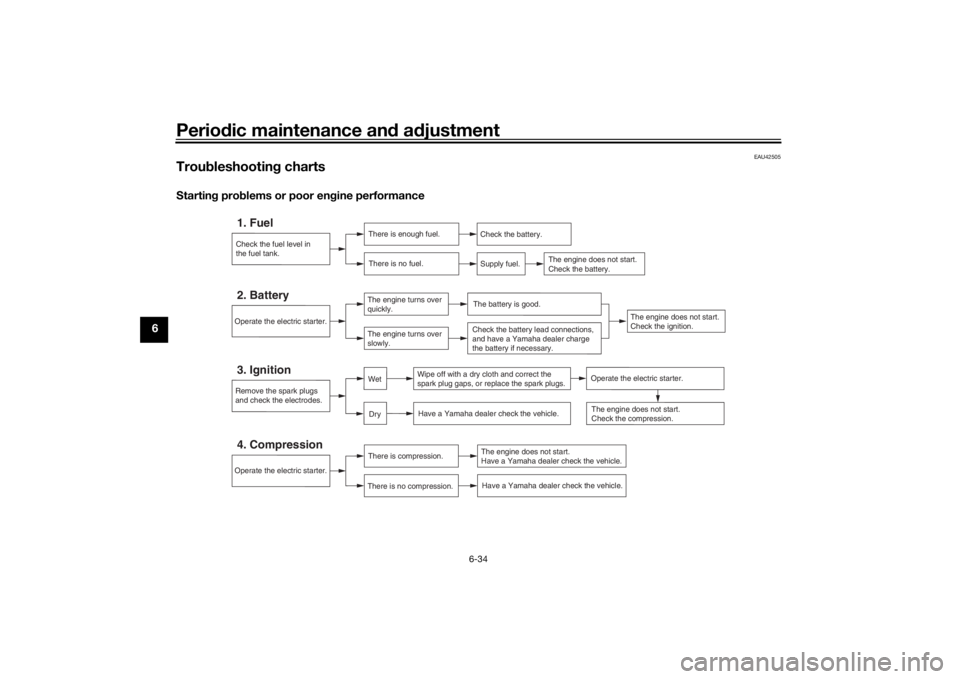
The following troubleshooting charts
represent quick and easy procedures
for checking these vital systems your-
self. However, should your motorcycle
require any repair, take it to a Yamaha
dealer, whose skilled technicians have
the necessary tools, experience, and
know-how to service the motorcycle
properly.
Use only genuine Yamaha replace-
ment parts. Imitation parts may look
like Yamaha parts, but they are often
inferior, have a shorter service life and
can lead to expensive repair bills.
WARNING
EWA15142
When checkin g the fuel system, d o
not smoke, an d make sure there are
no open flames or sparks in the ar-
ea, inclu din g pilot li ghts from water heaters or furnaces. Gasoline or
g
asoline vapors can i gnite or ex-
plo de, causin g severe injury or prop-
erty damag e.
U2SSE2E0.book Page 33 Monday, July 20, 2015 2:28 PM
Page 74 of 88
Periodic maintenance an d a djustment
6-34
6
EAU42505
Trou bleshootin g chartsStartin g pro blems or poor en gine performance
Check the fuel level in
the fuel tank.1. Fuel
There is enough fuel.
There is no fuel.
Check the battery.
Supply fuel.
The engine does not start.
Check the battery.
Remove the spark plugs
and check the electrodes.3. Ignition
Wipe off with a dry cloth and correct the
spark plug gaps, or replace the spark plugs.
Have a Yamaha dealer check the vehicle.
Operate the electric starter.4. Compression
There is compression.
There is no compression.
The engine does not start.
Have a Yamaha dealer check the vehicle.Have a Yamaha dealer check the vehicle.
The engine does not start.
Check the compression.
Operate the electric starter.2. Battery
The engine turns over
quickly.
The engine turns over
slowly.
The engine does not start.
Check the ignition.
The battery is good.Check the battery lead connections,
and have a Yamaha dealer charge
the battery if necessary.
DryWet
Operate the electric starter.
U2SSE2E0.book Page 34 Monday, July 20, 2015 2:28 PM
Page 77 of 88

Motorcycle care and stora ge
7-2
7
off any
deter gent resi due usin g
plenty of water, as it is harmful
to plastic parts.
Do not use any harsh chemical
prod ucts on plastic parts. Be
sure to avoi d usin g cloths or
spon ges which have b een in
contact with stron g or a brasive
cleanin g prod ucts, solvent or
thinner, fuel ( gasoline), rust re-
movers or inhi bitors, brake flui d,
antifreeze or electrolyte.
Do not use hi gh-pressure wash-
ers or steam-jet cleaners since
they cause water seepag e and
d eterioration in the followin g ar-
eas: seals (of wheel an d swin g-
arm bearin gs, fork an d b rakes),
electric components (couplers,
connectors, instruments,
switches an d li ghts), breather
hoses an d vents.
For motorcycles equippe d with
a win dshiel d: Do not use stron g
cleaners or har d spon ges as
they will cause dullin g or
sc
ratchin g. Some cleanin g
compoun ds for plastic may
leave scratches on the win d- shiel
d. Test the pro duct on a
small hi dden part of the win d-
shiel d to make sure that it does
not leave any marks. If the win d-
shiel d is scratche d, use a quality
plastic polishin g compoun d af-
ter washing .
After normal useRemove dirt with warm water, a mild
detergent, and a soft, clean sponge,
and then rinse thoroughly with clean
water. Use a toothbrush or bottlebrush
for hard-to-reach areas. Stubborn dirt
and insects will come off more easily if
the area is covered with a wet cloth for
a few minutes before cleaning.
After riding in the rain, near the sea oron salt-sprayed roadsSince sea salt or salt sprayed on roads
during winter are extremely corrosive
in combination with water, carry out
the following steps after each ride in
the rain, near the sea or on salt-
sprayed roads.
TIPSalt sprayed on roads in the winter
may remain well into spring.1. Clean the motorcycle with cold
water and a mild detergent, after
the engine has cooled down.
NOTICE: Do not use warm wa-
ter since it increases the corro-
sive action of the salt.
[ECA10792]
2. After drying the motorcycle, apply a corrosion protection spray on all
metal, including chrome- and
nickel-plated, surfaces to prevent
corrosion.
After cleanin g
1. Dry the motorcycle with a chamois or an absorbing cloth.
2. Use a chrome polish to shine chrome, aluminum and stainless-
steel parts, including the exhaust
system. (Even the thermally in-
duced discoloring of stainless-
steel exhaust systems can be re-
moved through polishing.)
U2SSE2E0.book Page 2 Monday, July 20, 2015 2:28 PM
Page 79 of 88
Motorcycle care and stora ge
7-4
7
2. Fill up the fuel tank and add fuel
stabilizer (if available) to prevent
the fuel tank from rusting and the
fuel from deteriorating.
3. Perform the following steps to protect the cylinders, piston rings,
etc. from corrosion.a. Remove the spark plug caps and spark plugs.
b. Pour a teaspoonful of engine oil into each spark plug bore.
c. Install the spark plug caps onto the spark plugs, and then pla-
ce the spark plugs on the cylin-
der head so that the electrodes
are grounded. (This will limit
sparking during the next step.)
d. Turn the engine over several times with the starter. (This will
coat the cylinder walls with oil.)
WARNING! To prevent dam-
a g e or injury from sparkin g,
make sure to groun d the
spark plu g electro des while
turning the en gine over.
[EWA10952]
e. Remove the spark plug caps
from the spark plugs, and then
install the spark plugs and the
spark plug caps.
4. Lubricate all control cables and the pivoting points of all levers and
pedals as well as of the side-
stand/centerstand.
5. Check and, if necessary, correct the tire air pressure, and then lift
the motorcycle so that both of its
wheels are off the ground. Alterna-
tively, turn the wheels a little every
month in order to prevent the tires
from becoming degraded in one
spot.
6. Cover each muffler outlet with a plastic bag to prevent moisture
from entering them.
7. Remove the battery and fully char- ge it. Store it in a cool, dry place
and charge it once a month. Do
not store the battery in an exces-
sively cold or warm place [less
than 0 °C (30°F) or more than 30
°C (90°F)]. For more information
on storing the battery, see page
6-27.
TIPMake any necessary repairs before
storing the motorcycle.
U2SSE2E0.book Page 4 Monday, July 20, 2015 2:28 PM
Page 80 of 88

Specifications
8-1
8
Dimensions:Overall length:2535 mm (99.8 in)
Overall width:
860 mm (33.9 in)
Overall height: 1130 mm (44.5 in)
Seat height: 670 mm (26.4 in)
Wheelbase:
1755 mm (69.1 in)
Ground clearance: 150 mm (5.91 in)
Minimum turning radius: 3.4 m (11.16 ft)Wei ght:Curb weight:
293 kg (646 lb)Engine:Combustion cycle:
4-stroke
Cooling system: Liquid cooled
Valve train: SOHC
Cylinder arrangement:
V-type
Number of cylinders: 2-cylinder
Displacement: 1304 cm³
Bore × stroke:
100.0 × 83.0 mm (3.94 × 3.27 in) Compression ratio:
9.5 : 1
Starting system: Electric starter
Lubrication system:
Wet sump
Engine oil:Recommended brand:
YAMALUBE
SAE viscosity grades:
10W-40
Recommended engine oil grade: API service SG type or higher, JASO
standard MA
Engine oil quantity: Oil change:
3.20 L (3.38 US qt, 2.82 Imp.qt)
With oil filter removal: 3.40 L (3.59 US qt, 2.99 Imp.qt)Coolant quantity:Coolant reservoir (up to the maximum level
mark):0.45 L (0.48 US qt, 0.40 Imp.qt)
Radiator (including all routes):
2.10 L (2.22 US qt, 1.85 Imp.qt)Air filter:Air filter element:Oil-coated paper elementFuel:Recommended fuel:Regular unleaded gasoline (Gasohol [E10]
acceptable)
Fuel tank capacity: 15 L (4.0 US gal, 3.3 Imp.gal) Fuel reserve amount:
4.1 L (1.08 US gal, 0.90 Imp.gal)
Fuel injection:Throttle body:
ID mark: 3D8D 40Spark plu g(s):Manufacturer/model:
NGK/LMAR7A-9
Spark plug gap: 0.8–0.9 mm (0.031–0.035 in)Clutch:Clutch type:Wet, multiple-discDrivetrain:Primary reduction ratio:
1.556 (70/45)
Final drive: Belt
Secondary reduction ratio: 2.258 (70/31)
Transmission type:
Constant mesh 5-speed
Gear ratio: 1st:
2.769 (36/13)
2nd: 1.778 (32/18)
3rd: 1.381 (29/21)
4th:
1.115 (29/26)
5th: 0.960 (24/25)
U2SSE2E0.book Page 1 Monday, July 20, 2015 2:28 PM
Page 82 of 88

Specifications
8-3
8
Auxiliary light:5.0 W × 1
License plate light: 5.0 W × 2
Meter lighting:
LED
Neutral indicator light: LED
High beam indicator light: LED
Oil level warning light:
LED
Turn signal indicator light: LED
Fuel level warning light: LED
Coolant temperature warning light:
LED
Engine trouble warning light: LEDFuse(s):Main fuse:
50.0 A
Headlight fuse: 20.0 A
Signaling system fuse: 10.0 A
Ignition fuse:
15.0 A
Parking lighting fuse: 10.0 A
Radiator fan motor fuse: 20.0 A Fuel injection system fuse:
10.0 A
Backup fuse: 10.0 A
U2SSE2E0.book Page 3 Monday, July 20, 2015 2:28 PM