Page 81 of 172
7-2
7
many features, including a protective struc-
ture and seat belts, to help protect occu-
pants, but the best way to avoid injuries is to
avoid accidents. There is a risk of injury or
death in any accident, even with these safety
features.
Driver requirements
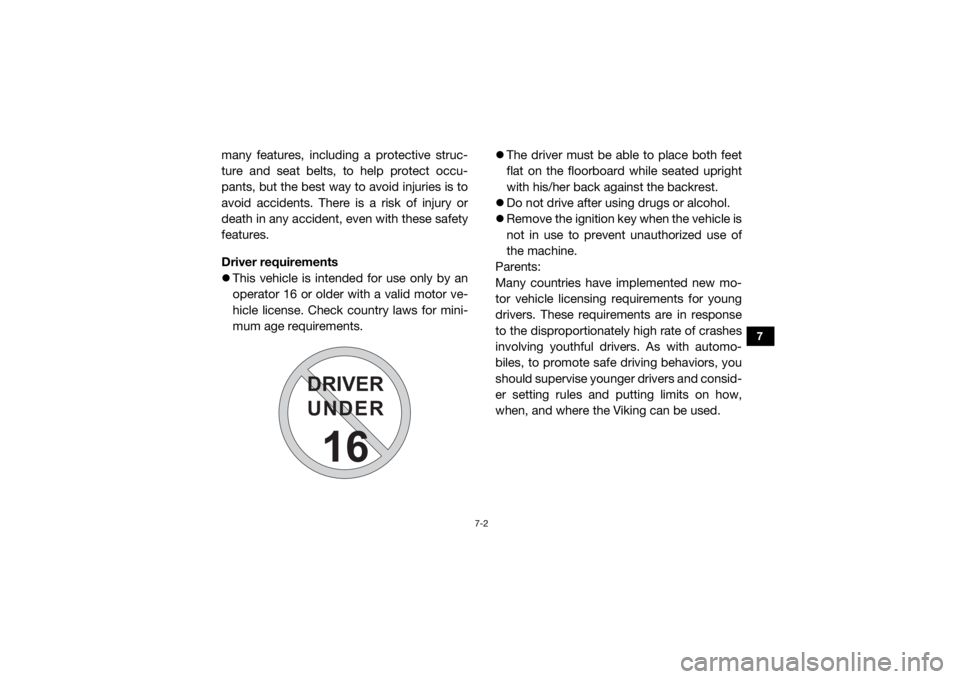
This vehicle is intended for use only by an
operator 16 or older with a valid motor ve-
hicle license. Check country laws for mini-
mum age requirements.
The driver must be able to place both feet
flat on the floorboard while seated upright
with his/her back against the backrest.
Do not drive after using drugs or alcohol.
Remove the ignition key when the vehicle is
not in use to prevent unauthorized use of
the machine.
Parents:
Many countries have implemented new mo-
tor vehicle licensing requirements for young
drivers. These requirements are in response
to the disproportionately high rate of crashes
involving youthful drivers. As with automo-
biles, to promote safe driving behaviors, you
should supervise younger drivers and consid-
er setting rules and putting limits on how,
when, and where the Viking can be used.
DRIVER
UNDER
16
UB427AE0.book Page 2 Monday, May 18, 2015 9:17 AM
Page 82 of 172
7-3
7
Passenger requirements
This vehicle is designed for the operator and
two passengers. Allowing passengers to ride
improperly can lead to serious injury or death.
As the operator, you are responsible for your
passengers.
Your passengers must be able to place
both feet on the floorboard while seated
upright with their backs against the back-
rests.
Your passengers must be able to reach and
hold the passenger handhold.
Allow only two passengers in the vehicle
and only in the designated passenger
seats. Do not carry any other passengers.
Do not carry passengers in the cargo bed.
Do not allow someone to ride as a passen-
ger who has been using drugs or alcohol.
Do not allow children who need child safety
seats or booster seats in the Viking. The
seat belt is not designed to restrain auto-
motive child safety seats. Occupant protection system
WARNING
EWB03350Do not make changes to the occupant pro-
tection system. If you install aftermarket
products or have your vehicle modified,
you may put yourself and others at greater
risk of serious injury or death. You are re-
sponsible for any such changes to the ve-
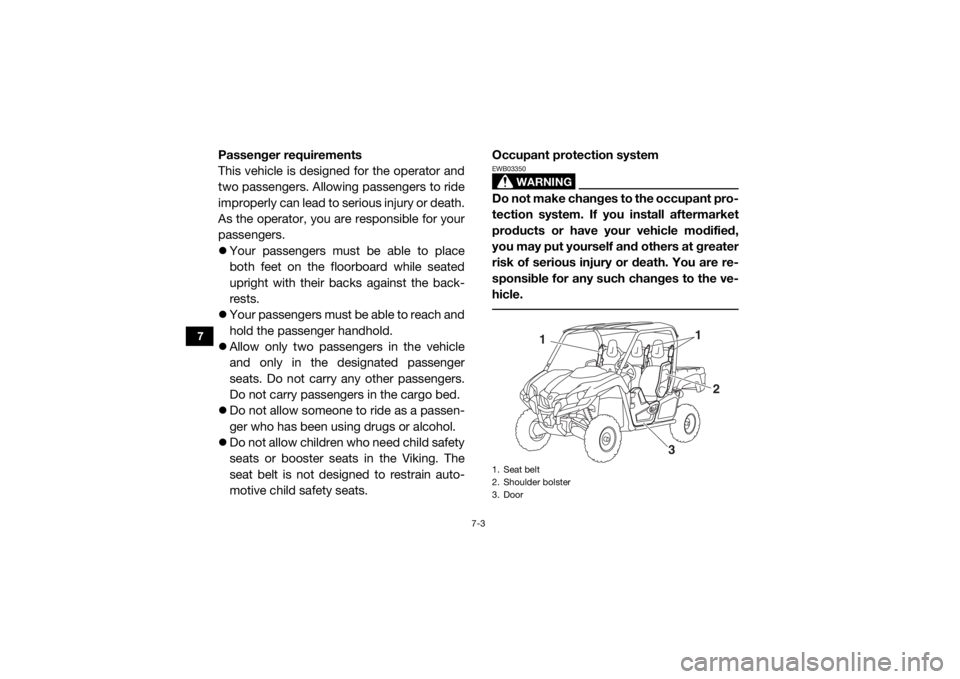
hicle. 1. Seat belt
2. Shoulder bolster
3. Door
2
3
1
1
UB427AE0.book Page 3 Monday, May 18, 2015 9:17 AM
Page 83 of 172
7-4
7
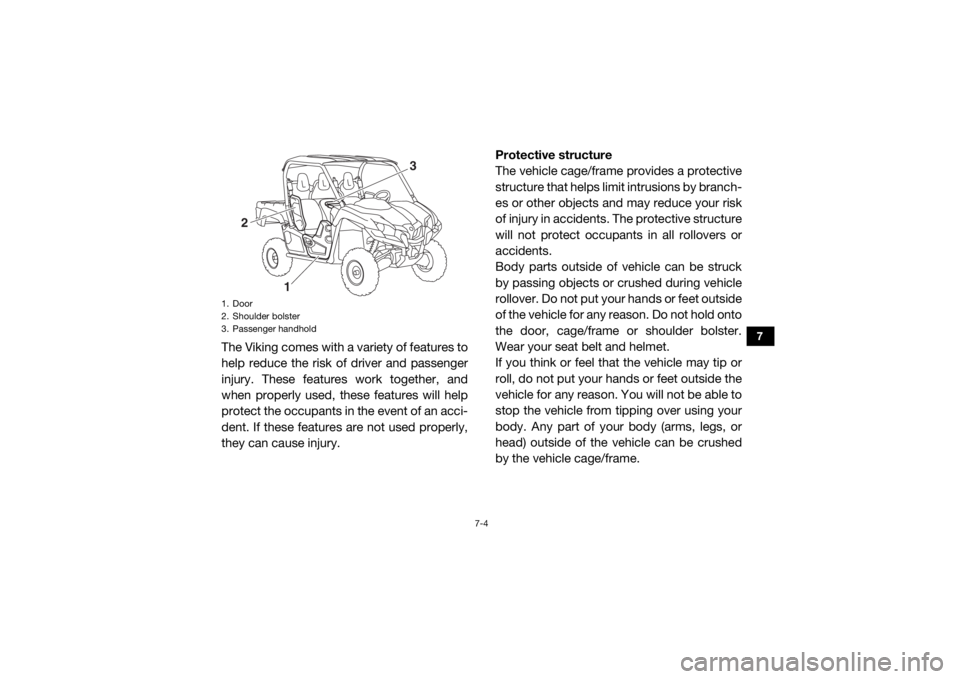
The Viking comes with a variety of features to
help reduce the risk of driver and passenger
injury. These features work together, and
when properly used, these features will help
protect the occupants in the event of an acci-
dent. If these features are not used properly,
they can cause injury. Protective structure
The vehicle cage/frame provides a protective
structure that helps limit intrusions by branch-
es or other objects and may reduce your risk
of injury in accidents. The protective structure
will not protect occupants in all rollovers or
accidents.
Body parts outside of vehicle can be struck
by passing objects or
crushed during vehicle
rollover. Do not put your hands or feet outside
of the vehicle for any reason. Do not hold onto
the door, cage/frame or shoulder bolster.
Wear your seat belt and helmet.
If you think or feel that the vehicle may tip or
roll, do not put your hands or feet outside the
vehicle for any reason. You will not be able to
stop the vehicle from tipping over using your
body. Any part of your body (arms, legs, or
head) outside of the vehicle can be crushed
by the vehicle cage/frame.1. Door
2. Shoulder bolster
3. Passenger handhold
2
1 3
UB427AE0.book Page 4 Monday, May 18, 2015 9:17 AM
Page 84 of 172
7-5
7
Seat belts
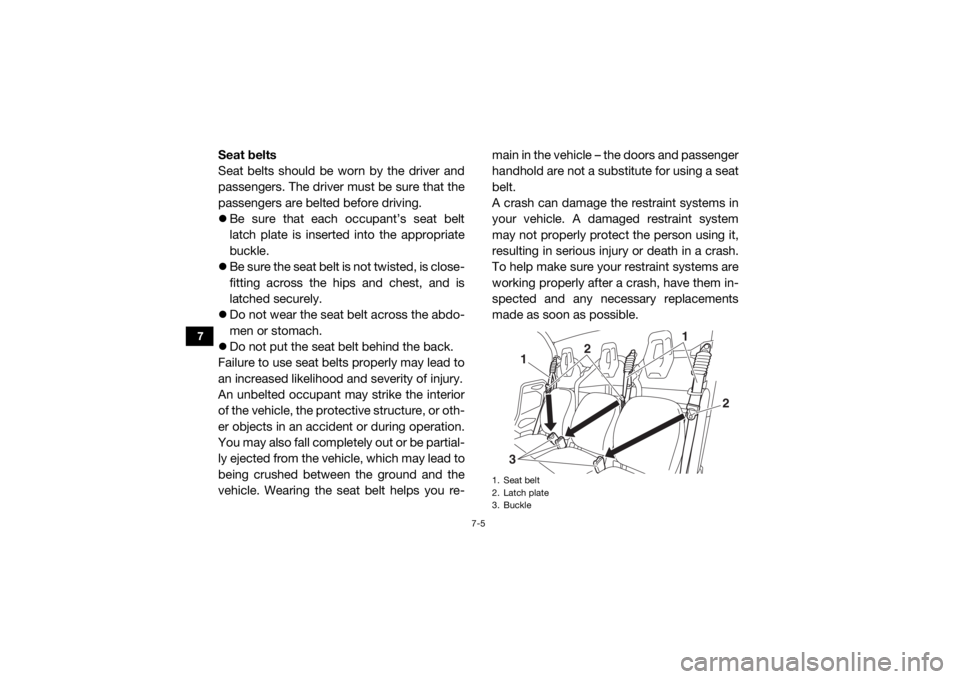
Seat belts should be worn by the driver and
passengers. The driver must be sure that the
passengers are belted before driving.
Be sure that each occupant’s seat belt
latch plate is inserted into the appropriate
buckle.
Be sure the seat belt is not twisted, is close-
fitting across the hips and chest, and is
latched securely.
Do not wear the seat belt across the abdo-
men or stomach.
Do not put the seat belt behind the back.
Failure to use seat belts properly may lead to
an increased likelihood and severity of injury.
An unbelted occupant may strike the interior
of the vehicle, the protective structure, or oth-
er objects in an accident or during operation.
You may also fall completely out or be partial-
ly ejected from the vehicle, which may lead to
being crushed between the ground and the
vehicle. Wearing the seat belt helps you re- main in the vehicle – the doors and passenger
handhold are not a substitute for using a seat
belt.
A crash can damage the restraint systems in
your vehicle. A damaged restraint system
may not properly protect the person using it,
resulting in serious injury or death in a crash.
To help make sure your restraint systems are
working properly after a crash, have them in-
spected and any necessary replacements
made as soon as possible.
1. Seat belt
2. Latch plate
3. Buckle
3
2
1
2
1
UB427AE0.book Page 5 Monday, May 18, 2015 9:17 AM
Page 85 of 172
7-6
7
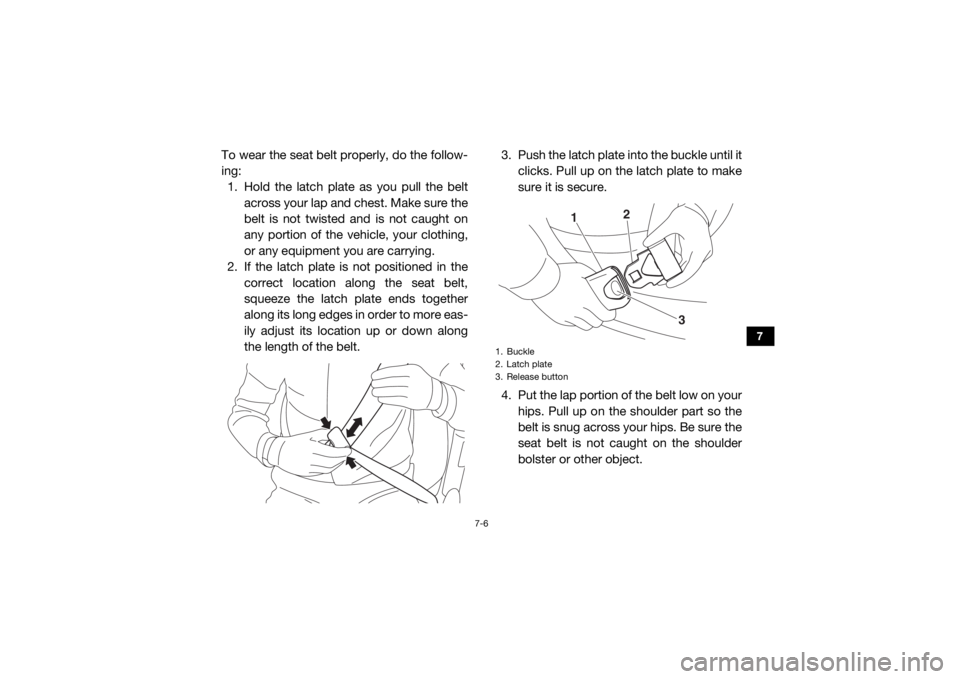
To wear the seat belt properly, do the follow-
ing:1. Hold the latch plate as you pull the belt across your lap and chest. Make sure the
belt is not twisted and is not caught on
any portion of the vehicle, your clothing,
or any equipment you are carrying.
2. If the latch plate is not positioned in the
correct location along the seat belt,
squeeze the latch plate ends together
along its long edges in order to more eas-
ily adjust its location up or down along
the length of the belt. 3. Push the latch plate into the buckle until it
clicks. Pull up on the latch plate to make
sure it is secure.
4. Put the lap portion of the belt low on your hips. Pull up on the shoulder part so the
belt is snug across your hips. Be sure the
seat belt is not caught on the shoulder
bolster or other object.
1. Buckle
2. Latch plate
3. Release button
1
3
2
UB427AE0.book Page 6 Monday, May 18, 2015 9:17 AM
Page 86 of 172
7-7
7
5. Position the shoulder belt over yourshoulder and across your chest. The
shoulder belt should fit against your
chest. If it is loose, pull the belt out all the
way and then let it retract.
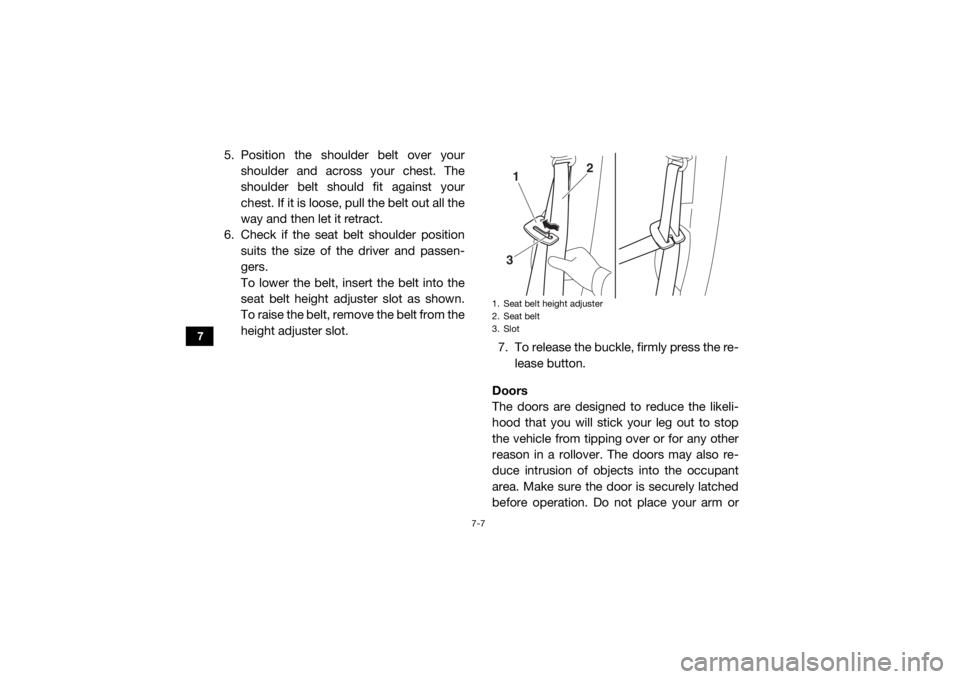
6. Check if the seat belt shoulder position suits the size of the driver and passen-
gers.
To lower the belt, insert the belt into the
seat belt height adjuster slot as shown.
To raise the belt, remove the belt from the
height adjuster slot.
7. To release the buckle, firmly press the re-lease button.
Doors
The doors are designed to reduce the likeli-
hood that you will stick your leg out to stop
the vehicle from tipping over or for any other
reason in a rollover. The doors may also re-
duce intrusion of objects into the occupant
area. Make sure the door is securely latched
before operation. Do not place your arm or
1. Seat belt height adjuster
2. Seat belt
3. Slot
1
2
3
UB427AE0.book Page 7 Monday, May 18, 2015 9:17 AM
Page 99 of 172
7-20
7
Wet brakes may have reduced effectiveness.
After leaving the water, test your brakes. If
necessary, apply the brakes several times to
let friction dry out the linings.NOTICEECB02170After driving your vehicle in water, be sure
to drain the trapped water by removing the
check hoses at the bottom of the air filter
case and air duct and the V-belt case drain
plug. Wash the vehicle in fresh water if it
has been operated in salt water or muddy
conditions. Loose terrain/slippery terrain
When driving on slippery terrain, including
wet, muddy, or icy conditions, as well as
loose gravel, be aware that you could begin
skidding or sliding. To avoid loss of control,
slow down and put the vehicle in four-wheel
drive before driving on a slippery surface and
plan your path to avoid making abrupt ma-
neuvers. If you feel the vehicle begin to slide sideways
or the back wheels slide during a turn, steer
into the direction of the slide if possible, to re-
gain directional control. For example, if you
feel the back of the vehicle start to slide to
your right, steer to the right.
Brush or wooded areas
When operating in areas with brush or trees,
watch carefully on both sides and above the
vehicle for obstacles such as branches that
the vehicle might hit, causing an accident.
Watch for brush that might enter the vehicle
as you pass and strike you or the passengers.
Never hold onto the cage/frame. The passen-
gers should always hold onto the passenger
handhold with both hands.
The muffler and other engine parts become
extremely hot during operation and remain
hot after the engine has stopped. To reduce
the risk of fire during operation or after leaving
the vehicle, do not let
brush, grass and other
materials collect under the vehicle, near theUB427AE0.book Page 20 Monday, May 18, 2015 9:17 AM
Page 130 of 172
8-30
8
EBU32440V-belt case drain plugThe V-belt case drain plug is located under
the cargo bed. (See page 4-22 for cargo bed
lifting and lowering procedures.)
After riding in water deep enough to allow wa-
ter to enter the V-belt case, remove the drain
plug to drain any water from the case.
If water drains from the V-belt case after re-
moving the drain plug, have a Yamaha dealer
inspect the vehicle, as the water may affect
other engine parts.
EBU32450Cleaning the spark arrester
WARNING
EWB03370Hot exhaust system may cause burns. To
avoid burns or fires, make sure that the en-
gine is stopped and the exhaust system is
cool before cleaning the spark arrester. Do
not start the engine while cleaning the ex-
haust system. 1. Remove the tailpipe bolts.
1. Air duct check hose
1
1. V-belt case drain plug
1
UB427AE0.book Page 30 Monday, May 18, 2015 9:17 AM