2016 YAMAHA MT-25 brake pads
[x] Cancel search: brake padsPage 6 of 96

Table of contentsSafety information............................ 1-1
Description....................................... 2-1
Left view ......................................... 2-1
Right view ....................................... 2-2
Controls and instruments ............... 2-3
Instrument and control functions... 3-1
Main switch/steering lock............... 3-1
Indicator lights and warning
lights............................................ 3-2
Multi-function meter unit ................ 3-4
Handlebar switches ...................... 3-10
Clutch lever .................................. 3-11
Shift pedal .................................... 3-12
Brake lever.................................... 3-12
Brake pedal .................................. 3-12
Fuel tank cap ................................ 3-13
Fuel ............................................... 3-13
Fuel tank breather hose and
overflow hose ............................ 3-15
Catalytic converter ....................... 3-15
Seats ............................................ 3-16
Helmet holders ............................. 3-17
Storage compartment .................. 3-18
Adjusting the shock absorber
assembly ................................... 3-18
Luggage strap holders ................. 3-19
Sidestand ..................................... 3-19
Ignition circuit cut-off system ....... 3-20For your safety – pre-operation
checks............................................... 4-1
Operation and important riding
points................................................. 5-1
Starting the engine .......................... 5-1
Shifting ............................................ 5-2
Tips for reducing fuel
consumption ................................ 5-3
Engine break-in ............................... 5-3
Parking ............................................ 5-4
Periodic maintenance and
adjustment........................................ 6-1
Owner’s tool kit ............................... 6-1
Periodic maintenance chart for
the emission control system ........ 6-3
General maintenance and
lubrication chart ........................... 6-4
Checking the spark plugs ............... 6-8
Engine oil and oil filter cartridge...... 6-9
Coolant.......................................... 6-12
Replacing the air filter element
and cleaning the check hose..... 6-13
Checking the throttle grip
free play ..................................... 6-15
Valve clearance ............................. 6-15
Tires .............................................. 6-15
Cast wheels................................... 6-17
Adjusting the clutch lever
free play ..................................... 6-17Checking the brake lever
free play..................................... 6-18
Brake light switches ..................... 6-19
Checking the front and rear
brake pads ................................ 6-19
Checking the brake fluid level ...... 6-20
Changing the brake fluid .............. 6-21
Drive chain slack........................... 6-21
Cleaning and lubricating the
drive chain ................................. 6-23
Checking and lubricating the
cables ........................................ 6-24
Checking and lubricating the
throttle grip and cable ............... 6-24
Checking and lubricating the
brake and shift pedals............... 6-24
Checking and lubricating the
brake and clutch levers ............. 6-25
Checking and lubricating the
sidestand................................... 6-26
Lubricating the swingarm
pivots......................................... 6-26
Checking the front fork ................. 6-26
Checking the steering................... 6-27
Checking the wheel bearings ....... 6-27
Battery .......................................... 6-28
Replacing the fuses ...................... 6-29
Replacing the headlight bulb ........ 6-30
Auxiliary light ................................ 6-31
Tail/brake light .............................. 6-31UB04E0E0.book Page 1 Wednesday, September 2, 2015 3:51 PM
Page 37 of 96

For your safety – pre-operation checks
4-1
4
EAU15599
Inspect your vehicle each time you use it to make sure the vehicle is in safe operating condition. Always follow the inspection
and maintenance procedures and schedules described in the Owner’s Manual.
WARNING
EWA11152
Failure to inspect or maintain the vehicle properly increases the possibility of an accident or equipment damage.
Do not operate the vehicle if you find any problem. If a problem cannot be corrected by the procedures provided in
this manual, have the vehicle inspected by a Yamaha dealer.Before using this vehicle, check the following points:
ITEM CHECKS PAGE
Fuel• Check fuel level in fuel tank.
• Refuel if necessary.
• Check fuel line for leakage.
• Check fuel tank breather hose and overflow hose for obstructions, cracks or
damage, and check hose connections.3-13, 3-15
Engine oil• Check oil level in engine.
• If necessary, add recommended oil to specified level.
• Check vehicle for oil leakage.6-9
Coolant• Check coolant level in reservoir.
• If necessary, add recommended coolant to specified level.
• Check cooling system for leakage.6-12
Front brake• Check operation.
• If soft or spongy, have Yamaha dealer bleed hydraulic system.
• Check brake pads for wear.
• Replace if necessary.
• Check fluid level in reservoir.
• If necessary, add specified brake fluid to specified level.
• Check hydraulic system for leakage.6-19, 6-20
UB04E0E0.book Page 1 Wednesday, September 2, 2015 3:51 PM
Page 38 of 96
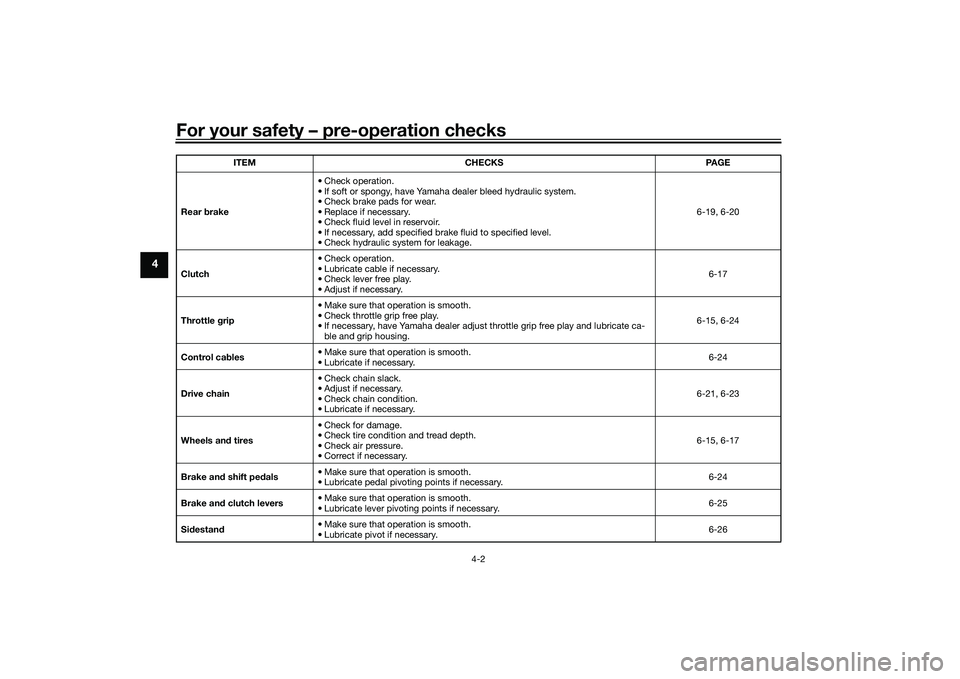
For your safety – pre-operation checks
4-2
4
Rear brake• Check operation.
• If soft or spongy, have Yamaha dealer bleed hydraulic system.
• Check brake pads for wear.
• Replace if necessary.
• Check fluid level in reservoir.
• If necessary, add specified brake fluid to specified level.
• Check hydraulic system for leakage.6-19, 6-20
Clutch• Check operation.
• Lubricate cable if necessary.
• Check lever free play.
• Adjust if necessary.6-17
Throttle grip• Make sure that operation is smooth.
• Check throttle grip free play.
• If necessary, have Yamaha dealer adjust throttle grip free play and lubricate ca-
ble and grip housing.6-15, 6-24
Control cables• Make sure that operation is smooth.
• Lubricate if necessary.6-24
Drive chain• Check chain slack.
• Adjust if necessary.
• Check chain condition.
• Lubricate if necessary.6-21, 6-23
Wheels and tires•Check for damage.
• Check tire condition and tread depth.
• Check air pressure.
• Correct if necessary.6-15, 6-17
Brake and shift pedals• Make sure that operation is smooth.
• Lubricate pedal pivoting points if necessary.6-24
Brake and clutch levers• Make sure that operation is smooth.
• Lubricate lever pivoting points if necessary.6-25
Sidestand• Make sure that operation is smooth.
• Lubricate pivot if necessary.6-26 ITEM CHECKS PAGE
UB04E0E0.book Page 2 Wednesday, September 2, 2015 3:51 PM
Page 47 of 96

Periodic maintenance and adjustment
6-4
6
EAU1770M
General maintenance and lubrication chartNO. ITEM CHECK OR MAINTENANCE JOBODOMETER READING
ANNUAL
CHECK 1000 km
(600 mi)10000 km
(6000 mi)20000 km
(12000 mi)30000 km
(18000 mi)40000 km
(24000 mi)
1 Air filter element•Replace.√√
2 Air filter check hose• Clean.√√√√√
3Clutch• Check operation.
•Adjust.√√√√√
4*Front brake• Check operation, fluid level and
vehicle for fluid leakage.√√√√√√
• Replace brake pads. Whenever worn to the limit
5*Rear brake• Check operation, fluid level and
vehicle for fluid leakage.√√√√√√
• Replace brake pads. Whenever worn to the limit
6*Brake hoses• Check for cracks or damage.
• Check for correct routing and
clamping.√√√√√
• Replace. Every 4 years
7*Brake fluid• Change. Every 2 years
8*Wheels• Check runout and for damage.√√√√
9*Tires• Check tread depth and for dam-
age.
• Replace if necessary.
• Check air pressure.
• Correct if necessary.√√√√√
10*Wheel bearings• Check bearings for looseness or
damage.√√√√
UB04E0E0.book Page 4 Wednesday, September 2, 2015 3:51 PM
Page 62 of 96

Periodic maintenance and adjustment
6-19
6
EAU22274
Brake light switchesThe brake light, which is activated by
the brake pedal and brake lever,
should come on just before braking
takes effect. If necessary, adjust the
rear brake light switch as follows, but
the front brake light switch should be
adjusted by a Yamaha dealer.
Turn the rear brake light switch adjust-
ing nut while holding the rear brake
light switch in place. To make the
brake light come on earlier, turn the ad-
justing nut in direction (a). To make the
brake light come on later, turn the ad-
justing nut in direction (b).
EAU22393
Checking the front and rear
brake padsThe front and rear brake pads must be
checked for wear at the intervals spec-
ified in the periodic maintenance and
lubrication chart.
EAU22432
Front brake pads
Each front brake pad is provided with
wear indicator grooves, which allow
you to check the brake pad wear with-
out having to disassemble the brake.
To check the brake pad wear, check
the wear indicator grooves. If a brake
pad has worn to the point that the wearindicator grooves have almost disap-
peared, have a Yamaha dealer replace
the brake pads as a set.
EAU36721
Rear brake pads
Each rear brake pad is provided with
wear indicator grooves, which allow
you to check the brake pad wear with-
out having to disassemble the brake.
To check the brake pad wear, check
the wear indicator grooves. If a brake
pad has worn to the point that the wear
indicator grooves have almost disap-
peared, have a Yamaha dealer replace
the brake pads as a set.
1. Rear brake light switch
2. Rear brake light switch adjusting nut
(a)
(b)1
2
1. Brake pad wear indicator groove
1 1
1. Brake pad wear indicator groove
1
1
UB04E0E0.book Page 19 Wednesday, September 2, 2015 3:51 PM
Page 63 of 96

Periodic maintenance and adjustment
6-20
6
EAU22582
Checking the brake fluid levelBefore riding, check that the brake fluid
is above the minimum level mark.
Check the brake fluid level with the top
of the reservoir level. Replenish the
brake fluid if necessary.
Front brakeRear brake
WARNING
EWA15991
Improper maintenance can result in
loss of braking ability. Observe
these precautions:
Insufficient brake fluid may al-
low air to enter the brake sys-
tem, reducing braking
performance.
Clean the filler cap before re-
moving. Use only DOT 4 brake
fluid from a sealed container.Use only the specified brake flu-
id; otherwise, the rubber seals
may deteriorate, causing leak-
age.
Refill with the same type of
brake fluid. Adding a brake fluid
other than DOT 4 may result in a
harmful chemical reaction.
Be careful that water does not
enter the brake fluid reservoir
when refilling. Water will signifi-
cantly lower the boiling point of
the fluid and may result in vapor
lock.
NOTICE
ECA17641
Brake fluid may damage painted
surfaces or plastic parts. Always
clean up spilled fluid immediately.As the brake pads wear, it is normal for
the brake fluid level to gradually go
down. A low brake fluid level may indi-
cate worn brake pads and/or brake
system leakage; therefore, be sure to
check the brake pads for wear and the
brake system for leakage. If the brake
1. Minimum level mark
1
1. Minimum level mark
Specified brake fluid:
DOT 4
1
UB04E0E0.book Page 20 Wednesday, September 2, 2015 3:51 PM
Page 77 of 96

Periodic maintenance and adjustment
6-34
6
EAU24361
Front wheel
EAUN0670
To remove the front wheel
WARNING
EWA10822
To avoid injury, securely support the
vehicle so there is no danger of it
falling over.1. Loosen the axle nut and the brake
caliper bolts.2. Lift the front wheel off the ground
according to the procedure in the
previous section “Supporting the
motorcycle”.
3. Remove the brake caliper (togeth-
er with the reflector on each side)
by removing the bolts. NOTICE:
Do not apply the brake after the
brake caliper has been re-
moved, otherwise the brake
pads will be forced shut.
[ECA22240]
4. Remove the axle nut.
5. Pull the wheel axle out, and then
remove the wheel.
To install the front wheel
1. Lift the wheel up between the fork
legs.2. Insert the wheel axle from the right
side and then install the axle nut.
3. Install the brake caliper (together
with the reflectors on each side)
by installing the bolts.
TIPMake sure that there is enough space
between the brake pads before install-
ing the brake caliper onto the brake
disc.4. Lower the front wheel so that it is
on the ground, and then put the
sidestand down.
5. Tighten the wheel axle and the
brake caliper bolts to the specified
torques.
6. Push down hard on the handlebar
several times to check for proper
fork operation.
1. Axle nut
1
1. Brake caliper bolt
1
Tightening torques:
Wheel axle:
60 Nm (6.0 m·kgf, 44 ft·lbf)
Brake caliper bolt:
35 Nm (3.5 m·kgf, 25 ft·lbf)
UB04E0E0.book Page 34 Wednesday, September 2, 2015 3:51 PM
Page 78 of 96

Periodic maintenance and adjustment
6-35
6
EAU25081
Rear wheel
EAU62612
To remove the rear wheel
WARNING
EWA10822
To avoid injury, securely support the
vehicle so there is no danger of it
falling over.1. Remove the drive chain puller cap,
and then loosen the locknut and
drive chain slack adjusting nut on
each side of the swingarm.2. Loosen the axle nut.
3. Lift the rear wheel off the ground
according to the procedure on
page 6-33.
4. Remove the axle nut.
5. Push the wheel forward, and then
remove the drive chain from the
rear sprocket.
TIPThe drive chain does not need to be
disassembled in order to remove and
install the rear wheel.6. While supporting the brake caliper
and slightly lifting the wheel, pull
the wheel axle out.TIPA rubber mallet may be useful to tap
the wheel axle out.7. Remove the wheel. NOTICE: Do
not apply the brake after the
wheel and brake disc have been
removed, otherwise the brake
pads will be forced shut.
[ECA11073]
1. Wheel axle
2. Drive chain slack adjusting nut
3. Locknut
4. Drive chain puller cap
342
1
1. Axle nut
1
1. Wheel axle
2. Washer
1 2
UB04E0E0.book Page 35 Wednesday, September 2, 2015 3:51 PM