2016 YAMAHA FJR1300A lights
[x] Cancel search: lightsPage 36 of 120

Instrument and control functions
3-22
3
EAU49432
D-mo de ( drive mo de)
D-mode is an electronically controlled
engine performance system with two
mode selections (touring mode “T” and
sports mode “S”).
Push the drive mode switch “MODE”
to switch between modes. (See page
3-23 for an explanation of the drive
mode switch.)
TIP
Before using D-mode, make sure you
understand its operation along with the
operation of the drive mode switch.
Tourin g mo de “T”
The touring mode “T” is suitable for
various riding conditions.
This mode allows the rider to enjoy
smooth drivability from the low-speed
range to the high-speed range.
Sports mo de “S”
This mode offers a sportier engine re-
sponse in the low- to mid-speed range
compared to the touring mode.
EAU1234J
Han dle bar switches
Left
Ri ght
EAU54201Dimmer/Pass switch “ / /PASS”
Set this switch to “ ” for the high
beam and to “ ” for the low beam.
To flash the high beam, push the pass
side “PASS” of the switch while the
headlights are on low beam.
1. Drive mode switch “MODE”
STOP
MODE
RUNSTART
1
1. Menu switch “MENU”
2. Select switch “ / ”
3. Cruise control switches
4. Horn switch “ ”
5. Turn signal switch “ / ”
6. Dimmer/Pass switch “ / /PASS”
1. Stop/Run/Start switch “ / / ”
2. Drive mode switch “MODE”
3. Hazard switch “ ”
RES
SETPA S S
1
6
5
4
2
3
STOP
MODE
RUNSTART
3
2
1
UB88E0E0.book Page 22 Friday, October 16, 2015 11:59 AM
Page 37 of 120

Instrument and control functions
3-23
3
EAU12461Turn si gnal switch “ / ”
To signal a right-hand turn, push this
switch to “ ”. To signal a left-hand
turn, push this switch to “ ”. When
released, the switch returns to the cen-
ter position. To cancel the turn signal
lights, push the switch in after it has re-
turned to the center position.
EAU12501Horn switch “ ”
Press this switch to sound the horn.
EAU54212Stop/Run/Start switch “ / / ”
To crank the engine with the starter,
set this switch to “ ”, and then push
the switch down towards “ ”. See
page 5-2 for starting instructions prior
to starting the engine.
Set this switch to “ ” to stop the en-
gine in case of an emergency, such as
when the vehicle overturns or when the
throttle cable is stuck.
EAU12735Hazar d switch “ ”
With the key in the “ON” or “ ” posi-
tion, use this switch to turn on the haz-
ard lights (simultaneous flashing of all
turn signal lights).
The hazard lights are used in case of an
emergency or to warn other drivers
when your vehicle is stopped where it
might be a traffic hazard.
NOTICE
ECA10062
Do not use the hazar d lig hts for an
exten ded len gth of time with the en-
g ine not runnin g, otherwise the bat-
tery may dischar ge.
EAU12781Cruise control switches
See page 3-7 for an explanation of the
cruise control system.
EAU54231Menu switch “MENU”
This switch is used to perform selec-
tions in the function display and setting
mode display of the multi-function me-
ter unit.
See “Multi-function meter unit” on
page 3-10 for detailed information.
EAU54221Select switch “ / ”
This switch is used to perform selec-
tions in the function display and setting
mode display of the multi-function me-
ter unit.
See “Multi-function meter unit” on
page 3-10 for detailed information.
EAU54691Drive mo de switch “MODE”
WARNING
EWA15341
Do not chan ge the D-mod e while the
vehicle is movin g.
Using this switch changes the drive
mode to touring mode “T” or sports
mode “S”.
The throttle grip must be completely
closed in order to change the drive
mode.
The selected mode is shown on the
drive mode display. (See page 3-12.)
The drive mode cannot be changed
while the cruise control system is oper-
ating.
UB88E0E0.book Page 23 Friday, October 16, 2015 11:59 AM
Page 43 of 120

Instrument and control functions
3-29
3
EAU13222
Fuel
Make sure there is sufficient gasoline in
the tank.
WARNING
EWA10882
Gasoline an d gasoline vapors are
extremely flammab le. To avoid fires
an d explosions an d to re duce the
risk of injury when refueling , follow
these instructions.
1. Before refueling, turn off the en- gine and be sure that no one is sit-
ting on the vehicle. Never refuel
while smoking, or while in the vi-
cinity of sparks, open flames, or
other sources of ignition such as
the pilot lights of water heaters
and clothes dryers.
2. Do not overfill the fuel tank. When refueling, be sure to insert the
pump nozzle into the fuel tank filler
hole. Stop filling when the fuel
reaches the bottom of the filler
tube. Because fuel expands when
it heats up, heat from the engine or
the sun can cause fuel to spill out
of the fuel tank. 3. Wipe up any spilled fuel immedi-
ately. NOTICE: Immediately
wipe off spille d fuel with a clean,
d ry, soft cloth, since fuel may
d eteriorate painte d surfaces or
plastic parts.
[ECA10072]
4. Be sure to securely close the fuel tank cap.
WARNING
EWA15152
Gasoline is poisonous an d can
cause injury or death. Han dle gaso-
line with care. Never siphon gasoline
b y mouth. If you shoul d swallow
some gasoline or inhale a lot of gas-
oline vapor, or get some gasoline in
your eyes, see your d octor immedi-
ately. If g asoline spills on your skin,
wash with soap an d water. If g aso-
line spills on your clothin g, chan ge
your clothes.
EAU49743
NOTICE
ECA11401
Use only unlea ded g asoline. The use
of lead ed g asoline will cause severe
d amag e to internal en gine parts,
such as the valves an d piston rin gs,
as well as to the exhaust system.
Your Yamaha engine has been de-
signed to use regular unleaded gaso-
line with a research octane number of
1. Fuel tank filler tube
2. Maximum fuel level
Recommen ded fuel:
Regular unleaded gasoline (Gasohol
[E10] acceptable)
Fuel tank capacity: 25 L (6.6 US gal, 5.5 Imp.gal)
Fuel reserve amount:
5.5 L (1.45 US gal, 1.21 Imp.gal)
UB88E0E0.book Page 29 Friday, October 16, 2015 11:59 AM
Page 51 of 120
Instrument and control functions
3-37
3
EAU39612
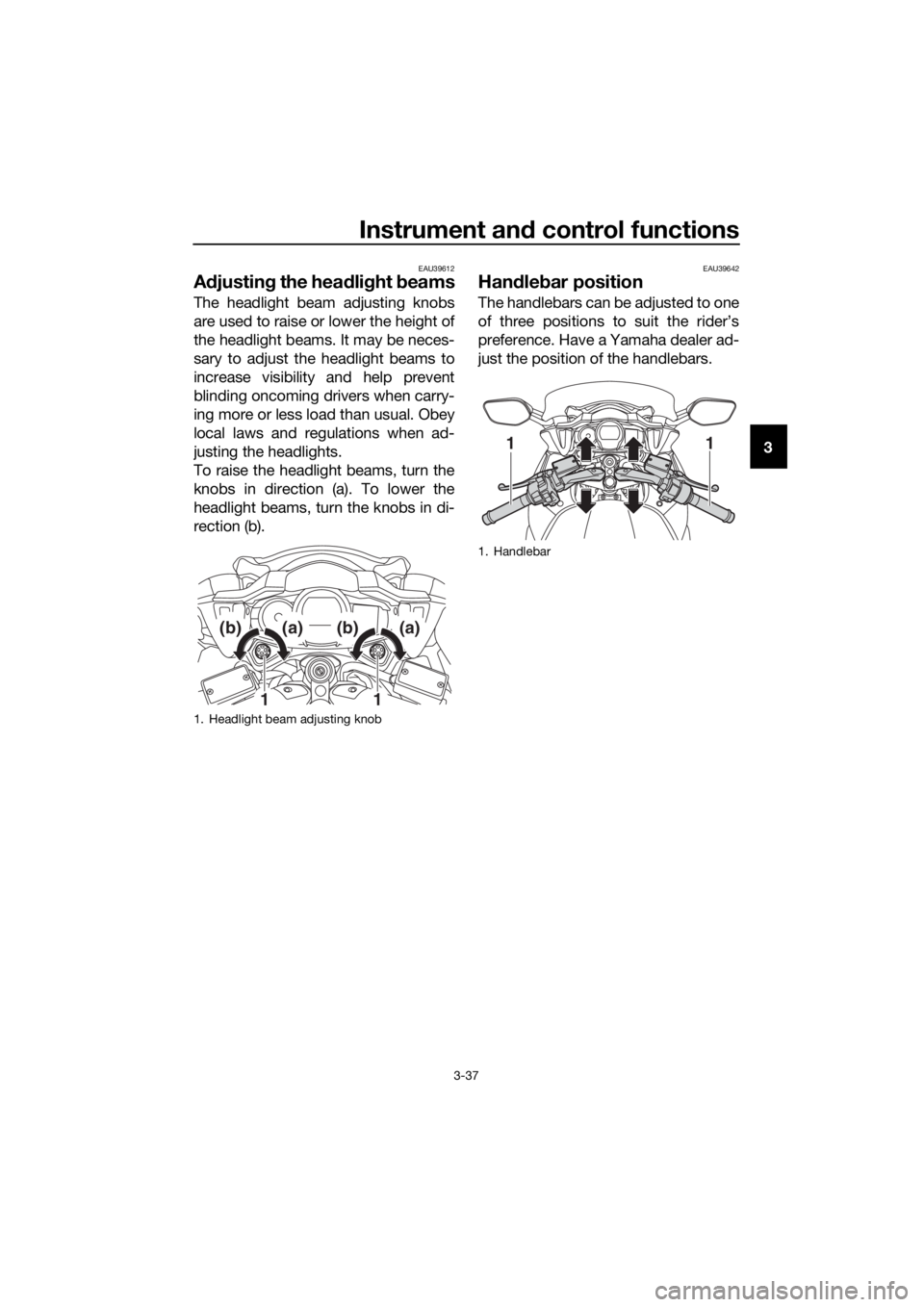
A djustin g the hea dlig ht beams
The headlight beam adjusting knobs
are used to raise or lower the height of
the headlight beams. It may be neces-
sary to adjust the headlight beams to
increase visibility and help prevent
blinding oncoming drivers when carry-
ing more or less load than usual. Obey
local laws and regulations when ad-
justing the headlights.
To raise the headlight beams, turn the
knobs in direction (a). To lower the
headlight beams, turn the knobs in di-
rection (b).
EAU39642
Han dle bar position
The handlebars can be adjusted to one
of three positions to suit the rider’s
preference. Have a Yamaha dealer ad-
just the position of the handlebars.
1. Headlight beam adjusting knob
11
(b)(a)(b)(a)
1. Handlebar
11
UB88E0E0.book Page 37 Friday, October 16, 2015 11:59 AM
Page 64 of 120

Operation and important rid ing points
5-2
5
EAU54171
Startin g the en gine
In order for the ignition circuit cut-off
system to enable starting, one of the
following conditions must be met:
The transmission is in the neutral
position.
The transmission is in gear with
the clutch lever pulled and the
sidestand up.
See page 3-44 for more informa-
tion.
1. Turn the key to “ON” and make sure that the start/engine stop
switch is set to “ ”.
The following warning lights and
indicator lights should come on for
a few seconds, then go off. Oil level warning light
Engine trouble warning light
Traction control system indi-
cator/warning light
Cruise control indicator lights
Immobilizer system indicator
light
NOTICE
ECA11834
If a warnin g or in dicator li ght does
not come on initially when the key is
turne d to “ON”, or if a warnin g or in-
d icator li ght remains on, see pag e
3-4 for the correspon din g warnin g
an d in dicator li ght circuit check.
The ABS warning light should
come on when the key is turned to
“ON”, and then go off after travel-
ing at a speed of 10 km/h (6 mi/h)
or higher.
NOTICE
ECA17682
If the ABS warnin g li ght does not
come on an d then g o off as ex-
plained above, see pag e 3-4 for the
warnin g lig ht circuit check.
2. Shift the transmission into the
neutral position. The neutral indi-
cator light should come on. If not,
ask a Yamaha dealer to check the
electrical circuit.
3. Start the engine by pushing the “ ” side of the start/engine
stop switch.
If the engine fails to start, release
the start/engine stop switch, wait
a few seconds, and then try again.
Each starting attempt should be
as short as possible to preserve
the battery. Do not crank the en-
gine more than 10 seconds on any
one attempt.
NOTICE
ECA11043
For maximum eng ine life, never ac-
celerate har d when the en gine is
col d!
UB88E0E0.book Page 2 Friday, October 16, 2015 11:59 AM
Page 66 of 120

Operation and important rid ing points
5-4
5 clutch lever in, use the brakes to
slow the motorcycle, and continue
to downshift as necessary.
4. Once the motorcycle has stopped, the transmission can be
shifted into the neutral position.
The neutral indicator light should
come on and then the clutch lever
can be released.
WARNING
EWA17380
Improper brakin g can cause
loss of control or traction. Al-
ways use b oth brakes an d apply
them smoothly.
Make sure that the motorcycle
and the en gine have sufficiently
slowe d b efore shiftin g to a low-
er gear. En gag in g a lower gear
when the vehicle or en gine
speed is too hi gh coul d make
the rear wheel lose traction or
the en gine to over-rev. This
coul d cause loss of control, an
acci dent an d injury. It coul d also
cause en gine or drive train dam-
a g e.
EAU64150Recommen ded shift points
The recommended shift points during
acceleration and deceleration are
shown in the table below.
EAU16811
Tips for re ducin g fuel con-
sumption
Fuel consumption depends largely on
your riding style. Consider the follow-
ing tips to reduce fuel consumption:
Shift up swiftly, and avoid high en-
gine speeds during acceleration.
Do not rev the engine while shift-
ing down, and avoid high engine
speeds with no load on the en-
gine.
Turn the engine off instead of let-
ting it idle for an extended length
of time (e.g., in traffic jams, at traf-
fic lights or at railroad crossings).
Shift up points:
1st → 2nd: 20 km/h (12 mph)
2nd → 3rd: 30 km/h (19 mph)
3rd → 4th: 40 km/h (25 mph)
4th → 5th: 50 km/h (31 mph)
5th → 6th: 60 km/h (37 mph)
Shift down points:
6th → 5th: 45 km/h (28 mph)
5th → 4th: 35 km/h (22 mph)
4th → 3rd: 25 km/h (16 mph)
UB88E0E0.book Page 4 Friday, October 16, 2015 11:59 AM
Page 117 of 120

10-1
10
Index
A
ABS ...................................................... 3-26
ABS warning light ................................... 3-5
Accessory box...................................... 3-36
Air filter element, cleaning .................... 6-17
Auxiliary DC jack .................................. 3-46
B
Battery .................................................. 6-32
Brake and clutch fluid levels,
checking............................................. 6-25
Brake and clutch fluids, changing ........ 6-27
Brake and clutch levers, checking
and lubricating ................................... 6-29
Brake and shift pedals, checking and
lubricating .......................................... 6-28
Brake lever ........................................... 3-25
Brake lever free play, checking ............ 6-23
Brake light switches ............................. 6-24
Brake pedal .......................................... 3-25
C
Cables, checking and lubricating ......... 6-27
Canister ................................................ 6-11
Care ........................................................ 7-1
Catalytic converters ............................. 3-31
Centerstand and sidestand, checking
and lubricating ................................... 6-29
Clutch lever ................................. 3-24, 6-23
Coolant ................................................. 6-15
Cowling vents, opening and closing .... 3-38
Cruise control indicator lights ................ 3-4
Cruise control switches ........................ 3-23
Cruise control system ............................ 3-7
D
Diagnostic connector ............................. 9-2
Dimmer/Pass switch ............................ 3-22
D-mode (drive mode) ........................... 3-22
E
Engine break-in ...................................... 5-5
Engine idling speed, checking ............. 6-18
Engine oil and oil filter cartridge ........... 6-11
Engine serial number.............................. 9-1
Engine trouble warning light................... 3-5
F
Final gear oil ......................................... 6-14
Front and rear brake pads, checking ... 6-24
Front fork, adjusting ............................. 3-40
Front fork, checking ............................. 6-31
Fuel....................................................... 3-29
Fuel consumption, tips for reducing ...... 5-4
Fuel tank cap........................................ 3-28 Fuel tank overflow hose ........................ 3-30
Fuses, replacing.................................... 6-34
H
Handlebar position, adjusting ............... 3-37
Handlebar switches .............................. 3-22
Hazard switch ....................................... 3-23
Headlight beams, adjusting .................. 3-37
High beam indicator light........................ 3-4
Horn switch........................................... 3-23
I
Identification numbers ............................ 9-1
Ignition circuit cut-off system ............... 3-44
Immobilizer system ................................. 3-1
Immobilizer system indicator light .......... 3-6
Indicator lights and warning lights .......... 3-4
M
Main switch/steering lock ....................... 3-2
Maintenance and lubrication, periodic ... 6-4
Maintenance, emission control
system .................................................. 6-3
Matte color, caution ................................ 7-1
Menu switch ......................................... 3-23
Model label ............................................. 9-1
Multi-function meter unit ...................... 3-10
N
Neutral indicator light.............................. 3-4
O
Oil level warning light .............................. 3-4
P
Panels, removing and installing .............. 6-7
Parking .................................................... 5-6
Part locations .......................................... 2-1
R
Rear suspension, lubricating ................ 6-30
Rear view mirrors .................................. 3-39
Rider seat height, adjusting .................. 3-33
S
Safety information................................... 1-1
Seats ..................................................... 3-31
Select switch ........................................ 3-23
Shifting .................................................... 5-3
Shift pedal............................................. 3-24
Shock absorber assembly, adjusting ... 3-42
Sidestand .............................................. 3-43
Spark plugs, checking .......................... 6-10
Specifications ......................................... 8-1
Starting the engine.................................. 5-2
Steering, checking ................................ 6-31
Stop/Run/Start switch .......................... 3-23
Storage ................................................... 7-4
UB88E0E0.book Page 1 Friday, October 16, 2015 11:59 AM
Page 118 of 120

Index
10-2
10
Storage compartments ......................... 3-35
Swingarm pivots, lubricating ................ 6-30
T
Throttle grip and cable, checking and
lubricating ........................................... 6-28
Throttle grip free play, checking ........... 6-19
Tires ...................................................... 6-20
Tool kit .................................................... 6-2
Traction control system ........................ 3-27
Traction control system indicator/
warning light ......................................... 3-5
Troubleshooting .................................... 6-36
Troubleshooting charts ......................... 6-37
Turn signal indicator lights ...................... 3-4
Turn signal switch ................................. 3-23
V
Valve clearance..................................... 6-19
Vehicle identification number ................. 9-1
Vehicle lights ......................................... 6-35
W
Wheel bearings, checking..................... 6-32
Wheels .................................................. 6-22
UB88E0E0.book Page 2 Friday, October 16, 2015 11:59 AM