2016 VOLVO XC70 372
[x] Cancel search: 372Page 11 of 396

Contents
9
11
11 Specifications
Label information.................................... 367
Dimensions............................................. 370
Weights................................................... 372
Engine specifications.............................. 373
Oil specifications..................................... 374
Oil volume............................................... 375
Coolant – specification and volume........ 376Transmission oil – specification and vol-
umes....................................................... 376
Brake fluid – specification and volume... 376
Power steering – specification................ 377Fuel tank volume – specification and vol-
ume......................................................... 377 Air conditioning – specification and vol-
ume......................................................... 377
Battery specifications............................. 378
Symbols – general information............... 379
Warning symbols.................................... 379
Indicator symbols.................................... 380
Information symbols............................... 381
Information symbols – ceiling console.... 382
Information symbols – center console.... 382
12
12 Index
Index....................................................... 384
Page 29 of 396
02 Safety
02
27
Reporting safety defects
The following information will help you report any perceived safety-related defects in yourvehicle.
Reporting safety defects in the U.S.
If you believe that your vehicle has a defect which could cause a crash orcould cause injury or death, youshould immediately inform theNational Highway Traffic SafetyAdministration (NHTSA) in additionto notifying Volvo Cars of NorthAmerica, LLC. If NHTSA receivessimilar complaints, it may open aninvestigation, and if it finds that asafety defect exists in a group ofvehicles, it may order a recall andremedy campaign. However, NHTSAcannot become involved in individ-ual problems between you, yourretailer, or Volvo Cars of NorthAmerica, LLC. To contact NHTSA,you may either call the Auto SafetyHotline toll-free at 1-888-327-4236(TTY: 1-800-424-9153) or write to: NHTSA, U.S. Department of Trans-portation, Washington D.C. 20590. You can also obtain other informa- tion about motor vehicle safety fromhttp://www.safercar.gov, where youcan also enter your vehicle's VIN(Vehicle Identification Number) tosee if it has any open recalls. Volvo strongly recommends that if your vehicle is covered under aservice campaign, safety or emis-sion recall or similar action, it shouldbe completed as soon as possible.Please check with your local retaileror Volvo Cars of North America, LLCif your vehicle is covered underthese conditions. NHTSA can be reached at:Internet:http://www.nhtsa.govTelephone:1-888-DASH-2-DOT (1-888-327-4236).
Reporting safety defects in CanadaIf you believe your vehicle has a defect that could cause a crash or could cause injury ordeath, you should immediately inform Trans-port Canada in addition to notifying VolvoCars of Canada Corp.
Transport Canada can be contacted at:1-800-333-0510 Teletypewriter (TTY): 613 990-4500Fax: 1-819-994-3372Mailing Address: Transport Canada - Road Safety, 80 rue Noël, Gatineau, (Quebec) J8Z0A1
Related information
•
Occupant safety (p. 26)
• Recall information (p. 26)
Page 283 of 396

08 Starting and driving
08
}}
281
Towing a trailer
When towing a trailer, always observe the legal requirements of the state/province.
NOTE
For the maximum trailer and tongue weights recommended by Volvo, seeWeights (p. 372).
•All Volvo models are equipped with energy-absorbing shock-mounted bump-ers. Trailer hitch installation should notinterfere with the proper operation of thisbumper system.
Trailer towing does not normally present any particular problems, but take into considera-tion: • Increase tire pressure to recommended full pressure, see Tire inflation – pressuretable (p. 300).
• When your vehicle is new, avoid towingheavy trailers during the first 620 miles(1,000 km).
• Maximum speed when towing a trailer:50 mph (80 km/h).
• Engine and transmission are subject toincreased loads. Therefore, engine cool-ant temperature should be closelywatched when driving in hot climates orhilly terrain. Use a lower gear and turn offthe air conditioner if the temperaturegauge needle enters the red range. •
If the automatic transmission begins tooverheat, a message will be displayed inthe text window.
• Avoid overload and other abusive opera-tion.
• Hauling a trailer affects handling, durabil-ity, and economy.
• It is necessary to balance trailer brakeswith the towing vehicle brakes to providea safe stop (check and observe state/local regulations).
• Do not connect the trailer's brake systemdirectly to the vehicle's brake system.
• More frequent vehicle maintenance isrequired.
• Remove the ball holder when the hitch isnot being used.
NOTE
• When parking the vehicle with a trailer on a hill, apply the parking brakebefore putting the gear selector in
P.
Always follow the trailer manufactur-er's recommendations for wheelchocking.
• When starting on a hill, put the gearselector in
D before releasing the park-
ing brake.
• If you use the manual (Geartronic) shiftpositions while towing a trailer, makesure the gear you select does not puttoo much strain on the engine (usingtoo high a gear).
• The drawbar assembly/trailer hitchmay be rated for trailers heavier thanthe vehicle is designed to tow. Pleaseadhere to Volvo's recommended trailerweights.
• Avoid driving with a trailer on inclinesof more than 15%.
Page 303 of 396

09 Wheels and tires
09
}}
301
Loading specifications
Properly loading your vehicle will provide maximum return of vehicle design perform-ance. Before loading your vehicle, familiarize your- self with the following terms for determiningyour vehicle's weight ratings, with or withouta trailer, from the vehicle's Federal/CanadianMotor Vehicle Safety Standards (FMVSS/CMVSS) label, and the vehicle's tire informa-tion placard:
Curb weightThe weight of the vehicle including a full tankof fuel and all standard equipment. It doesnot include passengers, cargo, or optionalequipment.
Capacity weightAll weight added to the curb weight, includingcargo and optional equipment. When towing,trailer hitch tongue load is also part of cargoweight.
Permissible axle weightThe maximum allowable weight that can becarried by a single axle (front or rear). Thesenumbers are shown on the Federal/CanadianMotor Vehicle Safety Standards (FMVSS/CMVSS) label. The total load on each axlemust never exceed its maximum permissibleweight.
Gross vehicle weight (GVW)The vehicle's curb weight + cargo + passen-gers.
NOTE
•The location of the various labels in your vehicle, see Label information(p. 367).
• A table listing important weight limitsfor your vehicle, see Weights (p. 372).
Loading specifications – load limit
The load limit of your vehicle is the combined weight of the occupants and cargo.
Steps for Determining Correct Load
Limit
1. Locate the statement "the combined weight of occupants and cargo shouldnever exceed XXX pounds" on your vehi-cle's placard.
2. Determine the combined weight of the driver and passengers that will be ridingin your vehicle.
3. Subtract the combined weight of the driver and passengers from XXX kilo-grams or XXX pounds.
4. The resulting figure equals the available amount of cargo and luggage loadcapacity. For example, if the "XXX"amount equals 1400 lbs. and there will befive 150 lb. passengers in your vehicle,the amount of available cargo and lug-gage load capacity is 650 lbs. (1400 – 750 (5 × 150) = 650 lbs.)
5. Determine the combined weight of lug- gage and cargo being loaded on the vehi-cle. That weight may not safely exceedthe available cargo and luggage loadcapacity calculated in Step 4.
Page 371 of 396

11 Specifications
11
369
List of labelsVehicle Emission Control Information. Your Volvo is designed to meet all appli- cable emission standards, as evidencedby the certification label on the undersideof the hood. For further information regar-ding these regulations, please consultyour Volvo retailer.
Engine oil. This label contains the recom-
mended engine oil specifications.
Vehicle Identification Number (VIN). The VIN plate is located on the top left surface of the dashboard. The VehicleIdentification Number (VIN) should alwaysbe quoted in all correspondence concern-ing your vehicle with the retailer and whenordering parts.
Tire inflation pressures. This label indi-
cates the correct inflation pressures for the tires that were on the vehicle when itleft the factory.
Federal Motor Vehicle Safety Stand- ards (FMVSS) specifications (USA) andMinistry of Transport (CMVSS) stand- ards (Canada). Your Volvo is designed to
meet all applicable safety standards, as evidenced by the certification label on thedriver's side B-pillar (the structural mem-ber at the side of the vehicle, at the rearof the driver's door opening). This labelalso includes codes for paint color, etc.For further information regarding theseregulations, please consult your Volvoretailer. U.S. models have the upperdecal; Canadian models have the lowerone.
Related information
• Weights (p. 372)
• Engine specifications (p. 373)
Page 374 of 396
11 Specifications
11
372
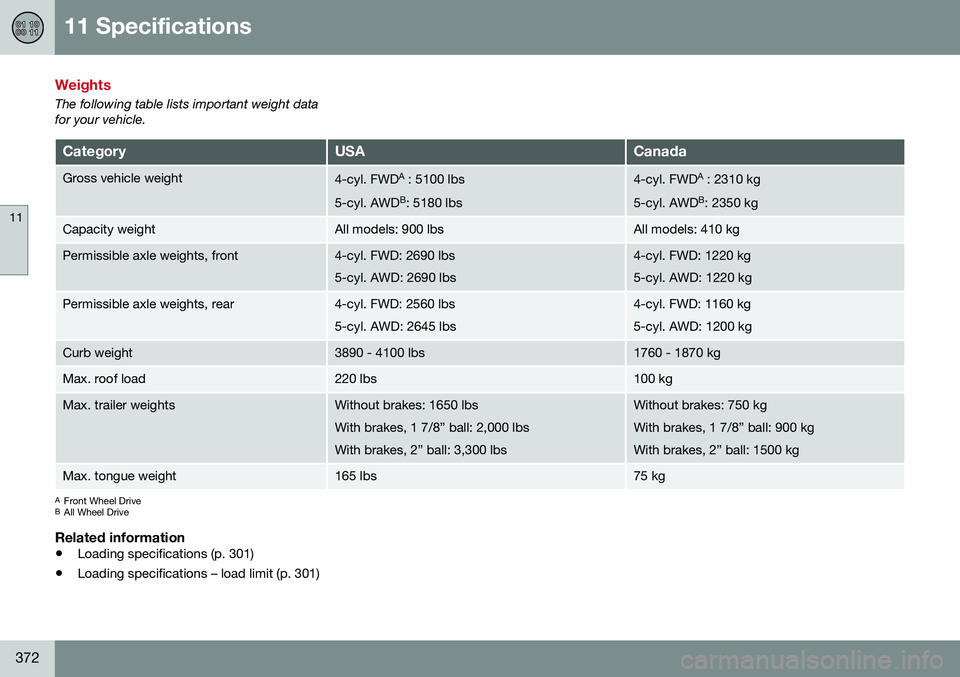
Weights
The following table lists important weight data for your vehicle.
CategoryUSACanada
Gross vehicle weight4-cyl. FWDA
: 5100 lbs
5-cyl. AWD B
: 5180 lbs4-cyl. FWD A
: 2310 kg
5-cyl. AWD B
: 2350 kg
Capacity weightAll models: 900 lbsAll models: 410 kg
Permissible axle weights, front4-cyl. FWD: 2690 lbs 5-cyl. AWD: 2690 lbs4-cyl. FWD: 1220 kg 5-cyl. AWD: 1220 kg
Permissible axle weights, rear4-cyl. FWD: 2560 lbs 5-cyl. AWD: 2645 lbs4-cyl. FWD: 1160 kg 5-cyl. AWD: 1200 kg
Curb weight3890 - 4100 lbs1760 - 1870 kg
Max. roof load220 lbs100 kg
Max. trailer weightsWithout brakes: 1650 lbs With brakes, 1 7/8” ball: 2,000 lbsWith brakes, 2” ball: 3,300 lbsWithout brakes: 750 kg With brakes, 1 7/8” ball: 900 kgWith brakes, 2” ball: 1500 kg
Max. tongue weight165 lbs75 kg
A Front Wheel Drive
B All Wheel Drive
Related information
• Loading specifications (p. 301)
• Loading specifications – load limit (p. 301)
Page 393 of 396

12 Index
12
391
Trips, long distance................................. 273
Tunnel detection........................................ 92
Turn signals............................................... 95 changing bulbs................................... 338
indicator lights...................................... 73
Two-stage booster cushion........... 57, 59, 60
U
Uniform Tire Quality Grading................... 303
Unlocking the tailgate.............................. 168
Unlocking the vehicle...... 155, 165, 166, 167
V
Vanity mirror............................................ 141 changing bulbs................................... 341
Vehicle dimensions XC70................................................... 370
Vehicle Event Data..................................... 18
Vehicle information.................................... 20
Vehicle loading........................ 142, 143, 301 roof loads............................................ 142
Vehicle maintenance................................ 322 performed by the owner..................... 323 Vehicle weights........................................ 372
Ventilated seats....................................... 130
Volvo and the environment........................ 22
Volvo ID..................................................... 21
Volvo maintenance.................................. 322
Volvo On Call Roadside Assistance.......... 24
Volvo programs......................................... 24
Volvo Sensus........................................... 111
W
Warning flashers, hazard........................... 94
Warning lights................................ 68, 70, 74
Warning symbol......................................... 75
Warning system, collision........ 209, 211, 217
Warranties................................................ 322
Washer fluid............................................. 344Washers
headlight............................................... 99
windshield............................................. 98
Water, driving through............................. 272
Waxing..................................................... 361
Weights.................................................... 372 Wheels..................................................... 288
changing............................................. 291
storing................................................. 289
Whiplash Protection System..................... 42 Windows power.................................................. 100
sun shade........................................... 100
Windshield heated......................................... 104, 132
rain sensor............................................ 98
washers................................................ 99
wipers/washers..................................... 98
Windshield washer fluid........................... 344
Windshield wipers.................................... 342 service position................................... 342
Wiper blades replacing............................................. 342
replacing tailgate wiper...................... 344