2016 VOLKSWAGEN JETTA emission
[x] Cancel search: emissionPage 214 of 412
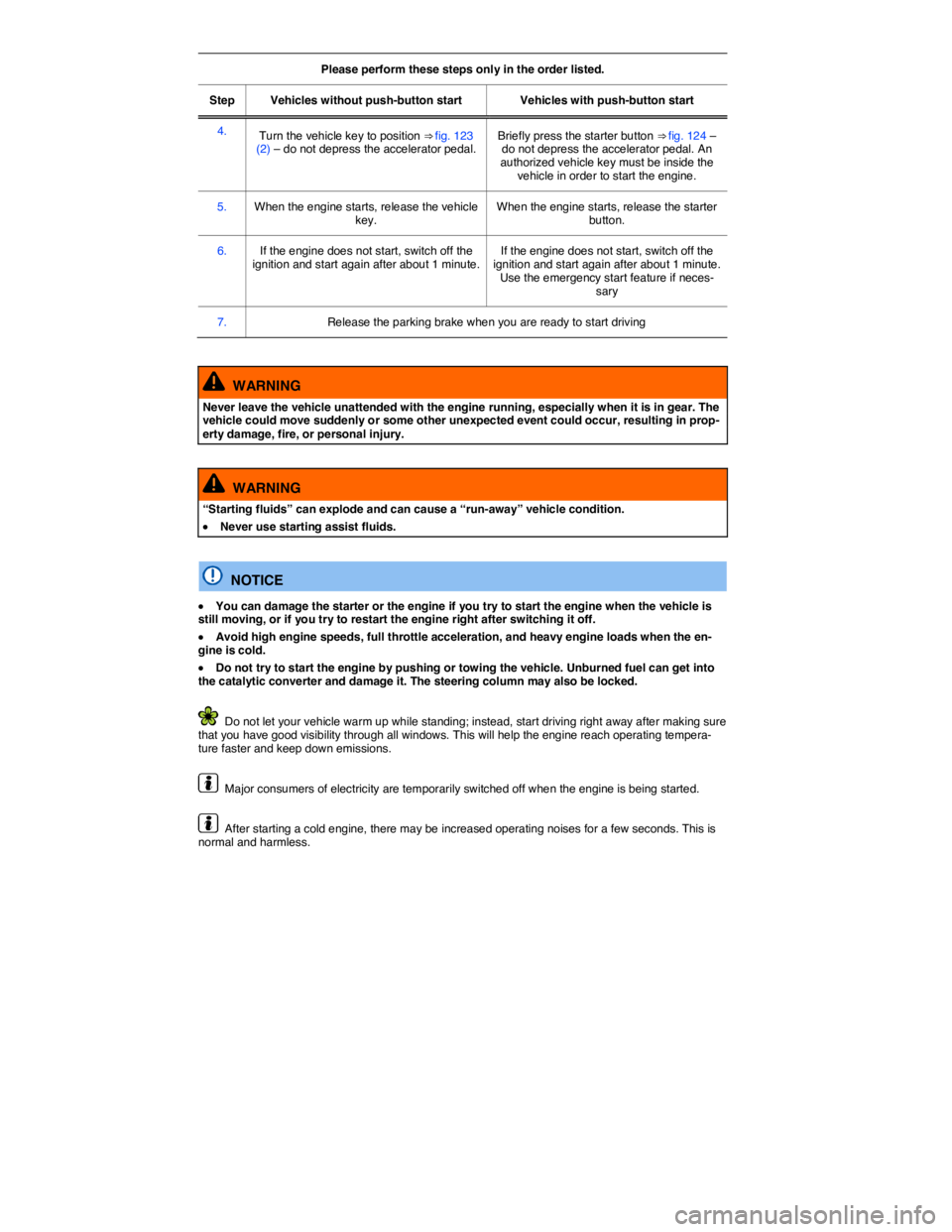
Please perform these steps only in the order listed.
Step Vehicles without push-button start Vehicles with push-button start
4. Turn the vehicle key to position ⇒ fig. 123 (2) – do not depress the accelerator pedal. Briefly press the starter button ⇒ fig. 124 – do not depress the accelerator pedal. An authorized vehicle key must be inside the vehicle in order to start the engine.
5. When the engine starts, release the vehicle key. When the engine starts, release the starter button.
6. If the engine does not start, switch off the ignition and start again after about 1 minute. If the engine does not start, switch off the ignition and start again after about 1 minute. Use the emergency start feature if neces-sary
7. Release the parking brake when you are ready to start driving
WARNING
Never leave the vehicle unattended with the engine running, especially when it is in gear. The vehicle could move suddenly or some other unexpected event could occur, resulting in prop-erty damage, fire, or personal injury.
WARNING
“Starting fluids” can explode and can cause a “run-away” vehicle condition.
x Never use starting assist fluids.
NOTICE
x You can damage the starter or the engine if you try to start the engine when the vehicle is still moving, or if you try to restart the engine right after switching it off.
x Avoid high engine speeds, full throttle acceleration, and heavy engine loads when the en-gine is cold.
x Do not try to start the engine by pushing or towing the vehicle. Unburned fuel can get into the catalytic converter and damage it. The steering column may also be locked.
Do not let your vehicle warm up while standing; instead, start driving right away after making sure that you have good visibility through all windows. This will help the engine reach operating tempera-ture faster and keep down emissions.
Major consumers of electricity are temporarily switched off when the engine is being started.
After starting a cold engine, there may be increased operating noises for a few seconds. This is normal and harmless.
Page 288 of 412

slightly with light pressure to open the misfueling guard. If the misfueling guard cannot be opened this way, see the nearest authorized Volkswagen dealer or authorized Volkswagen Service Facility and have the fuel system checked.
WARNING
Spilled fuel can cause fires, explosions, burns, and other severe injuries.
x Do not refuel from devices other than correct, undamaged standard diesel fuel pump noz-zles.
x Always stop refueling once the pump nozzle switches off so that the tank does not over-flow.
NOTICE
x It is your responsibility to put the right fuel in your vehicle and any damage that results from using the wrong fuel is not covered under the Emissions warranties or any other Volkswagen Limited Warranty.
x If you put any amount of the wrong fuel in the fuel tank, do not start the engine under any circumstances. Immediately contact the nearest authorized Volkswagen dealer or authorized Volkswagen Service Facility for assistance.
x If diesel fuel should get on any rubber hose, it must be wiped off immediately. The same applies if diesel fuel gets onto other parts of the vehicle, especially paint, tires, or a plastic part. Wash the contaminated vehicle parts right away with soap and warm water to help pre-vent leaks and serious damage.
NOTICE
Never force a fuel nozzle in the diesel misfueling guard. Forcing a fuel nozzle in the misfueling guard can damage it so that it can no longer help prevent misfueling.
x If you have problems inserting a diesel fuel nozzle, please check to make sure you are using the right kind of diesel fuel.
x If you must refuel with a non-standard diesel fuel nozzle, an adapter is available from Volkswagen to allow refueling. Contact an authorized Volkswagen dealer or authorized Volkswagen Service Facility for assistance. Only use an adapter approved by Volkswagen for your vehicle.
x Remember that the nozzle on a portable fuel container will generally not open the misfueling guard. If you must refuel with a portable fuel container in an emergency, you can pour diesel fuel very slowly from a portable container into the fuel filler neck of your vehicle. The fuel will flow slowly past the misfueling guard and into the tank.
Fuel capacities
Page 292 of 412
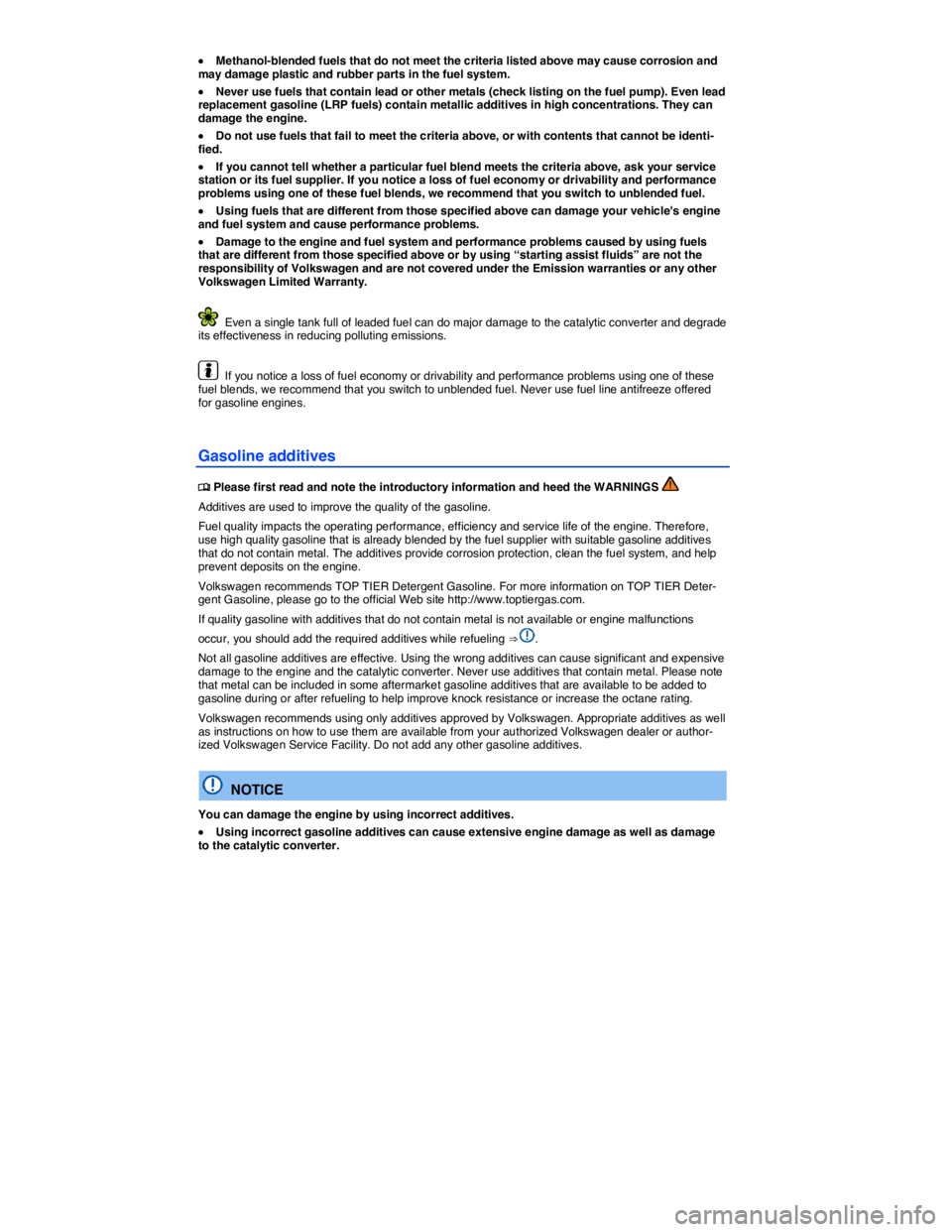
x Methanol-blended fuels that do not meet the criteria listed above may cause corrosion and may damage plastic and rubber parts in the fuel system.
x Never use fuels that contain lead or other metals (check listing on the fuel pump). Even lead replacement gasoline (LRP fuels) contain metallic additives in high concentrations. They can damage the engine.
x Do not use fuels that fail to meet the criteria above, or with contents that cannot be identi-fied.
x If you cannot tell whether a particular fuel blend meets the criteria above, ask your service station or its fuel supplier. If you notice a loss of fuel economy or drivability and performance problems using one of these fuel blends, we recommend that you switch to unblended fuel.
x Using fuels that are different from those specified above can damage your vehicle's engine and fuel system and cause performance problems.
x Damage to the engine and fuel system and performance problems caused by using fuels that are different from those specified above or by using “starting assist fluids” are not the responsibility of Volkswagen and are not covered under the Emission warranties or any other Volkswagen Limited Warranty.
Even a single tank full of leaded fuel can do major damage to the catalytic converter and degrade its effectiveness in reducing polluting emissions.
If you notice a loss of fuel economy or drivability and performance problems using one of these fuel blends, we recommend that you switch to unblended fuel. Never use fuel line antifreeze offered for gasoline engines.
Gasoline additives
Page 294 of 412
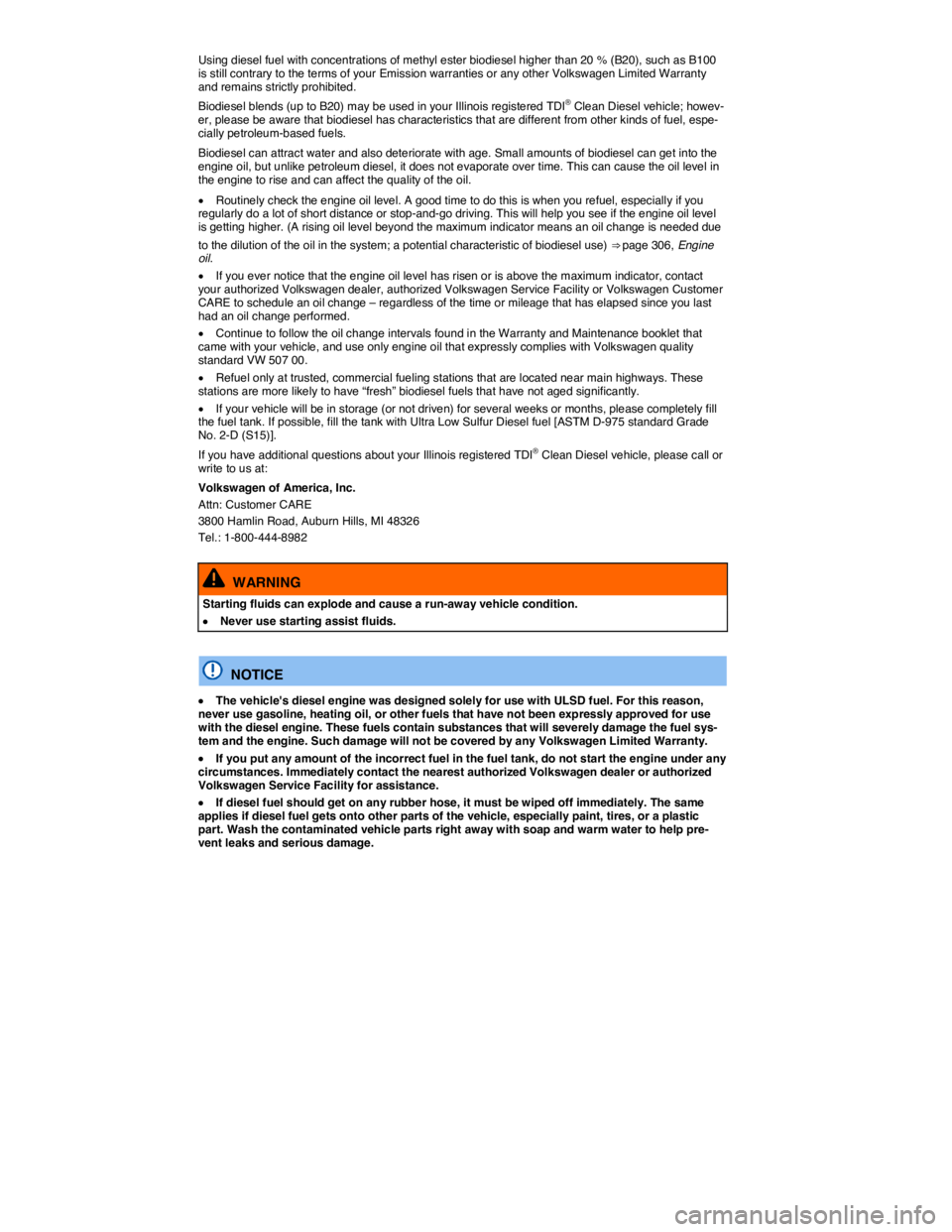
Using diesel fuel with concentrations of methyl ester biodiesel higher than 20 % (B20), such as B100 is still contrary to the terms of your Emission warranties or any other Volkswagen Limited Warranty and remains strictly prohibited.
Biodiesel blends (up to B20) may be used in your Illinois registered TDI® Clean Diesel vehicle; howev-er, please be aware that biodiesel has characteristics that are different from other kinds of fuel, espe-cially petroleum-based fuels.
Biodiesel can attract water and also deteriorate with age. Small amounts of biodiesel can get into the engine oil, but unlike petroleum diesel, it does not evaporate over time. This can cause the oil level in the engine to rise and can affect the quality of the oil.
x Routinely check the engine oil level. A good time to do this is when you refuel, especially if you regularly do a lot of short distance or stop-and-go driving. This will help you see if the engine oil level is getting higher. (A rising oil level beyond the maximum indicator means an oil change is needed due
to the dilution of the oil in the system; a potential characteristic of biodiesel use) ⇒ page 306, Engine oil.
x If you ever notice that the engine oil level has risen or is above the maximum indicator, contact your authorized Volkswagen dealer, authorized Volkswagen Service Facility or Volkswagen Customer CARE to schedule an oil change – regardless of the time or mileage that has elapsed since you last had an oil change performed.
x Continue to follow the oil change intervals found in the Warranty and Maintenance booklet that came with your vehicle, and use only engine oil that expressly complies with Volkswagen quality standard VW 507 00.
x Refuel only at trusted, commercial fueling stations that are located near main highways. These stations are more likely to have “fresh” biodiesel fuels that have not aged significantly.
x If your vehicle will be in storage (or not driven) for several weeks or months, please completely fill the fuel tank. If possible, fill the tank with Ultra Low Sulfur Diesel fuel [ASTM D-975 standard Grade No. 2-D (S15)].
If you have additional questions about your Illinois registered TDI® Clean Diesel vehicle, please call or write to us at:
Volkswagen of America, Inc.
Attn: Customer CARE
3800 Hamlin Road, Auburn Hills, MI 48326
Tel.: 1-800-444-8982
WARNING
Starting fluids can explode and cause a run-away vehicle condition.
x Never use starting assist fluids.
NOTICE
x The vehicle's diesel engine was designed solely for use with ULSD fuel. For this reason, never use gasoline, heating oil, or other fuels that have not been expressly approved for use with the diesel engine. These fuels contain substances that will severely damage the fuel sys-tem and the engine. Such damage will not be covered by any Volkswagen Limited Warranty.
x If you put any amount of the incorrect fuel in the fuel tank, do not start the engine under any circumstances. Immediately contact the nearest authorized Volkswagen dealer or authorized Volkswagen Service Facility for assistance.
x If diesel fuel should get on any rubber hose, it must be wiped off immediately. The same applies if diesel fuel gets onto other parts of the vehicle, especially paint, tires, or a plastic part. Wash the contaminated vehicle parts right away with soap and warm water to help pre-vent leaks and serious damage.
Page 295 of 412

x Damage to the engine and fuel system and performance problems caused by using fuels that are different from those specified above or by using “starting assist fluids” are not the responsibility of Volkswagen and are not covered under the Emission warranties or any other Volkswagen Limited Warranty.
x The vehicle is warranted to run on diesel fuel containing methyl ester biodiesel in concen-trations of 5 % or less. Never use methyl ester biodiesel in blend levels higher than 5 % (5 % methyl ester blends are sometimes designated or labeled as B5) unless your vehicle is regis-tered in Illinois. The properties of methyl ester biodiesel blends in levels greater than 5% will void coverage for related engine damage under the Emission warranties or any other Volkswagen Limited Warranty, unless your vehicle is registered in Illinois.
x Biodiesel especially in concentrations higher than B5, can attract water and also deteriorate with age. Small amounts of biodiesel can get into the engine oil, but unlike petroleum diesel, it does not evaporate over time. This can cause the oil level in the engine to rise and can affect the quality of the oil and if not detected and remedied promptly, will ultimately result in engine damage.
Page 353 of 412
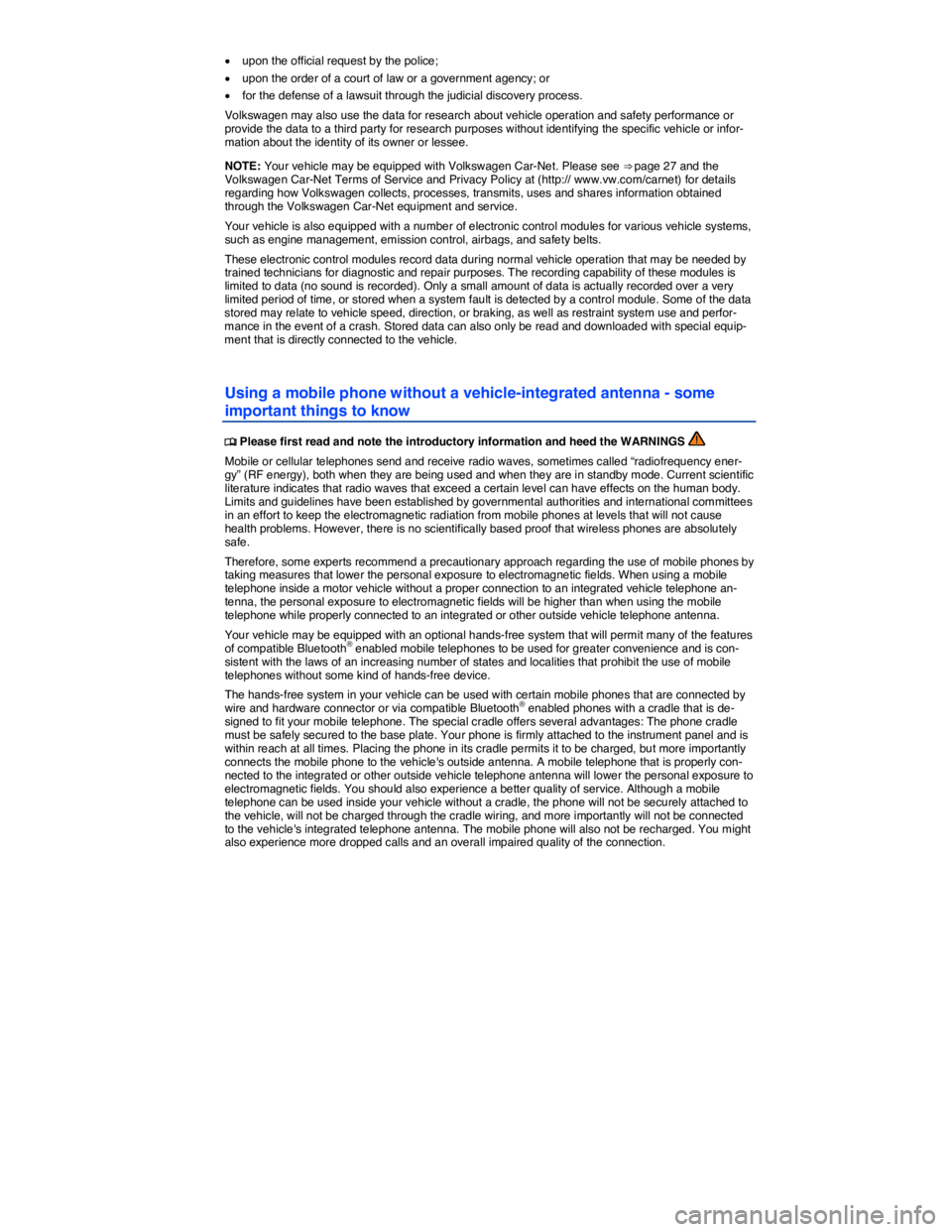
x upon the official request by the police;
x upon the order of a court of law or a government agency; or
x for the defense of a lawsuit through the judicial discovery process.
Volkswagen may also use the data for research about vehicle operation and safety performance or provide the data to a third party for research purposes without identifying the specific vehicle or infor-mation about the identity of its owner or lessee.
NOTE: Your vehicle may be equipped with Volkswagen Car-Net. Please see ⇒ page 27 and the Volkswagen Car-Net Terms of Service and Privacy Policy at (http:// www.vw.com/carnet) for details regarding how Volkswagen collects, processes, transmits, uses and shares information obtained through the Volkswagen Car-Net equipment and service.
Your vehicle is also equipped with a number of electronic control modules for various vehicle systems, such as engine management, emission control, airbags, and safety belts.
These electronic control modules record data during normal vehicle operation that may be needed by trained technicians for diagnostic and repair purposes. The recording capability of these modules is limited to data (no sound is recorded). Only a small amount of data is actually recorded over a very limited period of time, or stored when a system fault is detected by a control module. Some of the data stored may relate to vehicle speed, direction, or braking, as well as restraint system use and perfor-mance in the event of a crash. Stored data can also only be read and downloaded with special equip-ment that is directly connected to the vehicle.
Using a mobile phone without a vehicle-integrated antenna - some
important things to know
Page 360 of 412
Engine control and emission control system
Page 363 of 412

WARNING
Obey all applicable legal requirements when cleaning the diesel particulate filter.
x Clean the diesel particulate filter as recommended only when visibility, weather, road, and traffic conditions permit.
x Do not put others at risk.
Under certain engine conditions, you may smell a sulfur odor. This is not an indication of a mal-functioning emission control system. This depends upon the sulfur content of the diesel fuel.