2016 VOLKSWAGEN JETTA Wheels
[x] Cancel search: WheelsPage 241 of 412

XDL is an extension of the Electronic Differential Lock system. XDL does not react to drive wheel slippage when driving straight ahead. Instead, XDL detects slippage of the inside front wheel during fast cornering. XDL applies enough brake pressure to this wheel in order to stop the slippage. This improves traction, which helps the vehicle stay on track.
WARNING
Driving fast on icy, slippery, or wet roads can lead to a loss of control and result in serious personal injury for you and your passengers.
x Always adjust your speed and driving style to road, traffic, weather, and visibility condi-tions. Never let the additional safety that ESC, ABS, BAS, ASR, and EDL can provide tempt you into taking extra risks.
x Braking assistance systems cannot overcome the laws of physics and always prevent loss of vehicle control. Slippery and wet roads are still dangerous even with ESC and the other systems!
x Driving too fast on wet roads can cause the wheels to lose contact with the road and “hy-droplane.” A vehicle that has lost road contact cannot be braked, steered, or controlled.
x These systems cannot reduce the risk of accident, for example if you drive too fast for conditions or if you do not keep your distance from the vehicle in front of you.
x Although these systems are very effective and can help you control the vehicle in many difficult situations, always remember that your vehicle handling control is limited by tire trac-tion.
x When accelerating on a slippery surface, for example on ice and snow, depress the accel-erator carefully. Even with these systems, the wheels may start to spin, leading to a loss of vehicle control.
WARNING
The effectiveness of ESC can be significantly reduced if other components and systems that affect vehicle dynamics, including but not limited to brakes, tires, and other systems men-tioned above, are not properly maintained or functioning.
x Always remember that vehicle alterations or modifications can affect the functioning of the ABS, BAS, ASR, EDL, and ESC systems.
x Changing the vehicle suspension or using an unapproved tire/wheel combination can change the way the ABS, BAS, ASR, EDL, and ESC systems work and reduce their effective-ness.
x The effectiveness of ESC is also determined by the tires fitted ⇒ Tires and wheels.
All 4 wheels must be equipped with identical tires in order for ESC and ASR to work properly. Differences in the tread circumference of the tires can cause the system to reduce the engine power when it is not expected.
If ABS is not working, ESC, ASR, and EDL will also not work.
You may hear noises when these systems are active.
Page 332 of 412

Clean the wheels and under the door sills last. Use a different sponge or wash mitt.
WARNING
After the vehicle has been washed, the wet brakes or, in winter, brake discs or pads coated with ice, react slower and need longer stopping distances.
x Always dry the brakes and clean off any ice coatings with a few careful applications of the brake. Make sure not to endanger other motorists or cyclists or disobey legal requirements.
CAUTION
Sharp edges under the vehicle can cut exposed skin.
x Always protect your hands and arms from cuts on sharp metal edges when cleaning the underbody, the inside of the wheel housings, etc.
NOTICE
x The water temperature must not be more than +140 °F (+60 °C).
x To help prevent damage to the paint, do not wash the vehicle in direct sunlight.
x Do not use insect sponges, abrasive kitchen sponges or similar things to clean the vehicle. These can damage the paint finish.
x Never clean headlights with a dry cloth or sponge. Always use a wet cloth or sponge. For best results use soapy water.
x When washing or rinsing the vehicle in cold weather, do not let water get into the lock cylinders or point the hose at gaps around the doors, hood, or luggage compartment lid. The water could freeze on the locks and seals and make it difficult to open the vehicle!
x When outside temperatures are low, wipe the rubber seals and their contact surfaces dry to help prevent freezing.
NOTICE
To help prevent vehicle damage in a car wash:
x Compare the vehicle track width with the dimensions of the guide rails in the car wash to help prevent damage to wheel rims and tires!
x Switch off the rain sensor before driving the vehicle through a car wash ⇒ Rain sensor.
x Make sure there is enough clearance for the height and width of the vehicle.
x To help prevent paint damage to the engine hood, place wiper blades against the windshield after they have dried. Do not let them snap back into place.
x Fold the outside mirrors toward the vehicle body.
x Lock the luggage compartment lid to help prevent unintentional opening in the car wash.
Washing with a power washer
Page 337 of 412

Cleaning steel wheels
Stubborn brake dust can be removed with an industrial cleaner. Clean steel wheels regularly with a separate sponge.
Repair any paint damage on steel wheels before rust begins to form.
Cleaning alloy wheels
Every 2 weeks: Wash road salt and brake dust off alloy wheels, and clean the wheels with an acid-free detergent. Every 3 months: Volkswagen recommends applying a hard wax compound to the wheels.
If road salt and brake dust are not removed regularly, they can corrode the metal.
Use an acid-free detergent specifically designed for light alloy wheels. Do not use car polish or other abrasive products.
If the protective coating is damaged, for example by stone impact, repair the damaged area right away.
Caring for rubber door and window seals
Page 389 of 412

Removing the wheel
x Review the checklist ⇒ Preparations for changing a wheel.
x Loosen the wheel bolts ⇒ Wheel bolts.
x Lift the vehicle ⇒ Lifting the vehicle with the vehicle jack.
x Completely unscrew and remove the previously loosened wheel bolts using the hexagonal socket
in the screwdriver handle ⇒ fig. 193. Place the wheel bolts on a clean surface.
x Remove the wheel.
Mounting a compact spare wheel
If the tire is a unidirectional tire, be sure to install it in the proper rolling direction ⇒ Tires and wheels.
x Place the compact spare wheel on the axle.
x Screw in the wheel bolts clockwise and tighten them slightly using the hexagonal socket in the screwdriver handle.
x Lower the vehicle with the jack.
x Use the lug wrench to firmly tighten all wheel bolts (turn clockwise) ⇒ . Do not tighten them in sequence! Tighten any wheel bolt to begin, then tighten the wheel bolt diagonally opposite the first bolt, and so forth.
x Install the wheel bolt caps, center wheel hubcap, or wheel cover, if any ⇒ Wheel trim.
WARNING
Wheel bolts that are tightened or installed improperly can come loose, causing loss of vehi-cle control, a crash, and serious personal injury.
x Always keep wheel bolts and threads in the wheel hub clean and free of oil and grease. The wheel bolts must turn easily and must be tightened with the right torque.
x Use the hexagonal socket in the screwdriver handle only to turn the wheel bolts when they are loose, never to loosen them or tighten them firmly.
WARNING
Improper use of a compact spare wheel can cause loss of vehicle control, a crash or other accident, and serious personal injury.
x Never use a compact spare wheel if it is damaged or worn down to the wear indicators.
x Never drive faster than 50 mph (80 km/h) with a compact spare wheel. Avoid full-throttle acceleration, heavy braking, and fast cornering!
x Never drive more than 125 miles (200 km) with a compact spare wheel that is installed on the front axle (drive axle).
x Replace the compact spare with a normal wheel and tire as soon as possible. Compact spare tires are designed for brief use only.
After changing a wheel
Page 406 of 412

x If the vehicle battery is dead (because the electronic steering column lock engages and cannot be released).
x If you have to tow an automatic transmission vehicle more than 30 miles (50 km).
WARNING
It is not safe for children or other persons to ride in a vehicle that is being towed.
x Never let children or anyone else remain in the vehicle while it is being towed.
NOTICE
The drive axle rotates while the vehicle is being towed with its rear wheels off the ground. This can damage the automatic transmission.
x Never tow automatic transmission vehicle with the rear wheels off the ground.
x Tow manual transmission vehicles with the rear wheels off the ground only if it is certain that no transmission fluid can leak out.
Tips on towing
Page 407 of 412
When not to tow your vehicle
In the following situations, the vehicle cannot be towed and must be transported on a flatbed truck or trailer:
x If transmission fluid has leaked out of the transmission.
x If there is little or no oil in the transmission because of damage to your vehicle, it must be moved with the drive wheels off the ground.
x If the front and rear wheels cannot turn.
x When the vehicle battery is dead, because the steering may remain disabled and it may not be possible to release the electronic steering column lock.
x If you have to tow an automatic transmission vehicle more than 30 miles (50 km).
x If the steering or the wheel clearance might be impaired, for example, after an accident.
Towing other vehicles
x Obey all legal requirements
x Read and heed all towing information in the owner's manual for the other vehicle.
A vehicle can be towed only if the electronic steering column lock is released. In case of a power loss or malfunctions of the electrical system, the engine may have to be jump-started in order to re-lease the electronic steering column lock.
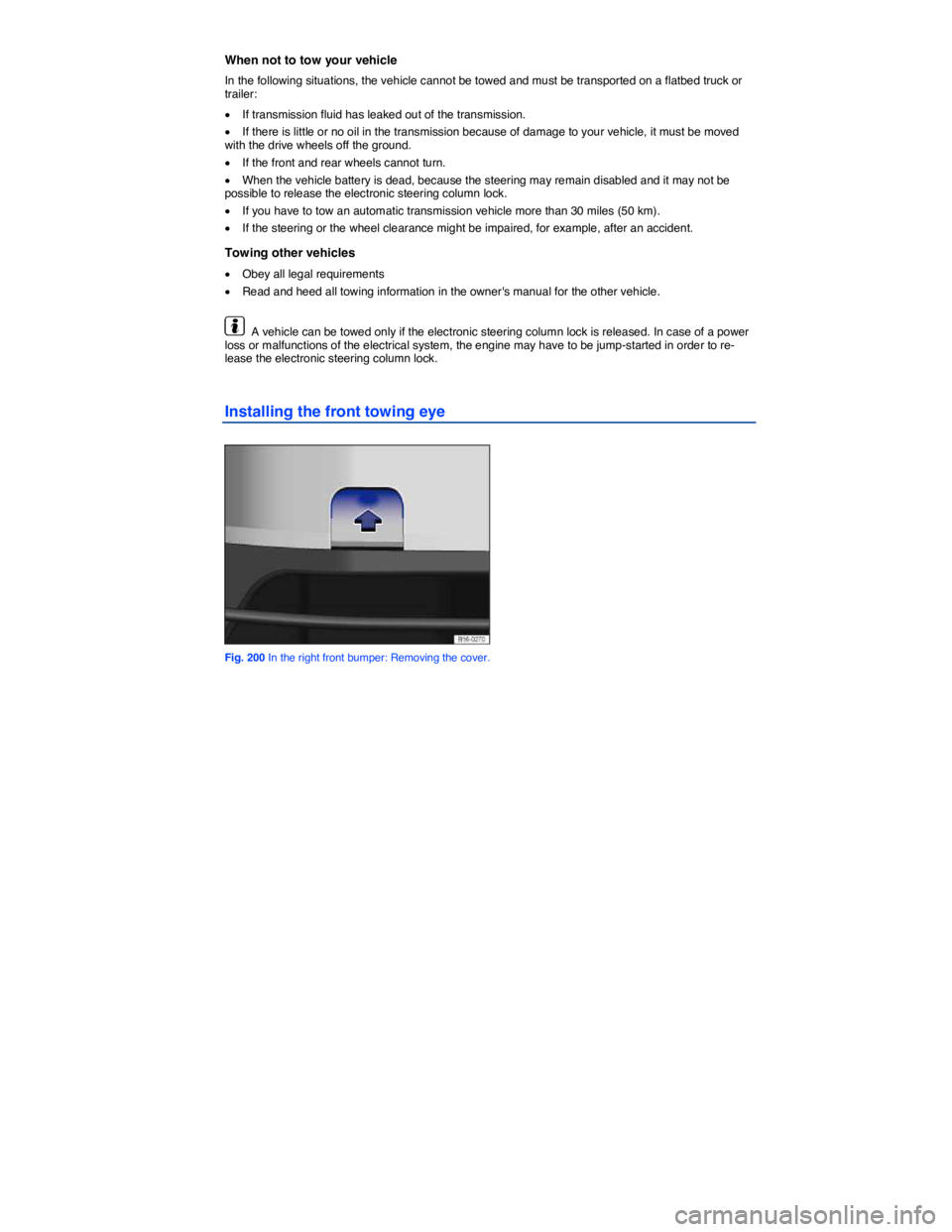
Installing the front towing eye
Fig. 200 In the right front bumper: Removing the cover.