Page 359 of 578

Adjust the tire pressure
The proper tire pressure helps reduce rolling resistance as well as
fuel consumption.
When purchasing new tires, always make sure that the tires are opti-
mized for lower rolling resistance.
Use low viscosity engine oil
Fully “synthetic,” low viscosity engine oils that expressly comply with
Volkswagen oil quality standards reduce fuel consumption. Low vis-
cosity engine oils reduce the frictional resistance on the engine and
are distributed more evenly and quickly, particularly when cold-
starting the engine. The effect is particularly apparent in vehicles that
frequently travel short distances.
Always ensure the right engine oil level is maintained and keep to the
scheduled service intervals (engine oil changes).
Make sure the engine oil that you purchase expressly complies with
Volkswagen oil quality standards and is the oil approved by
Volkswagen for your vehicle.
Avoid unnecessary weight
The lighter the vehicle, the more economical and eco-friendly it will
be. For example, an extra 220 lbs (100 kg) of weight increases fuel
consumption by up to 1 pint per 60 miles (0.3 l/100 km).
Remove all unnecessary items and unnecessary dead weight from
the vehicle.
Remove unnecessary aftermarket components
The more aerodynamic the vehicle, the less fuel it will consume. Af-
termarket components such as bicycle racks reduce its aerodynamic
performance.
Therefore, remove unnecessary structures and unused rack systems,
particularly if planning to drive at higher speeds.
Page 398 of 578
substances that can severely damage the fuel system and the
engine if the engine is started.
Fuels can pollute the environment. Spilled fuel must be collected
and disposed of properly, following all applicable environmental regu-
lations.
There is no emergency release for the fuel filler flap. Contact an
authorized Volkswagen dealer or an authorized Volkswagen Service
Facility for assistance.
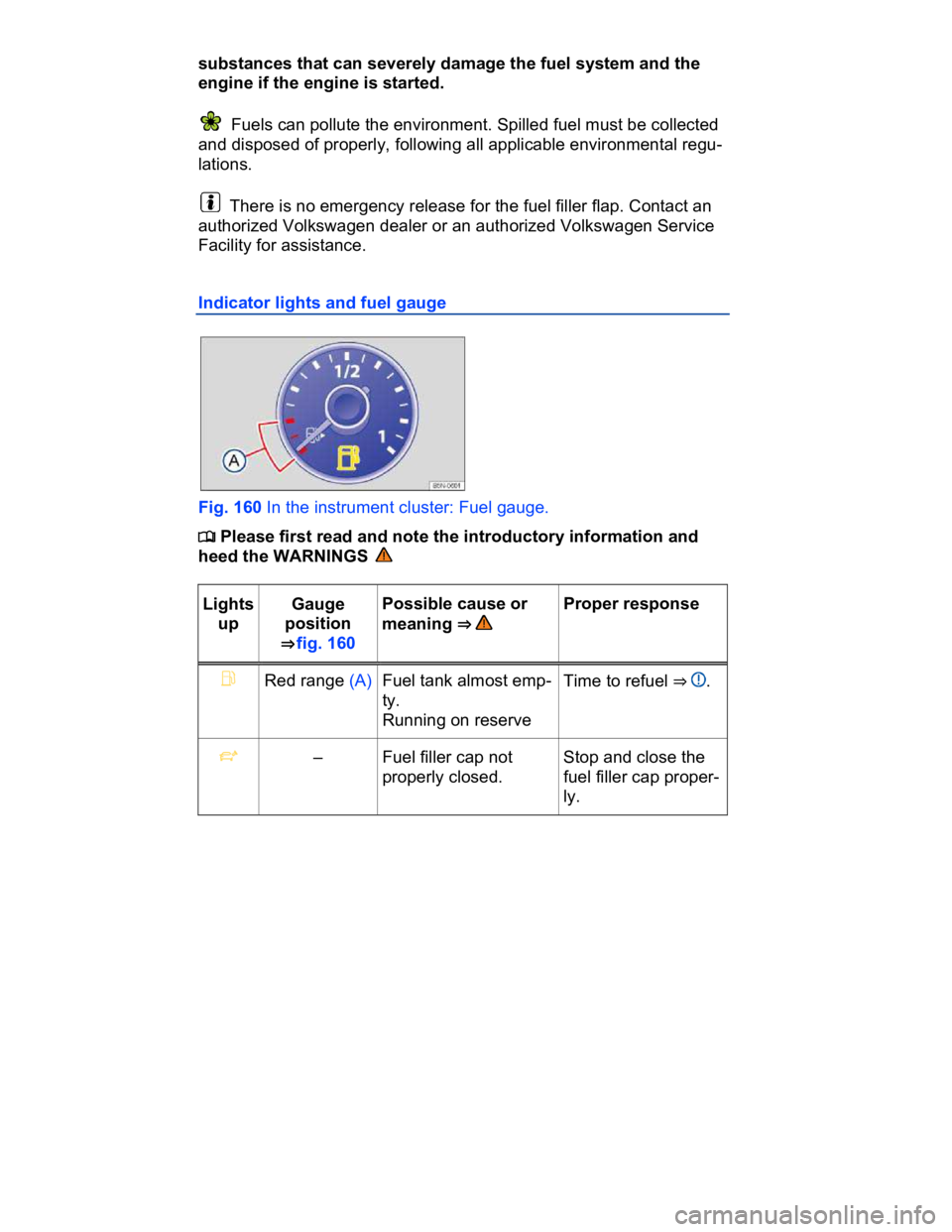
Indicator lights and fuel gauge
Fig. 160 In the instrument cluster: Fuel gauge.
Page 412 of 578

WARNING
The engine compartment of any motor vehicle is a potentially
dangerous area and can cause serious personal injury.
Always use extreme caution when doing any work in the en-
gine compartment. Always follow commonly accepted safety
practices and use common sense. Never risk personal injury.
Never perform any work in the engine compartment unless
you know exactly how to carry out the job and have the correct
technical information and the correct tools.
If you are uncertain about what to do, have the work per-
formed by an authorized Volkswagen dealer, an authorized
Volkswagen Service Facility, or another qualified workshop.
Serious personal injury may result from improperly performed
work.
We strongly recommend that you always have HID – High In-
tensity Discharge (Xenon) headlights and H7 bulbs replaced by
a qualified technician. Serious personal injury may result from
improperly performed work.
Never open or close the engine hood if steam or coolant is
escaping. Hot steam or coolant can cause serious burns. Al-
ways wait until you no longer see or hear steam or coolant es-
caping from the engine.
Always let the engine cool down completely before carefully
opening the hood.
Hot parts of the engine and the exhaust system will burn skin
on contact.
When the engine has cooled down and you are ready to open
the hood:
– Firmly apply the parking brake and shift the transmission
into Park (P) (automatic) or Neutral (manual only).
– Take the vehicle key out of the ignition.
– On vehicles with Keyless Access, make sure that the re-
mote control vehicle key is out of range of the vehicle and
that the vehicle cannot be started by depressing the starter
button ⇒ Starter button.
– Always keep children and others away from the engine
compartment and never leave them unsupervised.
Page 413 of 578

The engine coolant system is under pressure when the en-
gine is hot. Never unscrew the coolant expansion tank cap
when the engine is hot. Hot coolant can spray out and cause
severe burns and other serious injuries.
– Turn the cap slowly and very carefully in a counterclock-
wise direction while applying light downward pressure on the
top of the cap.
– Always protect your face, hands, and arms from hot escap-
ing coolant or steam by covering the cap with a large, thick
rag.
Never spill fluids on the engine or exhaust system when re-
filling. Spilling fluids onto hot parts of the engine or exhaust
system can cause a fire.
WARNING
High voltage systems in the engine compartment can cause
electrical shocks or even electrocution, severe burns, other se-
rious injuries, and even death!
Never short-circuit the electrical system. Be especially care-
ful when using jumper cables. The vehicle's battery could ex-
plode!
To reduce the risk of electrical shock and personal injury
while the engine is running or being started:
– Never touch ignition cables. Never touch other compo-
nents of the high voltage electronic ignition system.
– Never touch the wiring of the HID – High Intensity Dis-
charge (Xenon) headlights.
Read and heed the important information and warnings on
cleaning the engine compartment ⇒ Cleaning the engine com-
partment.
Page 416 of 578
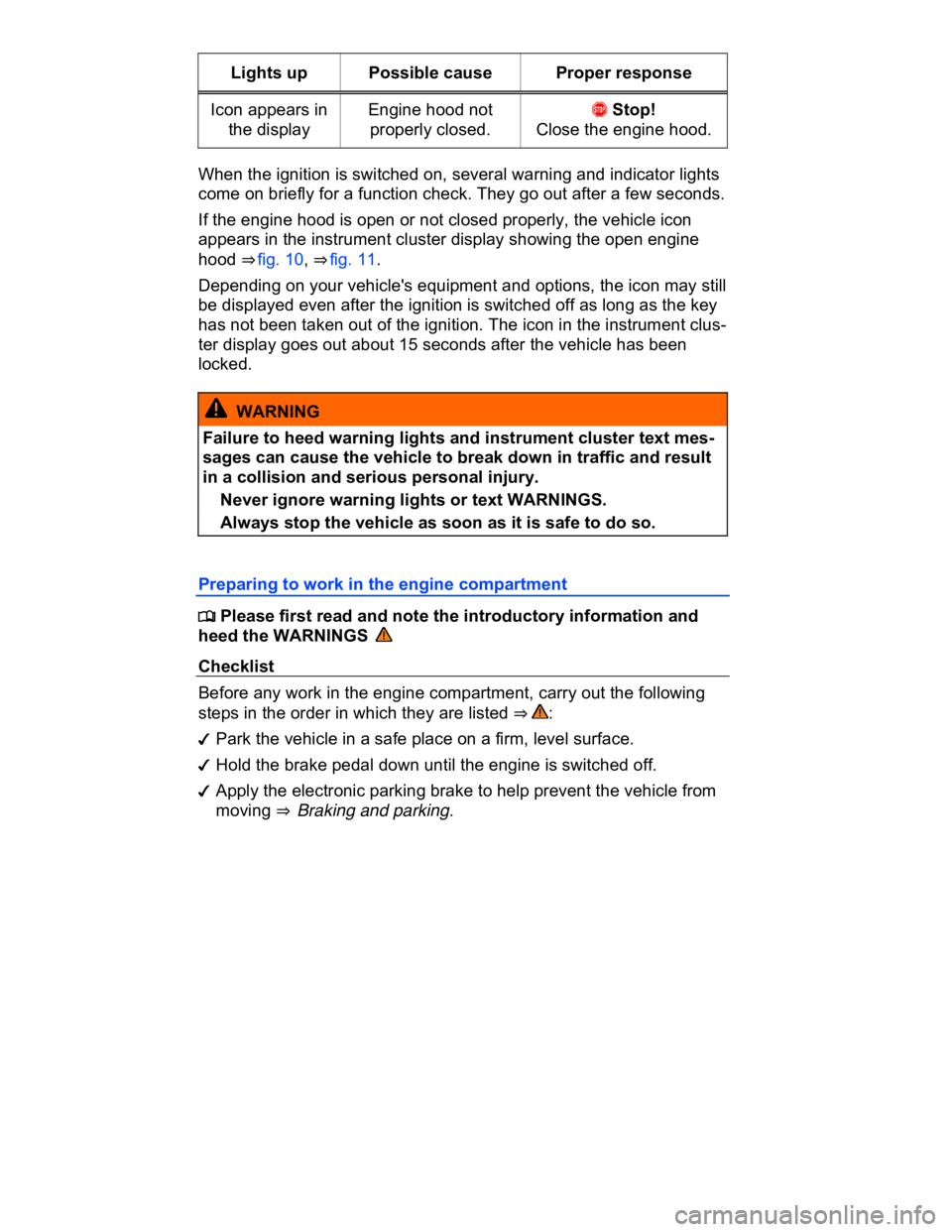
Lights up Possible cause Proper response
Icon appears in
the display
Engine hood not
properly closed.
Page 422 of 578
For vehicles with the 3.6 liter engine, the engine oil temperature can
be displayed in the Volkswagen Information System MFI menu ⇒ MFI
menu (Multi-Function Indicator).
WARNING
Failure to heed warning lights and instrument cluster text mes-
sages can cause the vehicle to break down in traffic and result
in a collision and serious personal injury.
Never ignore warning lights or text WARNINGS.
Always stop the vehicle as soon as it is safe to do so.
NOTICE
Failure to heed warning lights or text WARNINGS can result in
vehicle damage.
Engine oil specifications
Page 432 of 578
WARNING
Engine coolant is poisonous!
Always keep the coolant in its original container stored in a
safe place.
To reduce the risk of poisoning, never store engine coolant in
empty food or beverage containers or in any other containers
that might mislead someone into drinking from them.
Always keep engine coolant out of reach of children.
Always make sure there is enough of the correct coolant ad-
ditive to provide proper antifreeze protection at the coldest
temperatures that can be expected where the vehicle will be
used.
At extremely cold temperatures, the coolant could freeze,
causing the vehicle to break down. The heater would also not
work, and vehicle occupants could be without protection at
subfreezing temperatures.
Coolant and coolant additives can pollute the environment. Col-
lect leaking operating fluids and dispose of them properly in accord-
ance with applicable environmental laws and regulations.
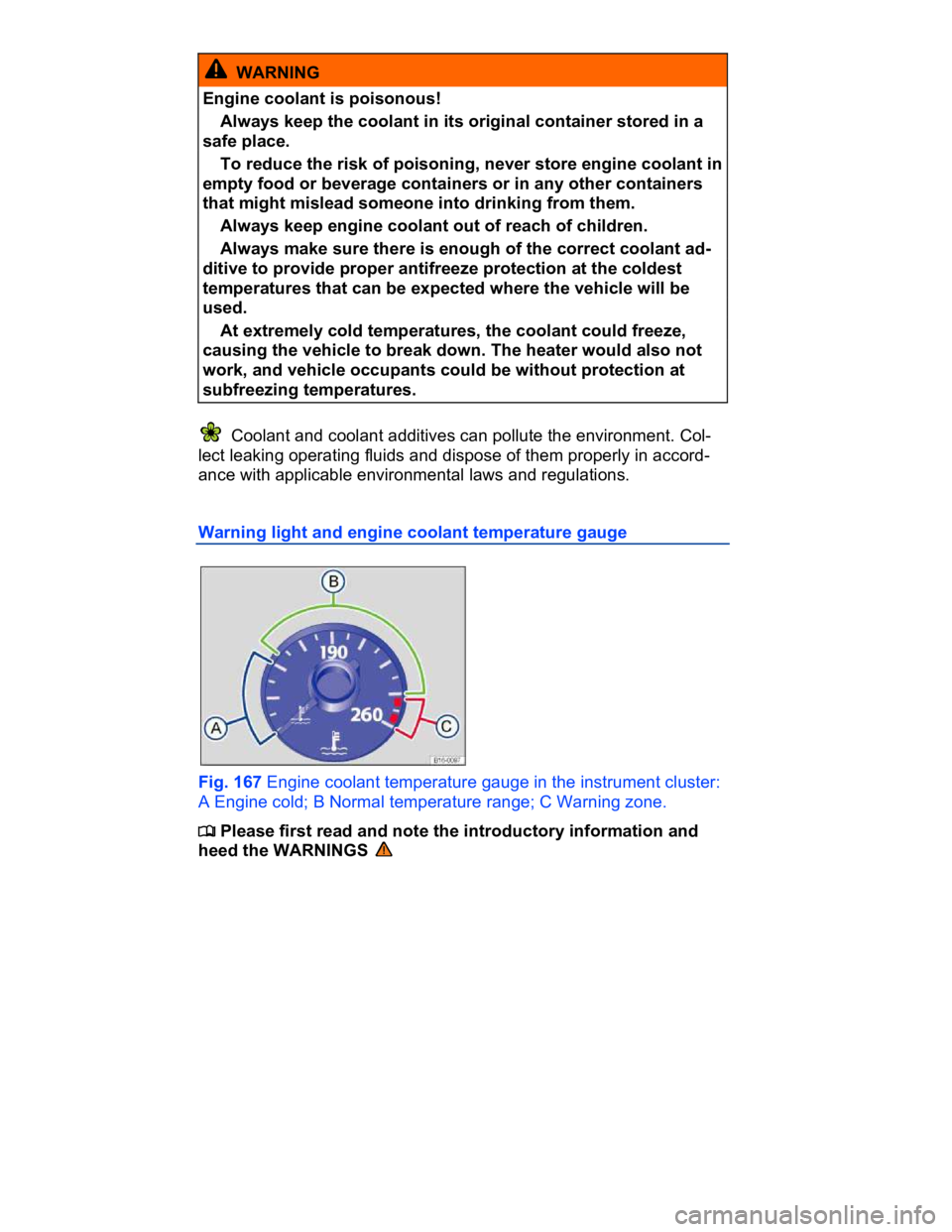
Warning light and engine coolant temperature gauge
Fig. 167 Engine coolant temperature gauge in the instrument cluster:
A Engine cold; B Normal temperature range; C Warning zone.
Page 433 of 578
If the indicator in the engine coolant temperature gauge is located in
the cold range (A), the engine has not reached operating tempera-
ture. High engine speeds and heavy engine loads should be avoided.
Under normal driving conditions, the needle should be in the middle
of the gauge. The temperature may go higher when the engine is
working hard, especially in hot weather.
When the ignition is switched on, several warning and indicator lights
come on briefly for a function check. They go out after a few seconds.
The following table explains what to do if the engine coolant tempera-
ture warning light ~ does not go out a few seconds after the engine
is started or starts flashing while driving.
Flashes
Temperature
gauge
needle
⇒ fig. 167
Possible
cause Proper response