2016 VAUXHALL VIVARO pressure control
[x] Cancel search: pressure controlPage 128 of 209

126Driving and operatingCaution
It is inadvisable to drive with hand
resting on the selector lever.
Brakes
The brake system comprises two
independent brake circuits.
If a brake circuit fails, the vehicle can
still be braked using the other brake
circuit. However, braking effect is
achieved only when you depress the
brake pedal firmly. You need to use
considerably more force for this. The
braking distance is extended. Seek
the assistance of a workshop before
continuing your journey.
When the engine is not running, the
support of the brake servo unit
disappears once the brake pedal has
been depressed once or twice.
Braking effect is not reduced, but
braking requires significantly greater
force. It is especially important to bear this in mind when being towed.
If control indicator R illuminates in
the instrument cluster while driving
and a corresponding message
appears in the Driver Information
Centre (DIC) 3 89, there is a fault in
the braking system. Seek the
assistance of a workshop
immediately.Control indicator R 3 85.
Vehicle messages 3 90.
Antilock brake system Antilock brake system (ABS)
prevents the wheels from locking.
ABS starts to regulate brake pressure as soon as a wheel shows a tendency to lock. The vehicle remains
steerable, even during hard braking.
ABS control is made apparent
through a pulse in the brake pedal
and the noise of the regulation
process.
For optimum braking, keep the brake
pedal fully depressed throughout the
braking process, despite the fact that
the pedal is pulsating. Do not reduce
the pressure on the pedal.
After starting-off, the system performs
a self-test which may be audible.
Control indicator u 3 86.
Fault
If control indicator u does not go out
a few seconds after the ignition is
switched on, or if it illuminates while
Page 129 of 209
Driving and operating127driving, there is a fault in the ABS.
Control indicator F 3 85 may also
illuminate in the instrument cluster
together with a corresponding
message in the Driver Information
Centre (DIC). The brake system
remains operational but without ABS
regulation.9 Warning
If there is a fault in the ABS, the
wheels may be liable to lock due
to braking that is heavier than
normal. The advantages of ABS are no longer available. During
hard braking, the vehicle can no longer be steered and may
swerve.
If control indicators u, F , R 3 85
and C 3 85 illuminate, there is a fault
in the braking system. A
corresponding message also
appears in the DIC 3 89. Have the
cause of the fault remedied by a
workshop.
Vehicle messages 3 90.
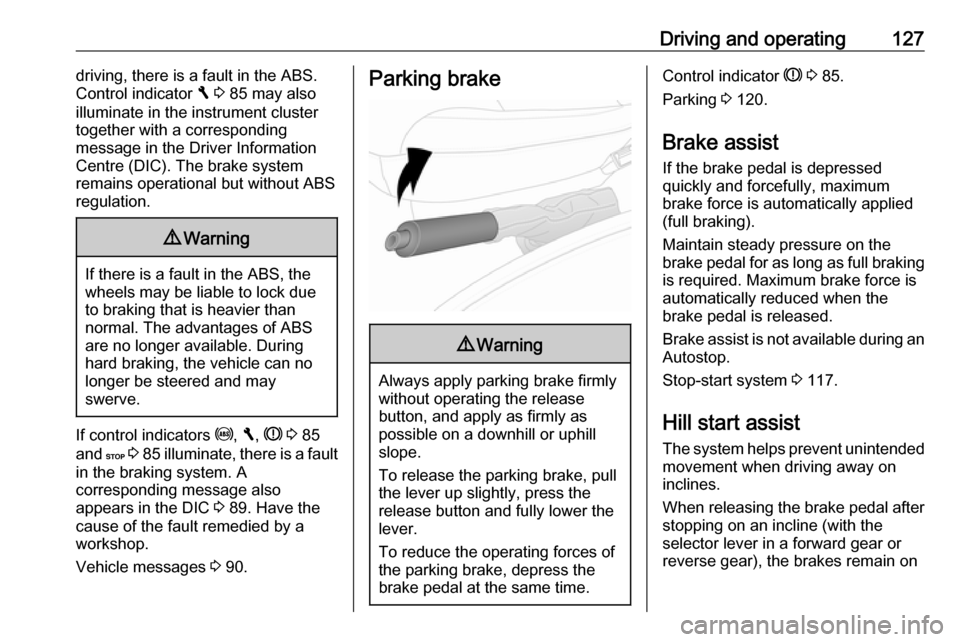
Parking brake9 Warning
Always apply parking brake firmly
without operating the release
button, and apply as firmly as
possible on a downhill or uphill
slope.
To release the parking brake, pull
the lever up slightly, press the
release button and fully lower the
lever.
To reduce the operating forces of
the parking brake, depress the
brake pedal at the same time.
Control indicator R 3 85.
Parking 3 120.
Brake assist If the brake pedal is depressed
quickly and forcefully, maximum
brake force is automatically applied
(full braking).
Maintain steady pressure on the
brake pedal for as long as full braking is required. Maximum brake force is
automatically reduced when the
brake pedal is released.
Brake assist is not available during an
Autostop.
Stop-start system 3 117.
Hill start assist
The system helps prevent unintended movement when driving away on
inclines.
When releasing the brake pedal after
stopping on an incline (with the
selector lever in a forward gear or
reverse gear), the brakes remain on
Page 145 of 209

Vehicle care143General Information
Accessories and vehicle modifications
We recommend the use of genuine
parts and accessories and factory
approved parts specific for your
vehicle type. We cannot assess or guarantee reliability of other products
- even if they have a regulatory or
otherwise granted approval.
Do not make any modifications to the
electrical system, e.g. changes of
electronic control units (chip tuning).Caution
When transporting the vehicle on
a train or on a recovery vehicle, the
mud flaps might be damaged.
Vehicle storage
Storage for a long period of time
If the vehicle is to be stored for several months:
● Wash and wax the vehicle.
● Have the wax in the engine compartment and underbody
checked.
● Clean and preserve rubber seals.
● Fill up fuel tank completely.
● Change the engine oil.
● Drain the washer fluid reservoir. ● Check the coolant antifreeze and
corrosion protection.
● Adjust tyre pressure to the value specified for full load.
● Park vehicle in a dry, well ventilated place. Engage first or
reverse gear. Prevent the vehicle from rolling.
● Do not apply the parking brake.● Open the bonnet, close all doors and lock the vehicle.
● Disconnect the clamp from the negative terminal of the vehicle
battery. Beware that all systems
are not functional, e.g. anti-theft
alarm system.
Putting back into operation When the vehicle is to be put back into
operation:
● Connect the clamp to the negative terminal of the vehicle
battery. Activate the electronics
of the power windows.
● Check tyre pressure.
● Fill up the washer fluid reservoir.
● Check the engine oil level.
● Check the coolant level.
● Fit the number plate, if necessary.
Page 149 of 209

Vehicle care147Engine coolant
The coolant provides freeze
protection down to approx. -28 °C.Caution
Only use approved antifreeze.
Coolant level
Caution
Too low a coolant level can cause engine damage.
If the cooling system is cold, the
coolant level should be just above the
MINI mark. Top-up if the level is low.9Warning
Allow the engine to cool before
opening the cap. Carefully open
the cap, relieving the pressure
slowly.
Top-up with antifreeze. If no
antifreeze is available, use clean tap
water or distilled water. Install the cap
tightly. Have the antifreeze
concentration checked and have the
cause of the coolant loss remedied by a workshop.
If a substantial amount of coolant is
required, it will be necessary to bleed
any trapped air from the cooling
system. Seek the assistance of a
workshop.
If the coolant temperature is too high, control indicator W 3 86 illuminates
red in the instrument cluster, together
with C 3 85. Consult a workshop if
coolant level is sufficient.
Power steering fluidCaution
Extremely small amounts of
contamination can cause steering
system damage and cause it to not work properly. Do not allow
contaminates to contact the fluid
side of the reservoir cap or from
entering the reservoir.
The power steering fluid reservoir is located below the front left wheel
arch, behind a trim panel.
The fluid level normally does not need
to be checked. If an unusual noise is
heard during steering or if the power
steering reacts conspicuously, seek
the assistance of a workshop.
Page 167 of 209

Vehicle care165
With the vehicle stationary, press
button on end of wiper lever
repeatedly until the tyre pressure
menu is displayed.
Low tyre pressure condition
A detected low tyre pressure
condition is indicated by illumination
of control indicator w 3 87 and a
corresponding message appears in
the DIC.
If w illuminates, stop as soon as
possible and inflate the tyres as
recommended 3 196.
After inflating, some driving may be
required to update the tyre pressure
values in the DIC. During this time w
may illuminate.
If w illuminates at lower temperatures
and extinguishes after some driving,
this could be an indicator for
approaching a low tyre pressure
condition. Check tyre pressure.
If the tyre pressure must be reduced
or increased, switch off ignition.
Only mount wheels with pressure
sensors, otherwise the tyre pressure
will not be displayed and w flashes for
several seconds then illuminates continuously together with control
indicator F 3 85 and a corresponding
message appears in the DIC.
A spare wheel or temporary spare
wheel is not equipped with pressure
sensors. TPMS is not operational for
these wheels. For the further three
wheels, TPMS remains operational.
Control indicator w and a
corresponding message appears at
each ignition cycle until the tyres are
inflated to the correct tyre pressure.
Driver Information Centre (DIC) 3 89.
Vehicle messages 3 90.
Page 168 of 209

166Vehicle carePuncture
A puncture or severely under-inflated
tyre is indicated by illumination of
control indicator w together with C
3 85 and a corresponding message
appears in the DIC. Stop vehicle and
switch off engine.
Tyre pressure 3 196, Tyre repair kit
3 168, Spare wheel 3 172, Wheel
changing 3 171.
Temperature dependency Tyre pressure depends on the
temperature of the tyre. During
driving, tyre temperature and
pressure increase.
Tyre pressure values provided on the tyre information label and tyre
pressure chart are valid for cold tyres,
which means at 20 °C. The pressure
increases by nearly 1.5 psi for a
10 °C temperature increase. This
must be considered when warm tyres
are checked.The tyre pressure value displayed in
the DIC shows the actual tyre
pressure. A cooled down tyre will show a decreased value, which does
not indicate an air leak.
Relearn function
After changing the wheels, TPMS
needs to recalculate.
With the vehicle stationary, select the tyre pressure menu in the DIC by
pressing button on end of wiper lever.
Press and hold button for approx.5 seconds to initialise recalculation. A
corresponding message appears in
the DIC.
Several minutes of driving at a speed above 25 mph may be required to
complete the relearn process. The
system can only provide limited
information during this time.
If problems occur during the relearn
process, control indicator w remains
illuminated and a warning message is
displayed in the DIC.
Driver Information Centre (DIC) 3 89.
Vehicle messages 3 90.
General information The use of commercially available
liquid tyre repair kits can impair the
function of the system. Factory-
approved tyre repair kits can be used.
Tyre repair kit 3 168.
External high-power radio equipment
could disrupt the tyre pressure
monitoring system.
Each time the tyres are replaced, TPMS sensors must be dismounted
and serviced by a workshop.
Page 201 of 209

Customer information199Vehicle data recording
and privacy
Event data recorders Data storage modules in the
vehicle
A large number of electronic
components of your vehicle contain
data storage modules temporarily or
permanently storing technical data
about the condition of the vehicle,
events and errors. In general, this
technical information documents the
condition of parts, modules, systems
or the environment:
● operating conditions of system components (e.g. filling levels)
● status messages of the vehicle and its single components (e.g.
number of wheel revolutions / rotational speed, deceleration,
lateral acceleration)
● dysfunctions and defects in important system components● vehicle reactions in particulardriving situations (e.g. inflation of
an airbag, activation of the
stability regulation system)
● environmental conditions (e.g. temperature)
These data are exclusively technical
and help identifying and correcting
errors as well as optimising vehicle
functions.
Motion profiles indicating travelled
routes cannot be created with these
data.
If services are used (e.g. repair
works, service processes, warranty
cases, quality assurance),
employees of the service network
(manufacturer included) are able to
read out this technical information
from the event and error data storage
modules applying special diagnostic
devices. If required, you will receive
further information at these
workshops. After an error has been
corrected, the data are deleted from
the error storage module or they are
constantly overwritten.When using the vehicle, situations
may occur in which these technical
data related to other information
(accident report, damages on the
vehicle, witness statements etc.) may
be associated with a specific person - possibly, with the assistance of an
expert.
Additional functions contractually
agreed upon with the client (e.g.
vehicle location in emergency cases)
allow the transmission of particular vehicle data from the vehicle.
Radio Frequency
Identification (RFID)
RFID technology is used in some
vehicles for functions such as tyre
pressure monitoring and ignition
system security. It is also used in
connection with conveniences such
as radio remote controls for door
locking/unlocking and starting, and in-
vehicle transmitters for garage door
openers. RFID technology in
Vauxhall vehicles does not use or
record personal information or link
with any other Vauxhall system
containing personal information.
Page 203 of 209

201Charging system .......................... 84
Child locks ................................... 28
Child restraint installation locations ................................... 59
Child restraints.............................. 57
Child restraint systems ................57
Cigarette lighter ........................... 78
Cleaning the vehicle ...................177
Climate control ............................. 15
Climate control systems .............101
Clock ............................................ 76
Coat hooks ................................... 66
Coin holder ................................... 65
Control indicators.......................... 81
Control of the vehicle .................113
Controls ........................................ 74
Controls in steering wheel ............74
Convex shape .............................. 36
Coolant ....................................... 147
Coolant and antifreeze ...............181
Coolant heater ............................ 106
Cooling (AC) ............................... 102
Cornering light .............................. 97
Cruise control ...................... 88, 131
Cupholders .................................. 66
Curtain airbag system .................. 56
D Danger, Warnings and Cautions ...4
Dashboard .................................... 10Daytime running lights............95, 97
Declaration of conformity ............197
DEF ............................................ 121
Demisting and defrosting ..............15
Diesel exhaust fluid ....................121
Diesel fuel filter .......................... 150
Diesel fuel system bleeding .......151
Diesel particle filter ....................120
Directional tyres ..................163, 172
Distance to service .......................80
Document tray .............................. 66
Door locks..................................... 23
Door open .................................... 89
Doors ............................................ 29
Double cab ................................... 67
DPF (diesel particle filter) ...........120
Driver assistance systems ..........131
Driver Information Centre .............89
Driving characteristics and towing tips .............................. 140
Driving economically................... 112
Driving hints ................................ 112
E ECO mode .................................. 112
ecoScoring.................................... 91
Electric adjustment ......................36
Electrical accessories ...................77
Electrical system......................... 157
Electronic climate control system 103Electronic data recording..............38
Electronic key system ...................22
Electronic Stability Program 86,
129, 141
Electronic Stability Program off ...86
End-of-life vehicle recovery .......144
Engine air filter............................ 146
Engine air flow indicator .............146
Engine coolant ........................... 147
Engine coolant temperature ........86
Engine data ............................... 186
Engine exhaust .......................... 120
Engine identification ...................184
Engine oil ...........145, 181, 185, 195
Engine oil additives ....................181
Engine oil level ............................ 91
Engine oil pressure ......................87
Engine oil viscosity grades .........181
Enhanced Traction function 128, 129
Entry lighting .............................. 100
Event data recorders ..................199
Exhaust gases ....................120, 175
Exit lighting ................................ 100
Exterior care .............................. 177
Exterior light ................................. 88
Exterior lighting ......................12, 95
Exterior mirrors ............................. 36