2016 VAUXHALL MOVANO_B belt
[x] Cancel search: beltPage 74 of 233

72Instruments and controlsInstruments and
controlsControls ....................................... 73
Steering wheel adjustment ........73
Steering wheel controls .............73
Horn ........................................... 73
Steering column controls ...........73
Windscreen wiper/washer .........74
Outside temperature ..................75
Clock ......................................... 75
Power outlets ............................. 76
Cigarette lighter ......................... 77
Ashtrays .................................... 77
Warning lights, gauges and indi‐ cators ........................................... 77
Instrument cluster ......................77
Speedometer ............................. 77
Odometer .................................. 78
Trip odometer ............................ 78
Tachometer ............................... 78
Fuel gauge ................................ 79
Engine coolant temperature gauge ....................................... 79
Engine oil level monitor .............80
Service display .......................... 80
Transmission display .................81Control indicators ......................81
Turn signal ................................. 83
Seat belt reminder .....................84
Airbag and belt tensioners .........84
Airbag deactivation ....................84
Charging system .......................84
Malfunction indicator light ..........84
Service vehicle soon .................85
Stop engine ............................... 85
Brake system ............................. 85
Antilock brake system (ABS) .....86
Upshift ....................................... 86
Lane departure warning ............86
Electronic Stability Program ......86
Electronic Stability Program off ............................................. 86
Engine coolant temperature ......87
Preheating ................................. 87
AdBlue ....................................... 87
Tyre pressure monitoring system ...................................... 87
Engine oil pressure ....................87
Low fuel ..................................... 88
Stop-start system ......................88
Exterior light .............................. 88
High beam ................................. 88
High beam assist .......................89
Fog light ..................................... 89
Rear fog light ............................. 89
Cruise control ............................ 89Tachograph............................... 89
Door open .................................. 89
Information displays .....................89
Driver Information Centre ..........89
Triple-Info-Display .....................90
Vehicle messages ........................90
Warning chimes .........................91
Trip computer ............................... 92
Tachograph .................................. 94
Page 85 of 233

Instruments and controls83Control indicators in the roof
console or instrument panel
Overview
OTurn signal 3 83XSeat belt reminder 3 84vAirbag and belt tensioners
3 84WAirbag deactivation 3 84pCharging system 3 84ZMalfunction indicator light
3 84AService vehicle soon 3 85oService display 3 85CStop engine 3 85RBrake system 3 85uAntilock brake system (ABS)
3 86kjUpshift, downshift 3 86ìLane departure warning 3 86RElectronic Stability Program
3 86ØElectronic Stability Program off
3 86WEngine coolant temperature
3 87!Preheating 3 87YAdBlue 3 87wTyre pressure monitoring
system 3 87IEngine oil pressure 3 87YLow fuel 3 88DAutostop 3 119\Autostop inhibited 3 1199Exterior light 3 88CHigh beam 3 88íHigh beam assist 3 89>Fog light 3 89rRear fog light 3 89mCruise control 3 89UCruise control speed limiter
3 89&Tachograph 3 89yDoor open 3 89
Turn signal
O flashes green.
Flashes if a turn signal or the hazard
warning flashers are activated.
Rapid flashing: failure of a turn signal
light or associated fuse.
An audible warning can be heard
when the turn signals are on. When
towing a trailer, the pitch of the
audible warning changes.
Page 86 of 233
84Instruments and controlsBulb replacement 3 162.
Fuses 3 170.
Turn signals 3 98.
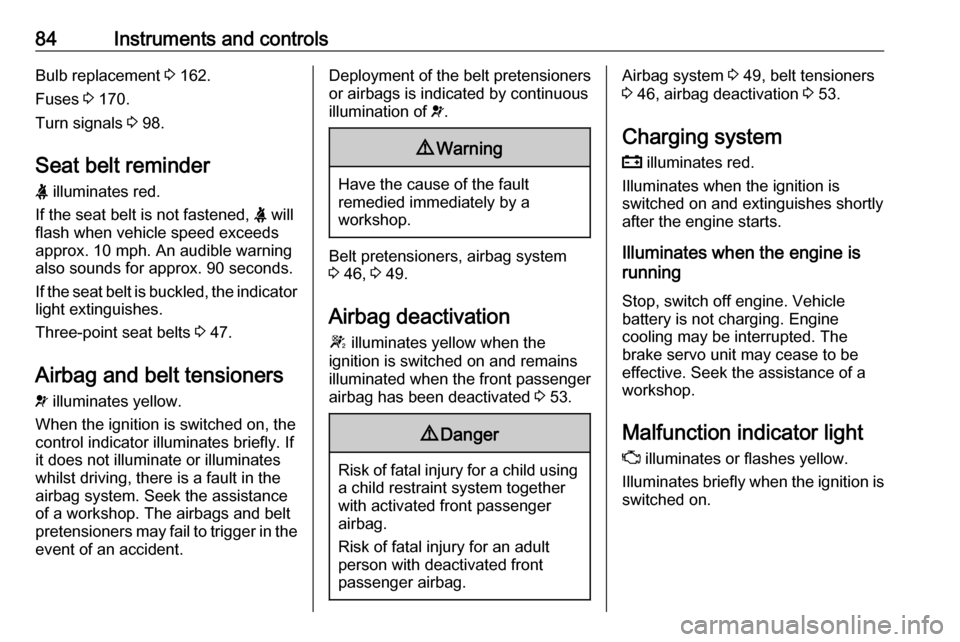
Seat belt reminder X illuminates red.
If the seat belt is not fastened, X will
flash when vehicle speed exceeds
approx. 10 mph. An audible warning
also sounds for approx. 90 seconds.
If the seat belt is buckled, the indicator light extinguishes.
Three-point seat belts 3 47.
Airbag and belt tensioners
v illuminates yellow.
When the ignition is switched on, the
control indicator illuminates briefly. If it does not illuminate or illuminates
whilst driving, there is a fault in the
airbag system. Seek the assistance
of a workshop. The airbags and belt
pretensioners may fail to trigger in the
event of an accident.Deployment of the belt pretensioners
or airbags is indicated by continuous
illumination of v.9 Warning
Have the cause of the fault
remedied immediately by a
workshop.
Belt pretensioners, airbag system
3 46, 3 49.
Airbag deactivation
W illuminates yellow when the
ignition is switched on and remains
illuminated when the front passenger
airbag has been deactivated 3 53.
9 Danger
Risk of fatal injury for a child using
a child restraint system together
with activated front passenger
airbag.
Risk of fatal injury for an adult
person with deactivated front
passenger airbag.
Airbag system 3 49, belt tensioners
3 46, airbag deactivation 3 53.
Charging system p illuminates red.
Illuminates when the ignition is
switched on and extinguishes shortly after the engine starts.
Illuminates when the engine is
running
Stop, switch off engine. Vehicle
battery is not charging. Engine
cooling may be interrupted. The
brake servo unit may cease to be
effective. Seek the assistance of a
workshop.
Malfunction indicator light
Z illuminates or flashes yellow.
Illuminates briefly when the ignition is
switched on.
Page 93 of 233

Instruments and controls91Tyre pressure monitoring system
3 177.
Warning chimes
When starting the engine or whilst driving
Only one warning chime will sound at
a time.
The warning chime regarding
unfastened seat belts has priority
over any other warning chime.
● If seat belt is not fastened 3 47.
● If a certain speed is exceeded with the parking brake applied
3 135.
● If the parking assist detects an object or a fault is present
3 142.
● If the vehicle has manual transmission automated and the
clutch temperature is too high 3 130.
● If the vehicle speed briefly exceeds a set limit 3 77.
● During closing of the power sliding door 3 26.● If the sliding door is open and the
parking brake is released 3 26.
● During activation and deactivation of alarm monitoring
of vehicle inclination 3 31.
● If the AdBlue level falls below a certain amount or a fault is
present 3 125.
● If the lane departure warning system detects an unintended
lane change and when the
system is activated 3 146.
When the vehicle is parked and/or the driver's door is opened
● When the key is in the ignition switch.
● With exterior lights on.
● If the vehicle has manual transmission automated 3 130;
the parking brake has not been
applied, neutral is not selected or the brake pedal has not been
depressed. A corresponding
message may also appear in the
Driver Information Centre (DIC)
3 89.● If the sliding side door exterior
handle is in the open position
when unlocking the vehicle 3 26.
● If the engine is in an Autostop but
not switched off. Stop-start
system 3 119.
Page 116 of 233

114Climate controlBus
Adjustable air vents may be located inthe roof frame above the seats. Turn
adjuster to increase/decrease airflow
to the appropriate seat.
Fixed air vents Additional air vents are located
beneath the windscreen and door
windows and in the foot wells.
Glovebox cooler
The air conditioning system can also
keep the contents of the glovebox
cool.
Maintenance
Air intake
The air intake in front of the
windscreen in the engine
compartment must be kept clear to
allow air intake. Remove any leaves,
dirt or snow.
Pollen filter The pollen filter cleans dust, soot,
pollen and spores from the air
entering the vehicle through the air
intake.
Air conditioning regular
operation
In order to ensure continuously
efficient performance, cooling must
be operated for a few minutes once a
month, irrespective of the weather
and time of year. Operation with
cooling is not possible when outside
temperature is too low.
ServiceFor optimal cooling performance, it is
recommended that the climate control system be checked annually, starting
three years after initial vehicle
registration, including:
● functionality and pressure test
● heating functionality
● leakage check
● check of drive belts
● cleaning of condenser and evaporator drainage
● performance check
Page 122 of 233

120Driving and operating
An Autostop is indicated when Ï
illuminates green in the instrument
cluster.
During an Autostop, the heating
performance, power steering and brake performance will be
maintained. Brake assist, however, is
not available 3 136.
Conditions for an Autostop
The stop-start system checks if each
of the following conditions is fulfilled,
otherwise an Autostop will be
inhibited and control indicator \ will
illuminate in the instrument cluster.
● the stop-start system is not manually deactivated
● the bonnet is fully closed
● the driver's door is closed or the driver's seat belt is fastened
● the vehicle battery is sufficiently charged and in good condition
● the engine is warmed up
● the engine coolant temperature is
not too high
● the ambient temperature is not too low
● the defrosting function is not activated
● the climate control system does not inhibit an Autostop
● the brake vacuum is sufficient ● the self-cleaning function of the diesel particle filter is not active
● the vehicle has moved since the last Autostop
Otherwise an Autostop will be
inhibited.An Autostop may become
unavailable as the ambient
temperature approaches freezing
point.
Certain settings of the climate control
system may also inhibit an Autostop.
See Climate control chapter for
further information 3 103.
Immediately after motorway driving
an Autostop may be inhibited.
Autostop may also be inhibited
temporarily if the vehicle battery has
been recharged by an external
source.
New vehicle running-in 3 117.
Vehicle battery discharge protection
To ensure reliable engine restarts,
several vehicle battery discharge
protection features are implemented
as part of the stop-start system.
Restart of the engine by the driver
Depress the clutch pedal to restart the
engine.
Page 123 of 233

Driving and operating121If the selector lever has been shifted
out of neutral (manual transmission)
or N (manual transmission
automated) or other conditions are
not met, start using the ignition key.
The green control indicator Ï will
extinguish in the instrument cluster
when the engine is restarted.
If the selector lever is shifted out of
neutral (manual transmission) or N
(manual transmission automated) before depressing the clutch first, a
restart will not take place.
Restart of the engine by the stop- start system
The selector lever must be in neutral (manual transmission) or N (manual
transmission automated) to enable an
automatic restart.
If one of the following conditions
occurs during an Autostop, the
engine will be restarted automatically
by the stop-start system. Control
indicator Ï will flash green in the
instrument cluster during an
automatic engine restart.● the stop-start system is manually
deactivated
● the bonnet is opened
● the driver's seat belt is unfastened and the driver's door
is opened
● the engine temperature is too low
● the vehicle battery is discharged
● the brake vacuum is not sufficient
● the vehicle starts to move
● the defrosting function is activated
● the climate control system requests an engine start
● the predetermined timing has been exceeded
If an electrical accessory, e.g. a
portable CD player, is connected to
the power outlet, a brief power drop during restart might be noticeable.
If the Infotainment system is active,
audio sound may briefly be reduced
or interrupted during the restart.
Warning chimes 3 91.Fault
If control indicator Ï illuminates
yellow, there is a fault in the stop-start system 3 88. A corresponding
message also appears in the DIC
3 89. Seek the assistance of a
workshop.
Parking9 Warning
● Do not park the vehicle on an
easily ignitable surface. The
high temperature of the
exhaust system could ignite the
surface.
● Always apply parking brake without pressing release
button. Apply as firmly as
possible on a downhill slope or
uphill slope. Depress brake
pedal at the same time to
reduce operating force.
● Switch off the engine.
● If the vehicle is on a level surface or uphill slope, engage
Page 178 of 233

176Vehicle careWinter tyresWinter tyres improve driving safety at
temperatures below 7 °C and should
therefore be fitted on all wheels.
In accordance with country-specific
regulations, affix the maximum speed sticker in the driver's field of view.
Tyre designations
E.g. 215/65 R 16 C 109 R215:tyre width, mm65:cross-section ratio (tyre height
to tyre width), %R:belt type: RadialRF:type: RunFlat16:wheel diameter, inchesC:cargo or commercial use88:load index e.g. 109 is
equivalent to approx. 1030 kgR:speed code letter
Speed code letter:
Q:up to 100 mphS:up to 112 mphT:up to 118 mphH:up to 130 mphV:up to 150 mphW:up to 168 mphDirectional tyres
Fit directional tyres such that they roll
in the direction of travel. The rolling
direction is indicated by a symbol
(e.g. an arrow) on the sidewall.
Tyre pressure
Check the pressure of cold tyres at
least every 14 days and before any
long journey. Do not forget the spare
wheel. This also applies to vehicles
with tyre pressure monitoring system.
The tyre pressure information label
on the driver's door frame indicates
the original equipment tyres and the
correspondent tyre pressures.
Always inflate tyres to the pressures
shown on the label.
Tyre pressures 3 219.
The tyre pressure data refers to cold
tyres. It applies to summer and winter
tyres.
Always inflate the spare tyre to the
pressure specified for full load.Incorrect tyre pressures will impair
safety, vehicle handling, comfort and
fuel economy and will increase tyre
wear.
Tyre pressures differ depending on
various options. For the correct tyre
pressure value, follow the procedure
below:
1. Identify the engine identifier code.
Engine data 3 201.
2. Identify the respective tyre.
The tyre pressure tables show all possible tyre combinations 3 219.
For the tyres approved for your
vehicle, refer to the EEC Certificate of
Conformity provided with your vehicle or other national registration
documents.
The driver is responsible for correct
adjustment of tyre pressure.9 Warning
If the pressure is too low, this can
result in considerable tyre warm-
up and internal damage, leading to tread separation and even to tyre
blow-out at high speeds.