Page 36 of 368

361-1. For safe use
Your vehicle is equipped with ADVANCED AIRBAGS designed based
on the US motor vehicle safety standards (FMVSS208). The airbag
sensor assembly (ECU) controls airbag deployment based on infor-
mation obtained from the sensors, etc. shown in the system compo-
nents diagram above. This informat ion includes crash severity and
occupant information. As the airbags deploy, a chemical reaction in
the inflators quickly fills the airbag s with non-toxic gas to help restrain
the motion of the occupants.
WARNING
■ SRS airbag precautions
Observe the following precautions regarding the SRS airbags.
Failure to do so may cause death or serious injury.
● The driver and all passengers in the vehicle must wear their seat belts
properly.
The SRS airbags are supplemental devices to be used with the seat belts.
● The SRS driver airbag deploys with considerable force, and can cause
death or serious injury especially if the driver is very close to the ai\
rbag.
The National Highway Traffic Safety Administration (NHTSA) advises:
Since the risk zone for the driver’s airbag is the first 2 - 3 in. (50 - 75 mm)
of inflation, placing yourself 10 in. (250 mm) from your driver airbag pro-
vides you with a clear margin of safety. This distance is measured from
the center of the steering wheel to your breastbone. If you sit less than
10 in. (250 mm) away now, you can change your driving position in sev-
eral ways:
• Move your seat to the rear as far as you can while still reaching the ped-
als comfortably.
• Slightly recline the back of the seat. Although vehicle designs vary, many drivers can achieve the 10 in. (250 mm) distance, even with the
driver seat all the way forward, simply by reclining the back of the seat
somewhat. If reclining the back of your seat makes it hard to see the
road, raise yourself by using a firm, non-slippery cushion, or raise the
seat if your vehicle has that feature.
• If your steering wheel is adjustable, tilt it downward. This points the air- bag toward your chest instead of your head and neck.
The seat should be adjusted as recommended by NHTSA above, while
still maintaining control of the foot pedals, steering wheel, and your view
of the instrument panel controls.
Page 200 of 368

2006-2. Maintenance
Maintenance requirements
General maintenance should be performed on a daily basis. This can
be done by yourself or by a Toyota dealer.
Scheduled maintenance should be performed at specified intervals
according to the maintenance schedule.
For details about maintenance items and schedules, refer to the “Sched-
uled Maintenance Guide” or “Owner’s Manual Supplement”.
You can perform some maintenance procedures by yourself.
Please be aware that do-it-yourself maintenance may affect warranty
coverage.
The use of Toyota Repair Manuals is recommended.
For details about warranty coverage, see the separate “Owner’s Warranty
Information Booklet” or “Owner’s Manual Supplement”.
■ Repair and replacement
It is recommended that genuine Toyota parts be used for repairs to ensure
performance of each system. If non-Toyota parts are used in replacement or if
a repair shop other than a Toyota dealer performs repairs, confirm the war-
ranty coverage.
To ensure safe and economical driv ing, day-to-day care and reg-
ular maintenance are essential. It is the owner’s responsibility to
perform regular checks. Toyota recommends the following main-
tenance:
General maintenance
Scheduled maintenance
Do-it-yourself maintenance
Page 202 of 368
2026-2. Maintenance
General maintenance
Listed below are the general maintenance items that should be
performed at the intervals specified in the “Owner’s Warranty
Information Booklet” or “Owner’s Manual Supplement/Sched-
uled Maintenance Guide”. It is recommended that any problem
you notice should be brought to the attention of your Toyota
dealer or qualified service shop for advice.
Engine compartment
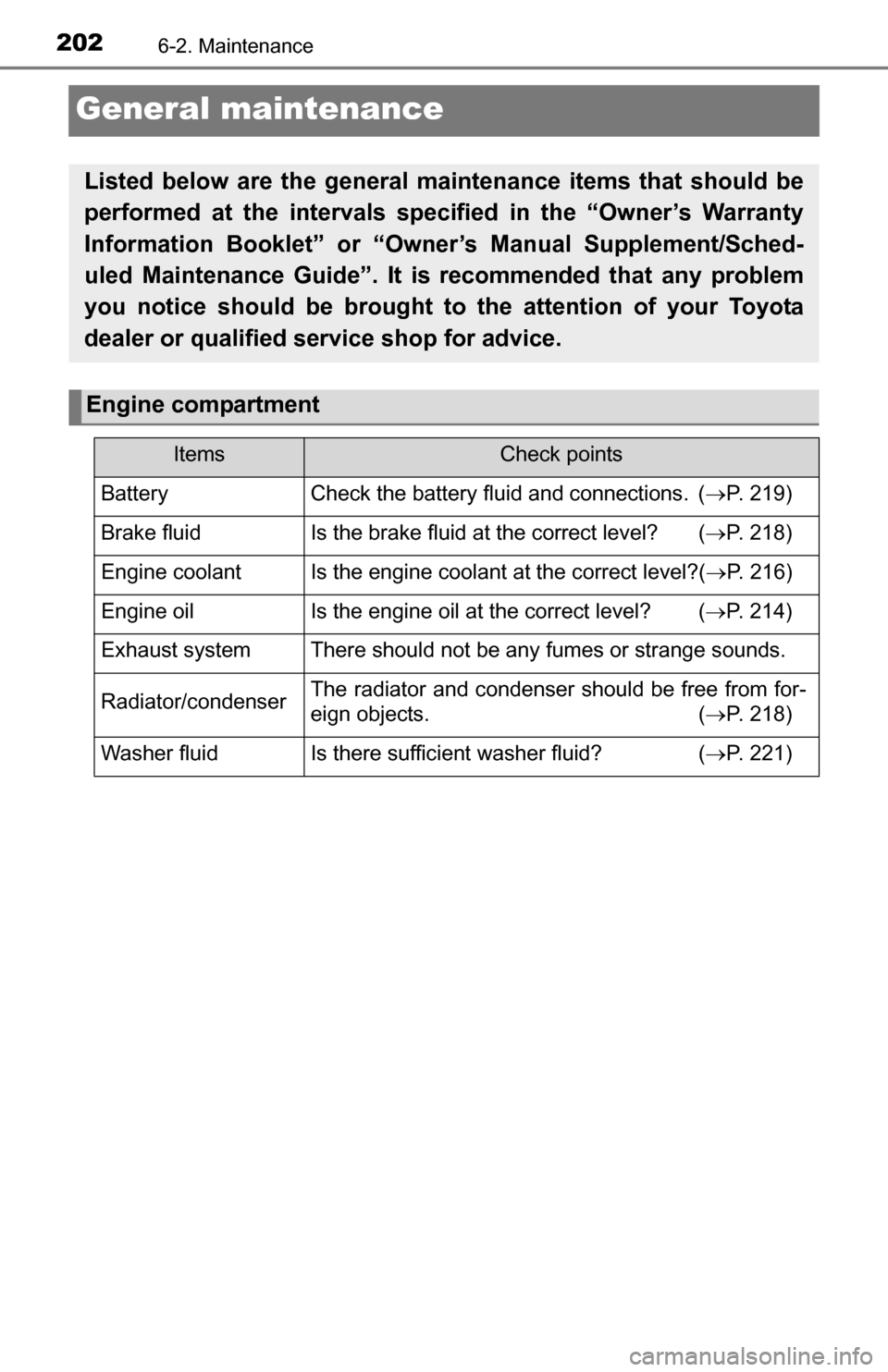
ItemsCheck points
BatteryCheck the battery fluid and connections. ( P. 219)
Brake fluidIs the brake fluid at the correct level? (P. 218)
Engine coolantIs the engine coolant at the correct level?( P. 216)
Engine oilIs the engine oil at the correct level? (P. 214)
Exhaust systemThere should not be any fumes or strange sounds.
Radiator/condenserThe radiator and condenser should be free from for-
eign objects. (P. 218)
Washer fluidIs there sufficient washer fluid? (P. 221)
Page 239 of 368
2396-3. Do-it-yourself maintenance
6
Maintenance and care
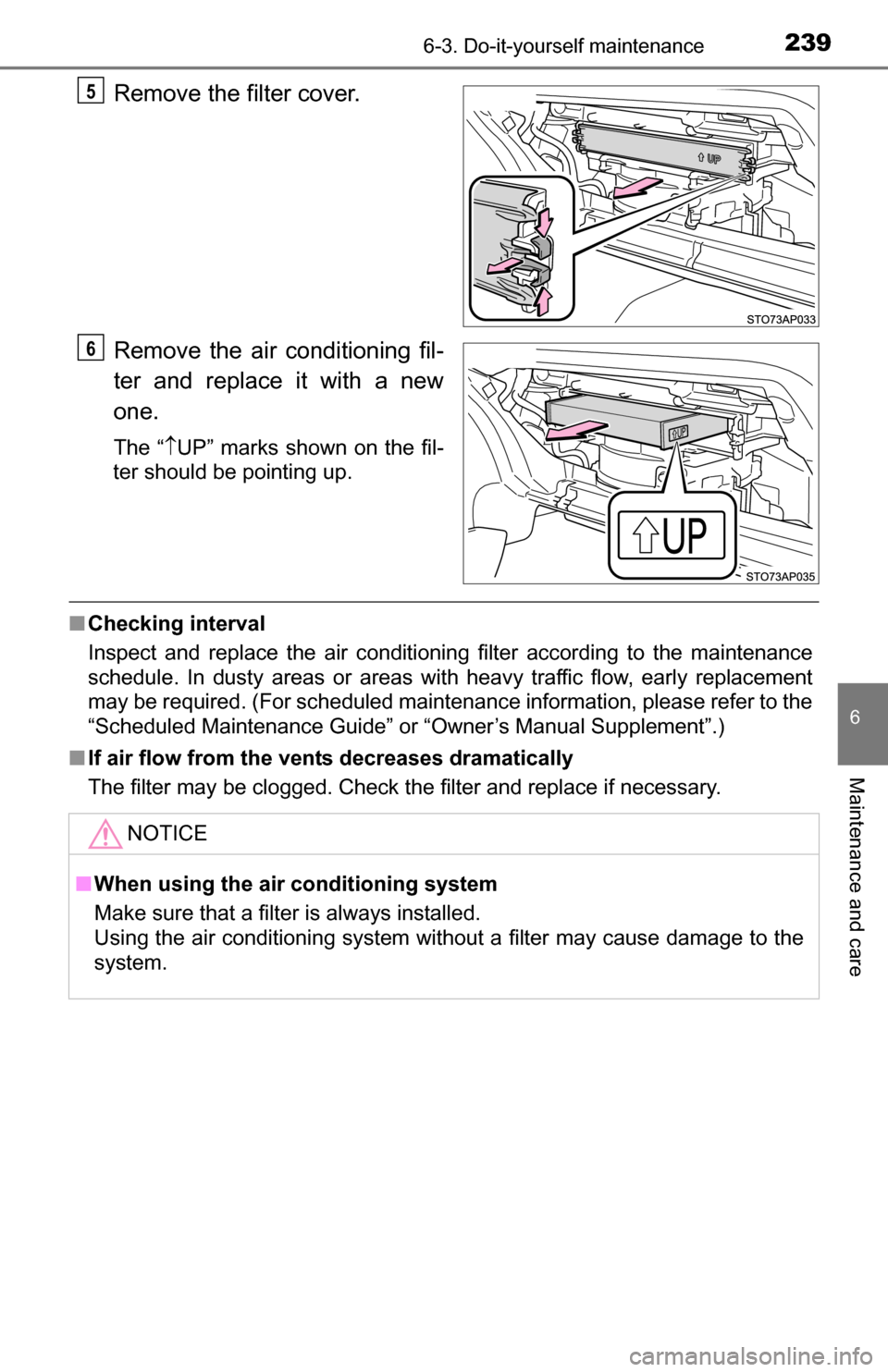
Remove the filter cover.
Remove the air conditioning fil-
ter and replace it with a new
one.
The “UP” marks shown on the fil-
ter should be pointing up.
■ Checking interval
Inspect and replace the air conditioning filter according to the maintenance
schedule. In dusty areas or areas with heavy traffic flow, early replacement
may be required. (For scheduled maintenance information, please refer to the
“Scheduled Maintenance Guide” or “Owner’s Manual Supplement”.)
■ If air flow from the vents decreases dramatically
The filter may be clogged. Check the filter and replace if necessary.
5
6
NOTICE
■When using the ai r conditioning system
Make sure that a filter is always installed.
Using the air conditioning system without a filter may cause damage to the
system.
Page 275 of 368

2757-2. Steps to take in an emergency
7
When trouble arises
*1: Parking brake engaged warning buzzer: The buzzer sounds to indicate that the parking brake is still engaged (with
the vehicle having reached a speed of 3 mph [5 km/h]).
*2: If equipped
*3: Open door warning buzzer: A buzzer will sound if the vehicle reaches a speed of 3 mph (5 km/h) or
more with any door open.
*4: Driver’s and front passenger’s seat belt buzzer: The driver’s and passenger’s seat belt buzzer sounds to alert the driver
and front passenger that his or her seat belt is not fastened. Once the
engine switch is turned to the “ON” or “START” position, the buzzer sounds
for 6 seconds. The buzzer sounds once if the driver’s or front passenger’s
seat belt is unfastened when the vehicle reaches a speed of 12 mph
(20 km/h). Then, if the seat belt is still unfastened after 30 seconds elapse,
the buzzer will sound intermittently for approximately 10 seconds, followed
by a different tone for approximately 20 more seconds.
*5: Refer to the separate “Scheduled Maintenance Guide” or “Owner’s ManualSupplement” for the maintenance interval applicable to your vehicle.
Maintenance required reminder light (except Canada) Indicates that maintenance is required according to the
driven distance on the maintenance schedule.
*5
Illuminates for about 3 seconds and then flashes for about
15 seconds approximately 4500 miles (7200 km) after the
reminder light has been reset.
If necessary, perform maintenance.
Comes on and remains on if the distance driven exceeds
5000 miles (8000 km) after the reminder light has been
reset. (The indicator will not work properly unless the
reminder light has been reset.)
Perform the necessary maintenance. Please reset the
reminder light after the maintenance is performed.
(P. 201)
Warning lightWarning light/Details/Actions