Page 242 of 368
2426-3. Do-it-yourself maintenance
■Use a CR2016 lithium battery
●Batteries can be purchased at your Toyota dealer, local electrical appliance
shops or camera stores.
● Replace only with the same or equivalent type recommended by the manu-
facturer.
● Dispose of used batteries according to local laws.
■ If the key battery is depleted
The following symptoms may occur:
●The wireless remote control will not function properly.
● The operational range will be reduced.
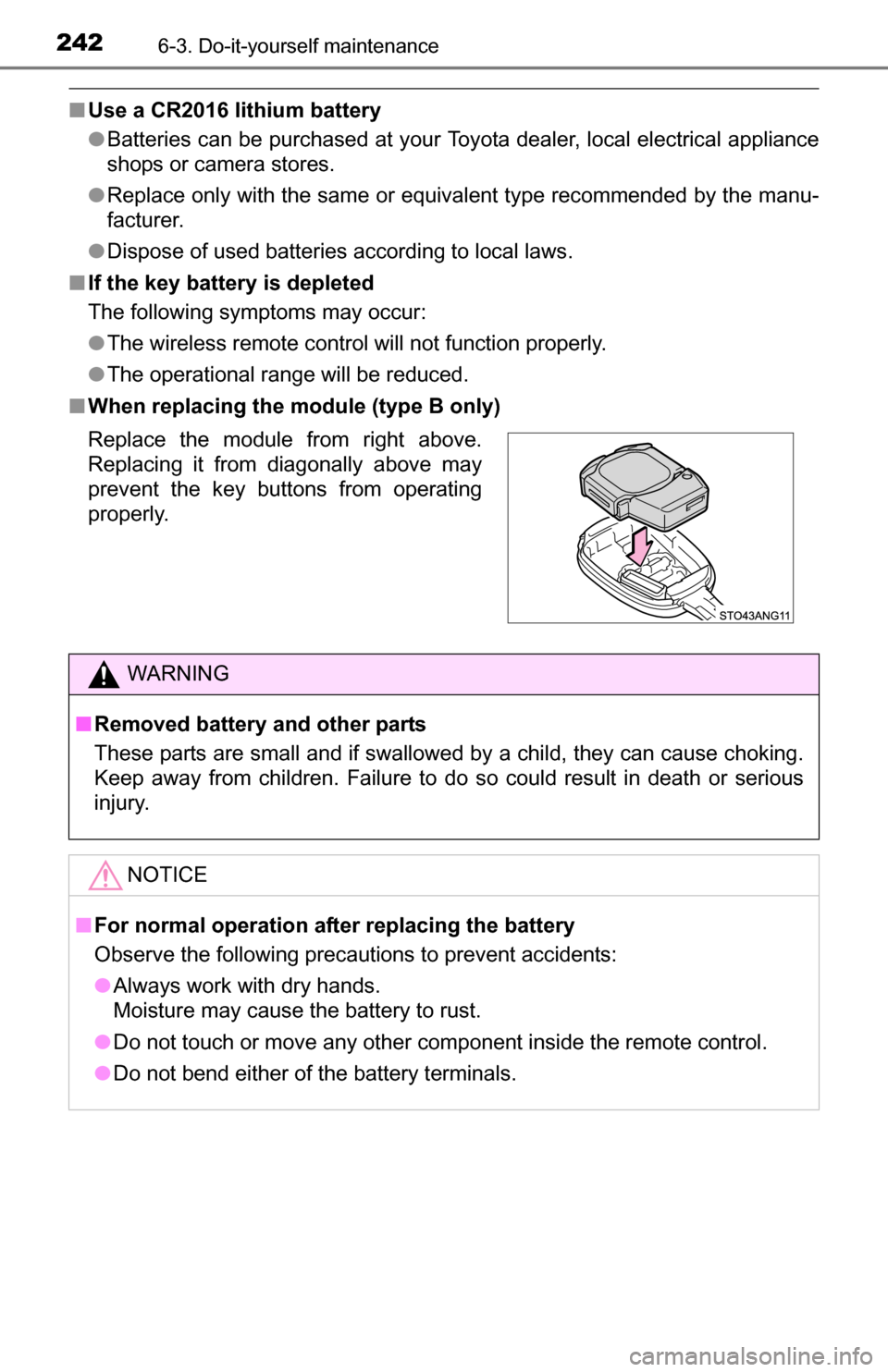
■ When replacing the module (type B only)
Replace the module from right above.
Replacing it from diagonally above may
prevent the key buttons from operating
properly.
WARNING
■Removed battery and other parts
These parts are small and if swallowed by a child, they can cause choking.
Keep away from children. Failure to do so could result in death or serious
injury.
NOTICE
■For normal operation after replacing the battery
Observe the following precautions to prevent accidents:
● Always work with dry hands.
Moisture may cause the battery to rust.
● Do not touch or move any other component inside the remote control.
● Do not bend either of the battery terminals.
Page 243 of 368
2436-3. Do-it-yourself maintenance
6
Maintenance and care
Checking and replacing fuses
Turn the engine switch to the “LOCK” position.
Open the fuse box cover.
Engine compartment: type A and B fuse boxesType A fuse box
Push the tab in and lift the lid off.
Type B fuse box
Push the tab in and lift the lid off.
If any of the electrical components do not operate, a fuse may
have blown. If this happens, check and replace the fuses as nec-
essary.
1
2
1
2
Page 247 of 368
2476-3. Do-it-yourself maintenance
6
Maintenance and care
NOTICE
■Before replacing fuses
Have the cause of electrical overload determined and repaired by your Toy-
ota dealer as soon as possible.
Page 298 of 368

2987-2. Steps to take in an emergency
Start the engine of the second vehicle. Increase the engine speed
slightly and maintain at that level for approximately 5 minutes to
recharge the batter y of your vehicle.
Maintain the engine speed of t he second vehicle and start the
engine of your vehicle.
Once the vehicle’s engine has started, remove the jumper cables in
the exact reverse order from which they were connected.
Once the engine starts, have the vehicle inspected at your Toyota
dealer as soon as possible.
■ Starting the engine when the battery is discharged (vehicles with an
automatic transmission)
The engine cannot be started by push-starting.
■ To prevent battery discharge
●Turn off the headlights and the audio system while the engine is not running.
● Turn off any unnecessary electrical components when the vehicle is running
at a low speed for an extended period, such as in heavy traffic.
■ Charging the battery
The electricity stored in the battery will discharge gradually even when the
vehicle is not in use, due to natural discharge and the draining effects of cer-
tain electrical appliances. If the vehicle is left for a long time, the battery may
discharge, and the engine may be unable to start. (The battery recharges
automatically during driving.)
3
4
5
Page 312 of 368
3128-1. Specifications
*: The fluid capacity is the reference quantity. If replacement is necessary,contact your Toyota dealer.
Ignition system
Spark plug
MakeDENSO SK16R11
NGK IFR5A11
Gap0.043 in. (1.1 mm)
NOTICE
■ Iridium-tipped spark plugs
Use only iridium-tipped spark plugs. Do not adjust the spark plug gap.
Electrical system
Battery
Open voltage* at
68 F (20 C): 12.6 12.8 V Fully charged
12.2
12.4 V Half charged
11 . 8
12.0 V Discharged
(
*: Voltage checked 20 minutes after the engine
and all the lights are turned off.)
Charging rates 5 A max.
Automatic transmission
Fluid capacity*6.8 qt. (6.4 L, 5.6 Imp.qt.)
Fluid typeToyota Genuine ATF WS
NOTICE
■Transmission fluid type
Using transmission fluid other than “Toyota Genuine ATF WS” may cause
deterioration in shift quality, locking up of the transmission accompanied by
vibration and, ultimately, damage to the vehicle’s transmission.