Page 532 of 800
532
PRIUS_OM_OM47A29U_(U)
6-3. Using the storage features
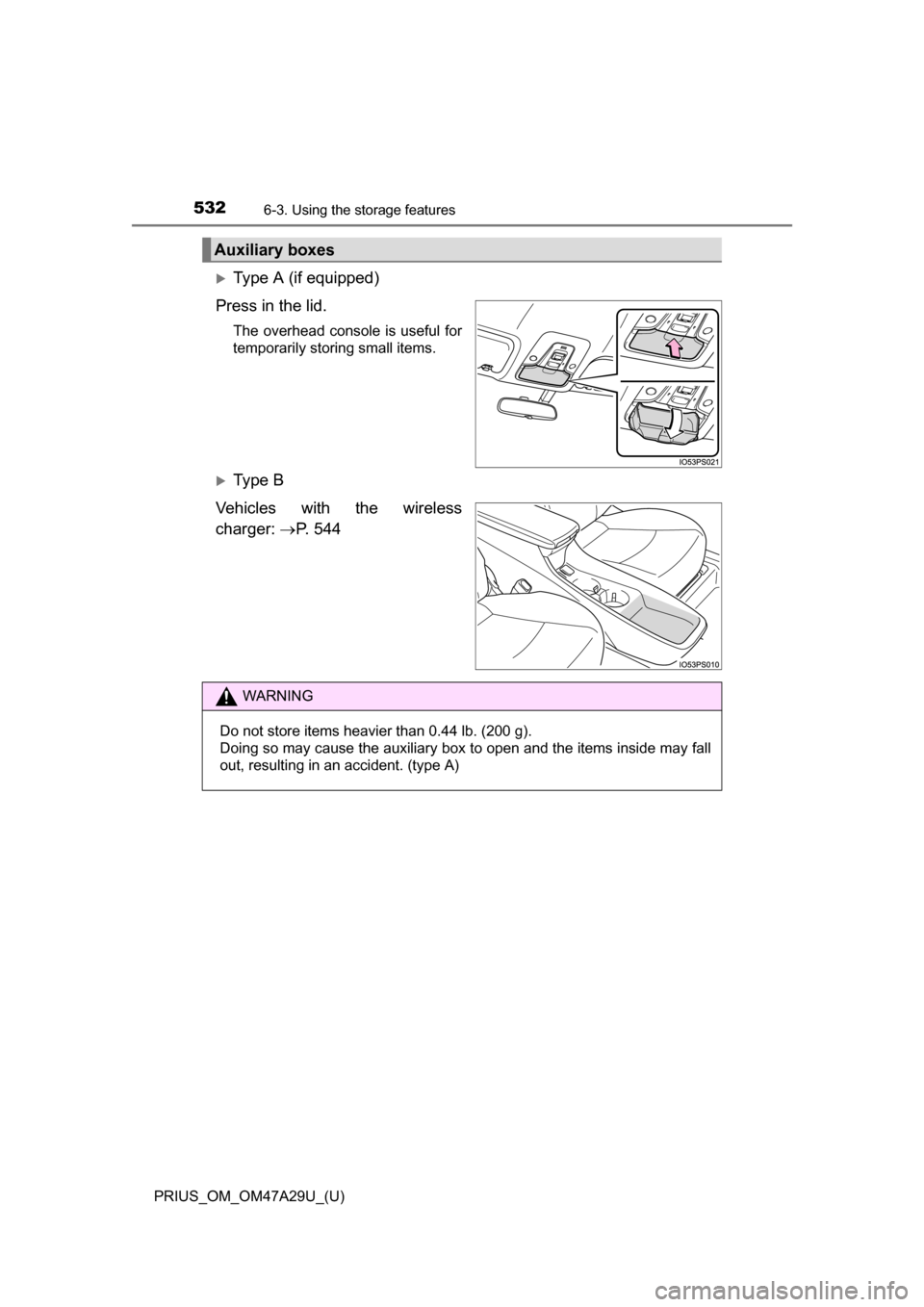
Type A (if equipped)
Press in the lid.
The overhead console is useful for
temporarily storing small items.
Ty p e B
Vehicles with the wireless
charger: P. 544
Auxiliary boxes
WARNING
Do not store items heavier than 0.44 lb. (200 g).
Doing so may cause the auxiliary box to open and the items inside may fall
out, resulting in an accident. (type A)
Page 533 of 800
533
PRIUS_OM_OM47A29U_(U)
6-3. Using the storage features
6
Interior features
Luggage compartment features
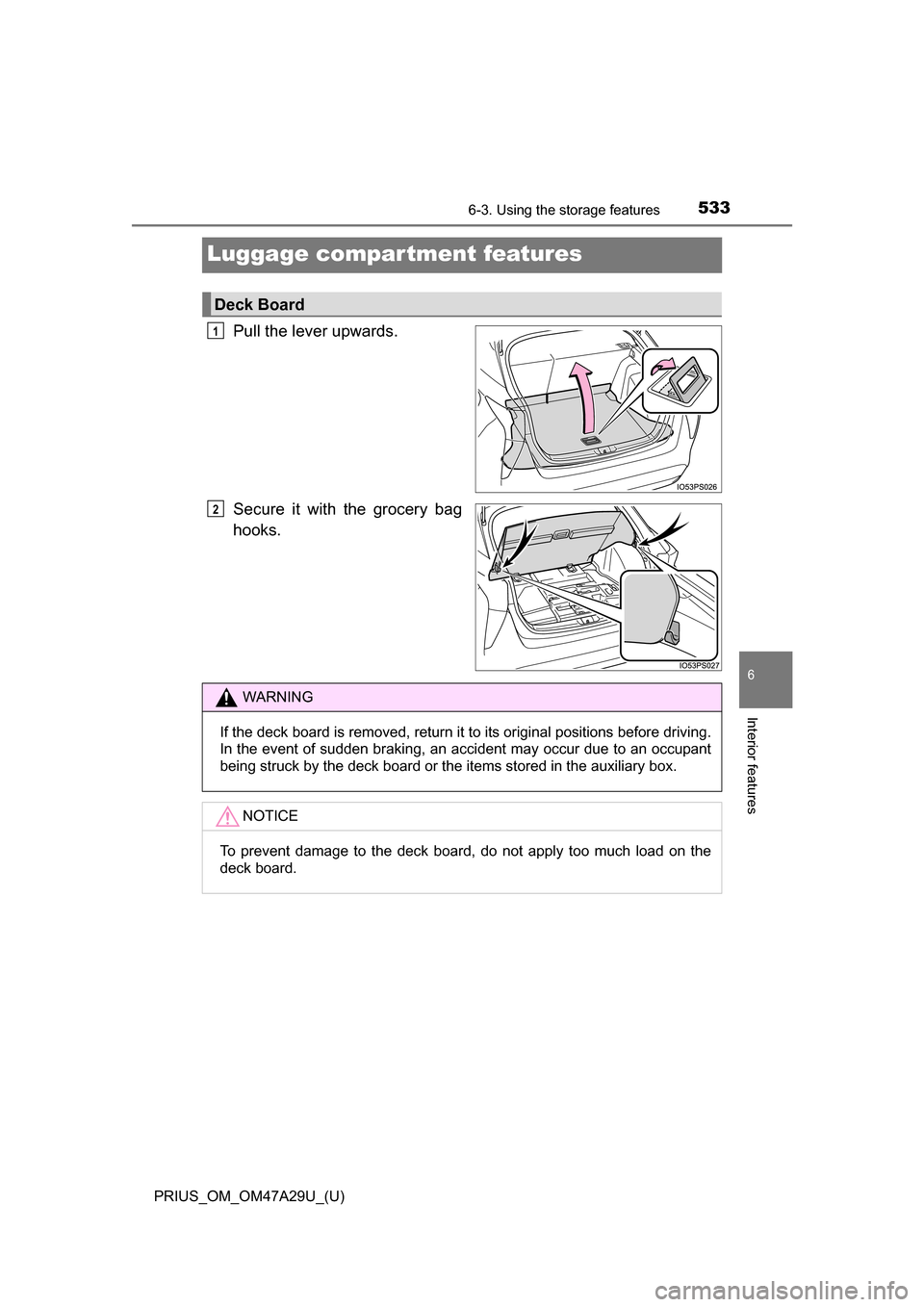
Pull the lever upwards.
Secure it with the grocery bag
hooks.
Deck Board
1
2
WARNING
If the deck board is removed, return it to its original positions before driving.
In the event of sudden braking, an accident may occur due to an occupant
being struck by the deck board or the items stored in the auxiliary box.
NOTICE
To prevent damage to the deck board, do not apply too much load on the
deck board.
Page 536 of 800
536
PRIUS_OM_OM47A29U_(U)
6-3. Using the storage features
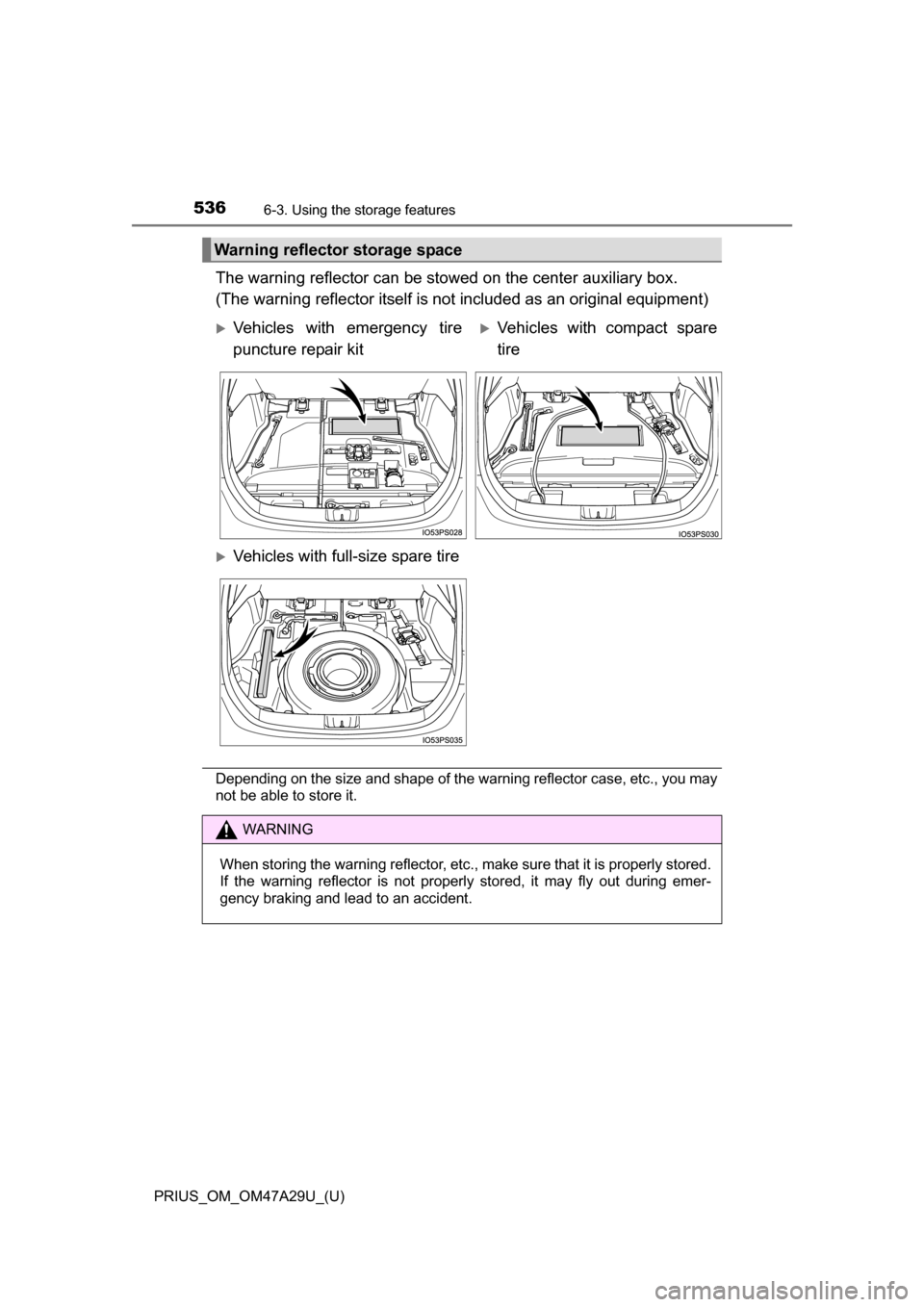
The warning reflector can be stowed on the center auxiliary box.
(The warning reflector itself is no t included as an original equipment)
Depending on the size and shape of the warning reflector case, etc., you may
not be able to store it.
Warning reflector storage space
Vehicles with emergency tire
puncture repair kitVehicles with compact spare
tire
Vehicles with full-size spare tire
WARNING
When storing the warning reflector, etc., make sure that it is properly stored.
If the warning reflector is not properly stored, it may fly out during emer-
gency braking and lead to an accident.
Page 588 of 800
588
PRIUS_OM_OM47A29U_(U)
7-3. Do-it-yourself maintenance
Hood
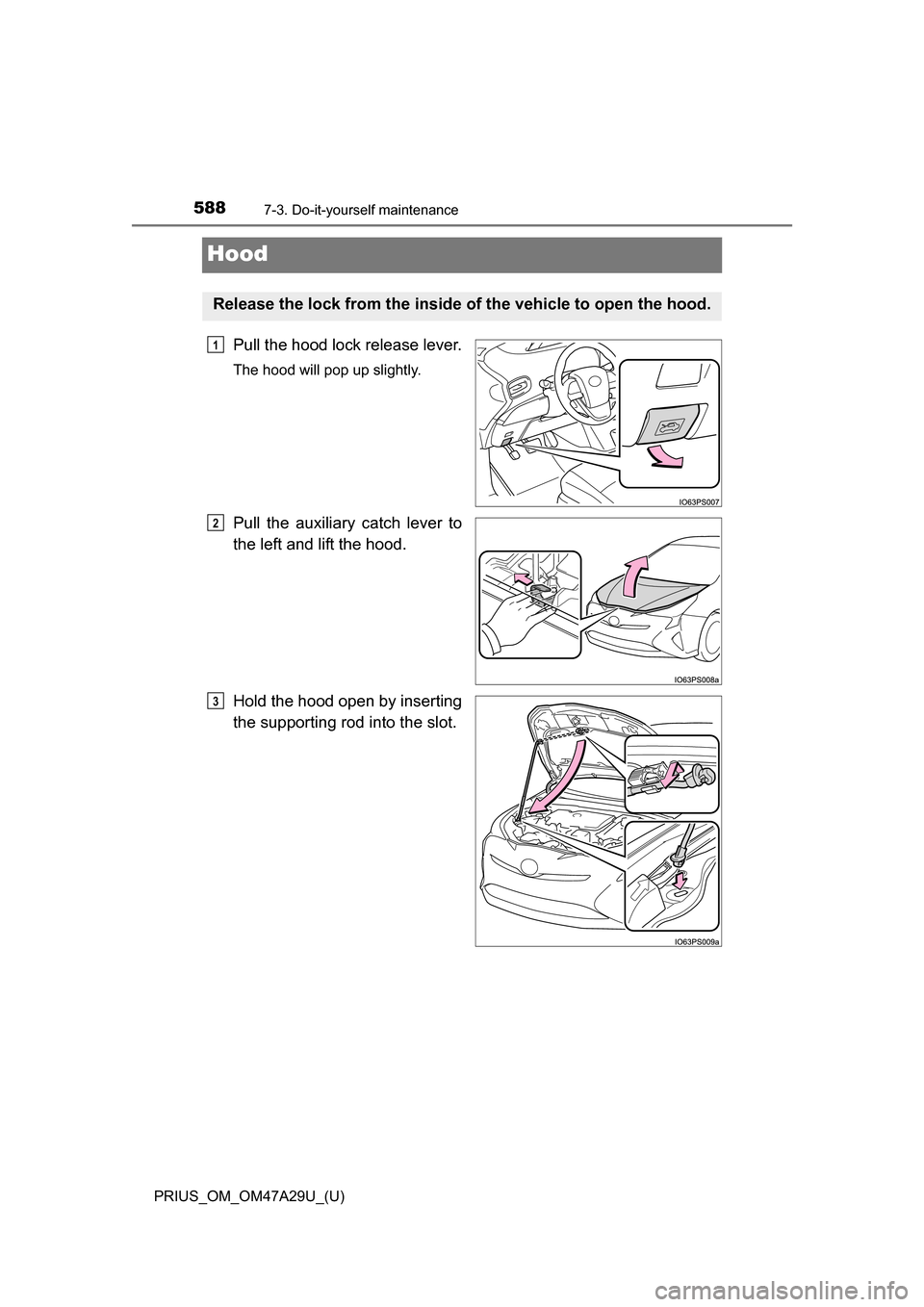
Pull the hood lock release lever.
The hood will pop up slightly.
Pull the auxiliary catch lever to
the left and lift the hood.
Hold the hood open by inserting
the supporting rod into the slot.
Release the lock from the inside of the vehicle to open the hood.
1
2
3
Page 611 of 800
PRIUS_OM_OM47A29U_(U)
6117-3. Do-it-yourself maintenance
7
Maintenance and care
■Situations in which the tire pressure warning system may not oper-
ate properly
●In the following cases, the tire pressure warning system may not operate
properly.
• If non-genuine Toyota wheels are used.
• When a replacement tire is used , the system may not operate cor-
rectly due to the structure of the replacement tire.
• A tire has been replaced with a tire that is not of the specified size.
• Tire chains etc. are equipped.
• An auxiliary-supported run- flat tire is equipped.
• If a window tint that affects the radio wave signals is installed.
• If there is a lot of snow or ice on the vehicle, particularly around the
wheels or wheel housings.
• If the tire inflation pressure is extremely higher than the specified level.
• If wheel without the tire pressure warning valve and transmitter is
used.
• If the ID code on the tire pressure warning valves and transmitters is not registered in the tire pressure warning computer.
●Performance may be affected in the following situations.
• Near a TV tower, electric power plant, gas station, radio station, largedisplay, airport or other facility that generates strong radio waves or
electrical noise
• When carrying a portable radio, cellular phone, cordless phone or other wireless communication device
●When the vehicle is parked, the time taken for the warning to start or go
off could be extended.
●When tire inflation pressure declines rapidly for example when a tire has
burst, the warning may not function.
■The initialization operation
●Make sure to carry out in itialization after adjusting the tire inflation pres-
sure.
Also, make sure the tires are cold be fore carrying out initialization or tire
inflation pressure adjustment.
●If you have accidentally turned the power switch off during initialization,
it is not necessary to press the reset switch again as initialization will
restart automatically when the power switch has been turned to ON
mode for the next time.
●If you accidentally press the reset s witch when initialization is not neces-
sary, adjust the tire inflation pressu re to the specified level when the
tires are cold, and conduct initialization again.
Page 766 of 800
766
PRIUS_OM_OM47A29U_(U)
◆Coussins gonflables SRS avantCoussin gonflable SRS du conduc teur/coussin gonflable SRS du
passager avant
Peuvent aider à protéger la tête et la poitrine du conducteur et du
passager avant contre les impa cts avec des composants intéri-
eurs
Coussin gonflable SRS de protection des genoux
Peut aider à protéger le conducteur
Coussin gonflable SRS du coussin de siège
Peut aider à retenir le passager avant.
◆Coussins gonflables SRS latéraux et en rideau
Coussins gonflables SRS latéraux
Peuvent aider à protéger le torse des occupants des sièges
avant
Coussins gonflabl es SRS en rideau
● Peuvent aider à protéger principalement la tête des occupants
des sièges latéraux
● Peuvent empêcher les occupants d’être éjectés du véhicule en
cas de tonneaux
1
2
3
4
5
Page 767 of 800
PRIUS_OM_OM47A29U_(U)
767
10
For owners
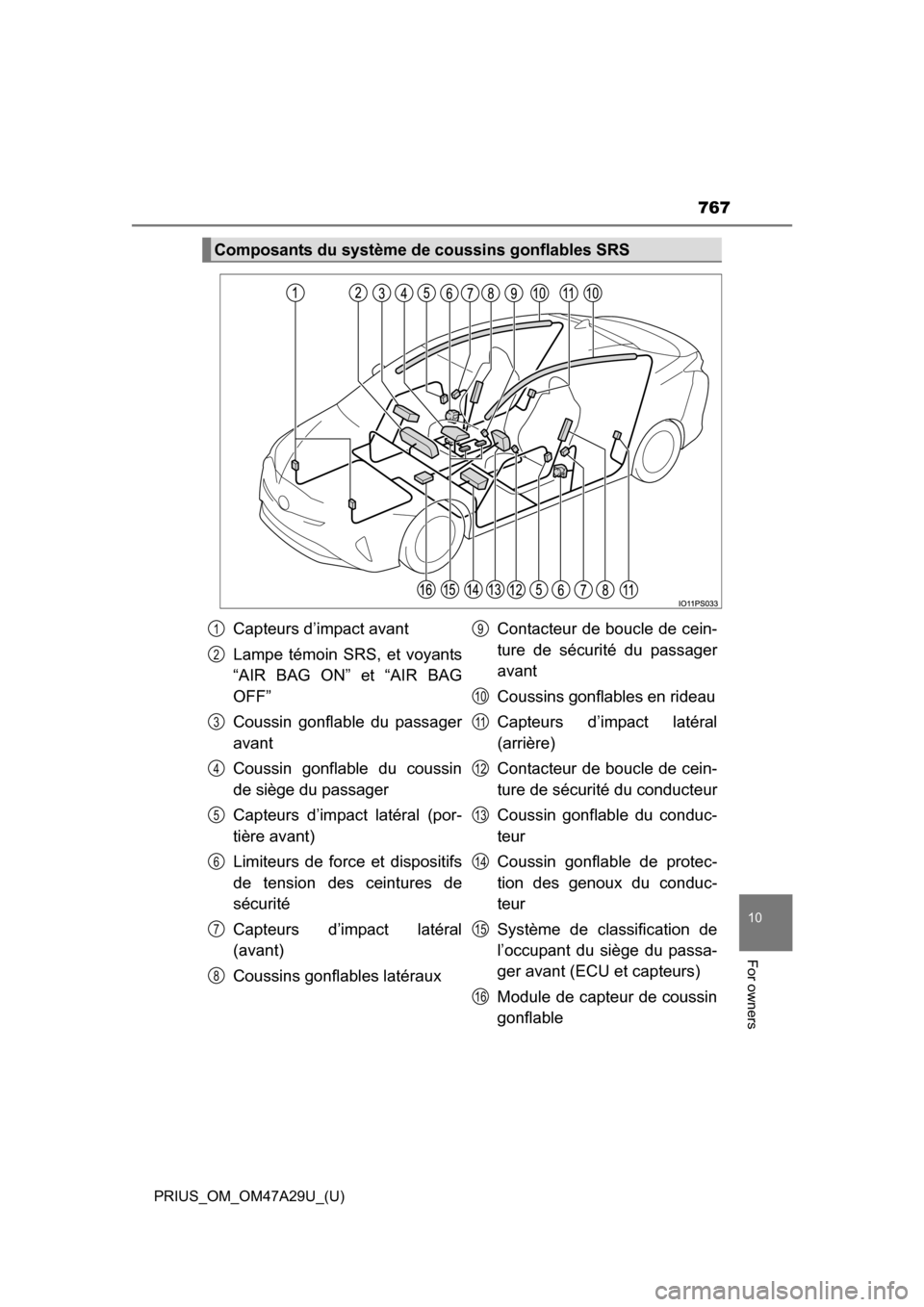
Composants du système de coussins gonflables SRS
Capteurs d’impact avant
Lampe témoin SRS, et voyants
“AIR BAG ON” et “AIR BAG
OFF”
Coussin gonflable du passager
avant
Coussin gonflable du coussin
de siège du passager
Capteurs d’impact latéral (por-
tière avant)
Limiteurs de force et dispositifs
de tension des ceintures de
sécurité
Capteurs d’impact latéral
(avant)
Coussins gonflables latéraux Contacteur de boucle de cein-
ture de sécurité du passager
avant
Coussins gonflables en rideau
Capteurs d’impact latéral
(arrière)
Contacteur de boucle de cein-
ture de sécurité du conducteur
Coussin gonflable du conduc-
teur
Coussin gonflable de protec-
tion des genoux du conduc-
teur
Système de classification de
l’occupant du siège du passa-
ger avant (ECU et capteurs)
Module de capteur de coussin
gonflable1
2
3
4
5
6
7
8
9
10
11
12
13
14
15
16
Page 768 of 800
768
PRIUS_OM_OM47A29U_(U)
Votre véhicule est doté de COUSSINS GONFLABLES ÉVOLUÉS
dont la conception s’appuie sur les normes de sécurité des véhicules
à moteur américains (FMVSS208). Le module de capteur de coussin
gonflable (ECU) contrôle le dépl oiement des coussins gonflables en
fonction des informations obtenues des capteurs et d’autres éléments
affichés dans le diagramme des composants du système ci-dessus.
Ces informations comprennent des données relatives à la gravité de
l’accident et aux occupants. Au moment du déploiement des coussins
gonflables, une réaction chimique se produit dans les gonfleurs de
coussin gonflable et les coussins gonflables se remplissent rapide-
ment d’un gaz non toxique pour aider à limiter le mouvement des
occupants.