2016 TOYOTA LAND CRUISER Changing tire
[x] Cancel search: Changing tirePage 212 of 608

212
LC200_OM_OM60M88U_(U)
4-3. Operating the lights and wipers
●In the situations shown below, the system may not be able to accurately
detect surrounding brightness levels. This may cause the low beams to
remain on or the high beams to cause problems for pedestrians, vehicles
ahead or other parties. In these cases, manually switch between the high
and low beams.
• In bad weather (rain, snow, fog, sandstorms etc.)
• The windshield is obscured by fog, mist, ice, dirt etc.
• The windshield is cracked or damaged.
• The inside rear view mirror or ca mera sensor is deformed or dirty.
• The camera sensor temperature is extremely high.
• Surrounding brightness levels are equal to those of headlights, tail lights or fog lights.
• Vehicles ahead have headlights that are either switched off, dirty, are
changing color, or are not aimed properly.
• When driving through an area of in termittently changing brightness and
darkness
• When frequently and repeatedly driving ascending/descending roads, or roads with rough, bumpy or uneven surfaces (such as stone-paved
roads, gravel tracks etc.)
• When frequently and repeatedly taking curves or driving on a winding road
• There is a highly reflective object ahead of the vehicle, such as a sign or
a mirror.
• The back of a vehicle ahead is highly reflective, such as a container on a truck.
• The vehicle’s headlights are damaged or dirty.
• The vehicle is listing or tilting, due to a flat tire, a trailer being towed etc.
• The high beam and low beam are repeatedly being switched between in an abnormal manner.
• The driver believes that the high beam may be causing problems or dis-
tress to other drivers or pedestrians nearby.
■ If a warning message of the Auto matic High Beam is displayed...
It may indicate a malfunction in the system. Contact your Toyota dealer.
Page 350 of 608

350
LC200_OM_OM60M88U_(U)
4-5. Using the driving support systems
■Conditions under which the BSM function may not function correctly
●The BSM function may not detect vehicles correctly in the following situa-
tions:
• When the sensor is misaligned due to a strong impact to the sensor or its
surrounding area
• When mud, snow, ice, a sticker, etc. is covering the sensor or surround-
ing area on the rear bumper
• When driving on a road surface that is wet with standing water during bad weather, such as heavy rain, snow, or fog
• When multiple vehicles are approaching with only a small gap between each vehicle
• When the distance between your vehicle and a following vehicle is short
• When there is a significant difference in speed between your vehicle and the vehicle that enters the detection area
• When the difference in speed between your vehicle and another vehicle
is changing
• When a vehicle enters a detection area traveling at about the same speed as your vehicle
• As your vehicle starts from a stop, a vehicle remains in the detection area
• When driving up and down consecutive steep inclines, such as hills, dips in the road, etc.
• When driving on roads with sharp bends, consecutive curves, or uneven surfaces
• When vehicle lanes are wide, or when driving on the edge of a lane, and
the vehicle in an adjacent lane is far away from your vehicle
• When a bicycle carrier or other accessor y is installed to the rear of the
vehicle
• When there is a significant difference in height between your vehicle and the vehicle that enters the detection area
• Immediately after the BSM main switch is turned on
● Instances of the BSM function unnecessarily detecting a vehicle and/or
object may increase in the following situations:
• When the sensor is misaligned due to a strong impact to the sensor or its
surrounding area
• When the distance between your vehicle and a guardrail, wall, etc. that enters the detection area is short
• When driving up and down consecutive steep inclines, such as hills, dips in the road, etc.
• When vehicle lanes are narrow, or when driving on the edge of a lane,
and a vehicle traveling in a lane other than the adjacent lanes enters the
detection area
• When driving on roads with sharp bends, consecutive curves, or uneven
surfaces
• When the tires are slipping or spinning
• When the distance between your vehicle and a following vehicle is short
• When a bicycle carrier or other accessor y is installed to the rear of the
vehicle
Page 515 of 608

5157-2. Steps to take in an emergency
LC200_OM_OM60M88U_(U)
7
When trouble arises
■When the tire pressure warning light comes on
Inspect the tires to check if a tire is punctured.
If a tire is punctured: P. 524
If none of the tires are punctured:
Turn the engine switch off then turn it to IGNITION ON mode. Check if the
tire pressure warning light comes on or flashes.
If the tire pressure warning light comes on
After the temperature of the tires has lowered sufficiently, check the
inflation pressure of each tire and adjust them to the specified level.
If the warning light does not turn off even after several minutes have
elapsed, check that the inflation pressu re of each tire is at the specified
level and perform initialization. (P. 464)
If the warning light does not turn off even after several minutes have
elapsed, have the vehicle inspected by your Toyota dealer immediately.
If the tire pressure warning light flashes for 1 minute then stay on
There may be a malfunction in the tire pressure warning system. Have
the vehicle inspected by your Toyota dealer immediately.
■The tire pressure warning light may turn on due to natural causes
The tire pressure warning light may turn on due to natural causes such as
natural air leaks or tire inflation pressure changes caused by tempera-
ture. In this case, adjusting the tire inflation pres sure will turn off the warn-
ing light (after a few minutes).
■When a tire is replaced with a spare tire
The spare tire is also equipped with the tire pressure warning valve and
transmitter. The tire pressure warning light will turn on if the tire inflation
pressure of the spare tire is low. If a tire goes flat, even though the flat tire
is replaced with the spare tire, the tire pressure warning light does not
turn off. Replace the spare tire with the repaired tire and adjust the proper
tire inflation pressure. T he tire pressure warning light will turn off after a
few minutes.
■Conditions that the tire pressure warning system may not function
properly
P. 4 6 8
■Changing the engine oil
Make sure to reset oil change system.
1
2
Page 533 of 608

5337-2. Steps to take in an emergency
LC200_OM_OM60M88U_(U)
7
When trouble arises
WARNING
■Replacing a flat tire
●Observe the following precautions.
Failure to do so may result in serious injury:
• Lower the spare tire completely to the ground before removing it from under the vehicle.
• Do not try to remove the wheel ornament by hand. Take due care in
handling the ornament to avoid unexpected personal injury.
• Do not touch the disc wheels or the area around the brakes immedi-
ately after the vehicle has been driven.
After the vehicle has been driven the disc wheels and the area
around the brakes will be extremely hot. Touching these areas with
hands, feet or other body parts wh ile changing a tire, etc. may result
in burns.
●Failure to follow these precautions could cause the wheel nuts to
loosen and the tire to fall off, resulting in death or serious injury.
• Have the wheel nuts tightened with a torque wrench to 97 ft•lbf (131 N•m, 13.4 kgf•m) as soon as possible after changing wheels.
• Do not attach a heavily damaged wheel ornament, as it may fly off
the wheel while the vehicle is moving.
• When installing a tire, only use wh eel nuts that have been specifi-
cally designed for that wheel.
• If there are any cracks or deforma tions in the bolt screws, nut
threads or bolt holes of the wheel, have the vehicle inspected by
your Toyota dealer.
• When installing the wheel nuts, be sure to install them with the tapered ends facing inward. ( P. 476)
Page 584 of 608
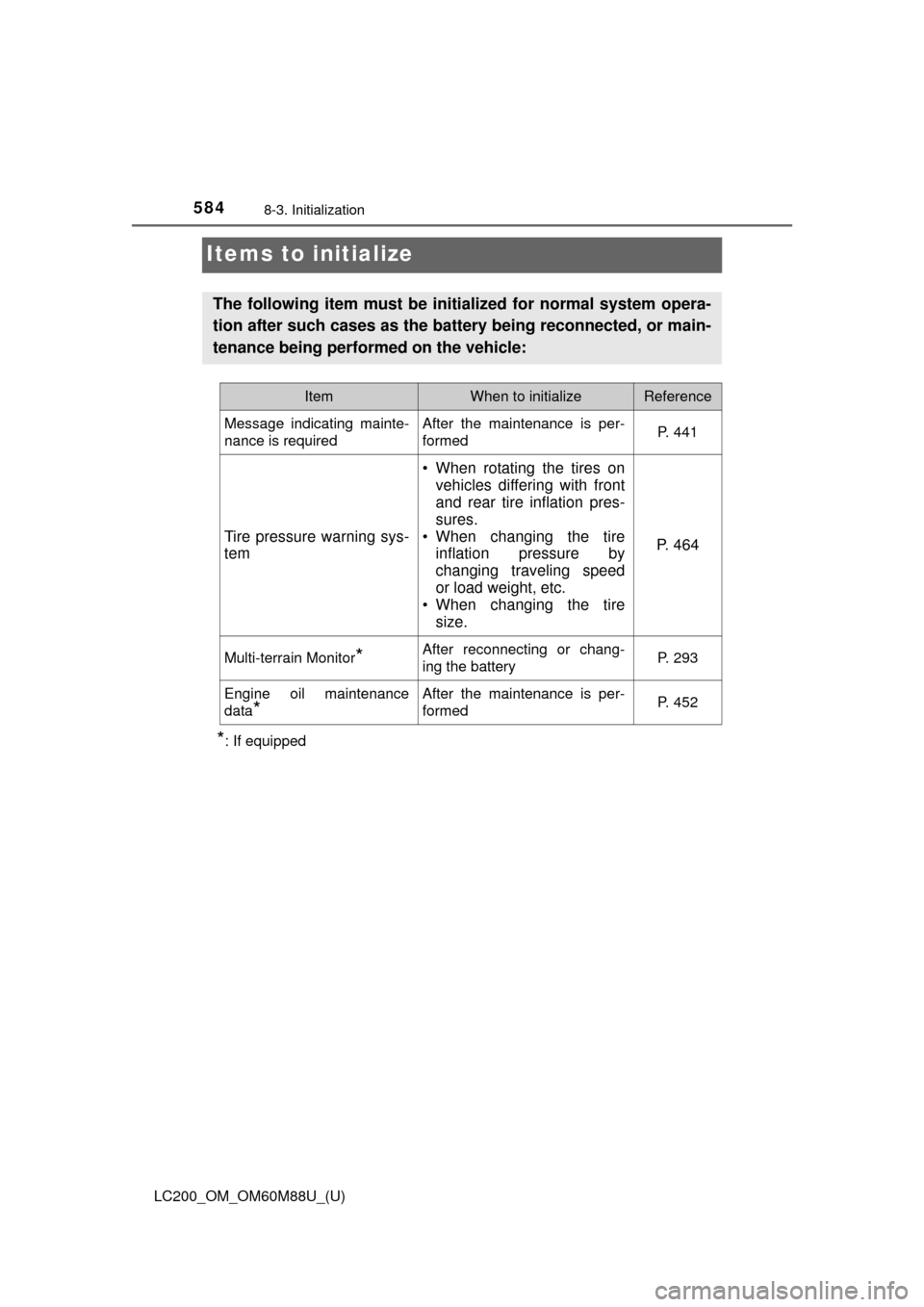
584
LC200_OM_OM60M88U_(U)
8-3. Initialization
Items to initialize
*: If equipped
The following item must be initialized for normal system opera-
tion after such cases as the battery being reconnected, or main-
tenance being performed on the vehicle:
ItemWhen to initializeReference
Message indicating mainte-
nance is requiredAfter the maintenance is per-
formedP. 441
Tire pressure warning sys-
tem
• When rotating the tires on vehicles differing with front
and rear tire inflation pres-
sures.
• When changing the tire inflation pressure by
changing traveling speed
or load weight, etc.
• When changing the tire
size.
P. 4 6 4
Multi-terrain Monitor*After reconnecting or chang-
ing the batteryP. 293
Engine oil maintenance
data
*
After the maintenance is per-
formedP. 452