Page 325 of 716
3254-5. Using the driving support systems
4
Driving
HIGHLANDER_U (OM48F09U)■
Conditions under which the Rear Cr oss Traffic Alert function will not
detect a vehicle
The Rear Cross Traffic Alert function is not designed to detect the following
types of vehicles and/or objects.
● Small motorcycles, bicycles, pedestrians etc.
*
●Vehicles approaching from directly behind
● Guardrails, walls, signs, parked vehicles and similar stationary objects
*
●Vehicles moving away from your vehicle
● Vehicles approaching from the parking spaces next to your vehicle
*
●Vehicles backing up in the parking space next to your vehicle*
*
: Depending on conditions, detection of a vehicle and/or object may occur.
■ Conditions under which the Rear Cross Traffic Alert function may not
function correctly
The Rear Cross Traffic Alert function may not detect vehicles correctly in the
following conditions:
● When ice or mud etc. is attached to the rear bumper
● During bad weather such as heavy rain, fog, snow etc.
● When multiple vehicles approach continuously
● Shallow angle parking
● When a vehicle is approaching at high speed
● When parking on a steep incline, such as hills, a dip in the road etc.
● Directly after the BSM main switch is set to on
● Directly after the engine is started with the BSM main switch on
● When towing a trailer
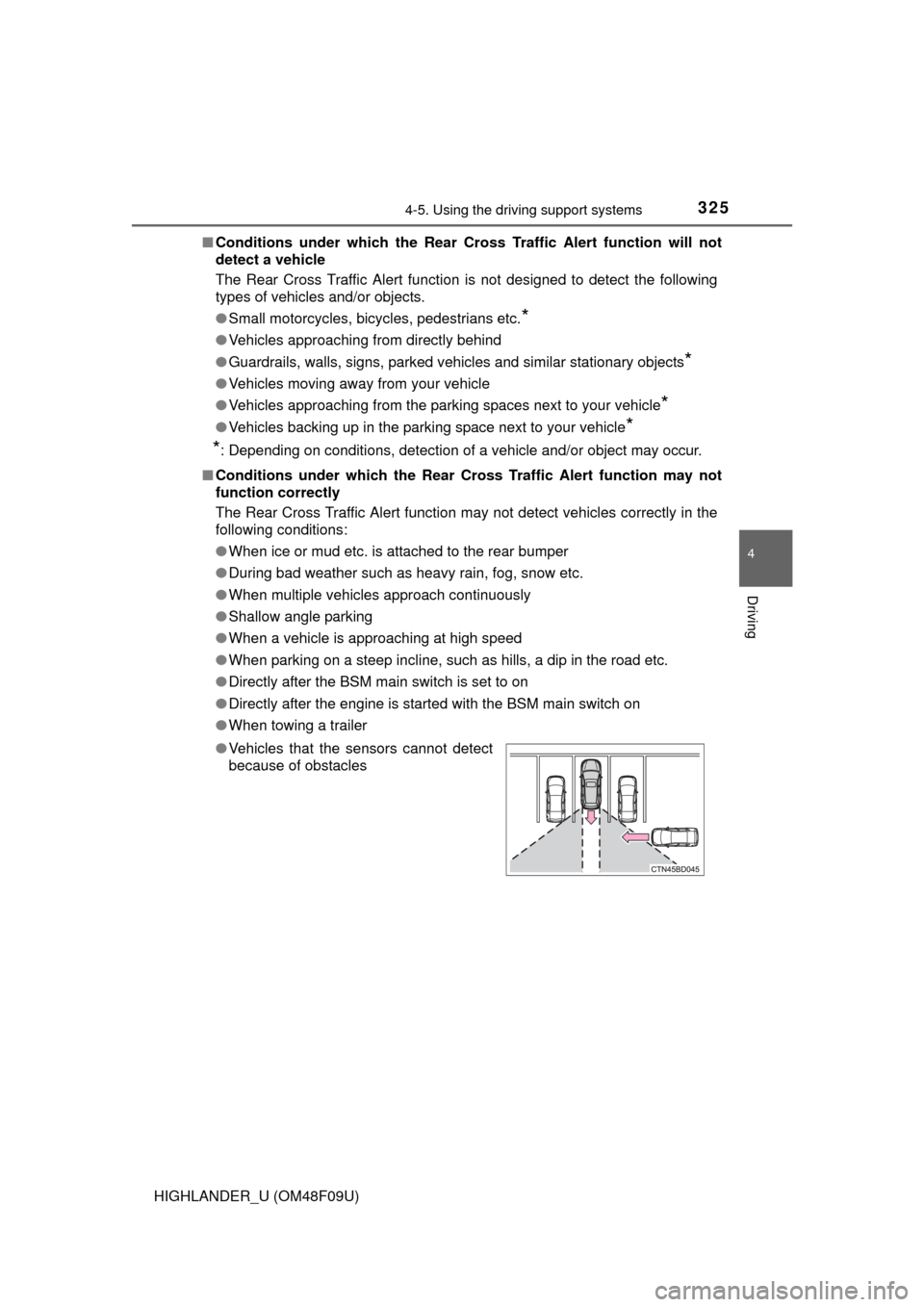
● Vehicles that the sensors cannot detect
because of obstacles
Page 469 of 716
4696-4. Using the other interior features
6
Interior features
HIGHLANDER_U (OM48F09U)
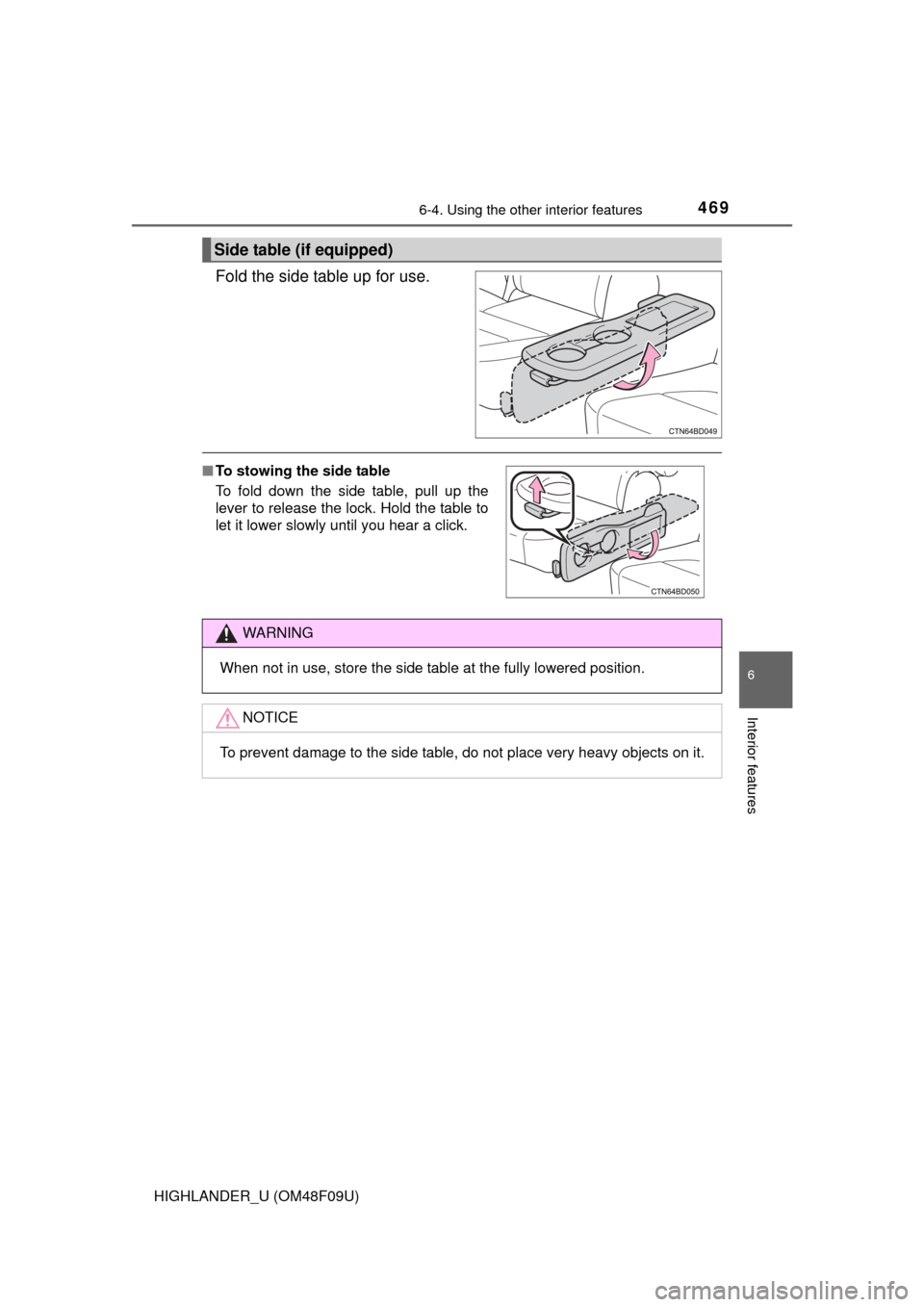
Fold the side table up for use.
Side table (if equipped)
■To stowing the side table
To fold down the side table, pull up the
lever to release the lock. Hold the table to
let it lower slowly until you hear a click.
WARNING
When not in use, store the side table at the fully lowered position.
NOTICE
To prevent damage to the side table, do not place very heavy objects on it.
Page 481 of 716

4816-4. Using the other interior features
6
Interior features
HIGHLANDER_U (OM48F09U)■
Stolen Vehicle Location
If your vehicle is stolen, Safety
Connect can work with local author-
ities to assist them in locating a nd recovering the vehicle. After filing
a police report, call the Safety Connect response center at 1-800-
331-4331 and follow the prompts for Safety Connect to initiate this
service.
In addition to assisting law enforcement with recovery of a stolen
vehicle, Safety-Connect-equippe d vehicle location data may, under
certain circumstances, be shared with third parties to locate your
vehicle. Further information is available at Toyota.com.
■Emergency Assistance Button (“SOS”)
In the event of an emergency on the road, push the “SOS” button to
reach the Safety Connect respon se center. The answering agent
will determine your vehicle’s location, assess the emergency, and
dispatch the necessary assistance required.
If you accidentally press the “SOS” button, tell the response-center
agent that you are not experiencing an emergency.
■
Enhanced Roadside Assistance
Enhanced Roadside Assi stance adds GPS data to the already
included warranty-based Toyota roadside service.
Subscribers can press the “SOS” bu tton to reach a Safety Connect
response-center agent, who can help with a wide range of needs,
such as: towing, flat tire, fuel deli very, etc. For a description of the
Enhanced Roadside Assistance se rvices and their limitations,
please see the Safety Connect Terms and Conditions, which are
available at Toyota.com.
Page 511 of 716
5117-3. Do-it-yourself maintenance
7
Maintenance and care
HIGHLANDER_U (OM48F09U)■
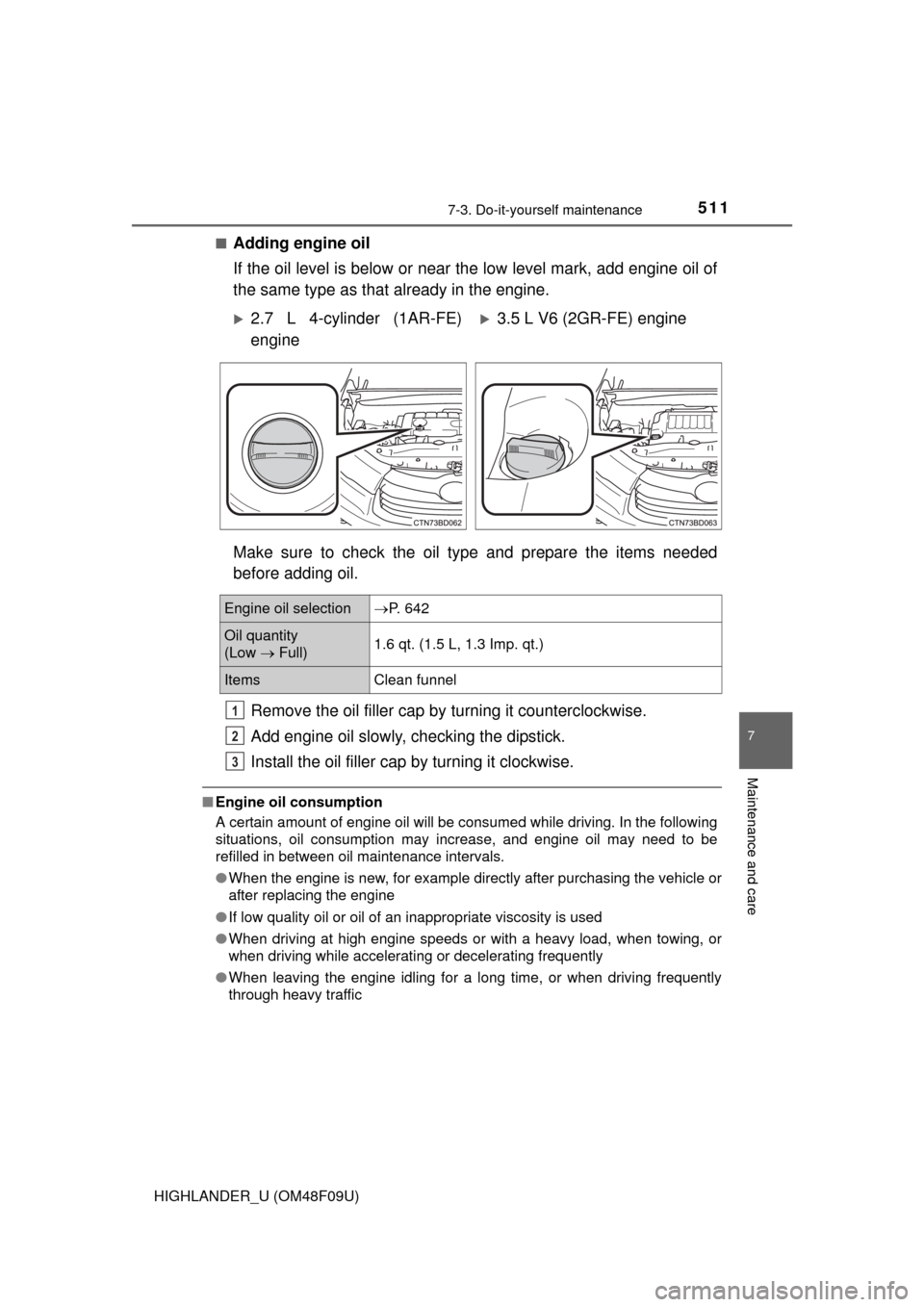
Adding engine oil
If the oil level is below or near the low level mark, add engine oil of
the same type as that
already in the engine.
Make sure to check the oil type and prepare the items needed
before adding oil. Remove the oil filler cap by turning it counterclockwise.
Add engine oil slowly, checking the dipstick.
Install the oil filler cap by turning it clockwise.
■ Engine oil consumption
A certain amount of engine oil will be consumed while driving. In the following
situations, oil consumption may increase, and engine oil may need to be
refilled in between oil maintenance intervals.
●When the engine is new, for example directly after purchasing the vehicle or
after replacing the engine
● If low quality oil or oil of an inappropriate viscosity is used
● When driving at high engine speeds or with a heavy load, when towing, or
when driving while accelerating or decelerating frequently
● When leaving the engine idling for a long time, or when driving frequently
through heavy traffic
2.7 L 4-cylinder (1AR-FE)
engine3.5 L V6 (2GR-FE) engine
Engine oil selection P. 642
Oil quantity
(Low Full) 1.6 qt. (1.5 L, 1.3 Imp. qt.)
Items
Clean funnel
1
2
3
Page 563 of 716
563
8
When trouble arises
HIGHLANDER_U (OM48F09U)
8-2. Steps to take in an emergency
The following may indicate a problem with your transmission. Contact
your Toyota dealer or commercial towing service before towing.
●The engine is running but the vehicle does not move.
● The vehicle makes an abnormal sound.
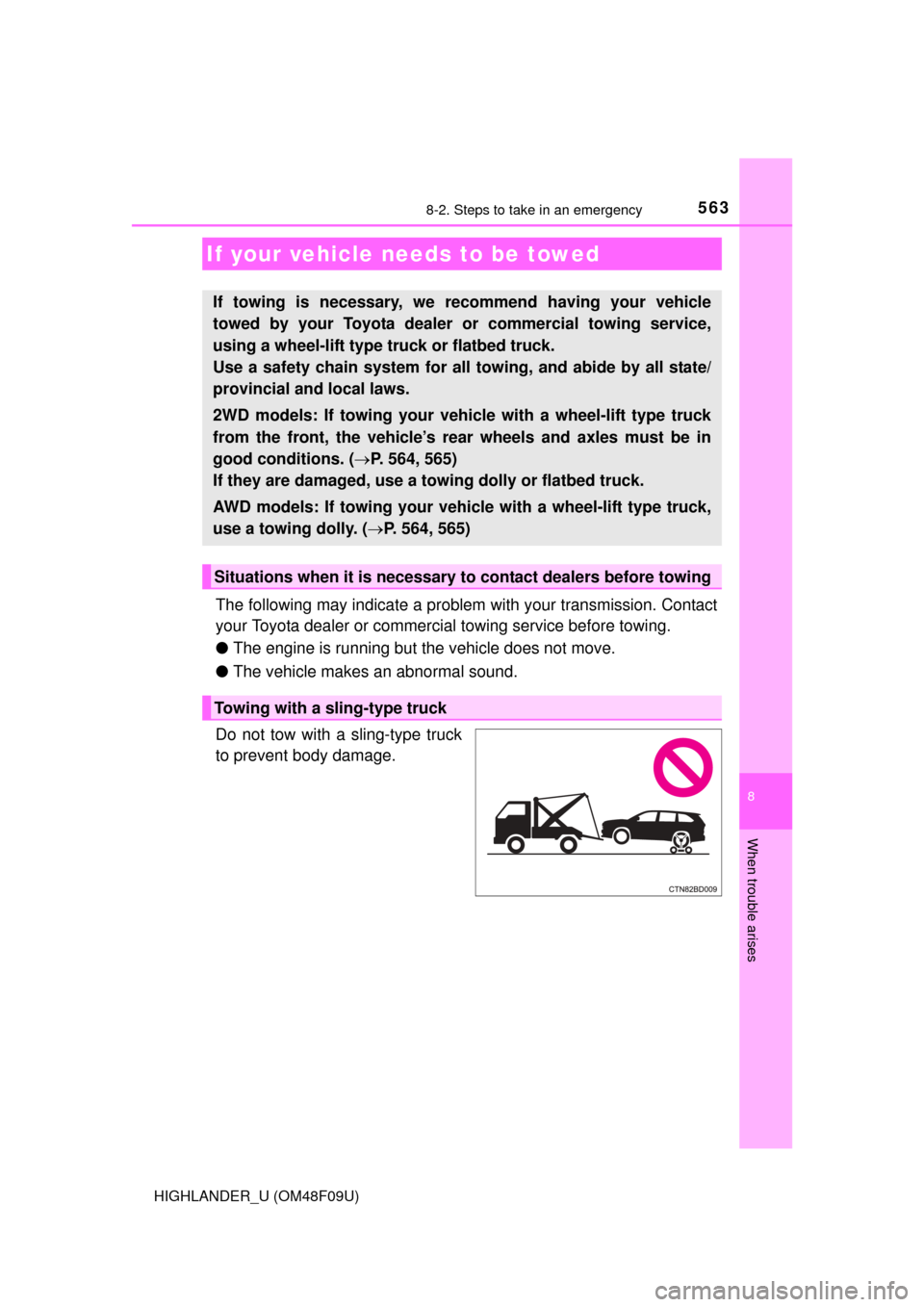
Do not tow with a sling-type truck
to prevent body damage.
If your vehicle needs to be towed
If towing is necessary, we re commend having your vehicle
towed by your Toyota dealer or commercial towing service,
using a wheel-lift type truck or flatbed truck.
Use a safety chain system for all towing, and abide by all state/
provincial and local laws.
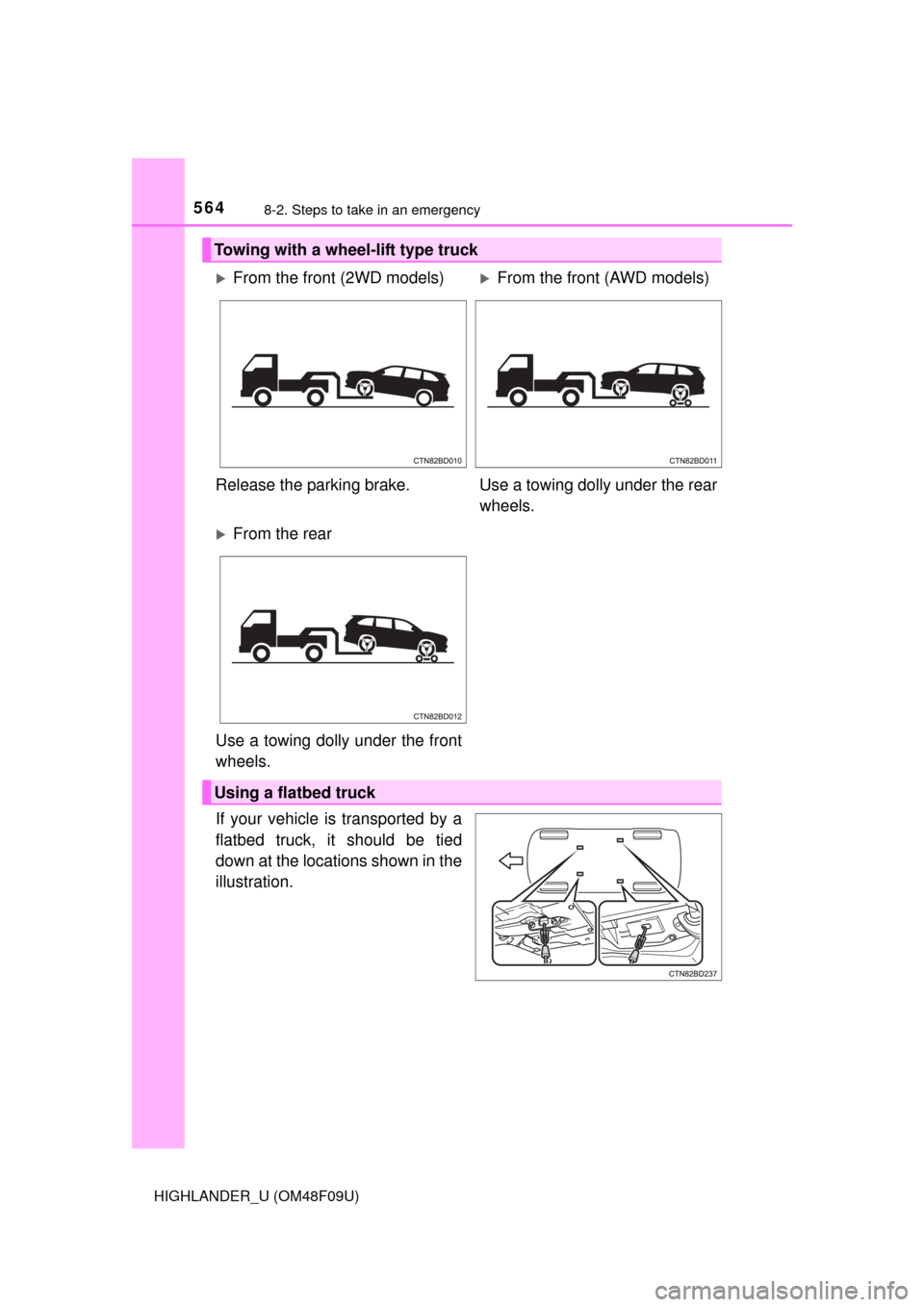
2WD models: If towing your vehicle with a wheel-lift type truck
from the front, the vehicle’s rear wheels and axles must be in
good conditions. ( P. 564, 565)
If they are damaged, use a towing dolly or flatbed truck.
AWD models: If towing your vehicl e with a wheel-lift type truck,
use a towing dolly. ( P. 564, 565)
Situations when it is necessary to contact dealers before towing
Towing with a sling-type truck
Page 564 of 716
5648-2. Steps to take in an emergency
HIGHLANDER_U (OM48F09U)
If your vehicle is transported by a
flatbed truck, it should be tied
down at the locations shown in the
illustration.
Towing with a wheel-lift type truck
From the front (2WD models)From the front (AWD models)
Release the parking brake. Use a towing dolly under the rear
wheels.
From the rear
Use a towing dolly under the front
wheels.
Using a flatbed truck
Page 565 of 716
5658-2. Steps to take in an emergency
8
When trouble arises
HIGHLANDER_U (OM48F09U)
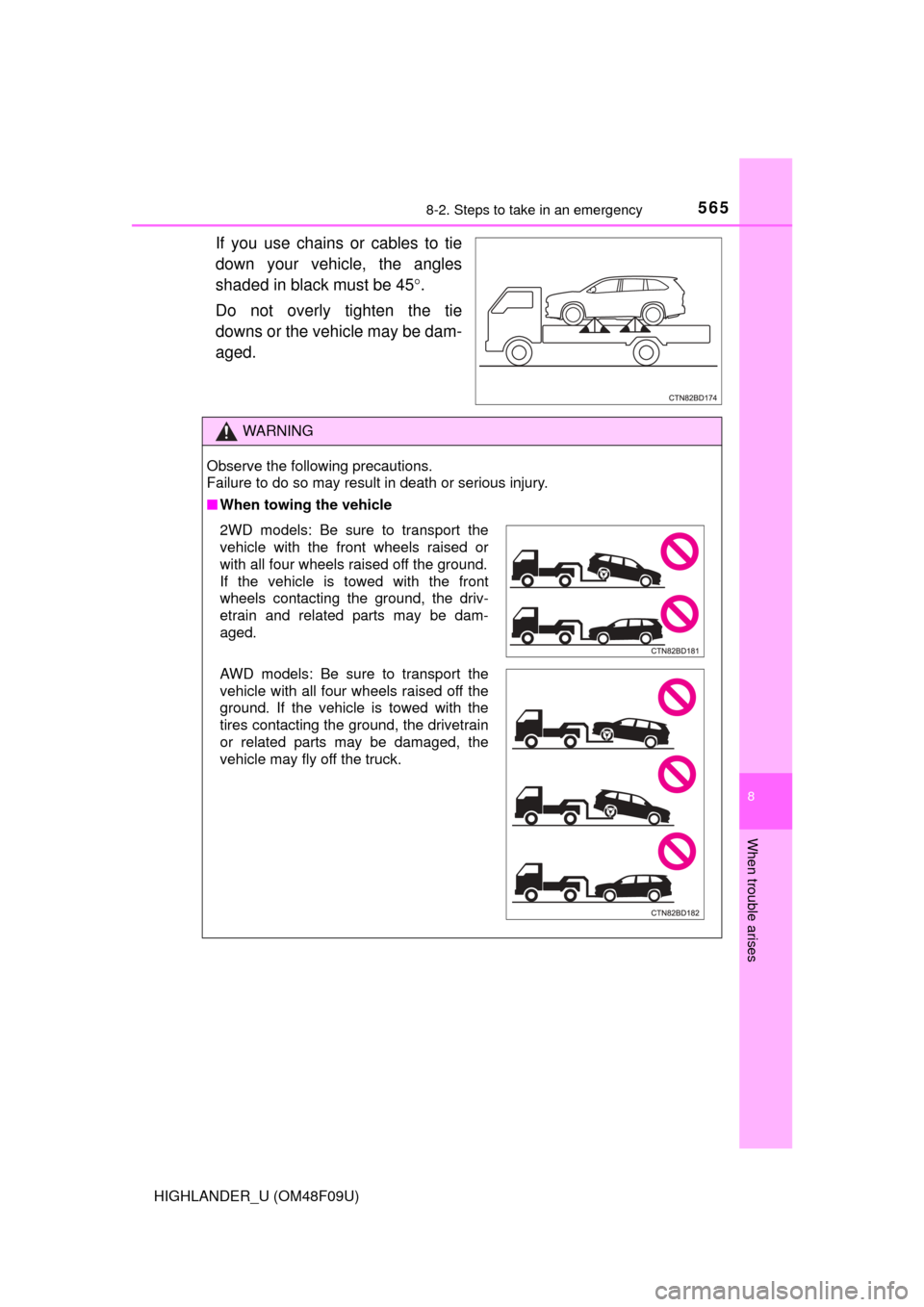
If you use chains or cables to tie
down your vehicle, the angles
shaded in black must be 45.
Do not overly tighten the tie
downs or the vehicle may be dam-
aged.
WARNING
Observe the following precautions.
Failure to do so may result in death or serious injury.
■ When towing the vehicle
2WD models: Be sure to transport the
vehicle with the front wheels raised or
with all four wheels raised off the ground.
If the vehicle is towed with the front
wheels contacting the ground, the driv-
etrain and related parts may be dam-
aged.
AWD models: Be sure to transport the
vehicle with all four wheels raised off the
ground. If the vehicle is towed with the
tires contacting the ground, the drivetrain
or related parts may be damaged, the
vehicle may fly off the truck.
Page 566 of 716
5668-2. Steps to take in an emergency
HIGHLANDER_U (OM48F09U)
NOTICE
■To prevent damage to the vehicle when towing using a wheel-lift type
truck
●Vehicles without a smart key system: Do not tow the vehicle from the rear
when the engine switch is in the “LOCK” position or the key is removed.
The steering lock mechanism is not strong enough to hold the front wheels
straight.
● Vehicles with a smart key system: Do not tow the vehicle from the rear
when the engine switch is off.
The steering lock mechanism is not strong enough to hold the front wheels
straight.
● When raising the vehicle, ensure adequate ground clearance for towing at
the opposite end of the raised vehicle. Without adequate clearance, the
vehicle could be damaged while being towed.
■ To prevent damage to the vehicle wh en towing with a sling-type truck
Do not tow with a sling-type truck, either from the front or rear.
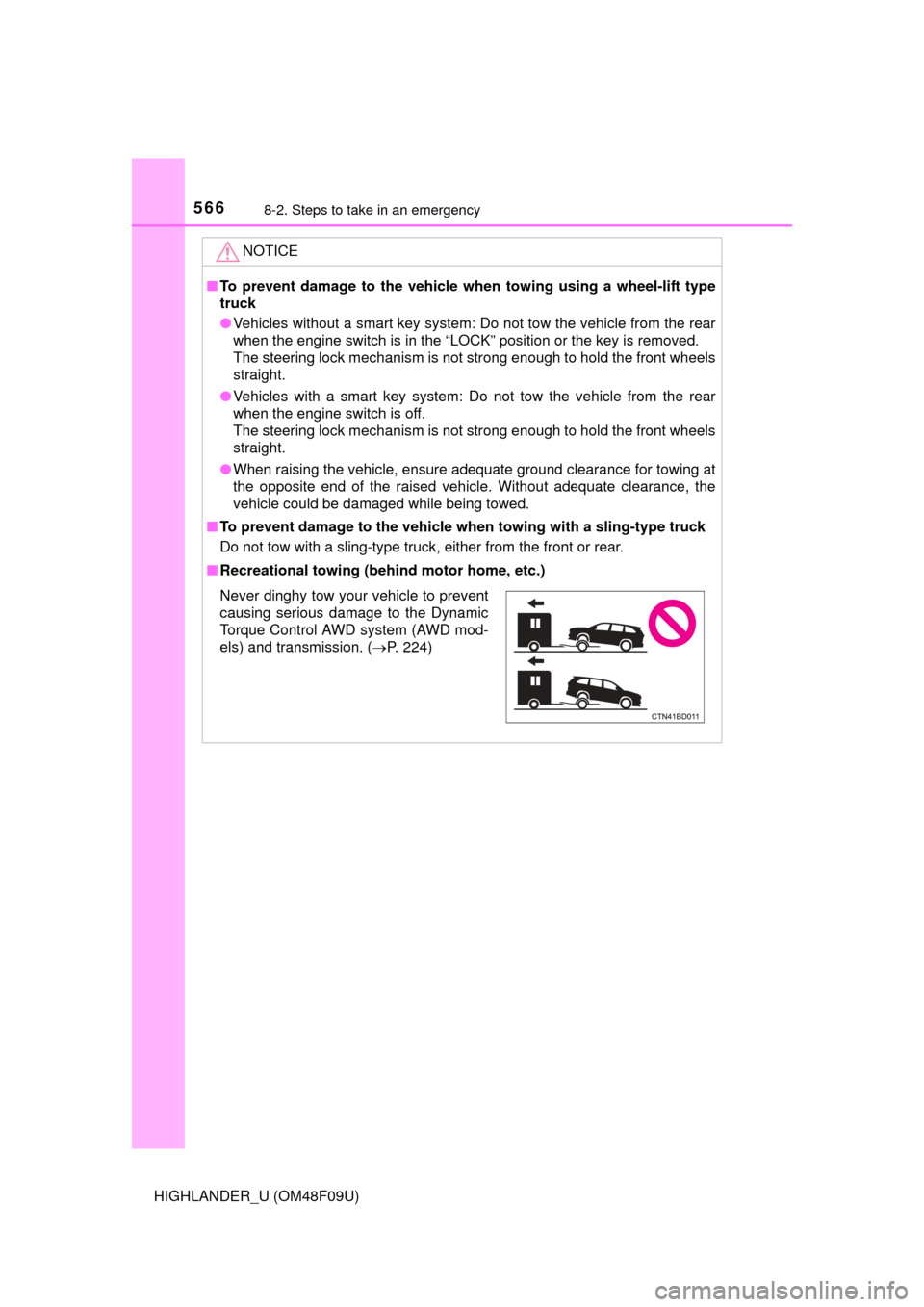
■ Recreational towing (beh ind motor home, etc.)
Never dinghy tow your vehicle to prevent
causing serious damage to the Dynamic
Torque Control AWD system (AWD mod-
els) and transmission. (P. 224)