Page 565 of 716
5658-2. Steps to take in an emergency
8
When trouble arises
HIGHLANDER_U (OM48F09U)
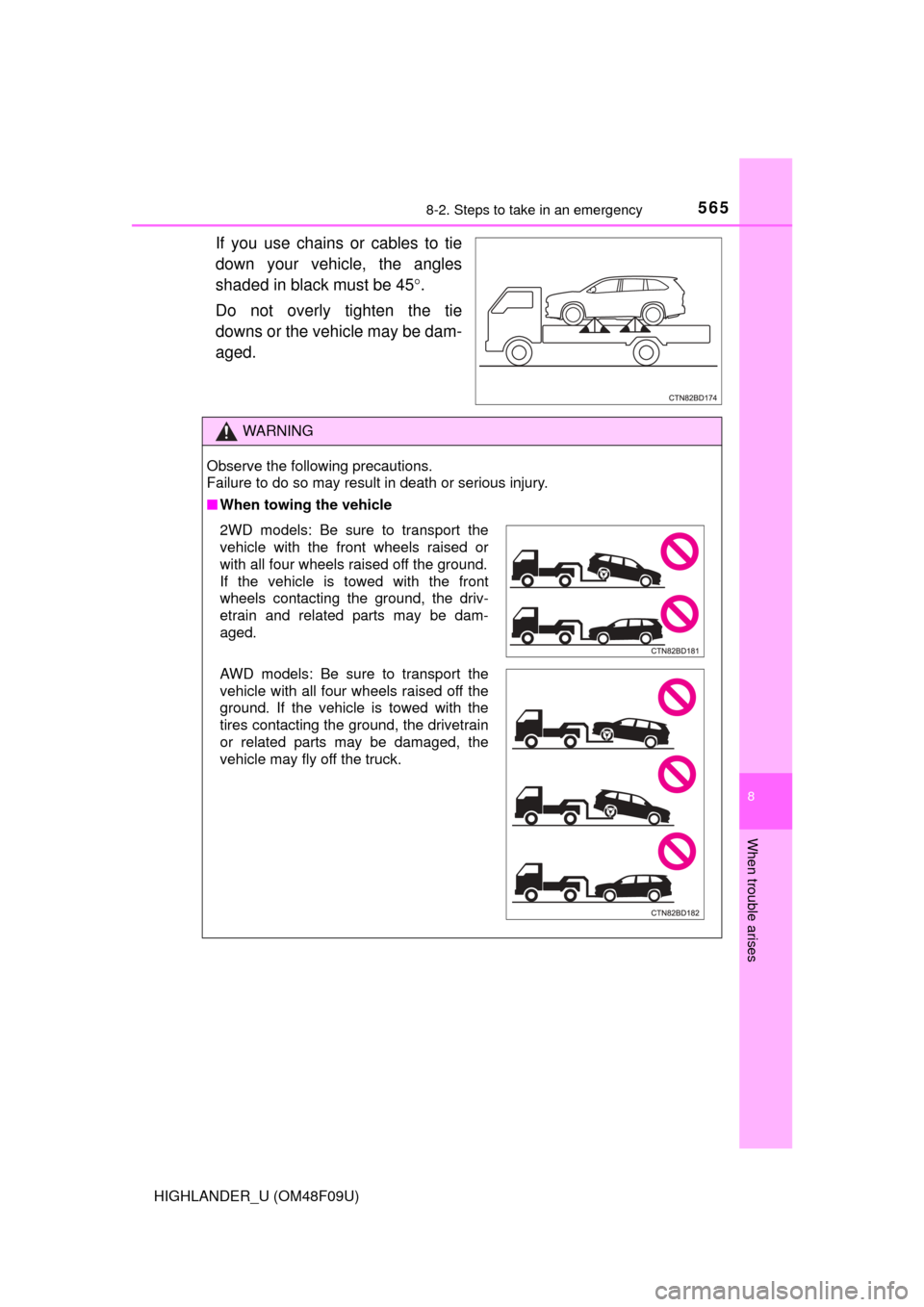
If you use chains or cables to tie
down your vehicle, the angles
shaded in black must be 45.
Do not overly tighten the tie
downs or the vehicle may be dam-
aged.
WARNING
Observe the following precautions.
Failure to do so may result in death or serious injury.
■ When towing the vehicle
2WD models: Be sure to transport the
vehicle with the front wheels raised or
with all four wheels raised off the ground.
If the vehicle is towed with the front
wheels contacting the ground, the driv-
etrain and related parts may be dam-
aged.
AWD models: Be sure to transport the
vehicle with all four wheels raised off the
ground. If the vehicle is towed with the
tires contacting the ground, the drivetrain
or related parts may be damaged, the
vehicle may fly off the truck.
Page 598 of 716

5988-2. Steps to take in an emergency
HIGHLANDER_U (OM48F09U)
WARNING
■Using the tire jack
Observe the following precautions.
Improper use of the tire jack may cause the vehicle to suddenly fall off
the jack, leading to death or serious injury.
●Do not use the tire jack for any purpose other than replacing tires or
installing and removing tire chains.
●Only use the tire jack that comes with this vehicle for replacing a flat
tire.
Do not use it on other vehicles, and do not use other tire jacks for
replacing tires on this vehicle.
●Put the jack properly in its jack point.
●Do not put any part of your body und er the vehicle while it is supported
by the jack.
●Do not start the engine or drive the vehicle while the vehicle is sup-
ported by the jack.
●Do not raise the vehicle while someone is inside.
●When raising the vehicle, do not put an object on or under the jack.
●Do not raise the vehicle to a height greater than that required to
replace the tire.
●Use a jack stand if it is necessary to get under the vehicle.
●When lowering the vehicle, make su re that there is no-one near the
vehicle. If there are people nearby, warn them vocally before lowering.
Page 616 of 716

6168-2. Steps to take in an emergency
HIGHLANDER_U (OM48F09U)
■The compact spare tire (vehicles with a compact spare tire)
●The compact spare tire is identified by the label “TEMPORARY USE
ONLY” on the tire sidewall.
Use the compact spare tire temporarily, and only in an emergency.
●Make sure to check the tire inflation pressure of the compact spare tire.
( P. 648)
■When the compact spare tire is installed (vehicles with a compact
spare tire)
The vehicle is lower when the compact spare tire is installed compared to
when standard tires are installed.
■When using the compact spare tire (vehicles with a tire pressure
warning system)
As the compact spare tire is not equipped with a tire pressure warning
valve and transmitter, lo w inflation pressure of the spare tire will not be
indicated by the tire pressure warning system. Also, if you replace the
compact spare tire after the tire pressure warning light comes on, the light
remains on.
■If you have a flat front tire on a road covered with snow or ice (vehi-
cles with a compact spare tire)
Install the compact spare tire on one of the rear wheels of the vehicle.
Perform the following steps and fit tire chains to the front tires:
Replace a rear tire with the compact spare tire.
Replace the flat front tire with the tire removed from the rear of the vehi-
cle.
Fit tire chains to the front tires.
1
2
3
Page 619 of 716
6198-2. Steps to take in an emergency
8
When trouble arises
HIGHLANDER_U (OM48F09U)
NOTICE
■Be careful when driving over bumps with the compact spare tire
installed on the vehicle.
The vehicle becomes lower when driving with the compact spare tire
compared to when driving with standard tires. Be careful when driving
over uneven road surfaces.
■Driving with tire chains and the compact spare tire
Do not fit tire chains to the compact spare tire.
Tire chains may damage the vehicle body and adversely affect driving
performance.
■When replacing the tires (vehicles with a tire pressure warning sys-
tem)
When removing or fitting the wheels, tires or the tire pressure warning
valve and transmitter, contact your Toyota dealer as the tire pressure
warning valve and transmitter may be damaged if not handled correctly.
■To avoid damage to the tire pressure warning valves and transmit-
ters (vehicles with a tire pressure warning system)
When a tire is repaired with liquid sealants, the tire pressure warning
valve and transmitter may not operate properly. If a liquid sealant is
used, contact your Toyota dealer or other qualified service shop as soon
as possible. Make sure to replace the tire pressure warning valve and
transmitter when replacing the tire. ( P. 522)
■When stowing the flat tire
●Ensure that there is no object caug ht between the tire and the vehicle
underbody.
●Securely tighten the spare tire clamp bolt to hold the spare wheel car-
rier by the hook.
●Stow the flat tire in the spare tire location. Failure to do so may cause
damage to the spare tire carrier. Proper storage reduces the possibility
of injury in a collision or during sudden braking.
●Have the flat tire repaired and the spare tire replaced with it as soon as
possible.
Page 714 of 716

714Alphabetical index
HIGHLANDER_U (OM48F09U)
Tires .......................................... 520Chains................................... 328
Checking ............................... 520
If you have a flat tire ............. 596
Inflation pressure .................. 648
Information ............................ 655
Replacing .............................. 596
Rotating tires......................... 521
Size ....................................... 648
Snow tires ............................. 329
Spare tire .............................. 596
Tire pressure warning
system ......... ....................... 522
Warning light ......................... 571
Tools ......................................... 597
Top tether strap ......................... 75
Towing Dinghy towing ....................... 224
Emergency towing ................ 563
Trailer towing ........................ 207
TRAC (Traction Control) ......... 301
Traction Control (TRAC) .................................... 301
Trailer towing .......................... 207
Transmission ........................... 234 Automatic transmission......... 234
If the shift lever cannot be shifted from P ..................... 623
S mode ................................. 236
Turn signal lights..................... 239
Replacing light bulbs............. 545
Turn signal lever ................... 239
Wattage ................................ 651 USB port ................................... 344
Utility vehicle precautions ...... 330
Valet key ................................... 112
Vanity lights ............................. 459
Wattage ................................ 651
Vanity mirrors .......................... 459
Vehicle data recordings .............. 9
Vehicle identification number ................................... 639
Vehicle Stability Control (VSC) ...................................... 301
Voice command system
*....... 419
VSC (Vehicle Stability Control) .................................. 301
U
V