2016 TOYOTA COROLLA gas
[x] Cancel search: gasPage 425 of 620

4257-1. Maintenance and care
7
Maintenance and care
COROLLA_TMMMS_TMMC_U (OM12J84U)
NOTICE
nCleaning detergents
lDo not use the following types of detergent, as they may discolor the vehi-
cle interior or cause streaks or damage to painted surfaces:
• Non-seat portions: Organic substances such as benzene or gasoline,
alkaline or acidic solutions, dye, and bleach
• Seats: Alkaline or acidic solutions, such as thinner, benzene, and alco- hol
l Do not use polish wax or polish cleaner. The instrument panel’s or other
interior part’s painted surface may be damaged.
n Preventing damage to leather surfaces
Observe the following precautions to avoid damage to and deterioration of
leather surfaces:
lRemove any dust or dirt from leather surfaces immediately.
l Do not expose the vehicle to direct sunlight for extended periods of time.
Park the vehicle in the shade, especially during summer.
l Do not place items made of vinyl, plastic, or containing wax on the uphol-
stery, as they may stick to the leather surface if the vehicle interior heats
up significantly.
n Water on the floor
Do not wash the vehicle floor with water.
Vehicle systems such as the audio system may be damaged if water comes
into contact with electrical components such as the audio system above or
under the floor of the vehicle. Water may also cause the body to rust.
n Cleaning the inside of the rear window
l Do not use glass cleaner to clean the rear window, as this may cause
damage to the rear window defogger heater wires or antenna. Use a cloth
dampened with lukewarm water to gently wipe the window clean. Wipe the
window in strokes running parall el to the heater wires or antenna.
l Be careful not to scratch or damage the heater wires or antenna.
Page 450 of 620

4507-3. Do-it-yourself maintenance
COROLLA_TMMMS_TMMC_U (OM12J84U)
Check the battery as follows.
nBattery exterior
Make sure that the battery terminals are not corroded and that
there are no loose connections, cracks, or loose clamps.
Terminals
Hold-down clamp
n Before recharging
When recharging, the battery produces hydrogen gas which is flammable and
explosive. Therefore, observe the following before recharging:
lIf recharging with the battery installed on the vehicle, be sure to disconnect
the ground cable.
l Make sure the power switch on the charger is off when connecting and dis-
connecting the charger cables to the battery.
n After recharging/reconnecting the ba ttery (vehicles with a smart key sys-
tem)
l Unlocking the doors using the smart key system may not be possible imme-
diately after reconnecting the battery. If this happens, use the wireless
remote control or the mechanical key to lock/unlock the doors.
l Start the engine with the engine switch in ACCESSORY mode. The engine
may not start with the engine switch turned off. However, the engine will
operate normally from the second attempt.
l The engine switch mode is recorded by the vehicle. If the battery is recon-
nected, the vehicle will return the engine switch mode to the status it was in
before the battery was disconnected. Make sure to turn off the engine
before disconnect the battery. Take extra care when connecting the battery
if the engine switch mode prior to discharge is unknown.
If the system will not start even after multiple attempts, contact your Toyota
dealer.
Battery
1
2
Page 451 of 620
4517-3. Do-it-yourself maintenance
7
Maintenance and care
COROLLA_TMMMS_TMMC_U (OM12J84U)
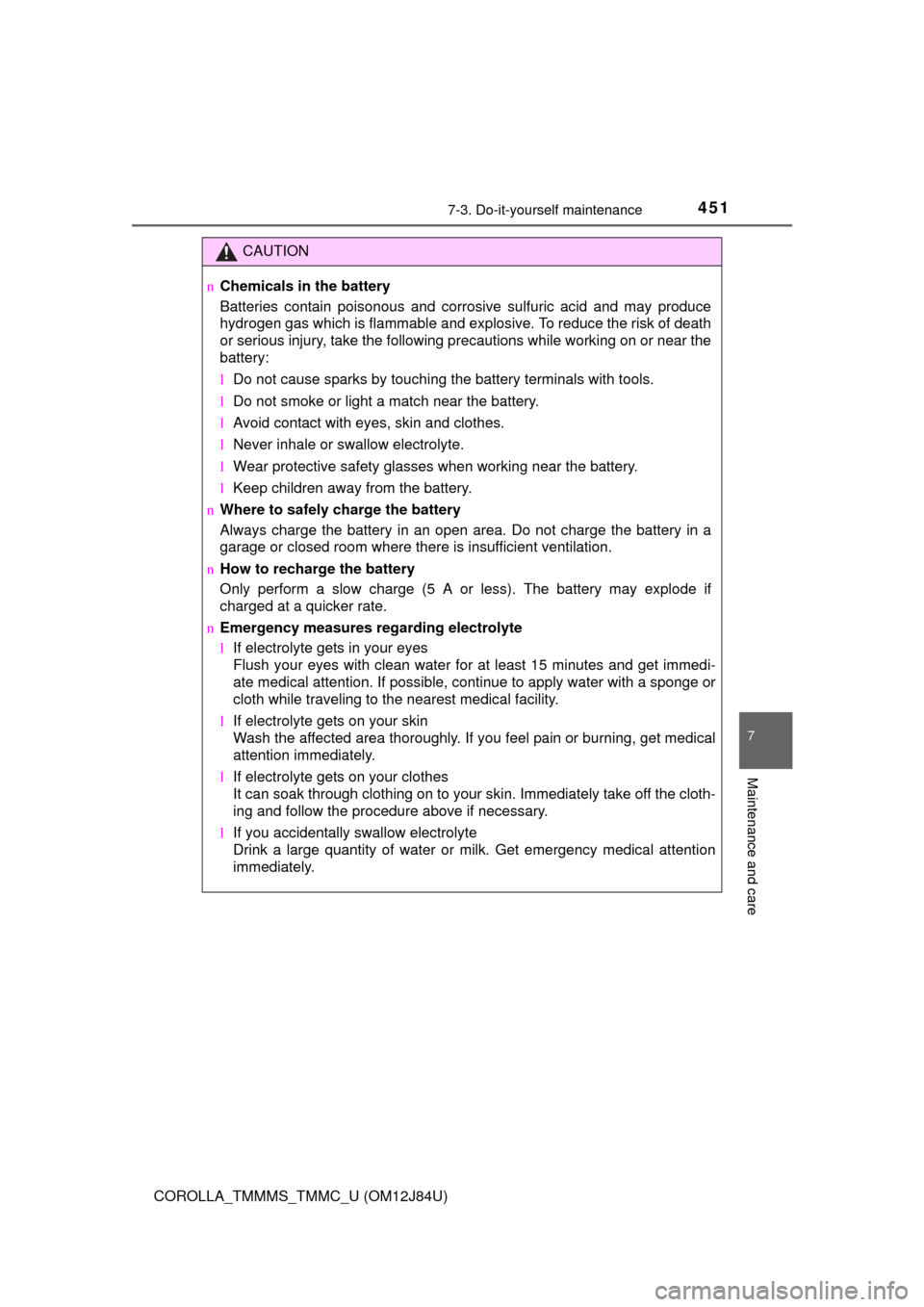
CAUTION
nChemicals in the battery
Batteries contain poisonous and corrosive sulfuric acid and may produce
hydrogen gas which is flammable and explosive. To reduce the risk of death
or serious injury, take the following precautions while working on or near the
battery:
lDo not cause sparks by touching the battery terminals with tools.
l Do not smoke or light a match near the battery.
l Avoid contact with eyes, skin and clothes.
l Never inhale or swallow electrolyte.
l Wear protective safety glasses when working near the battery.
l Keep children away from the battery.
n Where to safely charge the battery
Always charge the battery in an open area. Do not charge the battery in a
garage or closed room where there is insufficient ventilation.
n How to recharge the battery
Only perform a slow charge (5 A or less). The battery may explode if
charged at a quicker rate.
n Emergency measures regarding electrolyte
lIf electrolyte gets in your eyes
Flush your eyes with clean water for at least 15 minutes and get immedi-
ate medical attention. If possible, continue to apply water with a sponge or
cloth while traveling to the nearest medical facility.
l If electrolyte gets on your skin
Wash the affected area thoroughly. If you feel pain or burning, get medical
attention immediately.
l If electrolyte gets on your clothes
It can soak through clothing on to your skin. Immediately take off the cloth-
ing and follow the procedure above if necessary.
l If you accidentally swallow electrolyte
Drink a large quantity of water or milk. Get emergency medical attention
immediately.
Page 542 of 620
5428-2. Steps to take in an emergency
COROLLA_TMMMS_TMMC_U (OM12J84U)
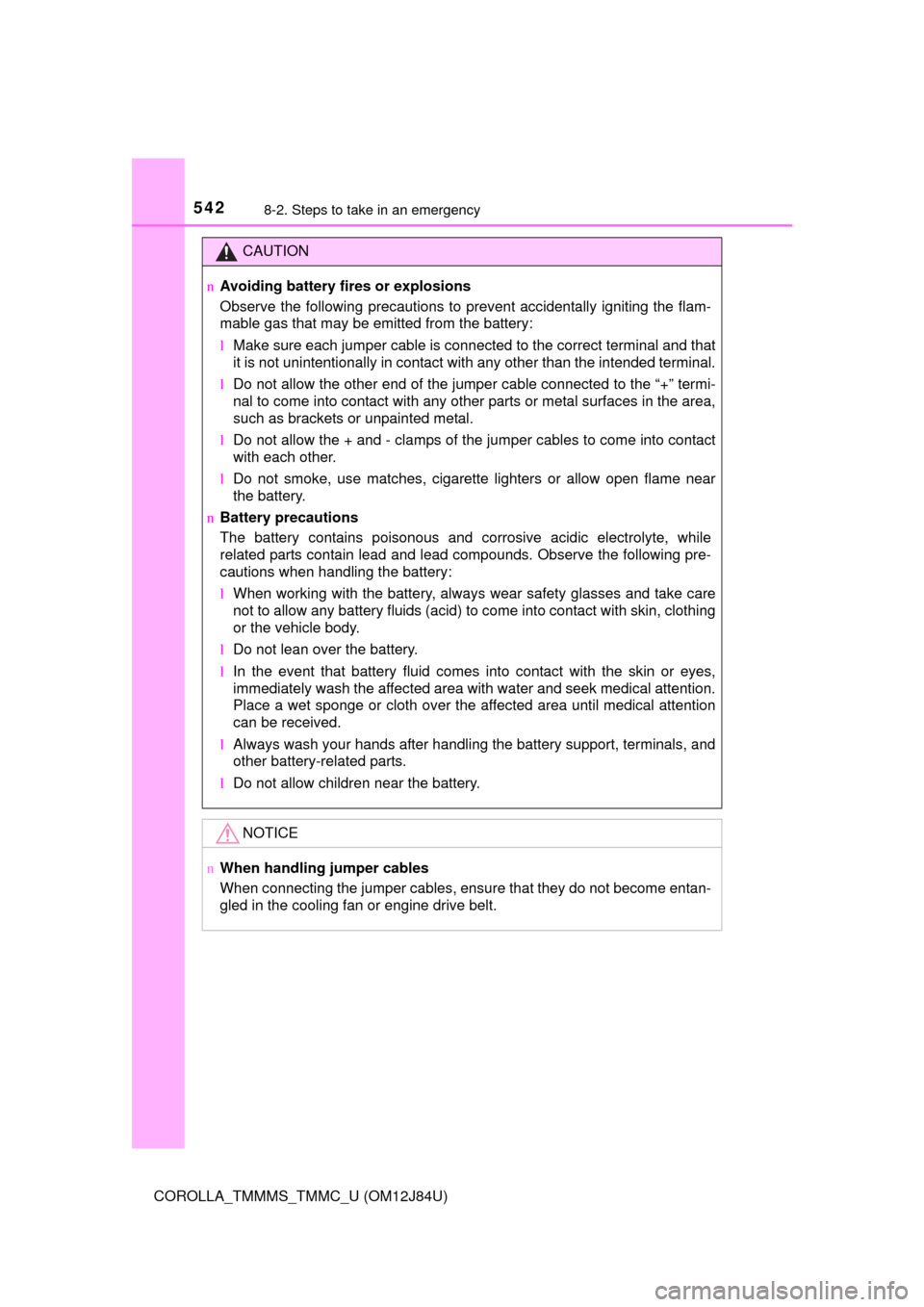
CAUTION
nAvoiding battery fires or explosions
Observe the following precautions to prevent accidentally igniting the flam-
mable gas that may be emitted from the battery:
lMake sure each jumper cable is connected to the correct terminal and that
it is not unintentionally in contact with any other than the intended terminal.
l Do not allow the other end of the jumper cable connected to the “+” termi-
nal to come into contact with any other parts or metal surfaces in the area,
such as brackets or unpainted metal.
l Do not allow the + and - clamps of the jumper cables to come into contact
with each other.
l Do not smoke, use matches, cigarette lighters or allow open flame near
the battery.
n Battery precautions
The battery contains poisonous and corrosive acidic electrolyte, while
related parts contain lead and lead compounds. Observe the following pre-
cautions when handling the battery:
lWhen working with the battery, always wear safety glasses and take care
not to allow any battery fluids (acid) to come into contact with skin, clothing
or the vehicle body.
l Do not lean over the battery.
l In the event that battery fluid comes into contact with the skin or eyes,
immediately wash the affected area with water and seek medical attention.
Place a wet sponge or cloth over the affected area until medical attention
can be received.
l Always wash your hands after handling the battery support, terminals, and
other battery-related parts.
l Do not allow children near the battery.
NOTICE
nWhen handling jumper cables
When connecting the jumper cables, ensure that they do not become entan-
gled in the cooling fan or engine drive belt.
Page 552 of 620
5529-1. Specifications
COROLLA_TMMMS_TMMC_U (OM12J84U)
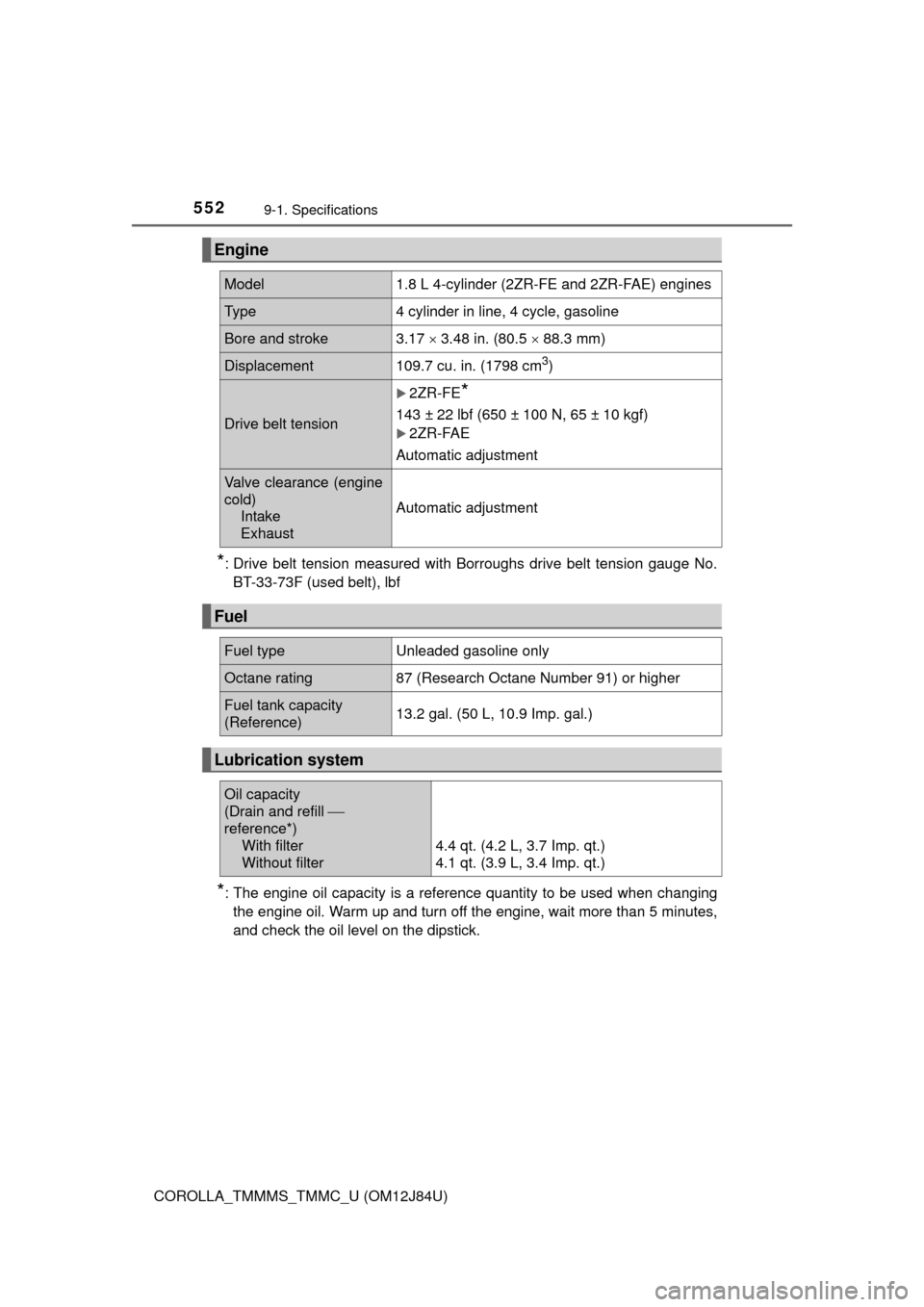
*: Drive belt tension measured with Borroughs drive belt tension gauge No.BT-33-73F (used belt), lbf
*: The engine oil capacity is a reference quantity to be used when changingthe engine oil. Warm up and turn off the engine, wait more than 5 minutes,
and check the oil level on the dipstick.
Engine
Model 1.8 L 4-cylinder (2ZR-FE and 2ZR-FAE) engines
Type4 cylinder in line, 4 cycle, gasoline
Bore and stroke 3.17 3.48 in. (80.5 88.3 mm)
Displacement 109.7 cu. in. (1798 cm3)
Drive belt tension
2ZR-FE*
143 ± 22 lbf (650 ± 100 N, 65 ± 10 kgf)
2ZR-FAE
Automatic adjustment
Valve clearance (engine
cold)
Intake
Exhaust Automatic adjustment
Fuel
Fuel type
Unleaded gasoline only
Octane rating87 (Research Octane Number 91) or higher
Fuel tank capacity
(Reference)13.2 gal. (50 L, 10.9 Imp. gal.)
Lubrication system
Oil capacity
(Drain and refill
reference*)
With filter
Without filter 4.4 qt. (4.2 L, 3.7 Imp. qt.)
4.1 qt. (3.9 L, 3.4 Imp. qt.)
Page 560 of 620
5609-1. Specifications
COROLLA_TMMMS_TMMC_U (OM12J84U)
nGasoline quality
In very few cases, driveability problems may be caused by the brand of gaso-
line you are using. If driveability problems persist, try changing the brand of
gasoline. If this does not correct the problem, consult your Toyota dealer.
n Gasoline quality standards
lAutomotive manufacturers in the U.S.A., Europe and Japan have developed
a specification for fuel quality called the World-Wide Fuel Charter (WWFC),
which is expected to be applied worldwide.
l The WWFC consists of four categories that are based on required emission
levels. In the U.S., category 4 has been adopted.
l The WWFC improves air quality by lowering emissions in vehicle fleets, and
improves customer satisfaction through better performance.
n Recommendation of the use of gaso line containing detergent additives
l Toyota recommends the use of gasoline that contains detergent additives to
avoid the build-up of engine deposits.
l All gasoline sold in the U.S.A. contains minimum detergent additives to
clean and/or keep clean intake systems, per EPA's lowest additives concen-
tration program.
l Toyota strongly recommends the use of Top Tier Detergent Gasoline. For
more information on Top Tier Detergent Gasoline and a list of marketers,
please go to the official website www.toptiergas.com.
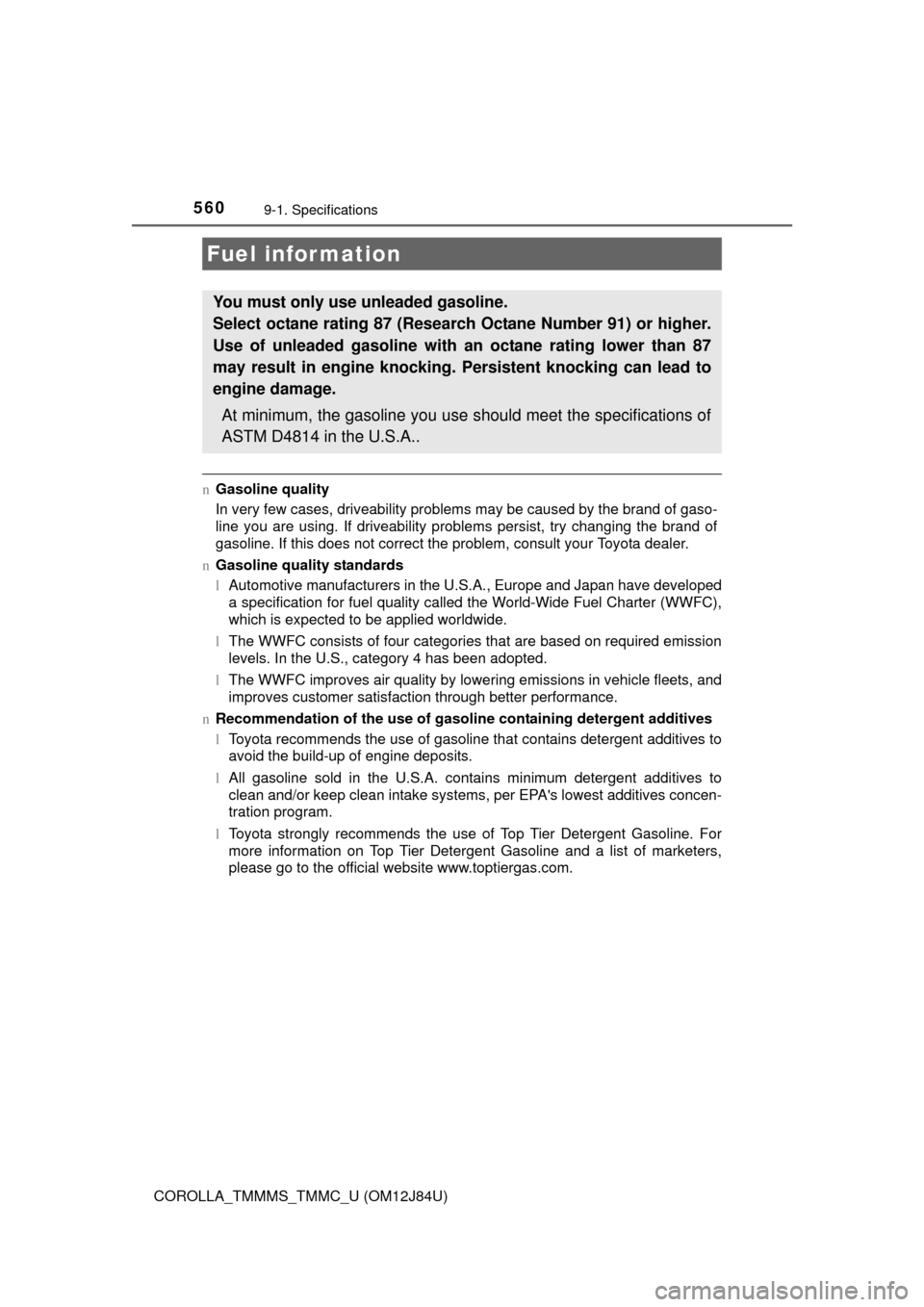
Fuel information
You must only use unleaded gasoline.
Select octane rating 87 (Research Octane Number 91) or higher.
Use of unleaded gasoline with an octane rating lower than 87
may result in engine knocking. Persistent knocking can lead to
engine damage.
At minimum, the gasoline you use s hould meet the specifications of
ASTM D4814 in the U.S.A..
Page 561 of 620
5619-1. Specifications
9
Vehicle specifications
COROLLA_TMMMS_TMMC_U (OM12J84U)n
Recommendation of the use of low emissions gasoline
Gasolines containing oxygenates such as ethers and ethanol, as well as
reformulated gasolines, are available in some cities. These fuels are typically
acceptable for use, providing they meet other fuel requirements.
Toyota recommends these fuels, since the formulations allow for reduced
vehicle emissions.
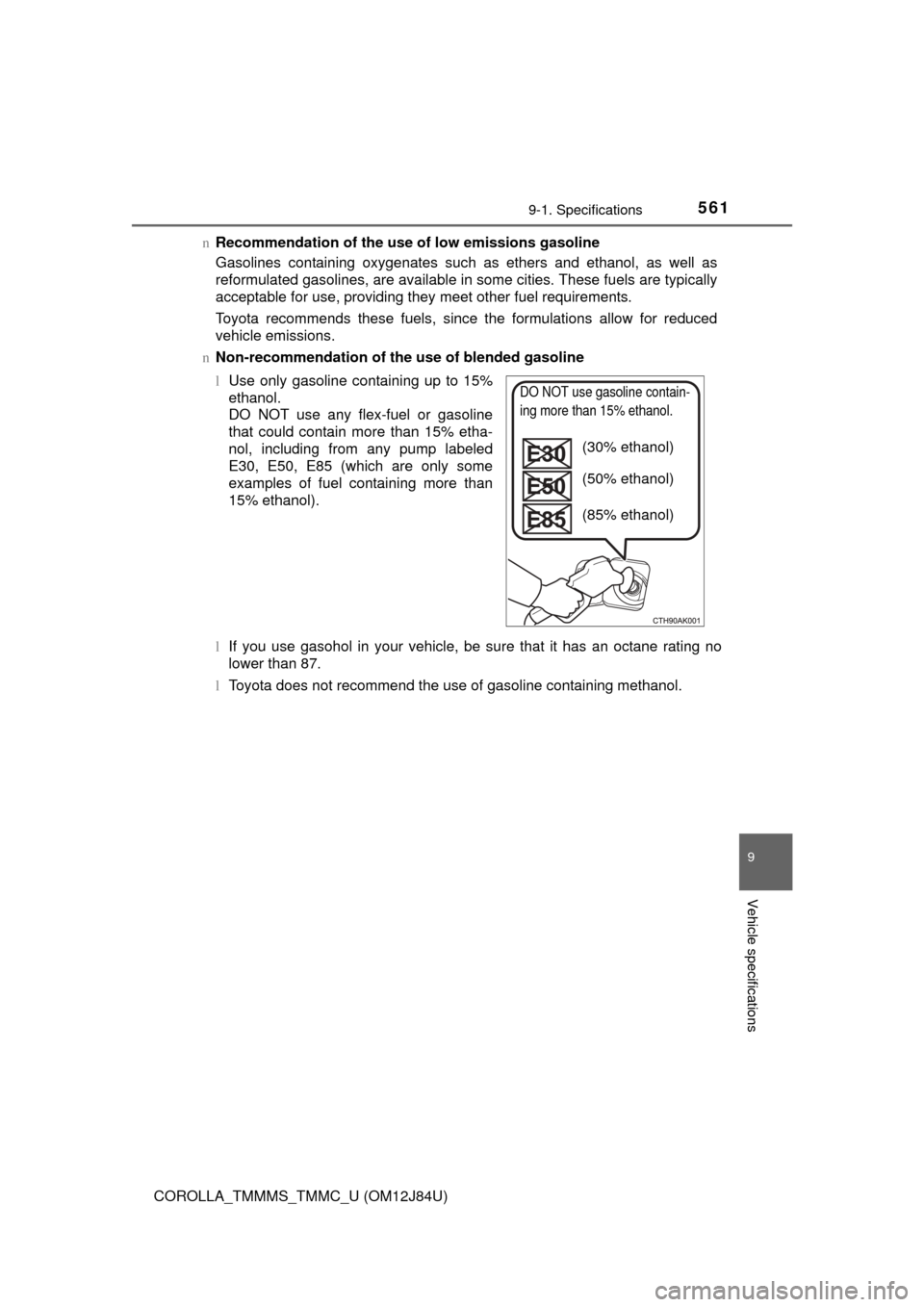
n Non-recommendation of the use of blended gasoline
lIf you use gasohol in your vehicle, be sure that it has an octane rating no
lower than 87.
l Toyota does not recommend the use of gasoline containing methanol.
l
Use only gasoline containing up to 15%
ethanol.
DO NOT use any flex-fuel or gasoline
that could contain more than 15% etha-
nol, including from any pump labeled
E30, E50, E85 (which are only some
examples of fuel containing more than
15% ethanol).
DO NOT use gasoline contain-
ing more than 15% ethanol.
(30% ethanol)
(50% ethanol)
(85% ethanol)
Page 562 of 620
5629-1. Specifications
COROLLA_TMMMS_TMMC_U (OM12J84U)n
Non-recommendation of the use of gasoline containing MMT
Some gasoline contains an octane enhancing additive called MMT (Methylcy-
clopentadienyl Manganese Tricarbonyl).
Toyota does not recommend the use of gasoline that contains MMT. If fuel
containing MMT is used, your emission control system may be adversely
affected.
The malfunction indicator lamp on the instrument cluster may come on. If this
happens, contact your Toyota dealer for service.
n If your engine knocks
lConsult your Toyota dealer.
l You may occasionally notice light knocking for a short time while accelerat-
ing or driving uphill. This is normal and there is no need for concern.
NOTICE
n Notice on fuel quality
lDo not use improper fuels. If improper fuels are used, the engine will be
damaged.
l Do not use leaded gasoline.
Leaded gasoline can cause damage to your vehicle’s three-way catalytic
converters causing the emission control system to malfunction.
l Do not use gasohol other than the type previously stated.
Other gasohol may cause fuel system damage or vehicle performance
problems.
l Using unleaded gasoline with an octane number or rating lower than the
level previously stated will cause persistent heavy knocking.
At worst, this will lead to engine damage.
n Fuel-related poor driveability
If poor driveability (poor hot starting, vaporization, engine knocking, etc.) is
encountered after using a different type of fuel, discontinue the use of that
type of fuel.
n When refueling with gasohol
Take care not to spill gasohol. It can damage your vehicle’s paint.