2016 TOYOTA COROLLA repair
[x] Cancel search: repairPage 422 of 620

4227-1. Maintenance and care
COROLLA_TMMMS_TMMC_U (OM12J84U)
NOTICE
nTo prevent paint deterioration and corrosion on the body and compo-
nents (aluminum wheels etc.)
l Wash the vehicle immediately in the following cases:
• After driving near the sea coast
• After driving on salted roads
• If coal tar or tree sap is present on the paint surface
• If dead insects, insect droppings or bird droppings are present on the
paint surface
• After driving in an area contaminated with soot, oily smoke, mine dust, iron powder or chemical substances
• If the vehicle becomes heavily soiled with dust or mud
• If liquids such as benzene and gasoline are spilled on the paint surface
l If the paint is chipped or scratched, have it repaired immediately.
l To prevent the wheels from corroding, remove any dirt and store in a place
with low humidity when storing the wheels.
n Cleaning the exterior lights
lWash carefully. Do not use organic substances or scrub with a hard brush.
This may damage the surfaces of the lights.
l Do not apply wax to the surfaces of the lights.
Wax may cause damage to the lenses.
n To prevent damage to the windshield wiper arms
When lifting the wiper arms away from the windshield, pull the driver side
wiper arm upward first, and then the passenger side. When returning the
wipers to their original position, do so from the passenger side first.
n When using a high pressure car wash
Do not bring the nozzle tip close to boots (rubber or resin manufactured
cover), connectors or the following parts. The parts may be damaged if they
come into contact with high-pressure water.
•Traction related parts
•Steering parts
•Suspension parts
• Brake parts
Page 426 of 620
426
COROLLA_TMMMS_TMMC_U (OM12J84U)
7-2. Maintenance
General maintenance should be performed on a daily basis. This can
be done by yourself or by a Toyota dealer.
Scheduled maintenance should be performed at specified intervals
according to the maintenance schedule.
For details about maintenance items and schedules, refer to the “Sched-
uled Maintenance Guide” or “Owner’s Manual Supplement”.
You can perform some maintenance procedures by yourself.
Please be aware that do-it-yourself maintenance may affect warranty
coverage.
The use of Toyota Repair Manuals is recommended.
For details about warranty coverage, refer to the separate “Owner’s War-
ranty Information Booklet” or “Owner’s Manual Supplement”.
Maintenance requirements
To ensure safe and economical driv ing, day-to-day care and reg-
ular maintenance are essential. It is the owner’s responsibility to
perform regular checks. Toyota recommends the following main-
tenance:
General maintenance
Scheduled maintenance
Do-it-yourself maintenance
Page 427 of 620

4277-2. Maintenance
7
Maintenance and care
COROLLA_TMMMS_TMMC_U (OM12J84U)
nRepair and replacement
It is recommended that genuine Toyota parts be used for repairs to ensure
performance of each system. If non-Toyota parts are used in replacement or if
a repair shop other than a Toyota dealer performs repairs, confirm the war-
ranty coverage.
n Resetting the reminder light (vehicl es with a drive monitor display) or
the message (vehicles with a multi-in formation display) indicating main-
tenance is required (U.S.A. only)
After the required maintenance is performed according to the maintenance
schedule, please reset the reminder light (vehicles with a drive monitor dis-
play) or the message (vehicles with a multi-information display).
To reset the reminder light (vehicles with a drive monitor display) or the mes-
sage (vehicles with a multi-information display), follow the procedure
described below:
Vehicles without a smart key system: Turn the engine switch to the “LOCK”
position with the trip meter A reading shown. ( P. 77, 82)
Vehicles with a smart key system: Turn the engine switch off with the trip
meter A reading shown. ( P. 77, 82)
Vehicles without a smart key system:
While pressing the “DISP” switch
*1 ( P. 77) or display change button*2
(P. 82), turn the engine switch to the “ON” position (do not start the
engine because reset mode will be canceled).
Vehicles with a smart key system:
While pressing the “DISP” switch
*1 ( P. 77) or display change button*2
(P. 82), turn the engine switch to the IGNITION ON mode (do not start the
engine because otherwise the reset mode will be canceled).
*1: Vehicles with a drive monitor display
*2: Vehicles with a multi-information display
Continue to press and hold the button until the trip meter displays “000000”.
n Allow inspection and repairs to be performed by a Toyota dealer
lToyota technicians are well-trained specialists and are kept up to date with
the latest service information. They are well informed about the operations
of all systems on your vehicle.
l Keep a copy of the repair order. It proves that the maintenance that has
been performed is under warranty cove rage. If any problem should arise
while your vehicle is under warranty, your Toyota dealer will promptly take
care of it.
1
2
3
Page 433 of 620
4337-2. Maintenance
7
Maintenance and care
COROLLA_TMMMS_TMMC_U (OM12J84U)
The OBD system determines that a problem exists somewhere in the
emission control system. Your vehicle may not pass the I/M test and
may need to be repaired. Contact your Toyota dealer to service the
vehicle.
l When the battery is disconnected or discharged
Readiness codes that are set duri ng ordinary driving are erased.
Also, depending on your driving habits, the readiness codes may
not be completely set.
l When the fuel tank cap is loose
The malfunction indicator lamp comes on indicating a temporary
malfunction and your vehicle may not pass the I/M test.
The error code in the OBD system will not be cleared unless the vehi-
cle is driven 40 or more times.
Contact your Toyota dealer to prepare the vehicle for re-testing.
Emission inspection an d maintenance (I/M)
programs
Some states have vehicle emission inspection programs which
include OBD (On Board Diagnos tics) checks. The OBD system
monitors the operation of the emission control system.
If the malfunction indicator lamp comes on
Your vehicle may not pass the I/M test in the following situations:
When the malfunction indicator lamp still remains on after sev-
eral driving trips
If your vehicle does not pass the I/M test
Page 457 of 620

4577-3. Do-it-yourself maintenance
7
Maintenance and care
COROLLA_TMMMS_TMMC_U (OM12J84U)
uRegistering ID codes
The tire pressure warning valve and transmitter is equipped with a
unique ID code. When replacing a tire pressure warning valve and
transmitter, it is necessary to register the ID code. Have the ID code
registered by your Toyota dealer.
nWhen to replace your vehicle’s tires
Tires should be replaced if:
lThe treadwear indicators are showing on a tire.
lYou have tire damage such as cuts, splits, cracks deep enough to
expose the fabric, and bulges indicating internal damage
lA tire goes flat repeatedly or cannot be properly repaired due to the size
or location of a cut or other damage
If you are not sure, consult with your Toyota dealer.
nReplacing tires and wheels (vehicles with a tire pressure warning
system)
If the ID code of the tire pressure warning valve and transmitter is not reg-
istered, the tire pressure warning system will not work properly. After driv-
ing for about 20 minutes, the tire pressure warning light blinks for 1
minute and stays on to indicate a system malfunction.
nTire life
Any tire over 6 years old must be checked by a qualified technician even
if it has seldom or never been used or damage is not obvious.
nRoutine tire inflation pressure checks (vehicles with a tire pressure
warning system)
The tire pressure warning system does not replace routine tire inflation
pressure checks. Make sure to check tire inflation pressure as part of
your routine of daily vehicle checks.
nLow profile tires (17-inch tires)
Generally, low profile tires will wear mo re rapidly and tire grip perfor-
mance will be reduced on snowy and /or icy roads when compared to
standard tires. Be sure to use snow tires or tire chains on snowy and/or
icy roads and drive carefully at a speed appropriate for road and weather
conditions.
Page 461 of 620

4617-3. Do-it-yourself maintenance
7
Maintenance and care
COROLLA_TMMMS_TMMC_U (OM12J84U)
NOTICE
nRepairing or replacing tires, wheels, tire pressure warning valves,
transmitters and tire valve caps (vehicles with a tire pressure warn-
ing system)
lWhen removing or fitting the wheels, tires or the tire pressure warning
valves and transmitters, contact your Toyota dealer as the tire pres-
sure warning valves and transmitters may be damaged if not handled
correctly.
lWhen replacing tire valve caps, do not use tire valve caps other than
those specified. The cap may become stuck.
nTo avoid damage to the tire pressure warning valves and transmit-
ters (vehicles with a tire pressure warning system)
When a tire is repaired with liquid sealants, the tire pressure warning
valve and transmitter may not operate properly. If a liquid sealant is
used, contact your Toyota dealer or other qualified service shop as soon
as possible. Make sure to replace the tire pressure warning valve and
transmitter when replacing the tire. ( P. 455)
nDriving on rough roads
Take particular care when driving on roads with loose surfaces or pot-
holes.
These conditions may cause losses in tire inflation pressure, reducing
the cushioning ability of the tires. In addition, driving on rough roads
may cause damage to the tires themselves, as well as the vehicle’s
wheels and body.
nLow profile tires (17-inch tires)
Low profile tires may cause greater damage than usual to the tire wheel
when sustaining impact from the road surface. Therefore, pay attention
to the following:
lBe sure to use proper tire inflation pressure. If tires are under-inflated,
they may be damaged more severely.
lAvoid potholes, uneven pavement, curbs and other road hazards. Fail-
ure to do so may lead to severe tire and wheel damage.
nIf tire inflation pressure of e ach tire becomes low while driving
Do not continue driving, or your tires and/or wheels may be ruined.
Page 465 of 620

4657-3. Do-it-yourself maintenance
7
Maintenance and care
COROLLA_TMMMS_TMMC_U (OM12J84U)
When replacing wheels, care should be taken to ensure that they are
equivalent to those removed in load capacity, diameter, rim width and
inset
*.
Replacement wheels are available at your Toyota dealer.
*: Conventionally referred to as “offset”.
Toyota does not recommend using the following:
l Wheels of different sizes or types
l Used wheels
l Bent wheels that have been straightened
l Use only Toyota wheel nuts and wrenches designed for use with
your aluminum wheels.
l When rotating, repairing or changi ng your tires, check that the
wheel nuts are still tight after driving 1000 miles (1600 km).
l Be careful not to damage the aluminum wheels when using tire
chains.
l Use only Toyota genuine balance weights or equivalent and a plas-
tic or rubber hammer when balancing your wheels.
nWhen replacing wheels (vehicles with a tire pressure warning sys-
tem)
The wheels of your vehicle are equipped with tire pressure warning
valves and transmitters that allow the tire pressure warning system to
provide advance warning in the event of a loss in tire inflation pressure.
Whenever wheels are replaced, tire pressure warning valves and trans-
mitters must be installed. ( P. 455)
Wheels
If a wheel is bent, cracked or heavily corroded, it should be
replaced. Otherwise, the tire may separate from the wheel or
cause a loss of handling control.
Wheel selection
Aluminum wheel precautions (if equipped)
Page 466 of 620
4667-3. Do-it-yourself maintenance
COROLLA_TMMMS_TMMC_U (OM12J84U)
CAUTION
nWhen replacing wheels
lDo not use wheels that are a different size from those recommended in
the Owner’s Manual, as this may result in a loss of handling control.
lNever use an inner tube in a leaking wheel which is designed for a
tubeless tire. Doing so may result in an accident, causing death or seri-
ous injury.
nWhen installing the wheel nuts
lNever use oil or grease on the wheel bolts or wheel nuts.
Oil and grease may cause the wheel nuts to be excessively tightened,
leading to bolt or disc wheel damage. In addition, the oil or grease can
cause the wheel nuts to loosen and the wheel may fall off, causing an
accident and resulting in death or serious injury. Remove any oil or
grease from the wheel bolts or wheel nuts.
nUse of defective wheels prohibited
Do not use cracked or deformed wheels.
Doing so could cause the tire to leak air during driving, possibly causing
an accident.
NOTICE
nReplacing tire pressure warning va lves and transmitters (vehicles
with a tire pressure warning system)
lBecause tire repair or replacement may affect the tire pressure warn-
ing valves and transmitters, make sure to have tires serviced by your
Toyota dealer or other qualified service shop. In addition, make sure to
purchase your tire pressure warning valves and transmitters at your
Toyota dealer.
lEnsure that only genuine Toyota wheels are used on your vehicle.
Tire pressure warning valves and transmitters may not work properly
with non-genuine wheels.
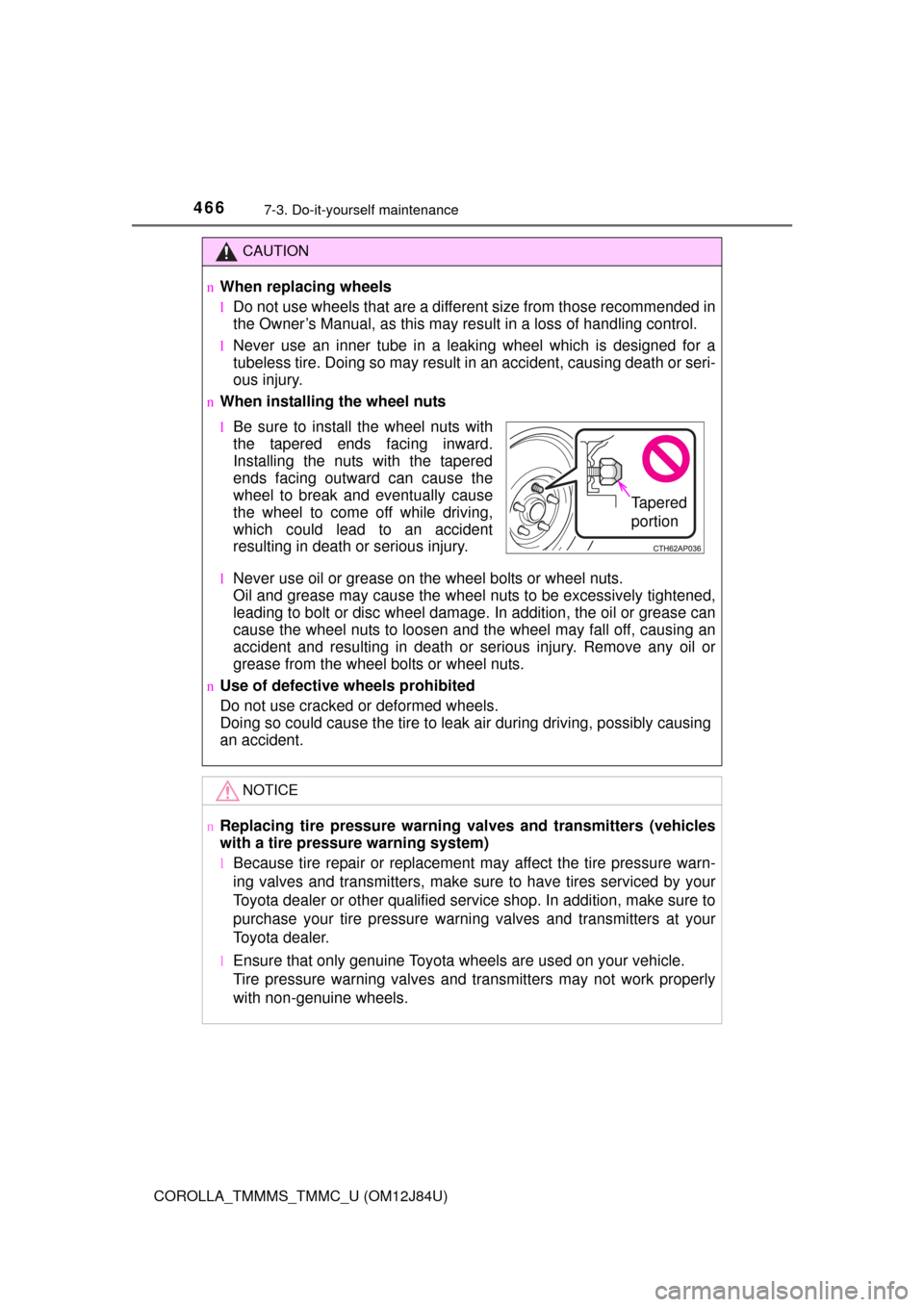
lBe sure to install the wheel nuts with
the tapered ends facing inward.
Installing the nuts with the tapered
ends facing outward can cause the
wheel to break and eventually cause
the wheel to come off while driving,
which could lead to an accident
resulting in death or serious injury.
Tapered
portion