Page 474 of 620
4747-3. Do-it-yourself maintenance
COROLLA_TMMMS_TMMC_U (OM12J84U)
nAfter a fuse is replaced
lIf the lights do not turn on even after the fuse has been replaced, a bulb may
need replacement. ( P. 475)
l If the replaced fuse blows again, have the vehicle inspected by your Toyota
dealer.
n If there is an overload in a circuit
The fuses are designed to blow, protecting the wiring harness from damage.
CAUTION
nTo prevent system breakdowns and vehicle fire
Observe the following precautions.
Failure to do so may cause damage to the vehicle, and possibly a fire or
injury.
lNever use a fuse of a higher amperage rating than that indicated, or use\
any other object in place of a fuse.
l Always use a genuine Toyota fuse or equivalent.
Never replace a fuse with a wire, even as a temporary fix.
l Do not modify the fuses or fuse boxes.
NOTICE
nBefore replacing fuses
Have the cause of electrical overload determined and repaired by your
Toyota dealer as soon as possible.
Page 482 of 620
4827-3. Do-it-yourself maintenance
COROLLA_TMMMS_TMMC_U (OM12J84U)n
Stop/tail/rear side marker lights and rear turn signal lights
Open the trunk lid and
remove the clips.
To prevent damage to the vehi-
cle, cover the tip of the screw-
driver with a rag.
Partly remove the luggage
trim cover.
Turn the bulb base counter-
clockwise.Rear turn signal light
Stop/tail/rear side marker
light
Remove the light bulb. Rear turn signal light
Stop/tail/rear side marker
light
When installing, reverse the steps listed.
1
2
3
1
2
4
1
2
5
Page 484 of 620
4847-3. Do-it-yourself maintenance
COROLLA_TMMMS_TMMC_U (OM12J84U)n
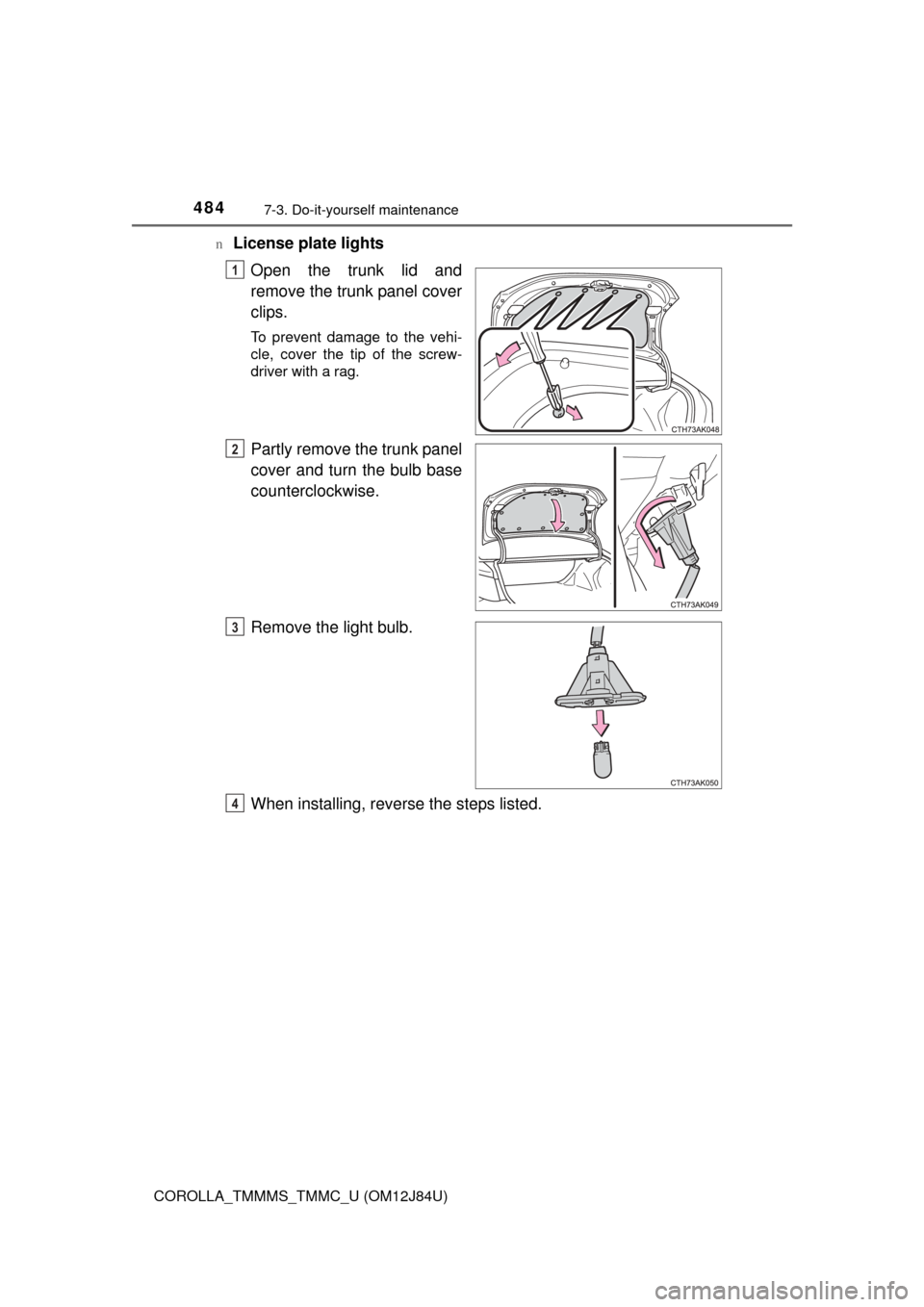
License plate lights
Open the trunk lid and
remove the trunk panel cover
clips.
To prevent damage to the vehi-
cle, cover the tip of the screw-
driver with a rag.
Partly remove the trunk panel
cover and turn the bulb base
counterclockwise.
Remove the light bulb.
When installing, reverse the steps listed.
1
2
3
4
Page 485 of 620

4857-3. Do-it-yourself maintenance
7
Maintenance and care
COROLLA_TMMMS_TMMC_U (OM12J84U)n
Replacing the following bulbs
If any of the lights listed below
has burnt out, have it replaced by
your Toyota dealer.
l Headlight low beams/daytime running lights
l High mounted stoplights
l Side turn signal lights (if equipped)
nLED light bulbs
The high mounted stoplights and headlight low beams/daytime running lights
consist of a number of LEDs. If any of the LEDs burns out, take your vehicle
to your Toyota dealer to have the light replaced.
n Condensation build-up on the inside of the lens
Temporary condensation build-up on the inside of the headlight lens does not
indicate a malfunction.
Contact your Toyota dealer for more information in the following situations:
lLarge drops of water have built up on the inside of the lens.
l Water has built up inside the headlight.
CAUTION
n Replacing light bulbs
lTurn off the lights. Do not attempt to replace the bulb immediately after
turning off the lights.
The bulbs become very hot and may cause burns.
l Do not touch the glass portion of the light bulb with bare hands. When it is
unavoidable to hold the glass portion, use and hold with a clean dry cloth
to avoid getting moisture and oils on the bulb.
Also, if the bulb is scratched or dropped, it may blow out or crack.
l Fully install light bulbs and any parts used to secure them. Failure to do so
may result in heat damage, fire, or water entering the headlight unit. This
may damage the headlights or cause condensation to build up on the lens.
n To prevent damage or fire
Make sure bulbs are fully seated and locked.
Page 491 of 620
491
8
When trouble arises
COROLLA_TMMMS_TMMC_U (OM12J84U)
8-2. Steps to take in an emergency
The following may indicate a problem with your transmission. Contact
your Toyota dealer or commercial towing service before towing.
lThe engine is running but the vehicle does not move.
l The vehicle makes an abnormal sound.
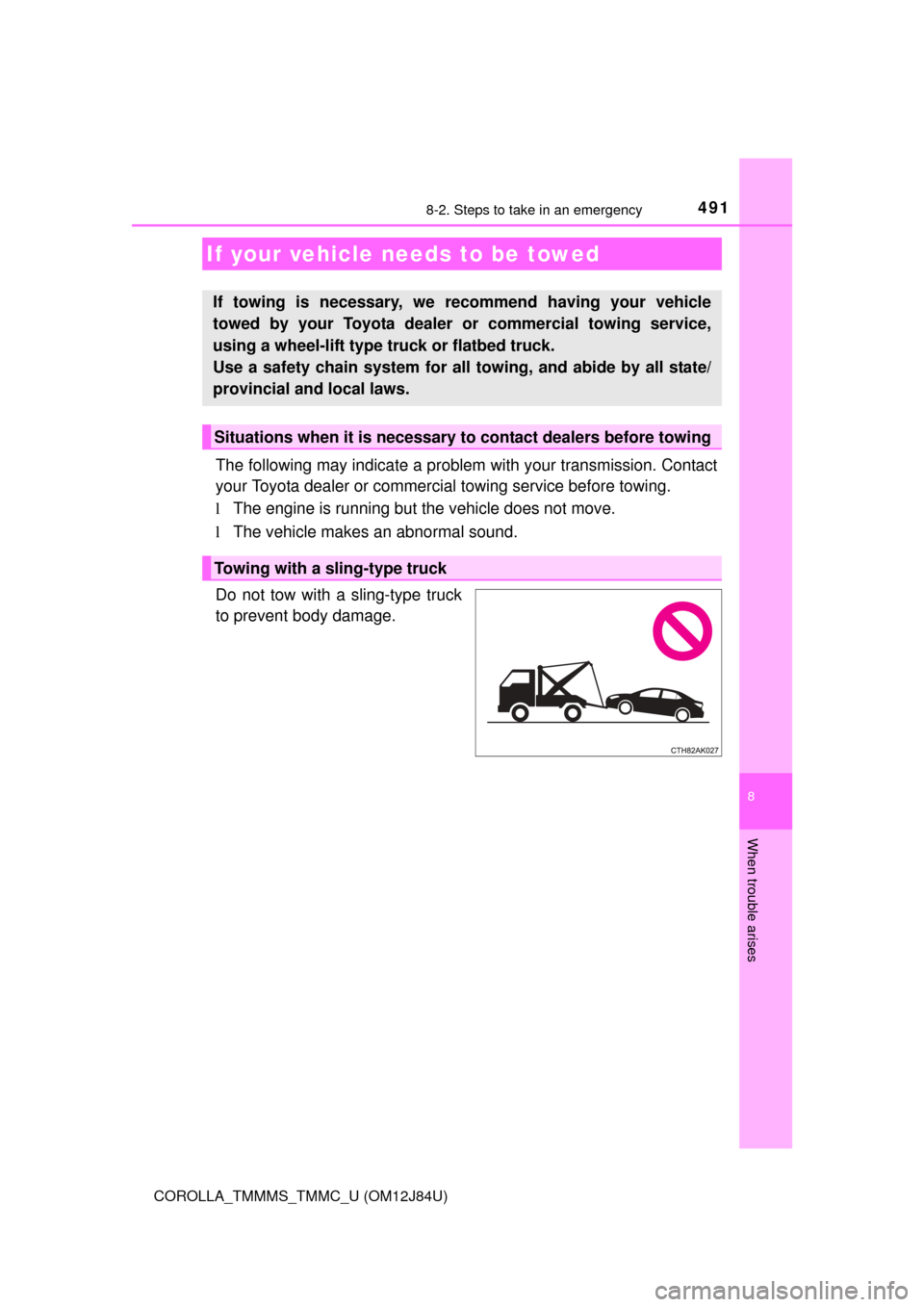
Do not tow with a sling-type truck
to prevent body damage.
If your vehicle needs to be towed
If towing is necessary, we re commend having your vehicle
towed by your Toyota dealer or commercial towing service,
using a wheel-lift type truck or flatbed truck.
Use a safety chain system for all towing, and abide by all state/
provincial and local laws.
Situations when it is necessary to contact dealers before towing
Towing with a sling-type truck
Page 495 of 620
4958-2. Steps to take in an emergency
8
When trouble arises
COROLLA_TMMMS_TMMC_U (OM12J84U)
NOTICE
nTo prevent damage to the vehicle when towing using a wheel-lift type
truck
lVehicles without a smart key system: Do not tow the vehicle from the rear
when the engine switch is in the “LOCK” position or the key is removed.
The steering lock mechanism is not strong enough to hold the front wheels
straight.
l Vehicles with a smart key system: Do not tow the vehicle from the rear
when the engine switch is off. The steering lock mechanism is not strong
enough to hold the front wheels straight.
l When raising the vehicle, ensure adequate ground clearance for towing at
the opposite end of the raised vehicle. Without adequate clearance, the
vehicle could be damaged while being towed.
n To prevent damage to the vehicle wh en towing with a sling-type truck
Do not tow with a sling-type truck, either from the front or rear.
n To prevent damage to the vehic le during emergency towing
Do not secure cables or chains to the suspension components.
Page 508 of 620

5088-2. Steps to take in an emergency
COROLLA_TMMMS_TMMC_U (OM12J84U)
CAUTION
nMaintenance of the tires
Each tire, including the spare (if provided), should be checked monthly
when cold and inflated to the inflation pressure recommended by the
vehicle manufacturer on the vehicle placard or tire inflation pressure
label (tire and load information label). (If your vehicle has tires of a dif-
ferent size than the size indicated on the vehicle placard or tire inflation
pressure label [tire and load information label], you should determine
the proper tire inflation pressure for those tires.)
As an added safety feature, your vehicle has been equipped with a tire
pressure monitoring system (TPMS-ti re pressure warning system) that
illuminates a low tire pre ssure telltale (tire pressure warning light) when
one or more of your tires is significantly under-inflated. Accordingly,
when the low tire pressure telltale (tire pressure warning light) illumi-
nates, you should stop and check your tires as soon as possible, and
inflate them to the proper pressure. Driving on a significantly under-
inflated tire causes the tire to overheat and can lead to tire failure.
Under-inflation also reduces fuel effi ciency and tire tread life, and may
affect the vehicle’s hand ling and stopping ability.
Please note that the TPMS (tire pres sure warning system) is not a sub-
stitute for proper ti re maintenance, and it is the driver’s responsibility to
maintain correct tire pressure, even if under-inflation has not reached
the level to trigger illumina tion of the TPMS low tire pressure telltale (tire
pressure warning light).
Your vehicle has also been equipped with a TPMS (tire pressure warn-
ing system) malfunction indicator to indicate when the system is not
operating properly. The TPMS (tire pressure warning system) malfunc-
tion indicator is combined with the lo w tire pressure telltale (tire pressure
warning light). When the system dete cts a malfunction, the telltale will
flash for approximately one minute and then remain continuously illumi-
nated. This sequence will continue up on subsequent vehicle start-ups
as long as the malfunction exists. When the malfunction indicator is illu-
minated, the system may not be able to detect or signal low tire pres-
sure as intended.
TPMS (tire pressure warning system) malfunctions may occur for a vari-
ety of reasons, including the installati on of replacement or alternate tires
or wheels on the vehicle that prevent the TPMS (tire pressure warning
system) from functioning properly. Always check the TPMS (tire pres-
sure warning system) malfunction te lltale after replacing one or more
tires or wheels on your vehicle to ensure that the replacement or alter-
nate tires and wheels allow the TPMS (tire pressure warning system) to
continue to function properly.
Page 518 of 620
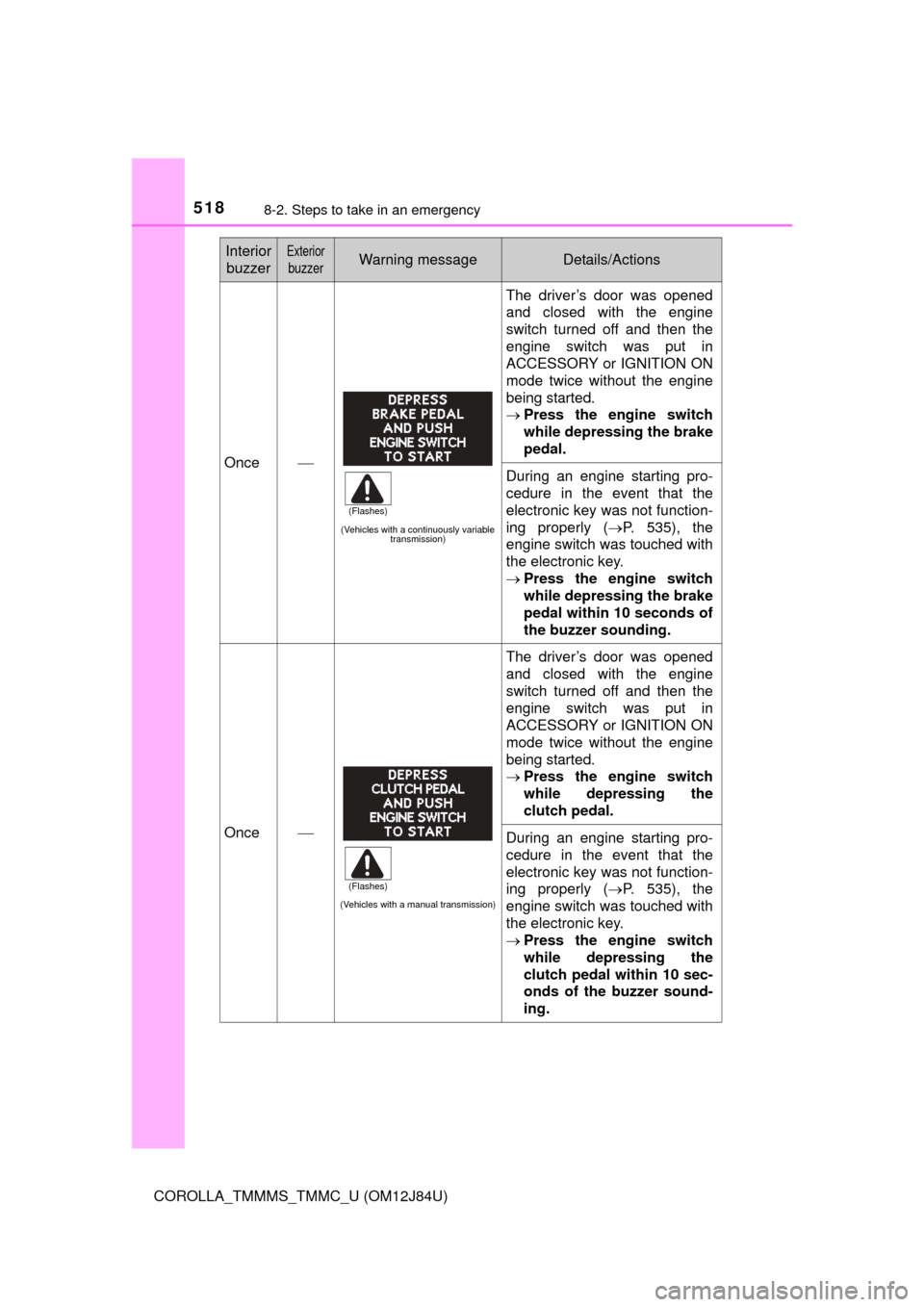
5188-2. Steps to take in an emergency
COROLLA_TMMMS_TMMC_U (OM12J84U)
Once
(Vehicles with a continuously variable transmission)
The driver’s door was opened
and closed with the engine
switch turned off and then the
engine switch was put in
ACCESSORY or IGNITION ON
mode twice without the engine
being started.
Press the engine switch
while depressing the brake
pedal.
During an engine starting pro-
cedure in the event that the
electronic key was not function-
ing properly ( P. 535), the
engine switch was touched with
the electronic key.
Press the engine switch
while depressing the brake
pedal within 10 seconds of
the buzzer sounding.
Once
(Vehicles with a manual transmission)
The driver’s door was opened
and closed with the engine
switch turned off and then the
engine switch was put in
ACCESSORY or IGNITION ON
mode twice without the engine
being started.
Press the engine switch
while depressing the
clutch pedal.
During an engine starting pro-
cedure in the event that the
electronic key was not function-
ing properly ( P. 535), the
engine switch was touched with
the electronic key.
Press the engine switch
while depressing the
clutch pedal within 10 sec-
onds of the buzzer sound-
ing.
Interior
buzzerExterior
buzzerWarning messageDetails/Actions
(Flashes)
(Flashes)