2016 TOYOTA 4RUNNER towing
[x] Cancel search: towingPage 407 of 528
4077-2. Steps to take in an emergency
7
When trouble arises
4RUNNER (U)_(OM35B23U)
If a tow truck is not available in an emergency, your vehicle may be
temporarily towed using cables or chains secured to the emergency
towing eyelet(s). This should only be attempted on hard surfaced
roads for at most 50 miles (80 km) at under 18 mph (30 km/h).
A driver must be in the vehicle to steer and operate the brakes. The
vehicle’s wheels, drive train, axles, steering and brakes must be in
good condition.
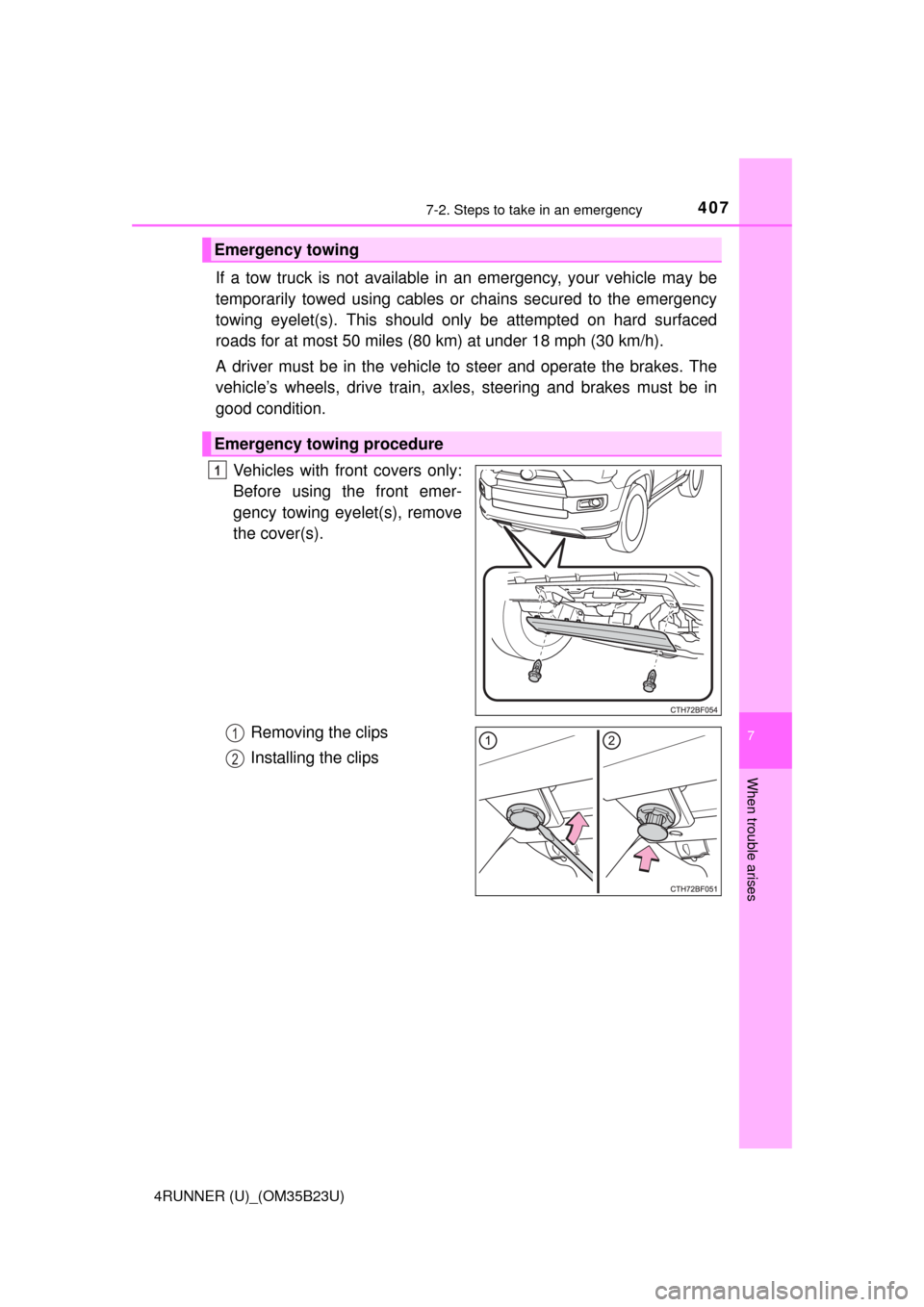
Vehicles with front covers only:
Before using the front emer-
gency towing eyelet(s), remove
the cover(s).
Removing the clips
Installing the clips
Emergency towing
Emergency towing procedure
1
1
2
Page 408 of 528
4087-2. Steps to take in an emergency
4RUNNER (U)_(OM35B23U)
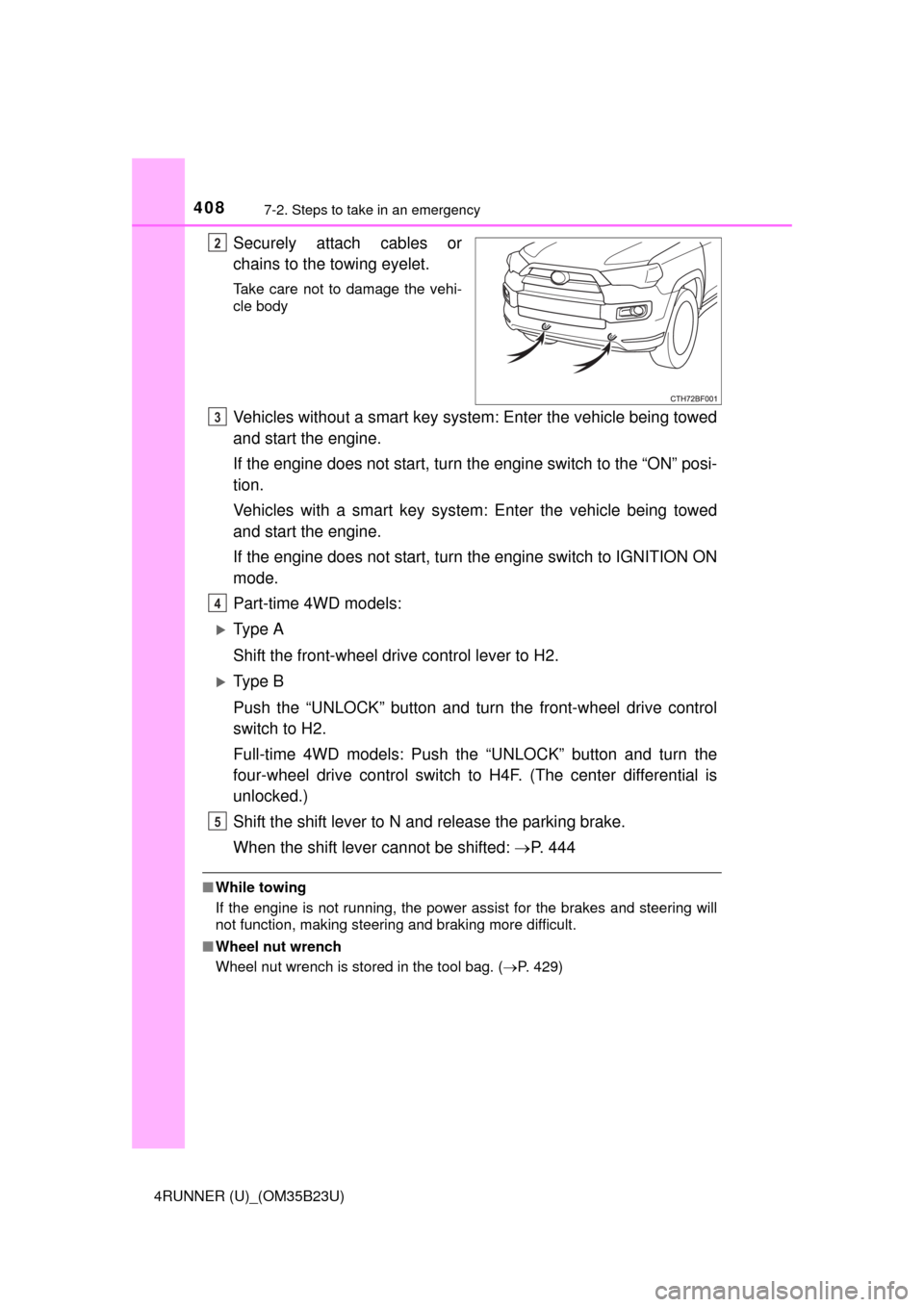
Securely attach cables or
chains to the towing eyelet.
Take care not to damage the vehi-
cle body
Vehicles without a smart key system: Enter the vehicle being towed
and start the engine.
If the engine does not start, turn the engine switch to the “ON” posi-
tion.
Vehicles with a smart key system: Enter the vehicle being towed
and start the engine.
If the engine does not start, turn the engine switch to IGNITION ON
mode.
Part-time 4WD models:
Ty p e A
Shift the front-wheel drive control lever to H2.
Ty p e B
Push the “UNLOCK” button and turn the front-wheel drive control
switch to H2.
Full-time 4WD models: Push the “UNLOCK” button and turn the
four-wheel drive control switch to H4F. (The center differential is
unlocked.)
Shift the shift lever to N and release the parking brake.
When the shift lever cannot be shifted: P. 4 4 4
■While towing
If the engine is not running, the power assist for the brakes and steering will
not function, making steering and braking more difficult.
■Wheel nut wrench
Wheel nut wrench is stored in the tool bag. (P. 429)
2
3
4
5
Page 409 of 528
4097-2. Steps to take in an emergency
7
When trouble arises
4RUNNER (U)_(OM35B23U)
CAUTION
Observe the following precautions.
Failure to do so may result in death or serious injury.
■When towing the vehicle
■While towing
●When towing using cables or chains, avoid sudden starts, etc. which place
excessive stress on the towing eyelets, cables or chains. The towing eye-
lets, cables or chains may become damaged, broken debris may hit peo-
ple, and cause serious damage.
●Vehicles without a smart key system: Do not turn the engine switch to the
“LOCK” position.
There is a possibility that the steering wheel is locked and cannot be oper-
ated.
●Vehicles with a smart key system: Do not turn the engine switch off.
There is a possibility that the steering wheel is locked and cannot be oper-
ated.
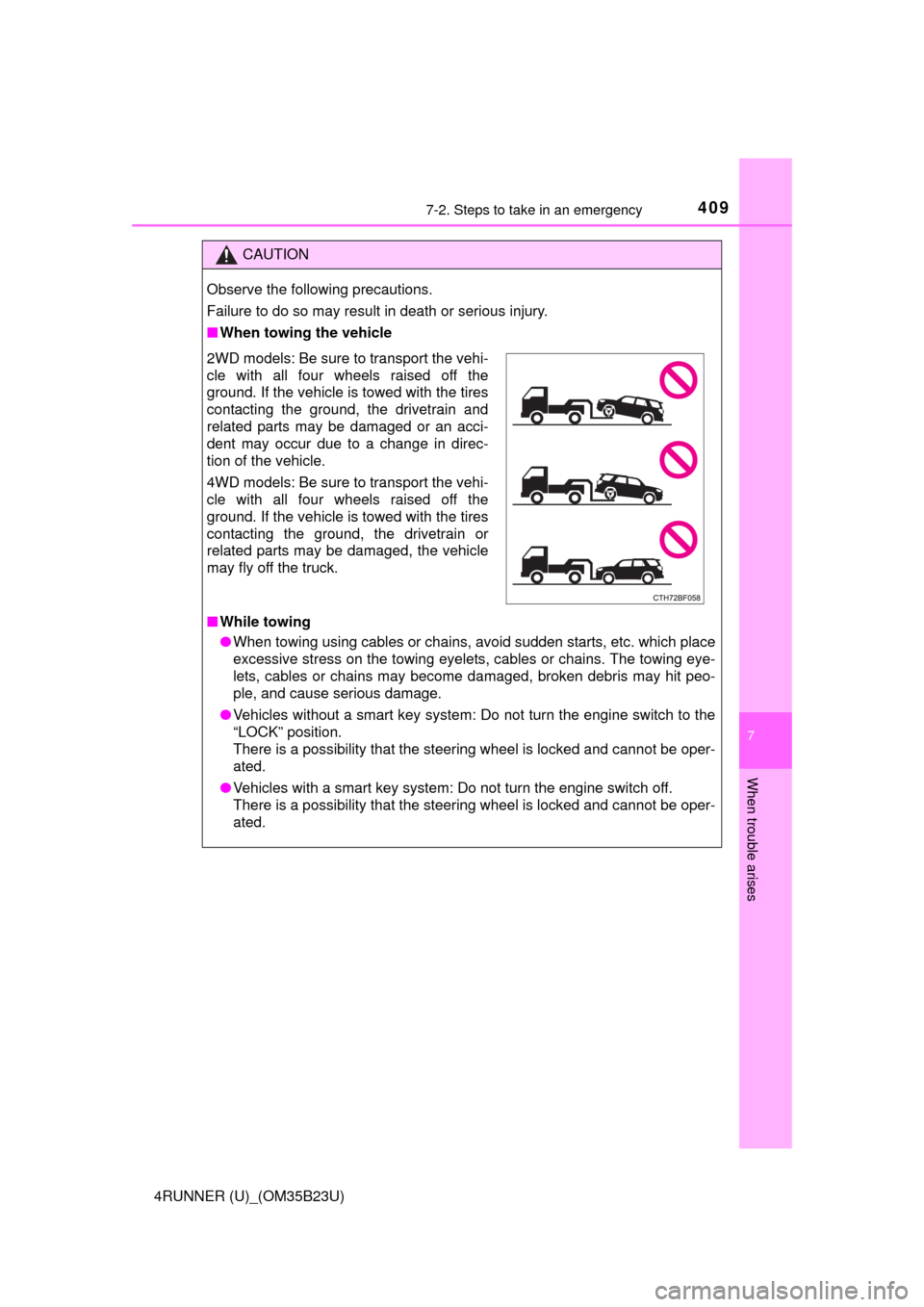
2WD models: Be sure to transport the vehi-
cle with all four wheels raised off the
ground. If the vehicle is towed with the tires
contacting the ground, the drivetrain and
related parts may be damaged or an acci-
dent may occur due to a change in direc-
tion of the vehicle.
4WD models: Be sure to transport the vehi-
cle with all four wheels raised off the
ground. If the vehicle is towed with the tires
contacting the ground, the drivetrain or
related parts may be damaged, the vehicle
may fly off the truck.
Page 410 of 528
4107-2. Steps to take in an emergency
4RUNNER (U)_(OM35B23U)
NOTICE
■To prevent damage to the vehicle when towing using a wheel-lift type
truck
●2WD models without a smart key system: Do not tow the vehicle from the
rear when the engine switch is in the “LOCK” position or the key is
removed. The steering lock mechanism is not strong enough to hold the
front wheels straight.
●2WD models with a smart key system: Do not tow the vehicle from the rear
when the engine switch is off. The steering lock mechanism is not strong
enough to hold the front wheels straight.
●When raising the vehicle, ensure adequate ground clearance for towing at
the opposite end of the raised vehicle. Without adequate clearance, the
vehicle could be damaged while being towed.
■To prevent damage to the vehicle when towing with a sling-type truck
Do not tow with a sling-type truck, either from the front or rear.
■To prevent damage to the vehicle during emergency towing
Do not secure cables or chains to the suspension components.
Page 440 of 528
4407-2. Steps to take in an emergency
4RUNNER (U)_(OM35B23U)
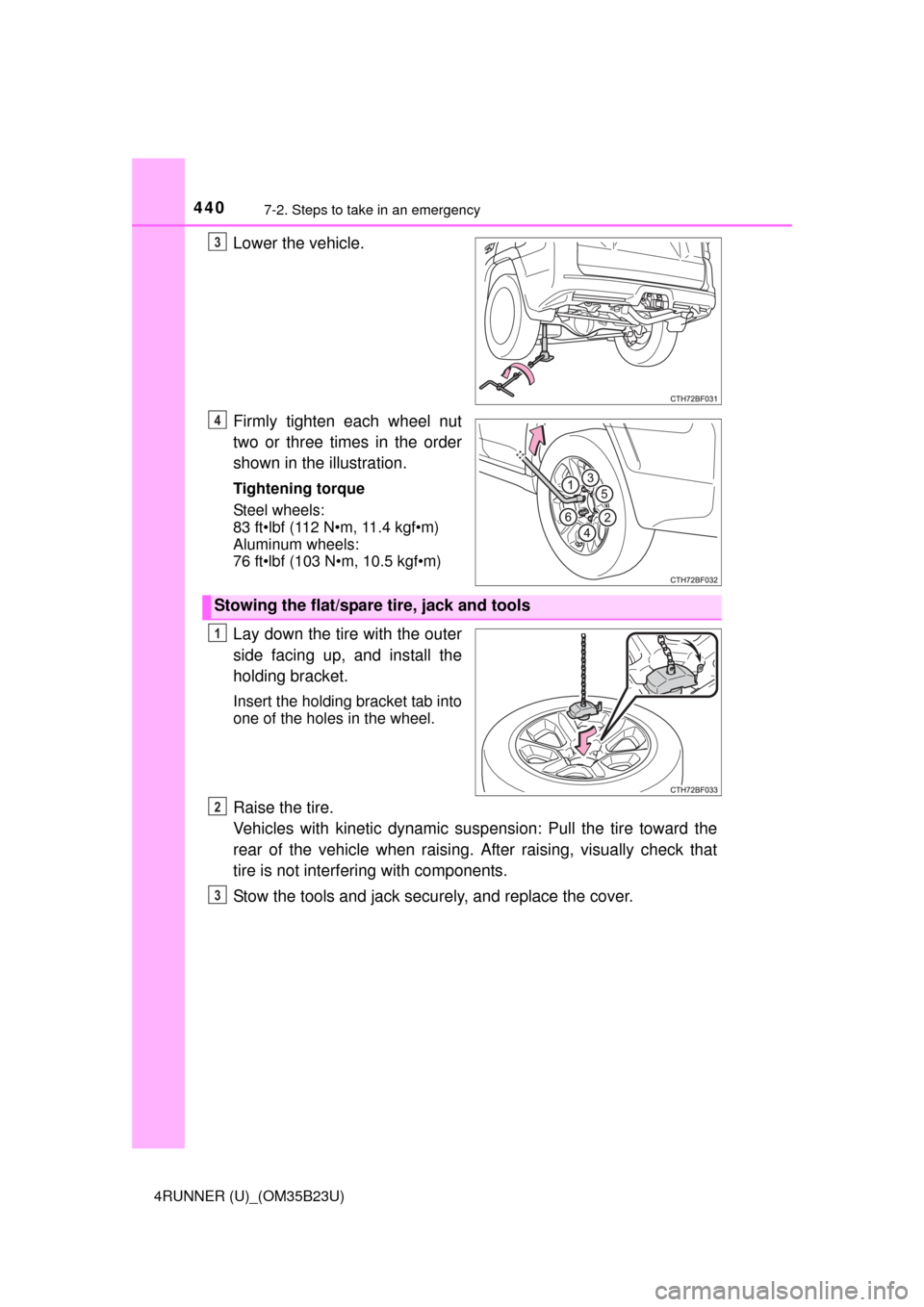
Lower the vehicle.
Firmly tighten each wheel nut
two or three times in the order
shown in the illustration.
Tightening torque
Steel wheels:
83 ft•lbf (112 N•m, 11.4 kgf•m)
Aluminum wheels:
76 ft•lbf (103 N•m, 10.5 kgf•m)
Lay down the tire with the outer
side facing up, and install the
holding bracket.
Insert the holding bracket tab into
one of the holes in the wheel.
Raise the tire.
Vehicles with kinetic dynamic suspension: Pull the tire toward the
rear of the vehicle when raising. After raising, visually check that
tire is not interfering with components.
Stow the tools and jack securely, and replace the cover.
3
4
Stowing the flat/spare tire, jack and tools
1
2
3
Page 441 of 528
4417-2. Steps to take in an emergency
7
When trouble arises
4RUNNER (U)_(OM35B23U)
■After completing the tire change
The tire pressure warning system must be reset. (P. 367)
■When using the spare tire (Vehicles without P245/60R20 tires)
As the spare tire is not equipped with a tire pressure warning valve and
transmitter, low inflation pressure of the spare tire will not be indicated by
the tire pressure warning system. Also, if you replace the spare tire after
the tire pressure warning light comes on, the light remains on.
NOTICE
■Do not drive the vehicle with a flat tire
Do not continue driving with a flat tire.
Driving even a short distance with a flat tire can damage the tire and the
wheel beyond repair.
■When stowing the flat tire
Ensure that there is no object caught between the tire and the vehicle
underbody.
■When replacing the tires
●When removing or fitting the wheels, tires or the tire pressure warning
valve and transmitter, contact your Toyota dealer as the tire pressure
warning valve and transmitter may be damaged if not handled cor-
rectly.
●Replace the grommets for the tire pressure warning valves and trans-
mitters as well.
■To avoid damage to the tire pressure warning valves and transmit-
ters
When a tire is repaired with liquid sealants, the tire pressure warning
valve and transmitter may not operate properly. If a liquid sealant is
used, contact your Toyota dealer or other qualified service shop as soon
as possible. Make sure to replace the tire pressure warning valve and
transmitter when replacing the tire. (P. 367)
Page 455 of 528
4557-2. Steps to take in an emergency
7
When trouble arises
4RUNNER (U)_(OM35B23U)
Stop the engine. Set the parking brake and shift the shift lever to P.
Remove the mud, snow or sand from around the stuck tire.
Place wood, stones or some other material under the tires to help
provide traction.
Restart the engine.
Shift the shift lever to D or R position and carefully apply the accel-
erator to free the vehicle.
Turn off TRAC and VSC if these functions are hampering your attempts to
free the vehicle. (P. 261)
If the vehicle becomes stuck
Carry out the following procedures if the tires spin or the vehicle
becomes stuck in mud, dirt or snow:
CAUTION
■When attempting to free a stuck vehicle
If you choose to push the vehicle back and forth to free it, make sure the
surrounding area is clear to avoid striking other vehicles, objects or people.
The vehicle may also lunge forward or lunge back suddenly as it becomes
free. Use extreme caution.
■When shifting the shift lever
Be careful not to shift the shift lever with the accelerator pedal depressed.
This may lead to unexpected rapid acceleration of the vehicle that may
cause an accident resulting in death or serious injury.
NOTICE
■To avoid damaging the transmission and other components
●Avoid spinning the wheels and depressing the accelerator pedal more
than necessary.
●If the vehicle remains stuck even after these procedures are performed,
the vehicle may require towing to be freed.
●When a warning message for the automatic transmission fluid temperature
is displayed while attempting to free a stuck vehicle, immediately remove
your foot from the accelerator pedal and wait until the warning message
disappears. Otherwise, the transmission may become damaged.
(
P. 422)
1
2
3
4
5
Page 516 of 528

516Alphabetical index
4RUNNER (U)_(OM35B23U)
Child safety ................................ 52
Airbag precautions .................. 37
Back door precautions .......... 116
Battery precautions ....... 361, 451
Child restraint system ............. 53
How your child should
wear the seat belt ................. 31
Installing child restraints ......... 57
Moon roof precautions .......... 155
Power window lock switch .... 145
Power window precautions ... 147
Rear door child-protectors ...... 99
Removed electronic
key battery precautions ...... 381
Seat belt extender
precautions ........................... 34
Seat belt precautions .............. 56
Seat heater precautions........ 291
Child-protectors......................... 99
Cleaning ........................... 334, 337
Aluminum wheels.................. 334
Exterior ................................. 334
Interior................................... 337
Seat belts .............................. 338
Clock ......................................... 309
Compass .................................... 85
Condenser ................................ 356
Console box ............................. 297
Cooling system
Engine overheating ............... 452
Crawl Control ........................... 249
Cruise control .......................... 221
Cup holders.............................. 298
Curtain shield airbags ............... 35
Customizable features ............ 485Daytime running light
system.................................... 208
Defogger
Front windshield ................... 286
Outside rear view
mirrors ........................ 280, 286
Rear window ................. 280, 286
Dimension ................................ 458
Dinghy towing.......................... 190
Display
Multi-information display ......... 81
Trip information....................... 83
Warning message................. 422
Do-it-yourself maintenance .... 346
Door courtesy lights
Wattage ................................ 469
Doors
Automatic door locking
and unlocking system......... 100
Back door ............................. 114
Door lock ........................ 98, 115
Door windows ....................... 145
Open door warning buzzer ... 105
Open door warning light ....... 415
Outside rear view mirrors ..... 143
Rear door child-protector ........ 99
Side doors .............................. 96
Downhill assist control
system.................................... 246
Driver’s seat position
memory .................................. 132
Driving ...................................... 158
Break-in tips.......................... 159
Correct driving posture ........... 28
Driving assist systems .......... 259
Off-road precautions ............. 272
Procedures ........................... 158
Winter drive tips .................... 268D