Page 373 of 528
3736-3. Do-it-yourself maintenance
6
Maintenance and care
4RUNNER (U)_(OM35B23U)■
Instructions for checking tire inflation pressure
When checking tire inflation pressure, observe the following:
●Check only when the tires are cold.
If your vehicle has been parked for at least 3 hours or has not been
driven for more than 1 mile or 1.5 km, you will get an accurate cold tire
inflation pressure reading.
●Always use a tire pressure gauge.
It is difficult to judge if a tire is properly inflated based only on its appear-
ance.
●It is normal for the tire inflation pressure to be higher after driving as
heat is generated in the tire. Do not reduce tire inflation pressure after
driving.
●Never exceed the vehicle capacity weight.
Passengers and luggage weight should be placed so that the vehicle is
balanced.
CAUTION
■Proper inflation is critical to save tire performance
Keep your tires properly inflated.
If the tires are not properly inflated, the following conditions may occur
which could lead to an accident resulting in death or serious injury:
●Excessive wear
●Uneven wear
●Poor handling
●Possibility of blowouts resulting from overheated tires
●Air leaking from between tire and wheel
●Wheel deformation and/or tire damage
●Greater possibility of tire damage while driving (due to road hazards,
expansion joints, sharp edges in the road, etc.)
NOTICE
■When inspecting and adjusting tire inflation pressure
Be sure to put the tire valve caps back on.
If a valve cap is not installed, dirt or moisture may get into the valve and
cause an air leak, resulting in decreased tire inflation pressure.
Page 375 of 528
3756-3. Do-it-yourself maintenance
6
Maintenance and care
4RUNNER (U)_(OM35B23U)
■When replacing wheels
The wheels of your vehicle are equipped with tire pressure warning
valves and transmitters that allow the tire pressure warning system to
provide advance warning in the event of a loss in tire inflation pressure.
Whenever wheels are replaced, tire pressure warning valves and trans-
mitters must be installed. (P. 367)
CAUTION
■When replacing wheels
●Do not use wheels that are a different size from those recommended in
the Owner’s Manual, as this may result in a loss of handling control.
●Never use an inner tube in a leaking wheel which is designed for a
tubeless tire. Doing so may result in an accident, causing death or seri-
ous injury.
■When installing the wheel nuts
●Never use oil or grease on the wheel bolts or wheel nuts.
Oil and grease may cause the wheel nuts to be excessively tightened,
leading to bolt or disc wheel damage. In addition, the oil or grease can
cause the wheel nuts to loosen and the wheel may fall off, causing an
accident and resulting in death or serious injury. Remove any oil or
grease from the wheel bolts or wheel nuts.
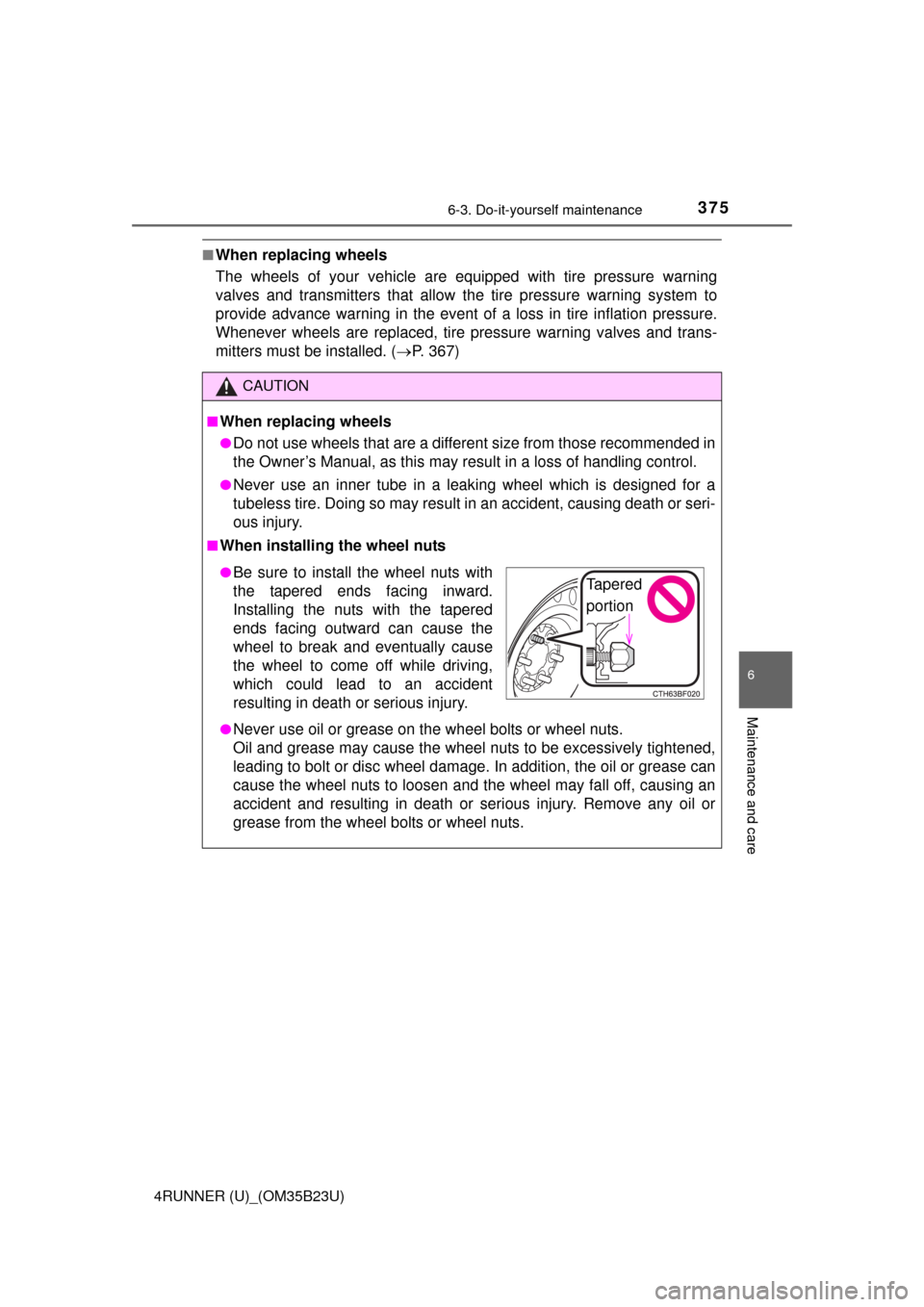
●Be sure to install the wheel nuts with
the tapered ends facing inward.
Installing the nuts with the tapered
ends facing outward can cause the
wheel to break and eventually cause
the wheel to come off while driving,
which could lead to an accident
resulting in death or serious injury.Tapered
portion
Page 379 of 528
3796-3. Do-it-yourself maintenance
6
Maintenance and care
4RUNNER (U)_(OM35B23U)
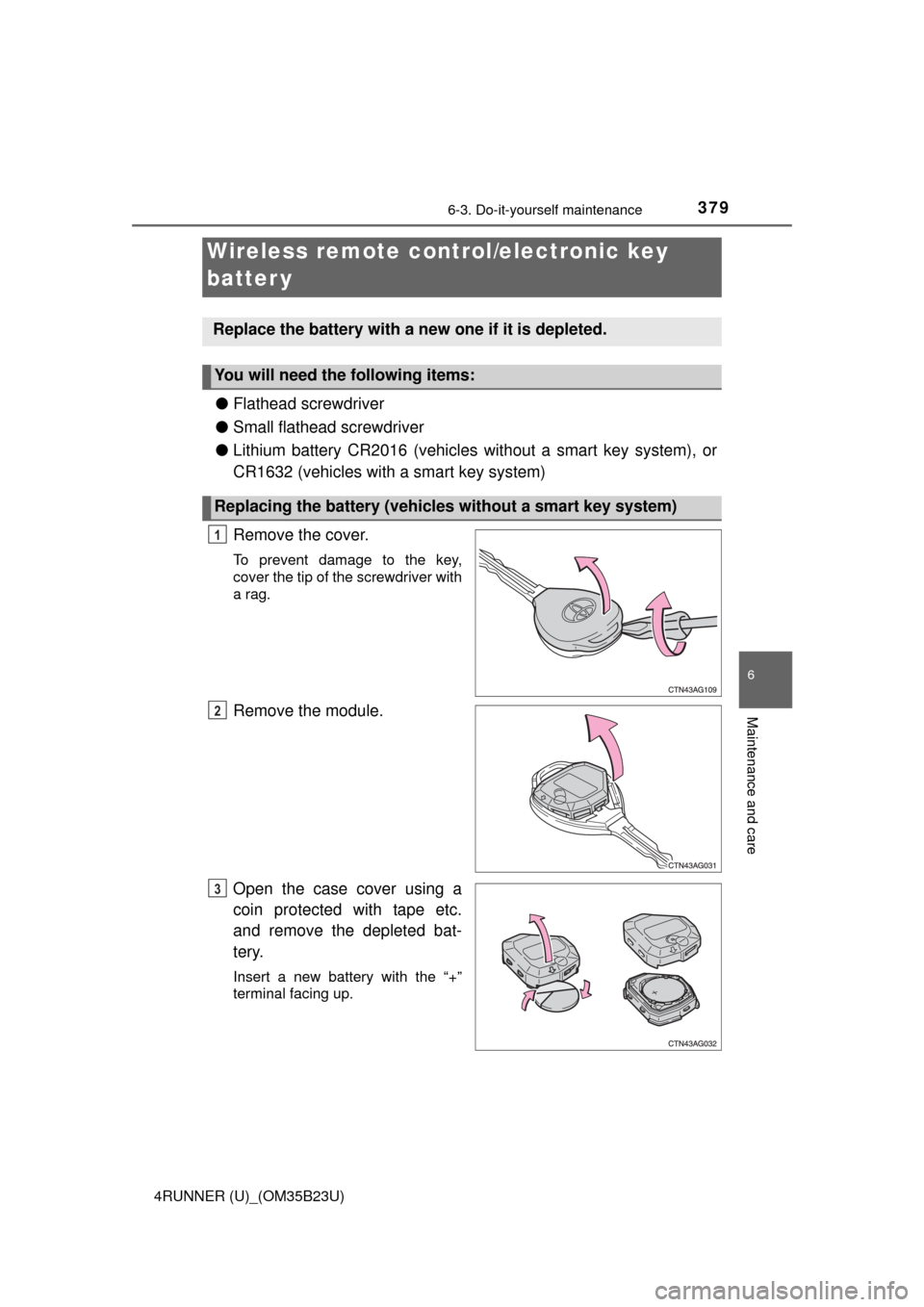
●Flathead screwdriver
●Small flathead screwdriver
●Lithium battery CR2016 (vehicles without a smart key system), or
CR1632 (vehicles with a smart key system)
Remove the cover.
To prevent damage to the key,
cover the tip of the screwdriver with
a rag.
Remove the module.
Open the case cover using a
coin protected with tape etc.
and remove the depleted bat-
tery.
Insert a new battery with the “+”
terminal facing up.
Wireless remote control/electronic key
batter y
Replace the battery with a new one if it is depleted.
You will need the following items:
Replacing the battery (vehicles without a smart key system)
1
2
3
Page 401 of 528
401
When trouble arises7
4RUNNER (U)_(OM35B23U)7-1. Essential information
Emergency flashers .......... 402
If your vehicle has to
be stopped in an
emergency ...................... 403
7-2. Steps to take in an
emergency
If your vehicle needs to
be towed ......................... 405
If you think something
is wrong .......................... 411
Fuel pump shut off
system ............................ 412
If a warning light turns
on or a warning
buzzer sounds ................ 413
If a warning message or
indicator is displayed ...... 422
If you have a flat tire.......... 429
If the engine will not
start ................................. 442
If the shift lever cannot
be shifted from P............. 444
If you cannot operate
back door opener ............ 445
If the electronic key does
not operate properly........ 446
If the vehicle battery is
discharged ...................... 448
If your vehicle overheats ... 452
If the vehicle becomes
stuck ............................... 455
Page 405 of 528
405
7
When trouble arises
4RUNNER (U)_(OM35B23U)
7-2. Steps to take in an emergency
The following may indicate a problem with your transmission. Contact
your Toyota dealer or commercial towing service before towing.
●The engine is running but the vehicle does not move.
●The vehicle makes an abnormal sound.
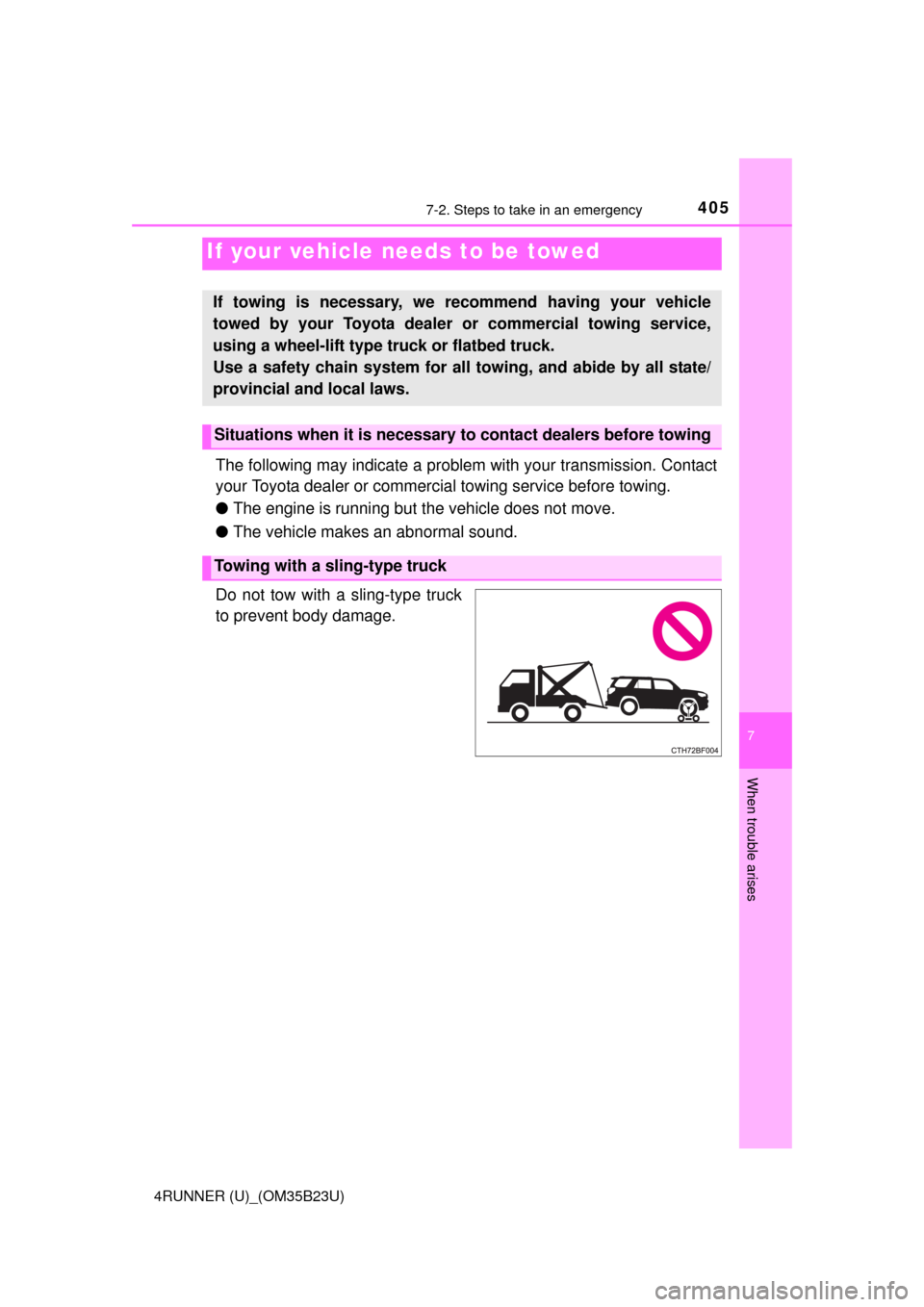
Do not tow with a sling-type truck
to prevent body damage.
If your vehicle needs to be towed
If towing is necessary, we recommend having your vehicle
towed by your Toyota dealer or commercial towing service,
using a wheel-lift type truck or flatbed truck.
Use a safety chain system for all towing, and abide by all state/
provincial and local laws.
Situations when it is necessary to contact dealers before towing
Towing with a sling-type truck
Page 406 of 528
4067-2. Steps to take in an emergency
4RUNNER (U)_(OM35B23U)
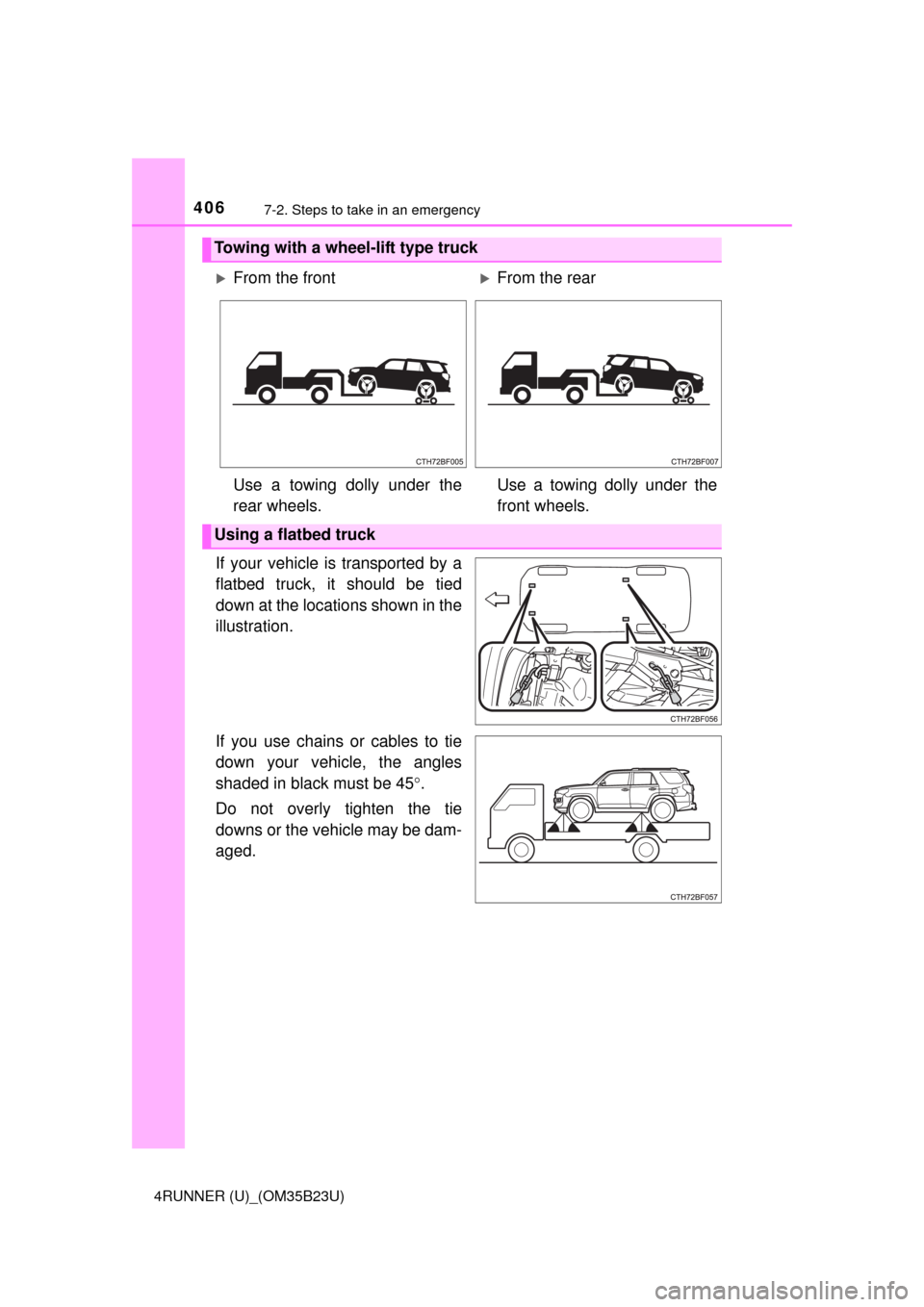
If your vehicle is transported by a
flatbed truck, it should be tied
down at the locations shown in the
illustration.
If you use chains or cables to tie
down your vehicle, the angles
shaded in black must be 45.
Do not overly tighten the tie
downs or the vehicle may be dam-
aged.
Towing with a wheel-lift type truck
From the frontFrom the rear
Use a towing dolly under the
rear wheels.Use a towing dolly under the
front wheels.
Using a flatbed truck
Page 411 of 528
4117-2. Steps to take in an emergency
7
When trouble arises
4RUNNER (U)_(OM35B23U)
●Fluid leaks under the vehicle.
(Water dripping from the air conditioning after use is normal.)
●Flat-looking tires or uneven tire wear
●Engine coolant temperature gauge needle continually points higher
than normal.
●Changes in exhaust sound
●Excessive tire squeal when cornering
●Strange noises related to the suspension system
●Pinging or other noises related to the engine
●Engine missing, stumbling or running roughly
●Appreciable loss of power
●Vehicle pulls heavily to one side when braking
●Vehicle pulls heavily to one side when driving on a level road
●Loss of brake effectiveness, spongy feeling, pedal almost touches
the floor
If you think something is wrong
If you notice any of the following symptoms, your vehicle proba-
bly needs adjustment or repair. Contact your Toyota dealer as
soon as possible.
Visible symptoms
Audible symptoms
Operational symptoms
Page 412 of 528
4127-2. Steps to take in an emergency
4RUNNER (U)_(OM35B23U)
Follow the procedure below to restart the engine after the system is
activated.
Vehicles without a smart key system
Turn the engine switch to the “ACC” or “LOCK” position.
Restart the engine.
Vehicles with a smart key system
Turn the engine switch to ACCESSORY mode or turn it off.
Restart the engine.
Fuel pump shut off system
To minimize the risk of fuel leakage when the engine stalls or
when an airbag inflates upon collision, the fuel pump shut off
system stops the supply of fuel to the engine.
NOTICE
■Before starting the engine
Inspect the ground under the vehicle.
If you find that fuel has leaked onto the ground, the fuel system has been
damaged and is in need of repair. Do not restart the engine.
1
2
1
2