Page 126 of 528
1263-3. Adjusting the seats
4RUNNER (U)_(OM35B23U)■
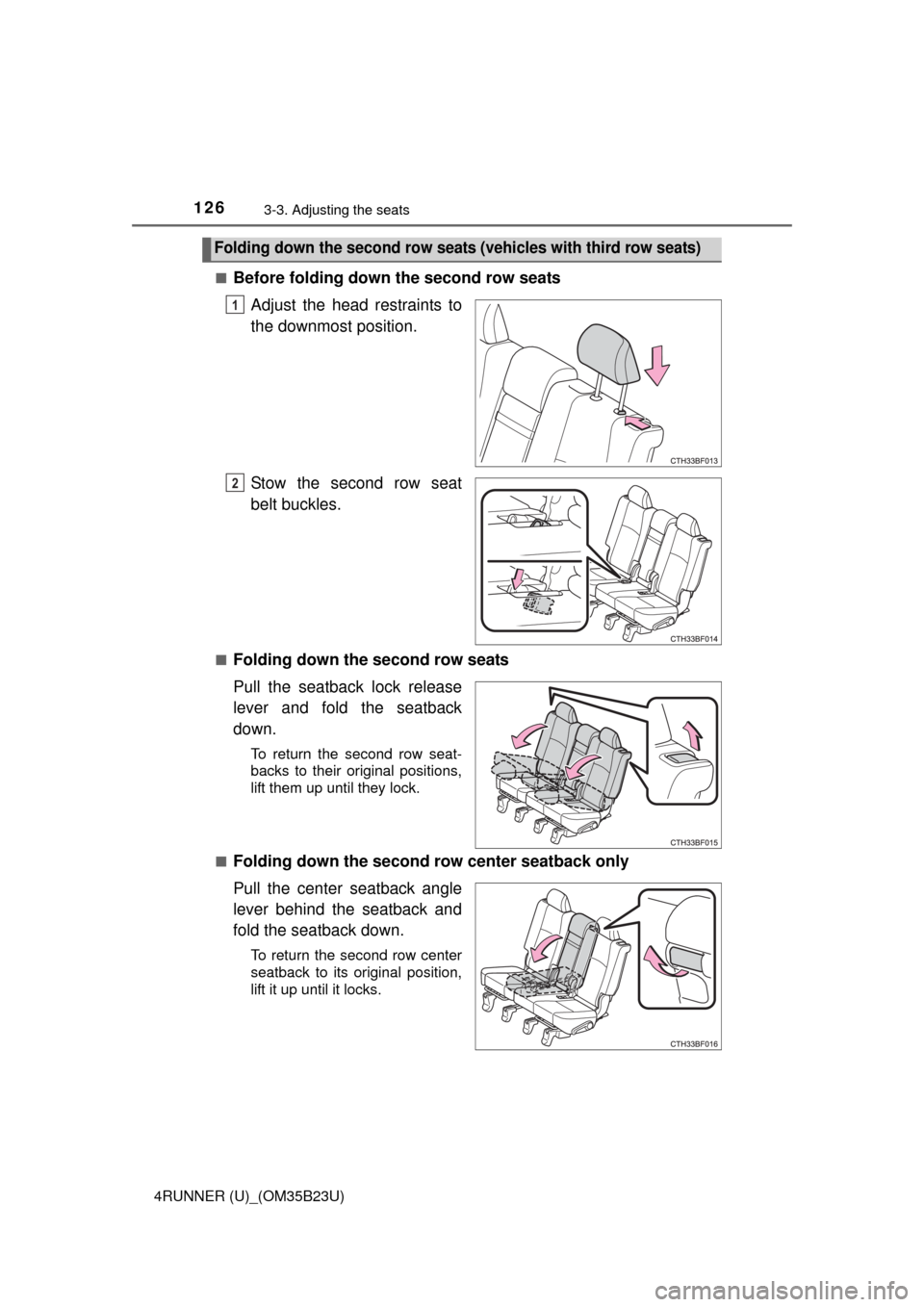
Before folding down the second row seats
Adjust the head restraints to
the downmost position.
Stow the second row seat
belt buckles.
■Folding down the second row seats
Pull the seatback lock release
lever and fold the seatback
down.
To return the second row seat-
backs to their original positions,
lift them up until they lock.
■
Folding down the second row center seatback only
Pull the center seatback angle
lever behind the seatback and
fold the seatback down.
To return the second row center
seatback to its original position,
lift it up until it locks.
Folding down the second row seats (vehicles with third row seats)
1
2
Page 131 of 528
1313-3. Adjusting the seats
3
Operation of each component
4RUNNER (U)_(OM35B23U)
CAUTION
■When folding the rear seatbacks down
Observe the following precautions. Failure to do so may result in death or
serious injury.
●Do not fold the seatbacks down while driving.
●Stop the vehicle on level ground, set the parking brake and shift the shift
lever to P.
●Do not allow anyone to sit on a folded seatback or in the luggage compart-
ment while driving.
●Do not allow children to enter the luggage compartment.
■Seat adjustment
●To reduce the risk of sliding under the lap belt during a collision, do not
recline the seat more than necessary.
If the seat is too reclined, the lap belt may slide past the hips and apply
restraint forces directly to the abdomen, or your neck may contact the
shoulder belt, increasing the risk of death or serious injury in the event of
an accident.
Adjustments should not be made while driving as the seat may unexpect-
edly move and cause the driver to lose control of the vehicle.
●Take care when adjusting the seat position to ensure that other passen-
gers are not injured by the moving seat.
●Do not put your hands under the seat or near the moving parts to avoid
injury.
Fingers or hands may become jammed in the seat mechanism.
■After returning the rear seatback to the upright position
Observe the following precautions. Failure to do so may result in death or
serious injury.
●Make sure the seatback is securely locked by pushing it forward and rear-
ward on the top.
●Check that the seat belts are not twisted or caught in the seatback.
NOTICE
■Stowing the seat belts
The seat belts and the buckles must be stowed before you fold down the
rear seatbacks.
Page 137 of 528
1373-3. Adjusting the seats
3
Operation of each component
4RUNNER (U)_(OM35B23U)
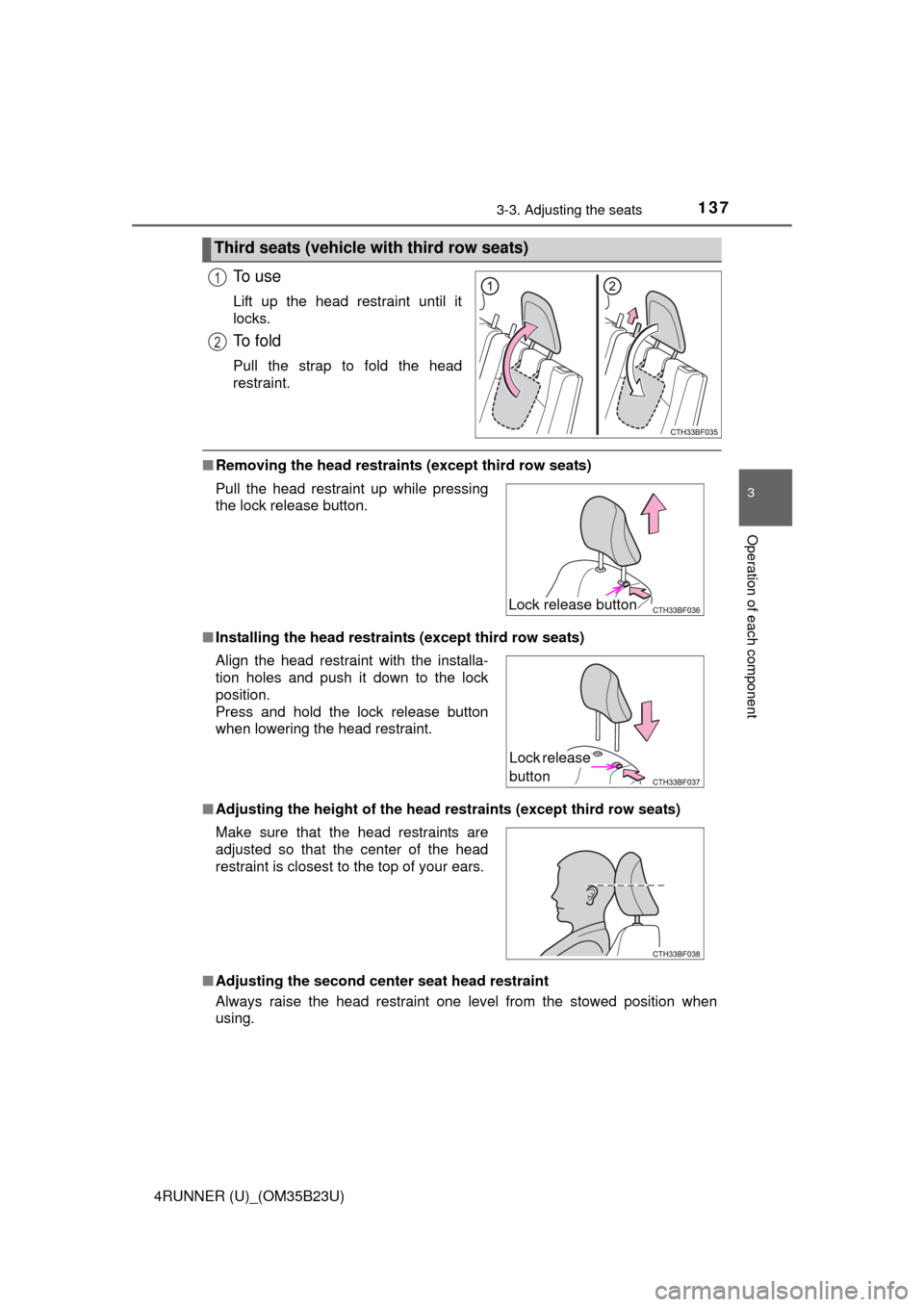
To u s e
Lift up the head restraint until it
locks.
To f o l d
Pull the strap to fold the head
restraint.
■Removing the head restraints (except third row seats)
■Installing the head restraints (except third row seats)
■Adjusting the height of the head restraints (except third row seats)
■Adjusting the second center seat head restraint
Always raise the head restraint one level from the stowed position when
using.
Third seats (vehicle with third row seats)
1
2
Pull the head restraint up while pressing
the lock release button.
Align the head restraint with the installa-
tion holes and push it down to the lock
position.
Press and hold the lock release button
when lowering the head restraint.
Make sure that the head restraints are
adjusted so that the center of the head
restraint is closest to the top of your ears.
Lock release button
Lock release
button
Page 157 of 528

157
Driving4
4RUNNER (U)_(OM35B23U)4-1. Before driving
Driving the vehicle ............. 158
Cargo and luggage ........... 168
Vehicle load limits ............. 173
Trailer towing..................... 174
Dinghy towing ................... 190
4-2. Driving procedures
Engine (ignition) switch
(vehicles without a
smart key system) ........... 191
Engine (ignition) switch
(vehicles with a
smart key system) ........... 194
Automatic transmission ..... 199
Turn signal lever................ 202
Parking brake .................... 203
4-3. Operating the lights
and wipers
Headlight switch ................ 204
Fog light switch ................. 210
Windshield wipers
and washer ..................... 212
Rear window wiper
and washer ..................... 215
4-4. Refueling
Opening the fuel tank
cap .................................. 2184-5. Using the driving
support systems
Cruise control .................... 221
Intuitive parking assist....... 225
Four-wheel drive
system (part-time
4WD models) .................. 231
Four-wheel drive
system (full-time
4WD models) .................. 235
Active traction control
system ............................ 239
AUTO LSD system............ 241
Rear differential lock
system ............................ 243
Downhill assist control
system ............................ 246
Crawl Control .................... 249
Multi-terrain Select ............ 252
Driving assist systems ...... 259
4-6. Driving tips
Winter driving tips ............. 268
Off-road precautions ......... 272
Page 159 of 528
1594-1. Before driving
4
Driving
4RUNNER (U)_(OM35B23U)
Make sure that the parking brake is set and shift the shift lever to D.
Gently depress the accelerator pedal.
Release the parking brake.
■Driving in the rain
●Drive carefully when it is raining, because visibility will be reduced, the win-
dows may become fogged-up, and the road will be slippery.
●Drive carefully when it starts to rain, because the road surface will be espe-
cially slippery.
●Refrain from driving at high speeds in the rain, as there may be a layer of
water between the tires and the road surface, preventing the steering and
brakes from operating properly.
■Engine speed while driving
In the following conditions, the engine speed may become high while driving.
This is due to automatic up-shifting control or down-shifting implementation to
meet driving conditions. It does not indicate sudden acceleration.
●The vehicle is judged to be driving uphill or downhill
●When the accelerator pedal is released
■Breaking in your new Toyota
To extend the life of the vehicle, observing the following precautions is recom-
mended:
●For the first 200 miles (300 km):
Avoid sudden stops.
●For the first 500 miles (800 km):
Do not tow a trailer.
●For the first 1000 miles (1600 km):
• Do not drive at extremely high speeds.
• Avoid sudden acceleration.
• Do not drive continuously in low gears.
• Do not drive at a constant speed for extended periods.
Starting off on a steep uphill
1
2
3
Page 168 of 528
1684-1. Before driving
4RUNNER (U)_(OM35B23U)
Cargo and luggage
Take notice of the following information about storage precau-
tions, cargo capacity and load:
●Stow cargo and luggage in the luggage compartment whenever
possible.
●Be sure all items are secured in place.
●To maintain vehicle balance while driving, position luggage evenly
within the luggage compartment.
●For better fuel economy, do not carry unnecessary weight.
Page 169 of 528

1694-1. Before driving
4
Driving
4RUNNER (U)_(OM35B23U)
Cargo capacity depends on the total weight of the occupants.
(Cargo capacity) = (Total load capacity) — (Total weight of occupants)
Steps for Determining Correct Load Limit —
(1) Locate the statement “The combined weight of occupants and
cargo should never exceed XXX kg or XXX lbs.” on your vehicle’s
placard.
(2) Determine the combined weight of the driver and passengers that
will be riding in your vehicle.
(3) Subtract the combined weight of the driver and passengers from
XXX kg or XXX lbs.
(4) The resulting figure equals the available amount of cargo and lug-
gage load capacity.
For example, if the “XXX” amount equals 1400 lbs. and there will be
five 150 lb passengers in your vehicle, the amount of available
cargo and luggage load capacity is 650 lbs. (1400 750 (5150) =
650 lbs.)
(5) Determine the combined weight of luggage and cargo being loaded
on the vehicle. That weight may not safely exceed the available
cargo and luggage load capacity calculated in Step 4.
(6) If your vehicle will be towing a trailer, load from your trailer will be
transferred to your vehicle. Consult this manual to determine how
this reduces the available cargo and luggage load capacity of your
vehicle.
(P. 458)
Capacity and distribution
Page 171 of 528

1714-1. Before driving
4
Driving
4RUNNER (U)_(OM35B23U)
■When using the roof rails (if equipped)
●To use the roof rails as a roof luggage
carrier, you must fit the roof rails with
two or more genuine Toyota cross rails
or their equivalent.
●When there is no luggage on the roof
luggage carrier Toyota recommends
that the front and rear cross rails be
secured in the positions indicated in
the illustration. This may reduce wind
noise while driving.
CAUTION
■Things that must not be carried in the luggage compartment
The following things may cause a fire if loaded in the luggage compart-
ment:
●Receptacles containing gasoline
●Aerosol cans
■Storage precautions
Observe the following precautions.
Failure to do so may prevent the pedals from being depressed properly,
may block the driver’s vision, or may result in items hitting the driver or
passengers, possibly causing an accident.
●Stow cargo and luggage in the luggage compartment whenever possi-
ble.
●Do not stack cargo and luggage in the luggage compartment higher
than the seatbacks.
●Do not place cargo or luggage in or on the following locations.
• At the feet of the driver
• On the front passenger or rear seats (when stacking items)
• On the instrument panel
• On the dashboard
●Secure all items in the occupant compartment.
●When you fold down the rear seats, long items should not be placed
directly behind the front seats.
●Never allow anyone to ride in the luggage compartment. It is not
designed for passengers. They should ride in their seats with their seat
belts properly fastened. Otherwise, they are much more likely to suffer
death or serious bodily injury, in the event of sudden braking, sudden
swerving or an accident.
Roof rails
Cross rails