Page 275 of 528
2754-6. Driving tips
4
Driving
4RUNNER (U)_(OM35B23U)
CAUTION
■Off-road driving precautions
Always observe the following precautions to minimize the risk of death, seri-
ous injury or damage to your vehicle:
●Drive carefully when off the road. Do not take unnecessary risks by driving
in dangerous places.
●Do not grip the steering wheel spokes when driving off-road. A bad bump
could jerk the wheel and injure your hands. Keep both hands and espe-
cially your thumbs on the outside of the rim.
●Always check your brakes for effectiveness immediately after driving in
sand, mud, water or snow.
●After driving through tall grass, mud, rock, sand, rivers, etc., check that
there is no grass, bush, paper, rags, stone, sand, etc. adhering or trapped
on the underbody. Clear off any such matter from the underbody. If the
vehicle is used with these materials trapped or adhering to the underbody,
a breakdown or fire could occur.
●In a rollover crash, an unbelted person is significantly more likely to die
than a person wearing a seat belt. Therefore, the driver and all passengers
should fasten their seat belts whenever the vehicle is moving.
●When driving off-road or in rugged terrain, do not drive at excessive
speeds, jump, make sharp turns, strike objects, etc. This may cause loss
of control or vehicle rollover causing death or serious injury. You are also
risking expensive damage to your vehicle’s suspension and chassis.
Page 336 of 528
3366-1. Maintenance and care
4RUNNER (U)_(OM35B23U)
NOTICE
■To prevent paint deterioration and corrosion on the body and compo-
nents (aluminum wheels etc.)
●Wash the vehicle immediately in the following cases:
• After driving near the sea coast
• After driving on salted roads
• If coal tar or tree sap is present on the paint surface
• If dead insects, insect droppings or bird droppings are present on the
paint surface
• After driving in an area contaminated with soot, oily smoke, mine dust,
iron powder or chemical substances
• If the vehicle becomes heavily soiled with dust or mud
• If liquids such as benzene and gasoline are spilled on the paint surface
●If the paint is chipped or scratched, have it repaired immediately.
●To prevent the wheels from corroding, remove any dirt and store in a place
with low humidity when storing the wheels.
■Cleaning the exterior lights
●Wash carefully. Do not use organic substances or scrub with a hard brush.
This may damage the surfaces of the lights.
●Do not apply wax to the surfaces of the lights.
Wax may cause damage to the lenses.
■High pressure car washes
●Vehicles with rear view monitor system: When washing the vehicle, do not
apply intensive bursts of water to the camera or camera area. Doing so
may result in the camera malfunctioning.
●Do not bring the nozzle tip close to boots (rubber or resin manufactured
cover), connectors or the following parts. The parts may be damaged if
they come into contact with high-pressure water.
• Traction related parts
• Steering parts
• Suspension parts
• Brake parts
Page 410 of 528
4107-2. Steps to take in an emergency
4RUNNER (U)_(OM35B23U)
NOTICE
■To prevent damage to the vehicle when towing using a wheel-lift type
truck
●2WD models without a smart key system: Do not tow the vehicle from the
rear when the engine switch is in the “LOCK” position or the key is
removed. The steering lock mechanism is not strong enough to hold the
front wheels straight.
●2WD models with a smart key system: Do not tow the vehicle from the rear
when the engine switch is off. The steering lock mechanism is not strong
enough to hold the front wheels straight.
●When raising the vehicle, ensure adequate ground clearance for towing at
the opposite end of the raised vehicle. Without adequate clearance, the
vehicle could be damaged while being towed.
■To prevent damage to the vehicle when towing with a sling-type truck
Do not tow with a sling-type truck, either from the front or rear.
■To prevent damage to the vehicle during emergency towing
Do not secure cables or chains to the suspension components.
Page 411 of 528
4117-2. Steps to take in an emergency
7
When trouble arises
4RUNNER (U)_(OM35B23U)
●Fluid leaks under the vehicle.
(Water dripping from the air conditioning after use is normal.)
●Flat-looking tires or uneven tire wear
●Engine coolant temperature gauge needle continually points higher
than normal.
●Changes in exhaust sound
●Excessive tire squeal when cornering
●Strange noises related to the suspension system
●Pinging or other noises related to the engine
●Engine missing, stumbling or running roughly
●Appreciable loss of power
●Vehicle pulls heavily to one side when braking
●Vehicle pulls heavily to one side when driving on a level road
●Loss of brake effectiveness, spongy feeling, pedal almost touches
the floor
If you think something is wrong
If you notice any of the following symptoms, your vehicle proba-
bly needs adjustment or repair. Contact your Toyota dealer as
soon as possible.
Visible symptoms
Audible symptoms
Operational symptoms
Page 440 of 528
4407-2. Steps to take in an emergency
4RUNNER (U)_(OM35B23U)
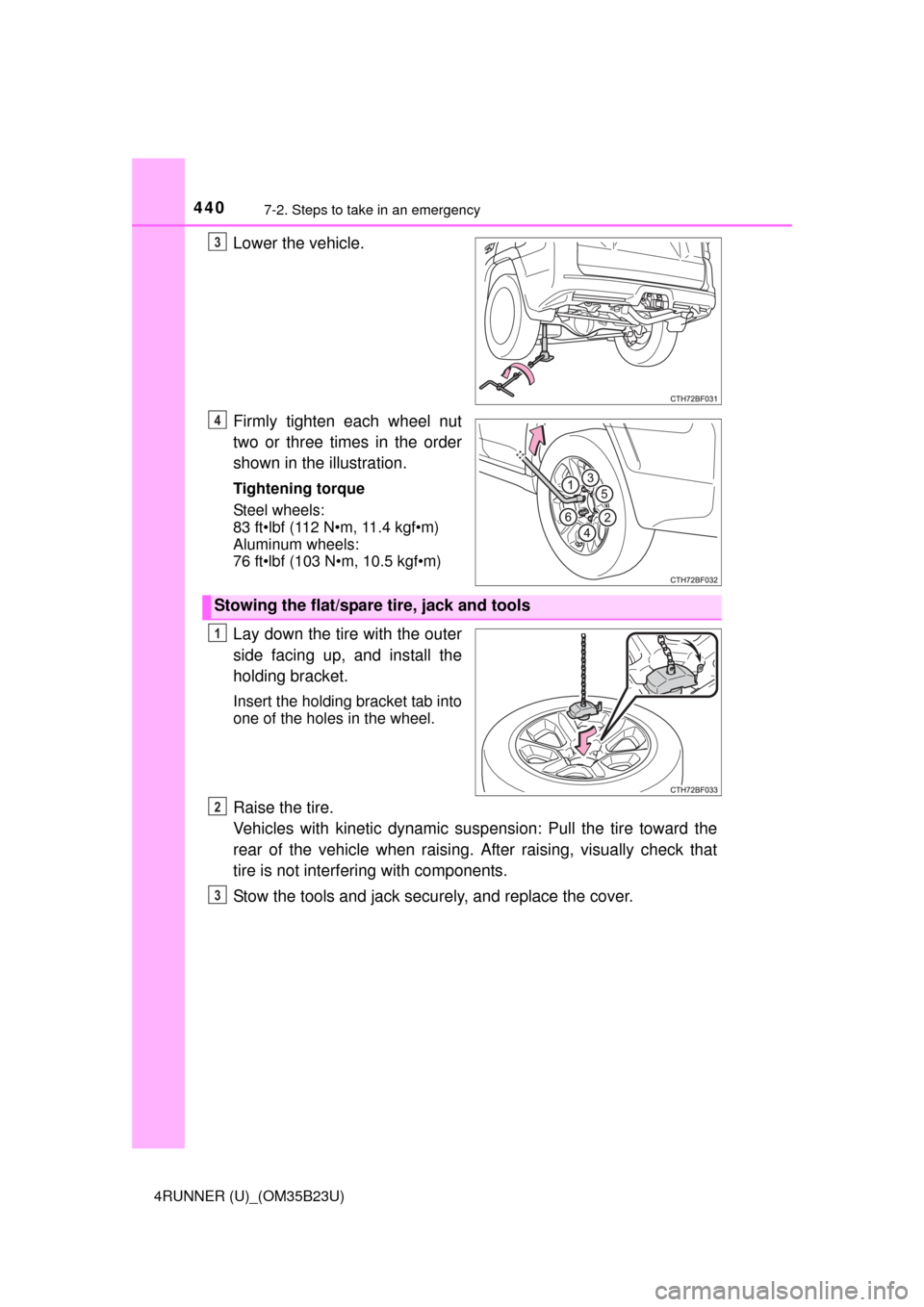
Lower the vehicle.
Firmly tighten each wheel nut
two or three times in the order
shown in the illustration.
Tightening torque
Steel wheels:
83 ft•lbf (112 N•m, 11.4 kgf•m)
Aluminum wheels:
76 ft•lbf (103 N•m, 10.5 kgf•m)
Lay down the tire with the outer
side facing up, and install the
holding bracket.
Insert the holding bracket tab into
one of the holes in the wheel.
Raise the tire.
Vehicles with kinetic dynamic suspension: Pull the tire toward the
rear of the vehicle when raising. After raising, visually check that
tire is not interfering with components.
Stow the tools and jack securely, and replace the cover.
3
4
Stowing the flat/spare tire, jack and tools
1
2
3
Page 505 of 528
505
9
For owners
4RUNNER (U)_(OM35B23U)
CAUTION
■Précautions avec le coussins gonflable SRS
●Ne placez rien sur le siège du passager avant, comme un coussin par
exemple. Cela a pour conséquence de répartir le poids du passager sur
toute la surface du siège, ce qui empêche le capteur de détecter correcte-
ment le poids du passager. En conséquence, les coussins gonflables fron-
taux SRS du passager avant risquent de ne pas se déployer en cas de
collision.
■Modification et mise au rebut des éléments du système de coussins
gonflables SRS
Consultez impérativement votre concessionnaire Toyota si vous avez
besoin d’intervenir sur votre véhicule ou de procéder à l’une des modifica-
tions suivantes. Les coussins gonflables SRS peuvent être défaillants ou se
déployer (se gonfler) accidentellement, provoquant la mort ou de graves
blessures.
●Installation, dépose, démontage et réparation des coussins gonflables
SRS
●Réparations, modifications, démontage ou remplacement du volant, du
tableau de bord, de la planche de bord, des sièges ou de leur garniture,
des montants avant, latéraux et arrière ou des rails latéraux de toit
●Réparations ou modifications des ailes avant, du pare-chocs avant ou des
flancs de l’habitacle
●Installation d’un protège-calandre (pare-buffle, pare-kangourou, etc.), de
chasse-neiges, de treuils ou d’une galerie de pavillon
●Modifications du système de suspension du véhicule
●Installation d’appareils électroniques, tels qu’une radio émetteur/récepteur
ou un lecteur CD
●Aménagements du véhicule visant à permettre sa conduite par une per-
sonne atteinte d’un handicap physique