2016 SUZUKI CELERIO water
[x] Cancel search: waterPage 4 of 201

V
ehi cle may , mee t wit h an
or due to
1. Installation of
- High wattage bulbs
- Non genuine lamps / hor ns
- Modified suspension / wheels
- Non genuine parts / accessor ies etc.
2. Retrofitment of LPG / CNG fuel systems/kits .
3. Usage of domestic LPG.
4. Shor t circuiting due to tamper ing of wir ing harness .
CA UTION: DO NOT ST ORE OR CARR Y INFLAMMABLE MATERIALS IN THE VEHICLE.
bre
ak-down
accident catch fire A
void driving into or star ting the vehic le in a
hea vily water logged area. V ehic le ma y break-
do wn or engine may fail due to
1. Water entry into the engine .
2. Shor t circuiting of the electr ical systems .
If the vehic le is stuc k in deep water,
star t / crank the vehic le until the level of water
dr ops belo w the level of exhaust pipe.
NO TE:
IF THE VEHICLE IS SUBMERGED IN WATER, REPOR T T O THE NEAREST
A UTHORIZED WORKSHOP . do
not “W
ARNING”
Page 38 of 201

2-16
BEFORE DRIVING
76MH1-74E
76MH1-74E
65D199
Lap-Shoulder Belt
Emergency Locking Retractor (ELR) The seat belt has an emergency locking retractor (ELR), which is designed to lock the seat belt only during a sudden stop orimpact. It also may lock if you pull the belt across your body very quickly. If this hap- pens, let the belt go back to unlock it, thenpull the belt across your body more slowly.
WA R N I N G
(Continued)• Pregnant women should use seatbelts, although specific recommen- dations about driving should be made by the woman’s medical advi-sor. Remember that the lap portion of the belt should be worn as low as possible across the hips, asshown in the diagram.• Do not wear your seat belt overhard or breakable objects in yourpockets or on your clothing. If an accident occurs, objects such as glasses, pens, etc. under the seatbelt can cause injury.(Continued)
as low as possible across the hips
WA R N I N G
(Continued)• Never use the same seat belt onmore than one occupant and never attach a seat belt over an infant orchild being held on an occupant’s lap. Such seat belt use could cause serious injury in the event of anaccident.• Periodically inspect seat beltassemblies for excessive wear anddamage. Seat belts should be replaced if webbing becomes frayed, contaminated, or damagedin any way. It is essential to replace the entire seat belt assembly after it has been worn in a severe impact,even if damage to the assembly is not obvious.• Children age 12 and under shouldride properly restrained in the rearseat.• Infants and small children shouldnever be transported unless theyare properly restrained. Restraint systems for infants and small chil-dren can be purchased locally andshould be used. Make sure that the system you purchase meets appli- cable safety standards. Read andfollow all the directions provided by the manufacturer.• For children, if the shoulder belt irri-tates the neck or face, move thechild closer to the center of the vehicle.(Continued)
WA R N I N G
(Continued) • Avoid contamination of seat beltwebbing by polishes, oils, chemi-cals, and particularly battery acid.Cleaning may safely be carried out using mild soap and water.• Do not insert any items such ascoins, clips, etc. into the seat beltbuckles, and be careful not to spill liquids into these parts. If foreignmaterials get into a seat belt buckle, the seat belt may not work properly.• All seatbacks should always be inan upright position when driving,or seat belt effectiveness may bereduced. Seat belts are designed to offer maximum protection whenseatbacks are in the upright posi- tion.
27
Page 49 of 201

2-27
BEFORE DRIVING
76MH1-74E
76MH1-74E
Note that even though your vehicle may be moderately damaged in a frontal collision,the collision may not have been severe enough to trigger the air bags to inflate. If your vehicle sustains ANY front-end dam-age, have the air bag system inspected by an authorized MARUTI SUZUKI dealer to ensure it is in proper working order.
Your vehicle is equipped with a diagnostic module which records information aboutthe air bag system if the air bags deploy ina crash. The module records informationabout overall system status, which sensorsactivated the deployment, and for a certain vehicle only, whether the driver’s seat belt was in use.
Servicing the air bag system If the air bags inflate, have the air bags andrelated components replaced by an autho- rized MARUTI SUZUKI dealer as soon as possible.
If your vehicle ever gets in deep water and the driver’s floor is submerged, the air bagcontroller could be damaged. If it does, have the air bag system inspected by theMARUTI SUZUKI dealer as soon as possi- ble.
Special procedures are required for servic- ing or replacing an air bag. For that reason, only an authorized MARUTI SUZUKI dealer should be allowed to service orreplace your air bags. Please remind any-
one who services your vehicle that it has air bags.
Service on or around air bag components or wiring must be performed only by an authorized MARUTI SUZUKI dealer.Improper service could result in unin- tended air bag deployment or could render the air bag inoperative. Either of these twoconditions may result in severe injury.
To prevent damage or unintended inflation of the air bag system, be sure the batteryis disconnected and the ignition switch hasbeen in the “LOCK” position for at least 90seconds before performing any electrical service work on your vehicle. Do not touch air bag system components or wires. Thewires are wrapped with yellow tape or yel- low tubing, and the couplers are yellow for easy identification.
Scrapping a vehicle that has an uninflated air bag can be hazardous. Ask your dealer,body repair shop or scrap yard for help with disposal.
38
Page 64 of 201

2-42
BEFORE DRIVING
76MH1-74E
76MH1-74E
NOTE: If the security system indicator blinks whenthe ignition switch is in the “ON” position, there may be something wrong with the security system. Ask your MARUTI SUZUKI dealer to inspect the system.
Depress Brake Pedal Indicator (if equipped)
76MH0A047
Refer to “Auto Gear Shift” in the “OPERAT- ING YOUR VEHICLE” section for details.
Fuel Filter Warning Light (For Diesel Engine Model)
60A541
This light comes on for several seconds when the ignition switch is turned to the “ON” position so you can check the light is working.
If the light comes on when driving, there is a possibility to have water in the fuel filter.Drain water as soon as possible. For
details of draining water, refer to “Fuel Fil- ter” in the “INSPECTION AND MAINTE- NANCE” section.
Glow Plug Indicator Light (For Diesel Engine Model)
60A543
If the coolant temperature is cool enough, this light comes on when the ignition switch is turned to the “ON” position and goes out when the glow plug is heated enough forengine starting.
Lighting Control Lever
65D611
Lighting Operation
60MK011
To turn the lights on or off, twist the knobon the end of the lever. There are threepositions:
OFF (1) All lights are off.
(2)Front position lights, tail lights, license plate light and instrument lights are on, but headlights are off.
(3)Front position lights, tail lights, licenseplate light, instrument lights and headlights are on.
WA R N I N G
To avoid possible injury, do not oper- ate controls by reaching through thesteering wheel.
(3)
(2)(1)
EXAMPLE
53
Page 72 of 201

3-2
OPERATING YOUR VEHICLE
76MH1-74E
76MH1-74E
NOTE: It is normal for water to drip from the air conditioning system after use.
4) Make sure the hood is fully closed and latched.5) Check the headlights, turn signal lights, brake lights and horn for proper opera- tion.6) Adjust the seat and head restraint (if equipped). 7) Check the brake pedal and the parkingbrake lever. 8) Adjust the mirrors. 9) Make sure that you and all passengershave properly fastened your seat belts. 10)Make sure that all warning lights come on as the key is turned to the “ON” posi-tion. 11)Check all gauges. 12)Make sure that the BRAKE SYSTEMWARNING light turns off when the parking brake is released.
Once a week, or each time you fill your fuel tank, perform the following under-hood checks:
1) Engine oil level 2) Coolant level3) Brake fluid level 4) Windshield washer fluid level 5) Battery solution level6) Hood latch operation Pull the hood release handle inside the vehicle. Make sure that you cannotopen the hood all the way without
releasing the secondary latch. Be sure to close the hood securely after check- ing for proper latch operation. See “Alllatches, hinges & locks” of “CHASSIS AND BODY” in the “Periodic Mainte- nance Schedule” in the “INSPECTIONAND MAINTENANCE” section for lubri- cation schedule.
Once a month, or each time you fill your fuel tank, check the tire pressure using a tire pressure gauge. Also check the tirepressure of the spare tire.
Engine Oil Consumption
It is normal for the engine to consume some engine oil during normal vehicle operation.
The amount of engine oil consumed depends on the viscosity of the oil, thequality of the oil and the conditions the vehicle is driven under. More oil is consumed during high-speeddriving and when there is frequent acceler- ation and deceleration. Under high loads, your engine also will consume more oil.A new engine also consumes more oil, since its pistons, piston rings and cylinder
walls have not yet become conditioned. New engines reach the normal level of oil consumption only after approximately 5000km (3000 miles) driving.
Oil consumption: Max. 1.0 L per 1000 km (1 Qt. per 600 miles)
When judging the amount of oil consump- tion, note that the oil may become diluted and make it difficult to accurately judge thetrue oil level. As an example, if a vehicle is used for repeated short trips, and consumes a nor-mal amount of oil, the dipstick may not show any drop in the oil level at all, even after 1000 km (600 miles) or more of driv-ing. This is because the oil is gradually becoming diluted with fuel or moisture, making it appear that the oil level has notchanged. You should also be aware that the diluting ingredients evaporate out when the vehicleis subsequently driven at high speeds, such as on an expressway, making it appear that oil is excessively consumedafter high-speed driving.
WA R N I N G
Make sure the hood is fully closed and latched before driv ing. If it is not, it can fly up unexpectedly duringdriving, obstructing your view and resulting in an accident.
61
Page 85 of 201

3-15
OPERATING YOUR VEHICLE
76MH1-74E
76MH1-74E
Warning functions A warning buzzer will sound or the indica- tor will blink under the following conditions.
Warning buzzer The clutch is heated due to excessiveload. The creeping function is being activated for a long period of time.
The ignition switch is turned to the “LOCK” position with the gear in 2nd, 3rd, 4th or 5th. In this case, turn the igni- tion switch to the “ON” position and shiftthe gearshift lever in the “N” position, shift it to the “D” or “M” or “R” position, then turn the ignition switch to “LOCK”. During a stop, the driver’s door is opened with the gearshift lever in the “R”, “D” or “M” positi on while the engine is running.
“N” indicato r blinking When the gear indicator lamp blinks “N”, you should depress the brake pedal and shift the gearshift lever to “N” position.
“1st” indicator blinking
When the gear indicator lamp blinks “1st”, you should depress the brake pedal and shift the gearshift lever to “N” position, thenshift to “D” or “M” position again a few sec- onds later.
“R” indicator blinking When the gear indicator lamp blinks “R”, you should depress the brake pedal andshift the gearshift lever to “N” position, then shift to “R” position again a few seconds later.
Braking
60G165S
The distance needed to bring any vehicleto a halt increases with the speed of the vehicle. The braking distance needed, for example, at 60 km/h (37 mph) will beapproximately 4 times greater than the braking distance needed at 30 km/h (19 mph). Start to brake the vehicle when thereis plenty of distance between your vehicle
and the stopping point, and slow down gradually.
Power-Assisted BrakesYour vehicle has power-assisted brakes. If power assistance is lost due to a stalledengine or other failur es, the system is still fully operational on reserve power and you can bring the vehicle to a complete stop bypressing the brake pedal once and holding it down. The reserve power is partly used up when you depress the brake pedal andreduces each time the pedal is pressed. Apply smooth and even pressure to the pedal. Do not pump the pedal.
NOTICE
In the above cases, pull over to theside of the road and stop the engine,and then ask your MARUTI SUZUKI dealer to inspect your vehicle. Other- wise, the clutch disc may be dam-aged.EXAMPLE
WA R N I N G
If water gets into the brake drums, brake performance may become poorand unpredictable. After driving through water or washingthe underside of the vehicle, test thebrakes while driving at a slow speedto see if they have maintained their normal effectiveness. If the brakes are less effective than normal, dry themby repeatedly applying the brakeswhile driving slowly until the brakeshave regained their normal effective-ness.
74
Page 91 of 201

4-3
DRIVING TIPS
76MH1-74E
76MH1-74E
Keep weight to a minimum The heavier the load, the more fuel the vehicle consumes. Take out any luggageor cargo when it is not necessary.
Keep tire pressures correct Underinflation of the tires can waste fuel due to increased running resistance of the tires. Keep your tires inflated to the correctpressure shown on the label on the driver’s side door or the driver’s door lock pillar.
Highway Driving
When driving at highway speeds, pay attention to the following: Stopping distance progressively increases with vehicle speed. Apply the brakes far enough ahead of the stoppingpoint to allow for the extra stopping dis- tance. On rainy days, “Hydroplaning” can occur.“Hydroplaning” is the loss of direct con- tact between the road surface and the vehicle’s tires due to a water film formingbetween them. Steering or braking the vehicle while “Hydroplaning” can be very difficult, and loss of control can occur.Keep speed down when the road surface is wet. At high speeds, the vehicle may beaffected by side winds. Therefore, reduce speed and be prepared for unex- pected buffeting, which can occur at theexits of tunnels, when passing by a cut of a hill, or when being overtaken by large vehicles, etc.
Driving on Hills
76MH0A063
When climbing steep hills, the vehiclemay begin to slow down and show a lackof power. If this happens, you should shift to a lower gear so that the engine will again be operating in its normalpower range. Shift rapidly to prevent the vehicle from losing momentum. When driving down a hill, the engineshould be used for braking by shifting into a lower gear.
Driving on Slippery Roads
60G089S
Under wet road conditions you should drive at a lower speed than on dry roadsdue to possible slippage of tires during braking. When driving on icy, snow-cov- ered, or muddy roads, reduce your speedand avoid sudden acceleration, abrupt braking, or sharp steering movements.
Tire Chains (if equipped)Tire chains should only be used if they are needed to increase traction or are required by law. Make sure that the chains you use
WA R N I N G
Try not to hold the brake pedal down too long or too often while goingdown a steep or long hill. This could cause the brakes to overheat, result- ing in reduced braking efficiency.Failure to take this precaution could result in loss of vehicle control.
R N D -M+
NOTICE
When descending a down hill, NEVER turn the igni tion key to the “LOCK” position. Emission control system damage may result.
80
Page 92 of 201
4-4
DRIVING TIPS
76MH1-74E
76MH1-74E
are the correct size for your vehicle’s tires. Also make sure that there is enough clear- ance between the fenders and the chainsas installed on the tires.
Install the chains on the front tires tightly, according to the chain manufacturer’s instructions. Retight en the chains after driving about 1.0 km (1/2 mile) if neces-sary. With the chains installed, drive slowly.
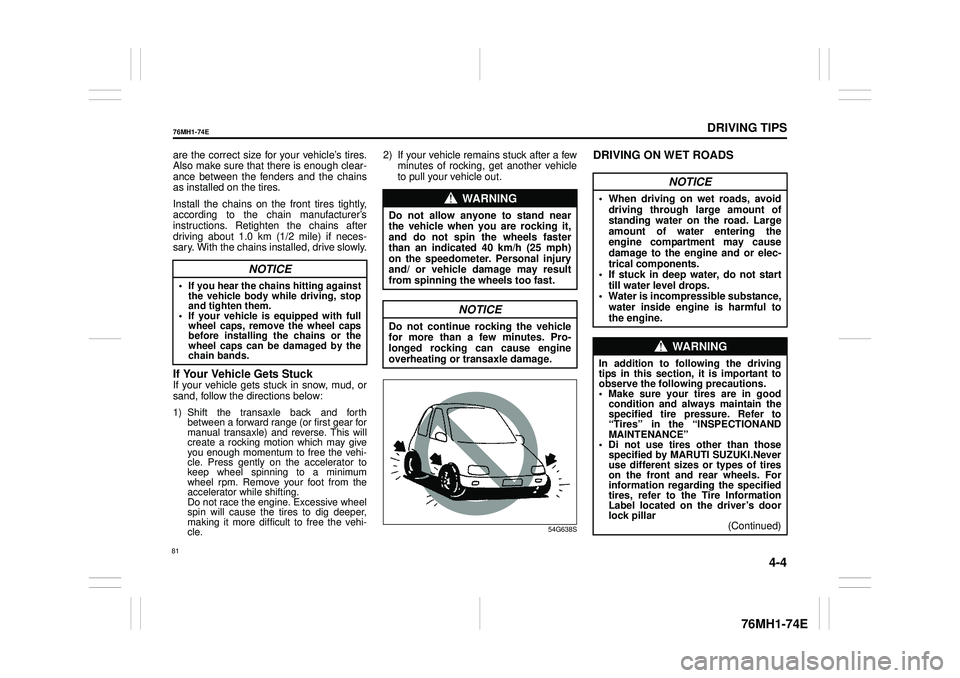
If Your Vehicle Gets StuckIf your vehicle gets stuck in snow, mud, orsand, follow the directions below:
1) Shift the transaxle back and forth between a forward range (or first gear formanual transaxle) and reverse. This willcreate a rocking motion which may giveyou enough momentum to free the vehi- cle. Press gently on the accelerator to keep wheel spinning to a minimumwheel rpm. Remove your foot from theaccelerator while shifting. Do not race the engine. Excessive wheelspin will cause the tires to dig deeper,making it more difficult to free the vehi- cle.
2) If your vehicle remains stuck after a few minutes of rocking, get another vehicle to pull your vehicle out.
54G638S
DRIVING ON WET ROADS
NOTICE
• If you hear the chains hitting against the vehicle body while driving, stopand tighten them.• If your vehicle is equipped with fullwheel caps, remove the wheel caps before installing the chains or the wheel caps can be damaged by thechain bands.
WA R N I N G
Do not allow anyone to stand near the vehicle when you are rocking it,and do not spin the wheels faster than an indicated 40 km/h (25 mph) on the speedometer. Personal injuryand/ or vehicle damage may result from spinning the wheels too fast.
NOTICE
Do not continue rocking the vehicle for more than a few minutes. Pro-longed rocking can cause engine overheating or transaxle damage.
NOTICE
• When driving on wet roads, avoid driving through large amount of standing water on the road. Large amount of water entering theengine compartment may cause damage to the engine and or elec- trical components.• If stuck in deep water, do not start till water level drops. • Water is incompressible substance,water inside engine is harmful to the engine.
WA R N I N G
In addition to following the driving tips in this section, it is important to observe the following precautions. • Make sure your tires are in good condition and always maintain the specified tire pressure. Refer to“Tires” in the “INSPECTIONAND MAINTENANCE” • Di not use tires other than thosespecified by MARUTI SUZUKI.Never use different sizes or types of tires on the front and rear wheels. Forinformation regard ing the specified tires, refer to the Tire Information Label located on the driver’s doorlock pillar(Continued)
81