2016 SUBARU OUTBACK Crossbars
[x] Cancel search: CrossbarsPage 14 of 572
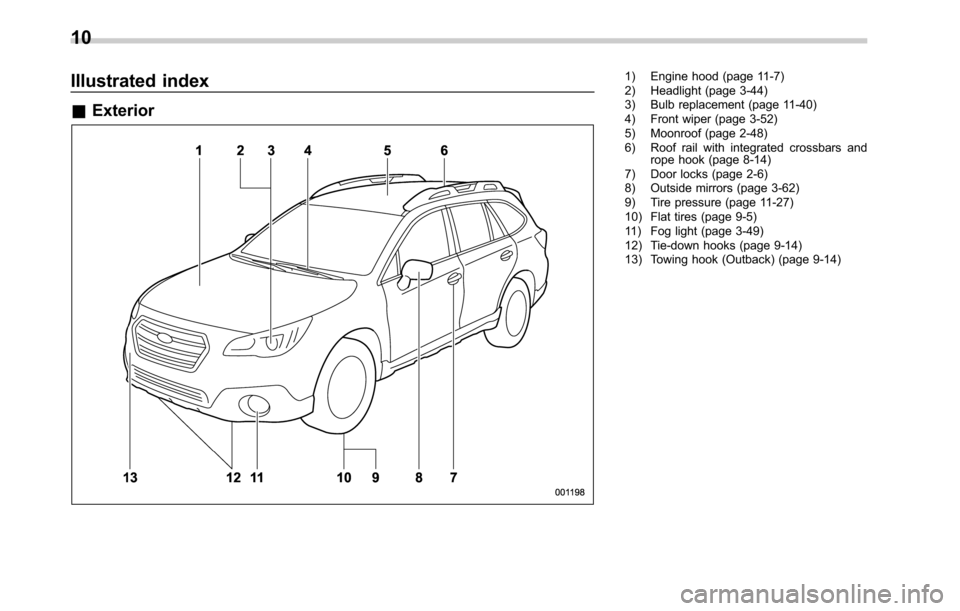
Illustrated index
&Exterior
1) Engine hood (page 11-7)
2) Headlight (page 3-44)
3) Bulb replacement (page 11-40)
4) Front wiper (page 3-52)
5) Moonroof (page 2-48)
6) Roof rail with integrated crossbars and
rope hook (page 8-14)
7) Door locks (page 2-6)
8) Outside mirrors (page 3-62)
9) Tire pressure (page 11-27)
10) Flat tires (page 9-5)
11) Fog light (page 3-49)
12) Tie-down hooks (page 9-14)
13) Towing hook (Outback) (page 9-14)
10
Page 411 of 572

New vehicle break-in driving–the first
1,000 miles (1,600 km)..................................... 8-2
Fuel economy hints............................................ 8-2
Engine exhaust gas (carbon monoxide)............ 8-2
Catalytic converter.............................................. 8-3
Periodic inspections........................................... 8-4
Driving in foreign countries............................... 8-4
Driving tips for AWD vehicles............................ 8-5
Off road driving................................................... 8-6
Legacy................................................................ 8-6
Outback.............................................................. 8-6
Winter driving...................................................... 8-8Operation during cold weather............................. 8-8
Driving on snowy and icy roads......................... 8-10
Corrosion protection.......................................... 8-11
Snow tires......................................................... 8-11
Tire chains......................................................... 8-12Rocking the vehicle........................................... 8-12
Loading your vehicle......................................... 8-12Vehicle capacity weight...................................... 8-13
GVWR and GAWR (Gross Vehicle Weight Rating
and Gross Axle Weight Rating)........................ 8-14
Roof rails with integrated crossbars
(Outback)........................................................ 8-14
Trailer hitch (Outback—if equipped).............. 8-18Connecting a trailer........................................... 8-19
If not towing a trailer.......................................... 8-20
Trailer towing (Legacy)...................................... 8-21
Trailer towing (Outback).................................... 8-21
Warranties and maintenance.............................. 8-21
Maximum load limits.......................................... 8-21
Trailer Hitches................................................... 8-25
Connecting a trailer........................................... 8-25
Trailer towing tips.............................................. 8-26
Driving tips
8
Page 424 of 572
Driving tips/Loading your vehicle
side door pillar. It includes the total weight
of the driver and all passengers and their
belongings, any optional equipment such
as a trailer hitch, roof rack or bike carrier,
etc., and the tongue load of a trailer.
&GVWR and GAWR (Gross
Vehicle Weight Rating and
Gross Axle Weight Rating)
Certification label
The certification label attached to the
driver’s side door shows GVWR (Gross
Vehicle Weight Rating) and GAWR (Gross
Axle Weight Rating).
The GVW (Gross Vehicle Weight) must
never exceed the GVWR. GVW is the
combined total of weight of the vehicle,
fuel, driver, all passengers, luggage, any
optional equipment and trailer tongueload. Therefore, the GVW changes de-
pending on the situation.
In addition, the total weight applied to
each axle (GAW) must never exceed the
GAWR. The front and rear GAWs can be
adjusted by relocating luggage inside the
vehicle.
Even if the total weight of your luggage is
lower than the vehicle capacity weight,
either front or rear GAW may exceed the
GAWR, depending on the distribution of
the luggage.
When possible, the load should be evenly
distributed throughout the vehicle.
If you carry heavy loads in the vehicle, you
should confirm that GVW and front and
rear GAWs are within the GVWR and
GAWR by putting your vehicle on a
vehicle scale, found at a commercial
weighing station.
Do not use replacement tires with a lower
load range than the originals because they
may lower the GVWR and GAWR limita-
tions. Replacement tires with a higher load
range than the originals do not increase
the GVWR and GAWR limitations.
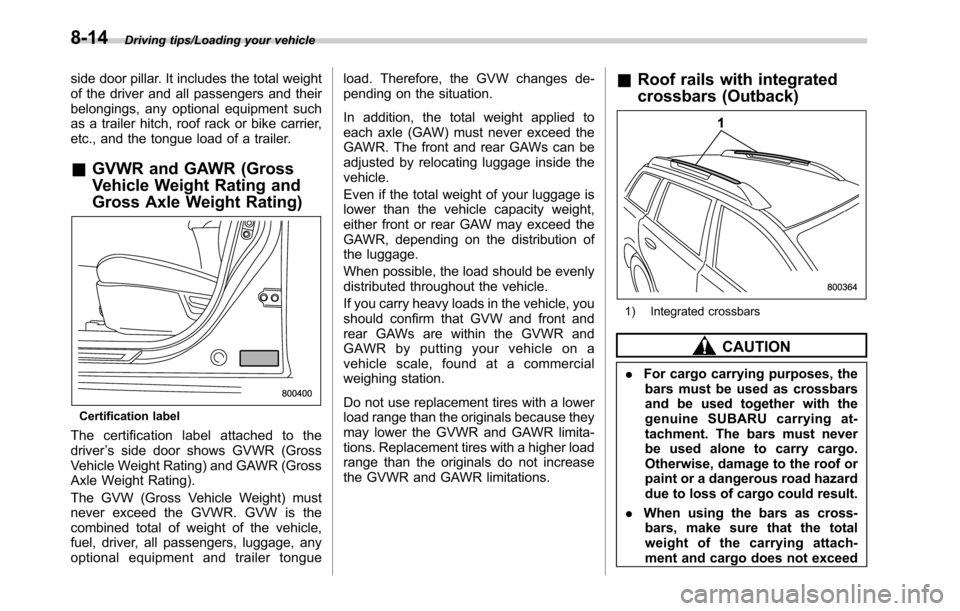
&Roof rails with integrated
crossbars (Outback)
1) Integrated crossbars
CAUTION
.For cargo carrying purposes, the
bars must be used as crossbars
and be used together with the
genuine SUBARU carrying at-
tachment. The bars must never
be used alone to carry cargo.
Otherwise, damage to the roof or
paint or a dangerous road hazard
due to loss of cargo could result.
.When using the bars as cross-
bars, make sure that the total
weight of the carrying attach-
ment and cargo does not exceed
8-14
Page 425 of 572

the maximum load limit. Over-
loading may cause damage to
the vehicle and create a safety
hazard.
The bars can be used as crossbars.
Cargo can be carried after setting the
bars as crossbarsand installing the
genuine SUBARU carrying attachment.
When you carry cargo on the roof using
the crossbars and a carrying attachment,
never exceed the maximum load limit
explained in the following. You should
also be careful that your vehicle does not
exceed the Gross Vehicle Weight Rating
(GVWR) and front and rear Gross Axle
Weight Rating (GAWR). For information
on loading cargo into or onto your vehicle,
refer to“Loading your vehicle”F8-12. The
maximum load limit of the cargo and
carrying attachment must not exceed the
allowable load limit described in the Own-
er’s Manual of a genuine SUBARU carry-
ing attachment. Place the heaviest load at
the bottom, nearest the roof, and evenly
distribute the cargo. Always properly
secure all cargo.!Installing carrying attachments on
the crossbars
When installing any carrying attachment
such as a bike carrier, ski carrier, kayak
carrier, cargo basket, etc. on the cross-
bars, follow the manufacturer’s instruc-
tions and make sure that the attachment is
securely fixed to the crossbars. Use only
attachments designed specifically for the
crossbars. A set of the crossbars is
designed to carry loads (cargo and attach-
ment) of not more than the allowable load
limit described in the Owner’s Manual of a
genuine SUBARU carrying attachment.
Before operating the vehicle, make sure
that the cargo is properly secured on the
attachment.
NOTE
.Remember that the vehicle’s center
of gravity is altered with the weight of
the load on the roof, thus affecting the
driving characteristics. Drive carefully,
avoid rapid starts, hard cornering and
abrupt stops. Crosswind effects will be
increased.
.Restore the bars to the original
position when the bars are not used
as crossbars.!How to use as crossbars
CAUTION
.Do not raise the bar higher than
necessary. The base of the bar
may be damaged.
.Be careful not to contact the bars
while sliding them. Otherwise,
the bars may be scratched or
the latch portions may be da-
maged.
.Do not slide the bar more than
necessary when sliding the bar.
The base of the bar may be
damaged.
.Do not allow the bar to fall on or
contact the roof panel or the
moonroof when sliding the bar.
Otherwise the roof panel may be
dented or the glass of the moon-
roof may be damaged.
Driving tips/Loading your vehicle
–CONTINUED–8-15
Page 426 of 572
Driving tips/Loading your vehicle
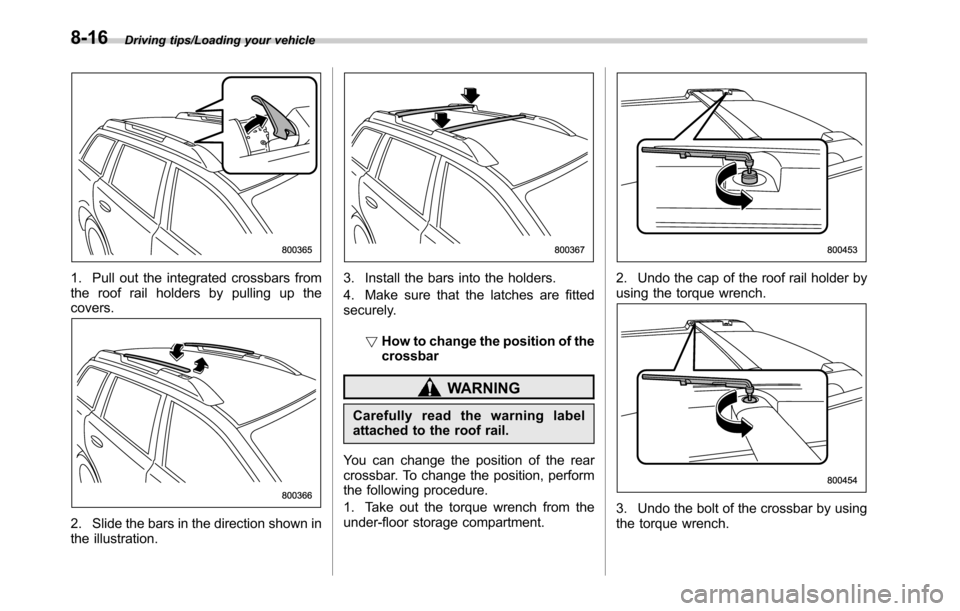
1. Pull out the integrated crossbars from
the roof rail holders by pulling up the
covers.
2. Slide the bars in the direction shown in
the illustration.
3. Install the bars into the holders.
4. Make sure that the latches are fitted
securely.
!How to change the position of the
crossbar
WARNING
Carefully read the warning label
attached to the roof rail.
You can change the position of the rear
crossbar. To change the position, perform
the following procedure.
1. Take out the torque wrench from the
under-floor storage compartment.
2. Undo the cap of the roof rail holder by
using the torque wrench.
3. Undo the bolt of the crossbar by using
the torque wrench.
8-16
Page 427 of 572
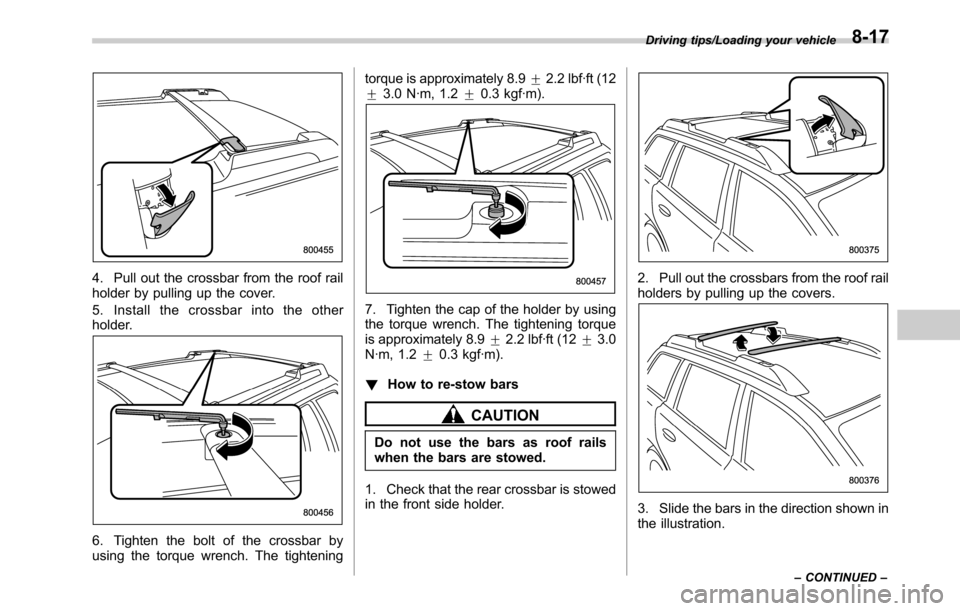
4. Pull out the crossbar from the roof rail
holder by pulling up the cover.
5. Install the crossbar into the other
holder.
6. Tighten the bolt of the crossbar by
using the torque wrench. The tighteningtorque is approximately 8.9+2.2 lbf·ft (12
+3.0 N·m, 1.2+0.3 kgf·m).
7. Tighten the cap of the holder by using
the torque wrench. The tightening torque
is approximately 8.9+2.2 lbf·ft (12+3.0
N·m, 1.2+0.3 kgf·m).
!How to re-stow bars
CAUTION
Do not use the bars as roof rails
when the bars are stowed.
1. Check that the rear crossbar is stowed
in the front side holder.
2. Pull out the crossbars from the roof rail
holders by pulling up the covers.
3. Slide the bars in the direction shown in
the illustration.
Driving tips/Loading your vehicle
–CONTINUED–8-17
Page 558 of 572

14-4Index
Locks................................................................... 2-33
Chime
Key ........................................................................ 3-4
Light..................................................................... 3-43
Seatbelt................................................................ 3-12
Cleaning
Aluminum wheels................................................... 10-3
Interior.................................................................. 10-5
Ventilation grille....................................................... 4-9
Climate control system................................................. 4-3
Automatic................................................................ 4-5
Manual................................................................... 4-6
Clock........................................................................ 3-32
Clutch
Fluid............................................................ 11-21, 12-8
Pedal.................................................................. 11-23
Coat hook................................................................. 6-13
Console...................................................................... 6-6
Continuously variable transmission (CVT)..................... 7-25
Fluid............................................................ 11-19, 12-8
Oil temperature warning light (AT OIL TEMP)............ 3-16
Coolant............................................................ 11-14, 12-8
Cooling system......................................................... 11-14
Corrosion protection................................................... 10-4
Crossbars................................................................. 8-14
Cruise control............................................................ 7-49
Indicator................................................................ 3-30
Set indicator.......................................................... 3-30
Cup holder.................................................................. 6-8
Front passenger’s .................................................... 6-8
Rear passenger’s..................................................... 6-9D
Daytime running light system....................................... 3-46
Defogger................................................................... 3-54
Defrosting................................................................... 4-9
Deicer....................................................................... 3-54
Differential gear oil
Front........................................................... 11-19, 12-7
Rear........................................................... 11-19, 12-7
Dimensions................................................................ 12-2
Disarming the alarm system......................................... 2-32
Disc brake pad wear warning indicators........................ 7-33
Dome light......................................................... 6-2, 11-48
Door
Locks..................................................................... 2-6
Open indicator light................................................. 3-22
Step light............................................................. 11-48
Unlock selection function................................. 2-17, 3-42
Double trip meter......................................................... 3-9
Drive belts............................................................... 11-18
Driving
All-Wheel Drive warning light................................... 3-22
AWD vehicles......................................................... 8-5
Car phone/cell phone
.................................................. 7
Drinking..................................................................... 6
Drugs........................................................................ 6
Foreign countries..................................................... 8-4
Off road.................................................................. 8-6
Pets.......................................................................... 7
Snowy and icy roads.............................................. 8-10
Tips ................................................. 7-24, 7-30, 8-2, 8-5
Tired or sleepy........................................................... 6